

Bone conduction glasses technology: costs off the invoice
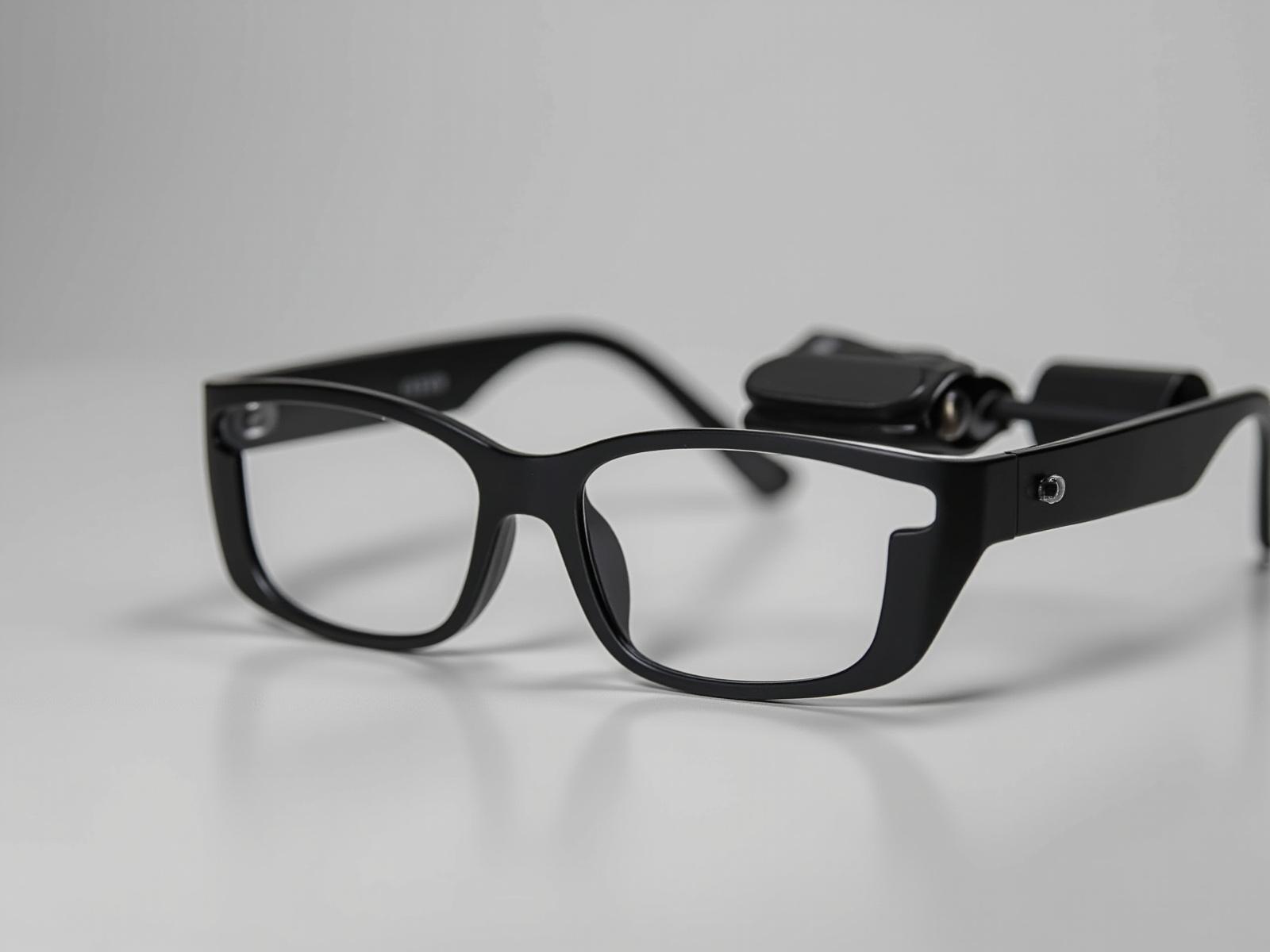
The cost of a bone conduction product is dominated by one component and constrained by one physical fact, and a buyer who understands both is a long way ahead of one comparing published prices. The component is the transducer, which is a precision part rather than a commodity. The physical fact is that the transducer has to press against the skull, and the design, the comfort and the schedule all follow from that requirement.
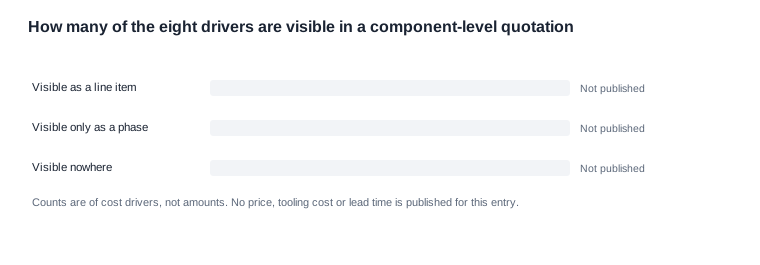
The part that surprises people is how much of the money is not on the invoice. Of the eight drivers in this category, four appear as line items in a component-level quotation, three appear only if the quotation is structured by phase, and one appears on no invoice at all — and that last one is the largest exposure a buyer in this category carries. So this article works through the drivers, shows where each one is visible, and sets out the quotation structure that makes them visible.
We publish no unit price, no minimum order quantity and no lead time for any model in our range, so what follows is a cost structure and a set of questions, not a number. A quotation you cannot read is not a cheaper quotation, it is a quotation whose risk has been hidden in a place you are not looking.
Who signs the quotation, and what they are being asked to approve
The buyer here is a procurement manager, a channel buyer or a brand product lead who has asked for a quotation and received one, and the decision in front of them is not usually the unit price. It is whether the number in front of them is the whole number, and whether the programme it buys is the programme they need.
The position in the supply chain matters here more than in most categories, because the buyer in bone conduction is usually buying a specified configuration rather than a catalogue configuration. A catalogue configuration is a product that exists; a specified configuration is a product that has to be defined, built, measured, documented and then made repeatably. Those are different cost structures and they are quoted differently, and the most common failure in this category is a buyer comparing a quotation for the first against a quotation for the second.
What the buyer is afraid of is a cost that appears later: the re-run of a measurement because the first one was not to a protocol, the tooling that has to be reworked because the contact geometry was not right, the documentation that has to be assembled because nobody owned it, the inventory that has to be relabelled because the claim was not settled. None of these is in the quotation. All of them are costs, and all of them are larger than a unit-price negotiation can recover.
There is a second supply chain fact that shapes the economics and is worth putting in the model early. Compare the bone conduction entry with the open-ear audio class in the same range. This entry publishes a 200 mAh cell, a charge time of two hours or less and roughly seven hours of rated runtime. The open-ear class publishes cells from 55 mAh paired units up to 100 mAh with roughly six to eight hours of rated runtime, and case capacities of 900, 1200 and 1400 mAh across the range. A larger cell delivering a similar rated runtime points to the load rather than the cell as the binding constraint — an inference to confirm rather than accept, but a useful one, because it means the runtime row is a specification you have to measure and not a figure you can copy into a plan.
The eight drivers, and where each one appears
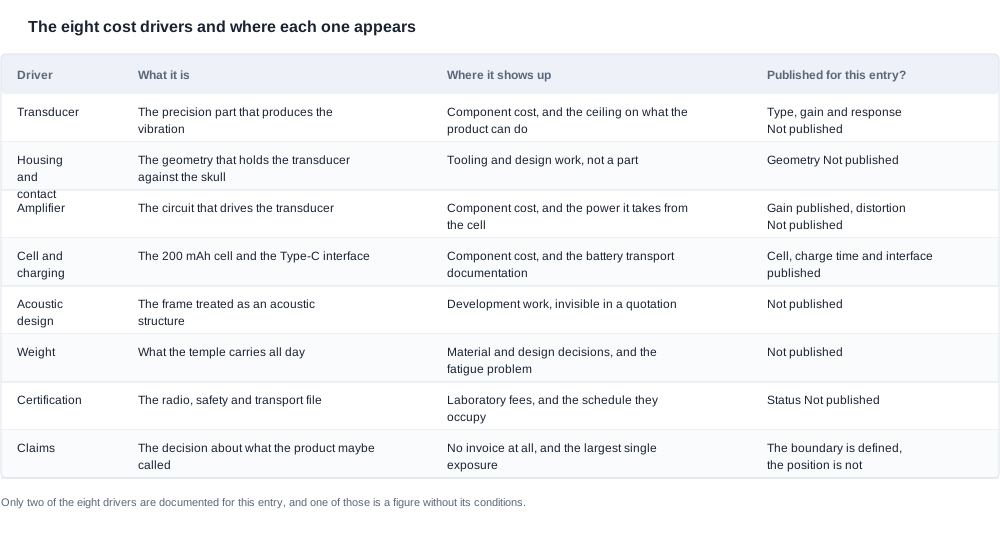
The transducer. The component that produces the vibration is the single largest cost driver in a bone conduction product, and it is also the component that sets the ceiling on what the product can do. Its type, its gain and its frequency response determine the sound, and a better one is meaningfully more expensive. The published gain figure says nothing about the response, which is where both the cost and the quality live.
The housing and the contact. The transducer has to be held against the skull with enough pressure to transmit, and the housing geometry is what sets that pressure. This is the cost driver that surprises people, because it is not a component at all — it is a design decision with a tooling consequence. A housing that transmits well is a housing that presses, and a housing that presses all day is a housing that gets taken off at lunchtime.
The amplifier. The circuit that drives the transducer, and the source of the gain. Its power draw competes with the cell in a product with a 200 mAh cell, and its distortion figure is what determines whether a loud sound is a clear sound. The published 35 dB is a gain figure; the distortion that would make that figure useful is Not published.
The cell and the charging. A bone conduction product needs a cell like any other, and the interesting constraint is the interface. Our range publishes Type-C for this category, and the reason is worth noting: a Type-C interface is more forgiving of a cell change, and it lets a user charge from a power bank they already own, which matters for a product sold on being usable all day. The cost consequence sits elsewhere — the UN 38.3 test summary covers the specific cell, so a cell substitution is a documentation event and a logistics event, not just a purchase order line.
The acoustic design. The frame is an acoustic structure, because the geometry around the transducer is what shapes the output into the ear. This is a design cost, not a component cost, and it is invisible in a component quotation.
The weight. It sits on the temple all day, and a bone conduction product carries a cell, an amplifier and a transducer. Weight is one of the two reasons the category has a fatigue problem, the other being contact pressure. It is also the row most often left open, and this entry publishes no frame weight.
The certification. It is a radio product in every market it reaches, and the file for it is the same work as for any other product with a radio in it — with the addition that a configuration change can invalidate part of it. The cost is the laboratory fees and, more expensively, the queue.
The claims. This is the cost driver that is not on any invoice and is the most expensive one. Where a bone conduction product is positioned decides which market it can be sold into and what it has to satisfy, and the positioning decision is made before a single unit is built.

What a quotation has to contain for you to see them
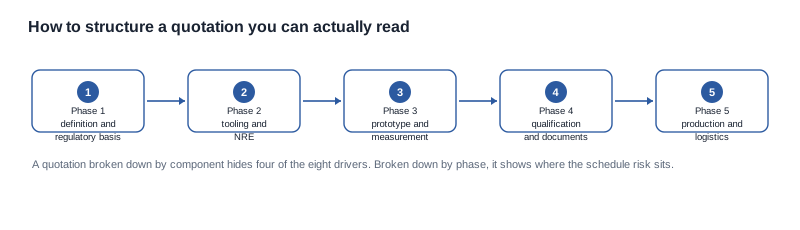
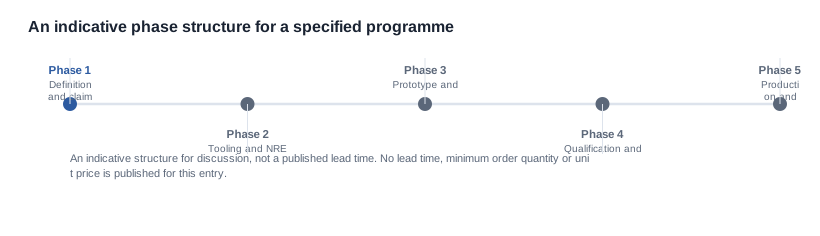
The structure that works is a quotation broken down by phase rather than by component, and it is worth knowing what each phase actually is before you ask for it.
Phase one, definition and regulatory basis. The work is agreeing what the product is, what it is called, in which markets, and on what basis. Its cost is mostly your own and your supplier's engineering and compliance time, and it is the phase that decides whether phases two to five happen at all.
Phase two, tooling and non-recurring engineering. The one-off cost of the housing geometry, the moulds and the fixtures, plus the engineering to reach them. The useful commercial questions are over what volume the tooling is amortised across, what happens to it if the programme stops, and whether the design is yours or the factory's. A tooling cost that is reusable across your next programme is worth a great deal more than a small tooling cost that ties you to one product.
Phase three, prototype and measurement. The samples, the measurement work and the iteration on the contact geometry. This is the phase where the specification becomes real, and it is the phase most often quoted as a favour rather than as a line, which is exactly how the cost of a second round gets absorbed invisibly.
Phase four, qualification and documentation. The conformity file, the labelling, the packaging, the instructions, the per-market work and the channel documentation. This is the phase where a missing model string stops the programme, so it is the phase that has to be scheduled rather than hoped for.
Phase five, production and logistics. The recurring cost, the packaging profile, the freight, the duty and the import route. The cost per unit is the smallest number in the whole structure, and the number of units at which the phases above are amortised is the number that decides whether the programme is worth running.
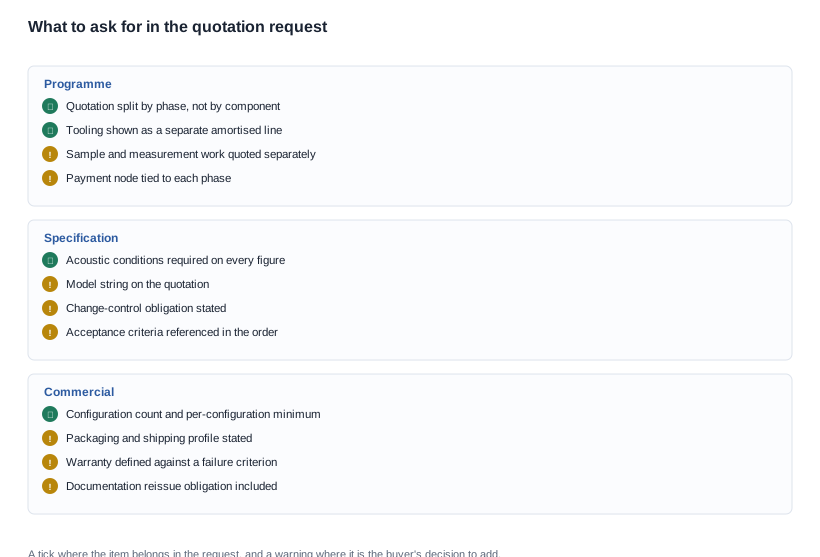
The seven questions to ask a supplier, in the order that surfaces the most: what is the transducer, and what are its frequency response and its gain; how much distortion is present at the published gain; how is the contact pressure set, and can the user adjust it; what is the weight of the complete unit; what is the published runtime, and under what condition; which market positions is the product designed for, and what documentation follows from that; and what has to change if the use case is different. The seventh is the question that reveals whether the product was designed for a case or assembled for a category.
The costs that never appear, and what they cost when they land
A claim that is wrong, and is discovered in a market. The symptom is a listing that has to be withdrawn, a market that stops selling the product, and inventory that cannot be sold where it was sent. The root cause is that the claim was decided after the programme was costed, and the positioning decision was never given a line in the budget. The prevention is to make phase one real, and to require the claim in one sentence before the quotation is broken into phases.
A specification that moves during the programme. The symptom is a re-run of a measurement, a re-issue of a document, and a phase that finishes late. The root cause is that the acceptance criteria were written after the sample arrived. The prevention is to attach the criteria and the measurement method to the order, so that a change to either is a change event with a cost owner.
A model string that has to be created. The symptom is a documentation phase that is longer than it should be, because a document that has to name a product cannot be assembled until the product has a name. The root cause is that identification was treated as administrative. The prevention is to ask for the string in the first request, and to treat it as a programme phase with a date.
A cell substitution in production. The symptom is a logistics hold on a battery shipment, in a market already announced. The root cause is that the cell was treated as a component rather than as a documented item, so the substitution passed through purchasing without a check. The prevention is a change-control clause naming the cell, with the documentation reissue obligation attached to it.
A configuration that nobody has documented. The symptom is a product in the field that no document covers. The root cause is a quotation that priced a catalogue configuration while the programme was building a specified one. The prevention is to ask for per-configuration documentation in the request, and to check that the quotation includes it.
A sample that was never measured properly. The symptom is a first production lot that does not behave like the demonstration. The root cause is a measurement taken without a protocol, without a baseline, or by one person without a record. The prevention is to price the measurement work as a phase, and to attach the protocol to the order as the acceptance standard.
A quoted programme, and what we will and will not price
What can be negotiated around this structure is broad, and it is mostly about the programme rather than the price. The phase structure itself, and whether the measurement and sample work is quoted or absorbed. The tooling amortisation volume, and what happens to the tooling if the programme stops. The payment nodes, one per phase, so that a phase that slips is a phase that is not paid for. The pilot quantity, so that the first lot is small enough to be a test of the programme rather than a bet on it. The documentation reissue obligation, and whether per-configuration documents are included. The acceptance window, so that a lot that fails the written criteria can be refused at inspection. The packaging and shipping profile, which is a real cost line in a product that ships with a battery. And the warranty, if it is written against a failure criterion rather than a period of time.
What cannot be negotiated is the laboratory cost and the laboratory queue, which are the same in every negotiation. Tooling is a one-off cost, so the useful questions are over what it is amortised across and who owns it. The transducer is a precision part and its cost is what it is. The acoustic design work around the contact geometry is not a commercial variable: the product either couples or it does not. And the claim decision is not a supplier variable at all — it belongs to the party placing the product on a market, and a supplier that offers to make it for you is offering something it is not positioned to give.
A worked scenario: a quotation that did not add up
The worked case that follows is hypothetical rather than a client project; it shows the order of the reasoning, not a measured outcome.
Assume a brand with an open-ear audio line that wants a private-listening model for a business channel, and a supplier that has quoted a single unit price with a tooling line and a note that the sample and the measurement work would be "arranged". The brand's constraint is that the previous programme overran, and the finance function wants to see where the money went.
The restructure. The brand asks for the quotation to be reissued by phase, and asks specifically that the sample work, the measurement work and the documentation work appear as lines. The supplier reissues, and the reissued quotation shows that the tooling is a smaller proportion of the programme than the single-price version implied, and that the qualification and documentation phase is a substantial line that the brand had not budgeted for.
The decision that falls out. The brand now sees two numbers it could not see before: the cost of the programme as it must be run, and the cost of the programme if the model string has to be created rather than issued. That second number is large enough that the brand asks for the model string as a condition of the quotation, and the answer changes the phase schedule.
The claim, moved into phase one. The brand writes the claim sentence and asks the supplier to confirm which parts of the published rows support it. The supplier confirms the technical rows and says plainly that the certification position is not published for this entry, which moves the market route into the brand's own work plan as a cost rather than leaving it as a risk. The brand adds it to the budget as an internal line, which is the cheapest way to make a risk visible.
The negotiation. The brand negotiates a payment node per phase, a pilot quantity that lets the first delivery be the test of the programme, and an acceptance clause tied to the measurement protocol, so the first lot can be refused at inspection rather than after launch.
The result. The programme is not cheaper. It is legible, and the brand now knows which two numbers would have sunk it. The unit price was never the variable that decided the outcome; the phase structure was.
What we publish, and what we will not price
We will publish the specification we hold and mark the rest as open, and we will not make a health claim or describe the product as a medical device. The bone conduction model in our range publishes 35 dB of amplification gain, a charge time of two hours or less, Type-C charging, a 200 mAh cell and a rated runtime of about seven hours.
We do not publish the model designation, the frequency response, the distortion figure, the leakage, the microphone pickup distance, the weight, the customisation capability for this category, or any certification position at model level. We will not estimate any of them, because a figure attached to a transducer without its response curve describes nothing. We publish no unit price, no minimum order quantity and no lead time for any model in the range, and we will quote a programme by phase with the assumptions written down, rather than give a number that depends on assumptions nobody has seen.
What we will do is take a specific use case and a market, and tell you which of the eight drivers your programme actually carries, which are already solved by the published platform, and which have to be paid for twice if the use case turns out to be different from the one the product was built for. The category background is under bone conduction audio technology, the boundary is set out under medical device boundary, and the alternative architecture is under open-ear audio specifications.
Three things to send with the quotation
Send the use case, the market and the volumes. We will say which drivers your programme carries and which are already covered by the published platform.
Send the claim sentence and the destination markets. We will say which frameworks bear on it and which parts of the published rows support it, and we will mark the parts that do not.
Send the quotation you have, and we will mark what it hides. We will tell you which of the eight drivers is missing from it and what that driver will cost when it lands. The range is under bone conduction glasses range and the evaluation route is under sample evaluation.
Related reading
- The category and its published specification — bone conduction audio
- The limits and the drawbacks — bone conduction limitations
- The scenarios it fits — bone conduction use cases
- The alternative form factor — open-ear audio
Tell us the use case and the market, and we will say which cost drivers your programme actually carries.


