

Bone conduction glasses technology: what each limit changes
Where bone conduction genuinely wins
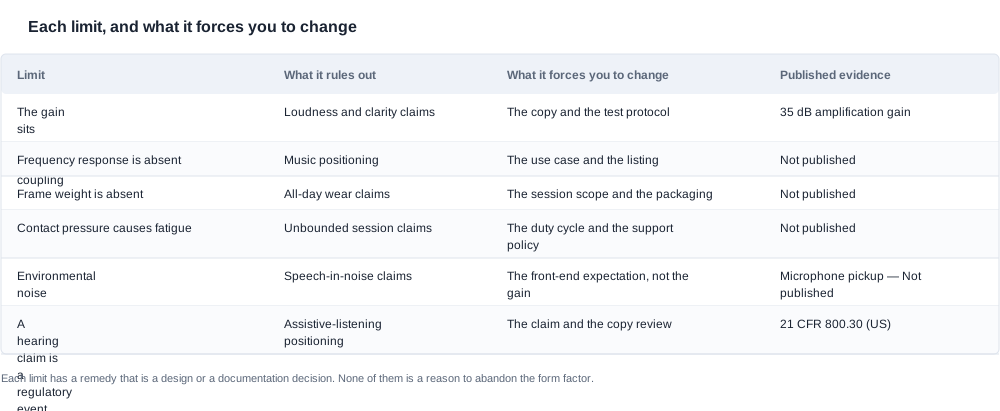
Bone conduction gets described as the superior form of open-ear audio, and in the specific sense that it leaves the ear canal completely open, it is. That is a real and valuable property, and it is also the whole of the advantage. Beyond it sits a set of physical limits that no amount of engineering enthusiasm removes: a volume ceiling, a frequency range that is narrower than most buyers expect, a fatigue mechanism that comes from wearing the frame itself, and a regulatory boundary that catches a lot of sellers out.
The useful way to hold those limits is as a design brief rather than as a list of apologies, and the test of whether you have done that is simple. Each limit should change three things: the product specification, the listing copy, and the support policy. A limit that changes none of the three is a limit you have not yet absorbed, and it will show up later as a return, a review, or a claim.
The buying task behind the limits
The reader here is a buyer who has been enthusiastic about the technology, or who has been handed a product by someone who was, and who now has to decide what to do about that enthusiasm. The typical sequence is: an enquiry goes out, quotations arrive with a good unit price, the product is scoped, and then somebody asks what the product cannot do — and the answer is more than the buyer expected.
Three decisions sit under that, and they are different from one another.
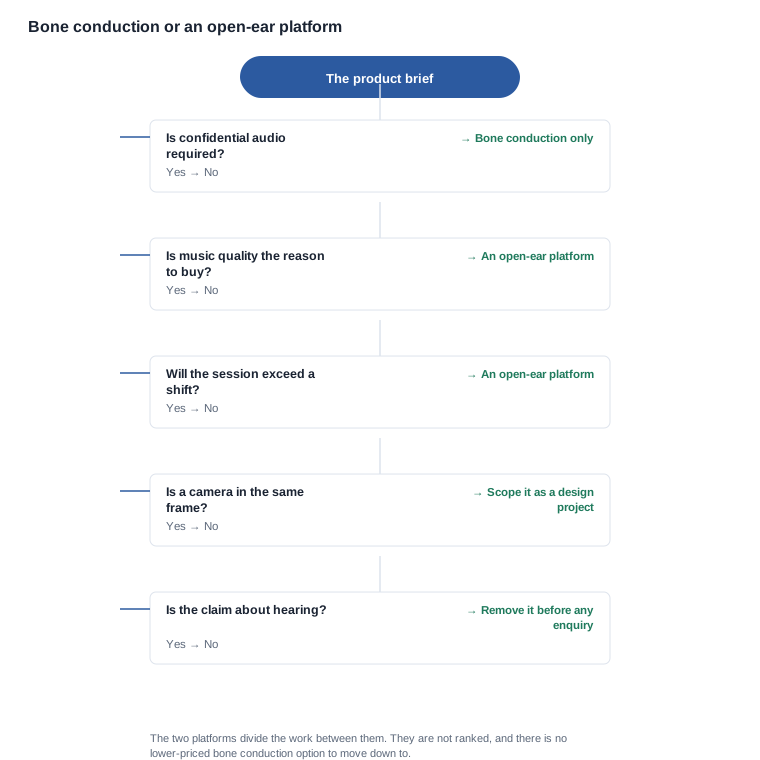
The first is whether the form factor is right for the application at all. This has to be settled before anything else, because it is the only decision that is expensive to reverse. Music, long sessions, and any configuration that also carries a camera are all cases where an open-ear platform serves the customer better.
The second is what the product promises. The limits constrain the copy more tightly than they constrain the hardware, and a product whose copy overreaches its limits will be returned by the customers the copy attracted.
The third is what happens when a customer who was correctly informed still returns the product. This is the one that costs money and the one that is almost never planned for, because a limits discussion is usually conducted as an argument about the product rather than as a support policy.
Where these limits come from
The physical limits, and the mechanism behind each one
The decibel figure describes gain, not quality. Our range publishes one bone conduction specification, and it is the only one we have: a 35 dB amplification gain, a 200 mAh battery, a charge time of two hours or less, a rated runtime of about seven hours, and Type-C charging. The model designation itself is not published, and the acoustic detail behind the figure is not either. We publish no driver size, no frequency response, no total harmonic distortion and no microphone pickup distance, and we will not fill those rows in.
The 35 dB figure is an amplification gain, and decibels are logarithmic: an increase of six decibels roughly doubles the sound pressure. That makes the number a statement about how much louder a sound is presented, not about how clear it is. The clarity of an amplified voice depends on frequency response and distortion, and a product can have a respectable gain figure and still be hard to understand. So treat 35 dB as a ceiling on loudness and a floor on usefulness, and do not put it on a retail box as a quality claim. A buyer comparing two bone conduction products on the decibel number alone is comparing the least informative figure in the specification.
The frequency range is narrower than most buyers expect. Low frequencies do not carry through the skull efficiently, and the result is thin. A customer who has been sold a music product will describe it as broken rather than as a design trade, which is why the expectation has to be stated accurately in the listing rather than left to the customer to discover.
Bone conduction does not replace open-ear audio. It does not. The two are doing different jobs. A temple speaker radiates sound from the frame towards the face while leaving the canal open, and it can carry more volume and considerably more low frequency than a bone conduction transducer pressed against the cheekbone. Bone conduction is smaller, it is genuinely absent from the ear, and it is better where the wearer's ear is occupied or where a sealed bud is unacceptable. For music, for a full day of listening, or for any use where the listener wants to hear the quality, an open-ear pair is normally the better answer. For a phone call in a workshop, for a cyclist who needs to hear traffic, or for a user who cannot wear an earbud, bone conduction is the better answer. They are a division of labour, not a ladder.
Comfort is bounded by contact pressure. This is the one that catches people out. Bone conduction works by vibrating the cheekbone, and the transducer has to press against the skull to transmit effectively. A frame that presses harder transmits more, and a frame that presses harder all day produces what is essentially localised bone pressure fatigue. Add the weight of a 200 mAh cell and a driver circuit to a frame worn continuously, and a full day is a genuine design constraint rather than a theoretical one.
This is the failure mode that does not show up in a shop. A twenty-minute trial feels fine. It is the sixth hour that decides whether the product gets worn, and a product that gets taken off at lunchtime is a product whose features were never actually used.
Environmental noise is amplified along with the source. Amplifying a voice in a quiet room is the easy case. Amplifying a voice in a street is not, because the device amplifies the street as well. Bone conduction is often sold as a solution to noise, and it partly is: the ear canal is open, so the wearer is not sealed off from the environment, and the wearer can adjust the balance between the amplified source and the real world. But the effective signal-to-noise improvement is bounded by the same noise the wearer is trying to hear past. In a genuinely loud environment, a good microphone and a good noise-cancelling front end do more than additional decibels.
The limit that is not negotiable
In the United States, bone conduction products are not sold as over-the-counter hearing aids. The FDA regulation at 21 CFR 800.30 defines an over-the-counter hearing aid as an air-conduction device intended for a person aged eighteen or older, and a bone conduction product is neither air-conduction nor a hearing aid. This is a hard line rather than a formality: a listing that markets the product as an OTC hearing aid in the United States is a listing that has stepped outside the category.
There is a legitimate route, and it is the one that fits the hardware. The FDA distinguishes a hearing aid, which is a medical device, from a personal sound amplification product, which is not, and a bone conduction device positioned as personal sound amplification sits on the correct side of that line. The commercial consequence is a constraint on what you can say: describe open amplification, hands-free calls and environmental awareness, and make no claim about treating, correcting or diagnosing hearing loss. We make no such claim on any of our own material, and we would advise any buyer to run their planned listing copy past someone qualified before it goes live.
The same discipline applies outside the United States, where the rules differ again and where a hearing-related claim can pull in a different regime entirely. The general principle holds everywhere: describe what the device does, not what condition it treats. The boundary is described at medical device boundary and the framework set at certification checklist.
The thresholds that tell you which limit bites
The matrix: which limit lands where
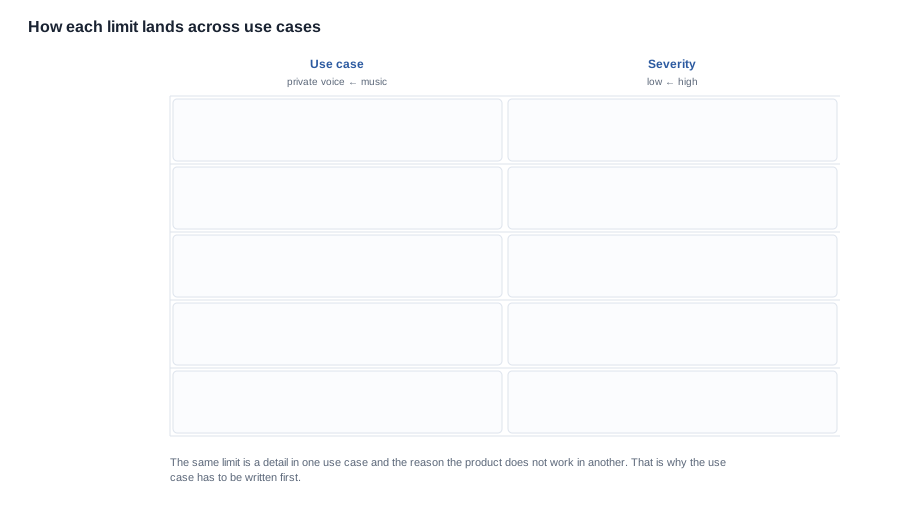
A limit is severe in one application and irrelevant in another, which is why a limits list without an application attached is not usable. The two axes that matter are what the audio is for and how long one session runs.
| Limit | Private voice in a shared space | Voice in a workshop | A long shift on a site | Music for a full day |
|---|---|---|---|---|
| Gain is not a loudness figure | Low impact | Medium | Medium | High |
| Narrow frequency range | Low impact | Medium | Low | High |
| Contact pressure fatigue | Low impact | Medium | High | High |
| Environmental noise in the path | Low impact | High | High | Low |
| Hearing claim is a regulatory event | High impact | High | High | High |
The reading is straightforward. The regulatory limit is the only one that applies everywhere, which is why it is handled as a claim discipline rather than as a product feature. The fatigue limit bites hardest exactly where the product is most useful, because a long site shift is the archetypal bone conduction application, and that combination is what makes the support policy rather than the hardware the decisive cost.
The thresholds, and the limits that are not negotiable
The session threshold. The threshold is the length of a single continuous block, measured with the wearer's own frame adjustment held constant, with several wearers. The line: the session length the product is sold for, and no longer. Our entry's roughly seven-hour rated runtime is a scale figure with no test condition behind it, and it should not be used to set that line.
The environment threshold. The threshold is the margin between the delivered signal and the ambient level in the target environment, measured on a defined source. The line: enough margin for the target environment, not for a laboratory.
The expectation threshold. The threshold is the claim in the listing copy, reviewed before publication. The line: the claim is supportable by a published row or by a structural property of the architecture, and nothing else. A privacy claim qualifies, because the output is a vibration rather than a sound wave. A clarity claim does not, because the frequency response is not published.
The non-negotiable limit. The regulatory boundary is not a threshold to be tuned. It is a category, and the product sits on one side of it permanently unless the hardware changes. The consequence for a buyer is that there is no negotiation, no specification and no firmware version that moves it, and the only lever available is the copy.

Testing a limit, and where a limit shows up late
How to test a limit before it reaches a customer
Every limit in this category has a test, and the tests are cheap. The discipline that matters is to write the acceptance criterion before the sample, because a limit that is discovered during an evaluation is a limit that will be renegotiated.
Test the session limit with a timed trial. Several wearers, one full working block, and a written question at the end: is the frame still comfortable at the end of the block, and where is the pressure felt. The output is a session number, not an opinion.
Test the environment limit in the environment. A masked source, at the distance the application uses, with the ambient level of the actual site. The output is a go or a no-go, and it is the only honest way to settle whether the application is viable.
Test the expectation limit on the copy. Take the draft listing and read it as a customer who is disappointed. If the customer would expect something the published rows do not support, the copy has to change. The range-wide checklist at certification checklist is the right companion document for the compliance half of this.
Test the unit-to-unit consistency. If the product is going into volume, compare a second unit against the first. The difference between units tells you whether the factory is holding the contact pressure consistently, and it is a process-control test that is very often skipped.
Where a limit shows up late
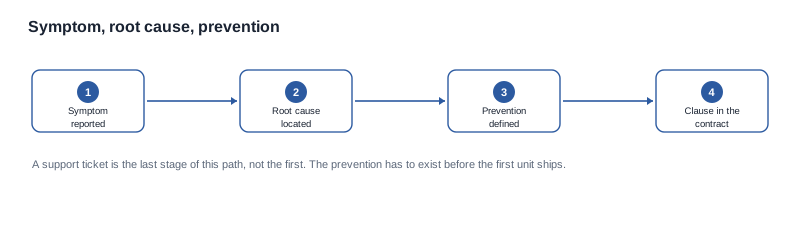
Fatigue reported as a defect. The single most expensive late appearance of a limit in this category, because the customer reports it as a fault and the support script treats it as one. A frame that transmits through the skull has to hold contact pressure against the temple, and sustained pressure produces localised discomfort that appears after roughly an hour. The prevention is a written wear limit in the listing and in the channel training, and a support script that opens with the wear limit rather than with a replacement offer. A unit returned for fatigue is a unit returned for a fault, and the difference between the two is entirely a policy decision.
A customer who wanted music. The copy attracted the customer whose expectation the technology cannot meet, and the return arrives with the claim that the product is defective. The prevention is upstream: the specification should state the working environment and the session length, and the copy should follow the specification.
A camera added to the same cell. A sensor, a radio, a transducer and a 200 mAh cell are competing loads, and the runtime that reaches the customer is set by the hardest of them. Treating the combination as a configuration option produces a product that passes a laboratory demonstration and fails in a shop. It is a design project with its own schedule.
A claim that was not reviewed before publication. The most serious late appearance, because it is not a product fault at all. It is a listing problem, and it produces a takedown, a channel notification and a stock write-down rather than a replacement.
A support policy that treats every return the same. The limit-driven returns are predictable and identifiable, and a policy that cannot distinguish them pays for the whole population of returns at the rate of the identifiable subset.
Cost, support and a worked review
What the limits do to the commercial structure
The limits have a commercial footprint, and the largest part of it is not in the unit price.
Fixed and not a negotiation target: the acoustic hardware, which is where the limits are designed around; the tooling, which in this category is specific to a frame that holds a consistent contact; the assessment cost and lead time; and the regulatory classification work, which the claim boundary does not allow to be traded.
Negotiable, and here the limits shape the negotiation more than they shape the price: the session scope in the product definition, because a product scoped to a bounded block is a different product from one scoped to all day and the copy, the packaging and the support script all follow it; the packaging configuration; the split of a first production run into two deliveries against a staged payment; the number of units taken at the pilot tier rather than the run tier; and the scope of the conformity assessment.
Documents to request before a deposit: the model designation table, since a product without one cannot be named in a file or a contract; the certificate register; the transport documentation for the fitted cell; the packaging artwork proof; the written wear limit and the support script that implements it; the agreed acceptance criteria for incoming inspection; and written confirmation that no claim in the listing copy characterises the product as a hearing aid or makes any claim about treating, preventing or improving hearing. Look for the clause language at contract terms and for the commercial structure of a first order at pricing.
A worked review
Assume a product lead has a bone conduction frame on the bench and has to decide what to change before the first production run. The target application is a site supervisor on a plant floor, a single session of one shift block, first market the European Union.
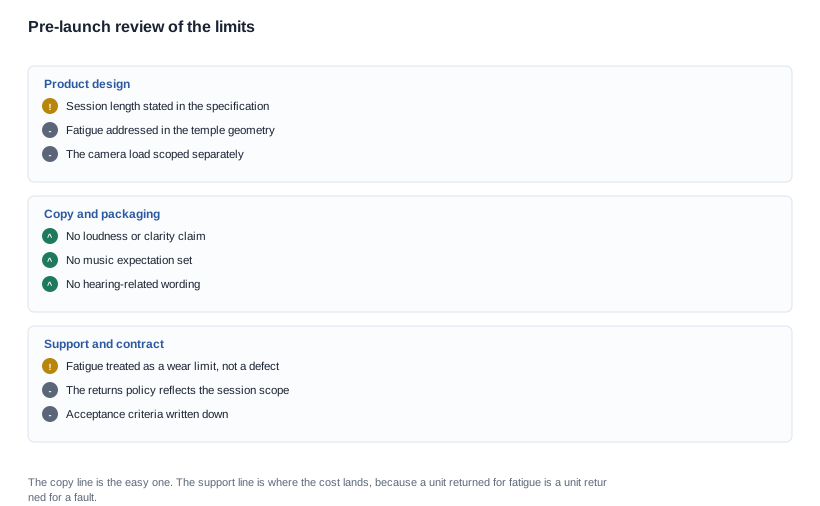
The review works through the limits and asks, for each one, which of the three things it changes. The gain limit changes the copy and nothing else: the 35 dB figure stays in the technical description, and the listing leads with the environment rather than with a number. The frequency limit changes the copy and the customer profile: the product is not marketed to anyone who wants music, and the channel selection follows from that. The fatigue limit changes the product definition, the copy and the support policy — the session is written as a shift block, the listing states a wear limit, and the support script opens with the wear limit rather than with a replacement. The environmental limit changes the product expectation and the sample protocol: the trial happens on a real site with a real masked source, because a quiet room would return a result that says nothing. The regulatory limit changes the copy and the file, and it is the one that cannot be negotiated.
The review then produces two decisions that the initial brief did not contain. The first is that the product is scoped to a bounded session, which means the campaign language cannot use all-day or continuous phrasing, which in turn narrows the channel. The second is that the support script is a deliverable with a review date rather than a document written once, because the wear limit is the one thing in the programme most likely to be questioned by a customer who has been told it clearly and still returns the product.
The commercial conclusion is that the cheapest version of this programme is the one where the limits are designed in rather than discovered. A product scoped to a shift block, sold into channels that understand it, and supported by a script that opens with the wear limit will have a return profile that is predictable, and a predictable return profile is a number that can be planned for. The version that discovers the limits in the returns queue pays for them twice: once in the replacement unit and once in the review.
What we publish, and what to send us
Its limits are the design brief, not apologies
It is worth being precise: bone conduction is a specialised and genuinely useful form factor, and its limits are the design brief rather than a list of apologies. We will publish the specification we have, which is the 35 dB gain, the 200 mAh cell, the two-hour charge time, the roughly seven-hour runtime and the Type-C interface, and we will not publish a driver size, a frequency response or a distortion figure that the company has not confirmed. We will also not describe the product in a way that suggests it treats a medical condition, because it is not a medical device and a listing that implies otherwise creates a problem in the exact market where the demand is strongest.
What we will do is match the form factor to the use case honestly, and tell you early if the use case you have in mind is one where an open-ear temple speaker is the better product for your customer.
Send the draft listing, and we will mark it up
If you send the draft listing as well, we will tell you which published rows it relies on and which of its claims no row supports. The category we publish a single specification for is at bone conduction audio, the alternative form factor and how the two divide the work is at open-ear audio, and the rows that decide a long-wear product are at materials and ergonomics.
Related reading
- The category we publish a single specification for — bone conduction audio
- The alternative form factor and how the two divide the work — open-ear audio
- The regulatory line described here, in full — certification checklist
- The rows that decide a long-wear product — materials and ergonomics
Tell us the environment the product will be used in and how long a session has to last, and we will say whether bone conduction is the right form factor for it or whether an open-ear model is.


