

Every European sourcing project reaches the same point. The samples work, the unit price is agreed, the shipping plan is drafted, and then somebody in the brand's legal or compliance team asks a single question: who is the responsible person for this product once it is sitting on our shelf?
The question usually arrives by email, and it usually arrives with a slight edge to it, because the person asking has already been told that "the factory is in China" and has not yet been told what that means in legal terms. Buyers write to us about this often enough that it deserves a straight answer rather than a paragraph of caveats.
Here is the short version before the detail. A factory outside the European Union can be the manufacturer of the product, and it can hold the technical documentation that every other party in the chain depends on. It cannot be the economic operator established in the Union, because it has no establishment in the Union — and that role has to exist somewhere, with an address a market surveillance authority can write to. If your business imports our smart glasses into the European Union under your own brand, then that role is normally yours, or you appoint somebody to hold it on your behalf.
The confusion is not carelessness. "Responsible person" is used loosely across the European market for at least three different legal roles, and buyers who meet the phrase in PPE, cosmetics, medical devices or machinery often carry a definition that does not fit consumer electronics at all. Getting the role right before the first purchase order costs one email. Getting it wrong costs a customs hold, a marketplace delisting, or a recall with nobody in the Union to answer the authority's letter.

can a chinese factory be the responsible person: the direct answer
There are three answers to that question, and which one is correct depends entirely on which role you are asking about. This is the single most useful thing to establish, because people who answer the question once and never re-examine it tend to apply the wrong answer to all three roles at once.
As the manufacturer — yes. The party that designs or makes the product is the manufacturer, wherever it is established. A Shenzhen factory that builds smart glasses for your brand is the manufacturer. It carries the manufacturer duties in full: it identifies the product, it keeps the technical documentation, it draws up the declaration of conformity, it ensures the product is safe for the intended use, and it keeps the batch and production records that let you trace a unit back to a production run. Nothing in the rule requires the manufacturer to be inside the European Union. That is precisely why a second role exists.
As the economic operator established in the Union — no. A factory registered outside the EU cannot be the party established in the Union. This is not a technicality that can be engineered around with a registered address or a fulfilment partner. The role is defined by an establishment in the Union: a place where the operator can be reached, where documents can be produced, and where the obligations can actually be discharged. A factory outside the Union is, structurally, the wrong candidate for that role.
As the party that supports your compliance file — yes, and this is where the factory earns its place in the chain. Everything the Union-established operator needs to do starts with the manufacturer. The technical file, the declaration of conformity, the product identification, the batch traceability, the test reports behind the claims you make in your listing, the contact details of the factory itself — all of that originates at the factory. What the factory cannot do is appoint itself to a role it is not eligible for, and any supplier that tells you it has "handled GPSR for you" is telling you something that needs checking against your own structure.
There is a practical test you can apply in one sentence. Ask: who in this arrangement is established in the European Union and can be served by an authority? The answer names your role. Everything else in the arrangement is support. If you can answer that question before placing an order, you have already avoided the expensive mistake. If you cannot, then the answer is "not published" until a supplier tells you, and a supplier telling you is precisely the thing that has to be checked rather than assumed.
The failure case is worth naming plainly, because it is common. A brand imports under its own name, the factory produces a file, and nobody ever appoints anybody. Nothing breaks at the factory, nothing breaks on the vessel, and the problem appears months later when a marketplace asks who is the economic operator for a listing, or an authority asks for the declaration of conformity. At that point the work is not "find a document"; it is "reconstruct a chain of custody that was never designed". The cost of that reconstruction is the reason this question belongs in the first supplier call rather than the last one.
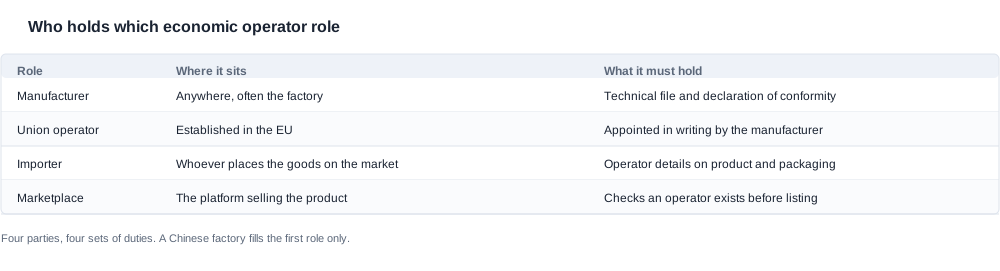

The four roles behind "can a chinese factory be the responsible person"
The European framework recognises four separate parties, and a single product will usually involve three or four of them at once. Procurement teams who have dealt with batteries or radio equipment sometimes assume the roles blur together; they do not. Each role has its own duties, its own address, and its own signature on the paperwork.
-
The manufacturer. You, if you design the product; the factory, if it does. Duties include product identification, technical documentation, the declaration of conformity, batch traceability, and making sure the general safety requirements are met before the product is placed on the market. The manufacturer keeps the technical file for ten years and must be able to produce it on request.
-
The party established in the Union, appointed in writing. Where the manufacturer is not established in the Union, the manufacturer must designate, in writing, a person established in the Union who keeps the technical documentation and the declaration of conformity on the manufacturer's behalf, provides the operator details to market surveillance authorities, cooperates with those authorities, and takes corrective action where a product is found non-compliant. In practice this is normally an authorised representative, and it is normally a real cost with a real signature on it — not a formality you can borrow from a friend.
-
The importer. Whoever first places the product on the Union market. A brand bringing finished goods into the EU under its own name is typically the importer. Importer duties are substantial and are the ones a buyer is most likely to underestimate: verifying that the manufacturer and the Union-established party are identified, checking that the product carries the required information, putting the operator details onto the product and the packaging, keeping the technical documentation and the declaration of conformity for ten years, and withdrawing or recalling when a problem surfaces.
-
The online marketplace. A platform that lists the product carries obligations of its own, including checking that a responsible economic operator is identified before the product is published. This is the part that surprises sellers, because the compliance obligation reaches the platform as well as the seller, and the platform's own checks are now a working part of the route to market rather than a theoretical one.
The trade-off for a buyer is straightforward. Taking the importer role yourself gives you control: you choose the packaging, you sign what appears on it, and you decide what goes live. Appending the same role to a partner or a representative service costs money and time but reduces the volume of work you carry personally. What you cannot do is leave the role empty, and the failure mode to avoid is the arrangement where nobody has ever asked who holds it.
A second trade-off sits underneath the first, and it is about evidence rather than cost. Each role requires documentation that exists and is verifiable — a signature that can be checked, a document that can be produced on demand, a number that can be traced. A role held by a party that answers questions vaguely is worse than a role held by a party that answers precisely, because the authority and the marketplace will ask the same question with less patience.
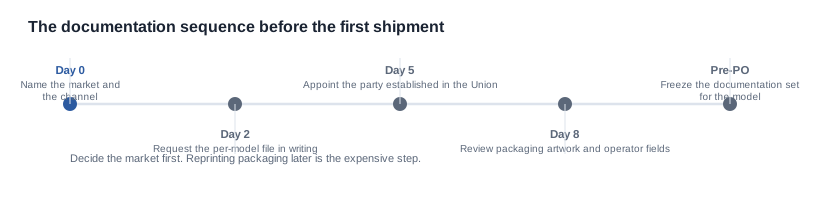
What "can a chinese factory be the responsible person" changes about your paperwork
Role separation looks abstract until it appears on a carton. The economic operator details have to appear on the product itself, and where the product is too small for that, on the packaging. The information set typically covers the manufacturer's name and postal address, the details of the party established in the Union, the importer's details where the importer is not the manufacturer, and a product identifier that makes the item traceable, together with the warnings and safety information in the language of the market it is sold into.
Smart glasses make the size problem sharper than it is for most consumer goods. A pair of glasses has a temple arm, a frame front and a charging case, and the amount of legible surface area on the product itself is limited. Most buyers therefore land on a structure where the product carries a model identifier, a batch or serial reference and the manufacturer's name, while the packaging carries the full operator details. That is a design decision with consequences: it means the packaging artwork for each market is different, it means a relabelling mistake reaches retail, and it means the case insert is part of your compliance chain rather than a piece of marketing collateral.
That last point is where packaging errors become customs problems rather than marketing problems. A box designed for several markets that carries only one market's operator details does not satisfy the others, and the consequence is a shipment held rather than a sale refused. Holding a container costs demurrage and rewrites the delivery schedule; refusing a sale at the platform costs the listing and the ranking history behind it. Both are more expensive than a packaging artwork review.
There is a related question buyers ask at the same time, and it deserves a separate answer: may a brand use the factory's existing declaration of conformity? In a properly documented arrangement, yes — the manufacturer has drawn it up and holds it. But the brand signs what goes on the product and the packaging, and the brand is the party the authority will deal with. A declaration of conformity signed by a factory that does not know your brand, your model designation, or your market is a document with the wrong product on it, and that mismatch is discovered at listing review rather than at your desk.
Now the part that requires honesty about our own catalogue, because a buyer reading this will ask and we would rather answer it now than have it surface in a due diligence questionnaire. Our catalogue does not carry a per-model certification row. The compliance body of the product catalogue does not mention CE, FCC, RoHS, RED or EN 18031 at all. The export certification page is images and nothing else: ten patent certificates — eight of them design patents, two of them utility models — and no per-model conformity mapping attached to any of them.
Read that carefully. It means two things. It means we hold patent documentation that is publicly visible. It means we do not publish a matrix saying "model X holds certificate Y for market Z", because we do not publish such a matrix at all. For a buyer, the practical consequence is that per-model, per-market conformity evidence has to be requested in writing, model by model, before the order — it cannot be scraped from a catalogue table, and any supplier who offers you a single document covering "all models" should be asked which models it actually names.
The other commercial facts a buyer will want at the same moment — unit price, minimum order quantity, lead time, sample fee, warranty period, certificate numbers — are equally not published on our side. They are quoted per project. A supplier who publishes a price without publishing the certification matrix, or the other way round, is giving you half of the file and asking you to infer the rest.
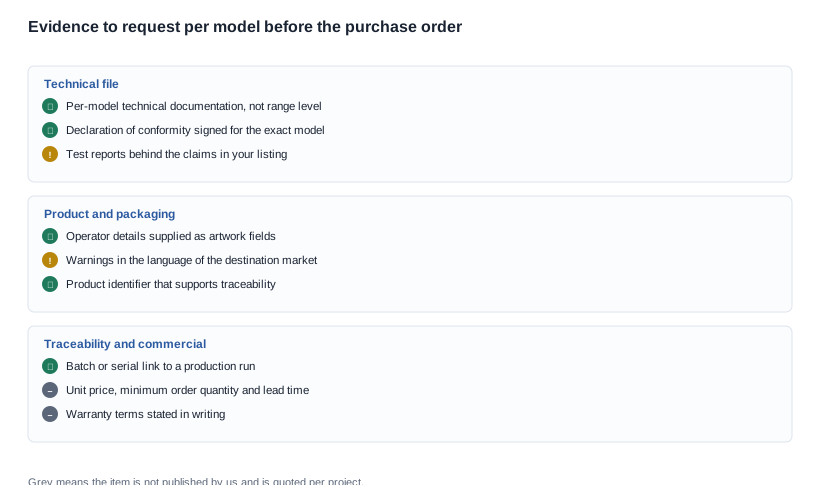

A due diligence checklist for "can a chinese factory be the responsible person"
This is the list we suggest putting into a supplier questionnaire when the destination market is the European Union. It is not a legal checklist; it is a document-request list, and it is written so that a factory genuinely capable of supporting a compliant launch can answer every line without a week of internal meetings.
-
Which legal entity manufactures the product, and what is its full registered address? If the answer is a trading company rather than the factory, that is not disqualifying, but the technical documentation will then sit with the factory and you will need both entities named in the file.
-
Does the technical file exist for this exact model designation, and who signs the declaration of conformity? Ask for the model string as it appears on the product label, not a family name. A file covering "the camera range" is not a file covering your SKU.
-
Which conformity evidence can you provide for this model and this market, and in what form? Test reports, declarations, certificates — and note that the existence and validity of a document is something you verify, not something you assume. A supplier naming a certificate without a number, an issuing body, or a date has not given you evidence.
-
How is the product identified for traceability, and what record links a serial or batch number to a production run? This is where a recall becomes manageable rather than catastrophic. The question to press on is the granularity: a date and a production line is weaker than a batch number tied to a bill of materials.
-
Who writes the operator details on the product and the packaging, and at what stage? Answering this well means the factory supplies artwork-ready fields and does not stamp them itself for your market.
-
What does the file need from us, in what format, and by when? A supplier who needs your artwork finalised before they can finalise the document is telling you the real lead time for compliant delivery, which is longer than the production lead time.
The shortlist criteria behind these questions are worth stating, because they apply across factories and not just to us. Look for a supplier that separates its own responsibilities clearly, answers the model-specific questions rather than the range-level ones, and says "not published" instead of guessing when it does not have a figure. That last behaviour is a genuine signal: a supplier who will not invent a certificate number for you is a supplier who has a certificate drawer with actual documents in it.
The reverse signals matter just as much. A supplier who offers a single declaration covering every model in the catalogue. A supplier who asks you to sign your own conformity declaration without providing the technical file behind it. A supplier who cannot say who signs and says "we handle all the certification for you". Each of those is a trade-off you might accept for speed, but accept it knowingly rather than by accident.
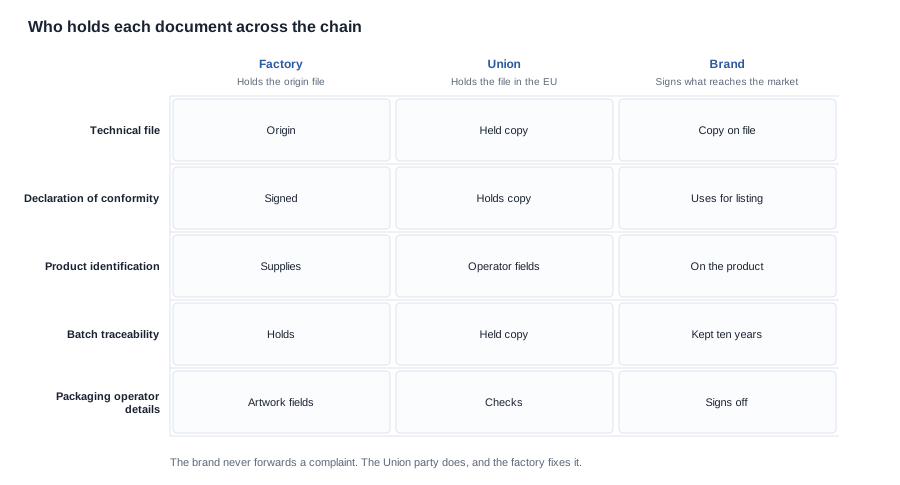

Why the market changes the answer to "can a chinese factory be the responsible person"
A final complication that catches buyers who generalise from a previous project. The roles described here belong to the European Union's general product safety framework. Other markets have their own vocabulary and their own requirements, and a factory file that satisfies one market does not automatically satisfy another.
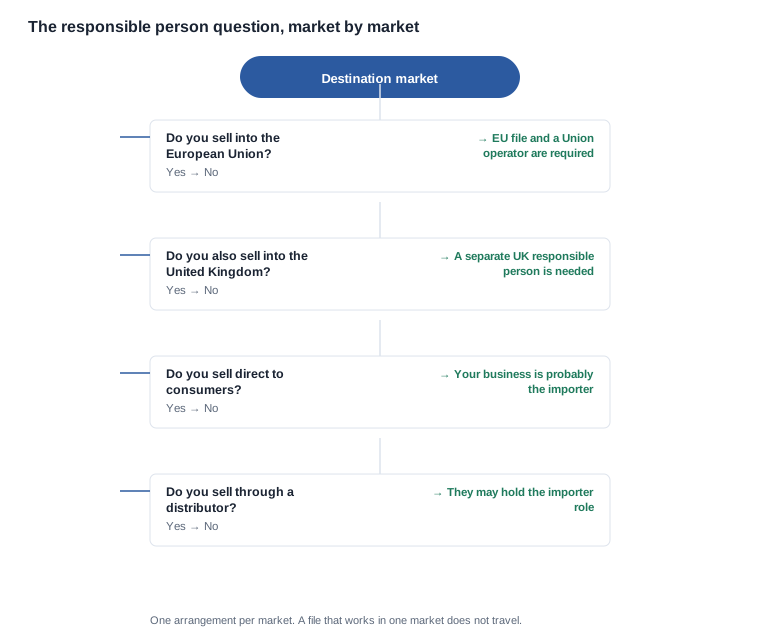
The United Kingdom has a separate regime with its own responsible-person requirement and its own conformity marking practice, and it is not satisfied by an EU arrangement. The United States has no equivalent single EU-style representative construct, and the obligations that bite hardest there are state-level and marketplace-level rather than Union-level. Other jurisdictions add their own requirements, often local-language labelling and local-agent requirements. The practical consequence for procurement is that the destination market and the channel have to be decided before the documentation work starts, because the documentation is market-specific and reworking it after the artwork is printed is expensive.
The channel also decides the answer. A brand importing finished goods into its own warehouse and selling through its own storefront is the importer. A brand that ships direct to consumers from a fulfilment partner is very likely to be the importer as well, even if it never physically touches the goods. A distributor that takes title in the Union before sale may take the importer role instead of you, which is a legitimate structure and a genuine trade-off: less work for you, less control for you, and a different set of documents to verify. Whichever way the roles fall, the test remains the same — somebody established in the Union must be reachable by an authority, and you should be able to name them.
The same logic applies across a product line rather than a single SKU. A brand that sells six models into the Union has six product identifications, six sets of artwork and, in practice, six document sets. Suppliers who quote one compliance fee for a range are usually quoting for the easy case and billing for the rest later. Ask for the per-model position, because that is where the real cost hides.
The position we take on "can a chinese factory be the responsible person"
We are a factory outside the European Union, and we will not describe ourselves as an economic operator established in the Union, because that would be false and because a buyer who believes it is worse off than one who never asked. What we do is supply the manufacturer's side of the file in the form your appointed party needs it: the technical documentation, the declaration of conformity, the product identification, the batch traceability and the factory's own contact details, for the models we build.
What we will also do is tell you plainly that the per-model, per-market conformity evidence we hold is not published in the catalogue, and that you should request it in writing for the specific model designations you intend to sell, before you commit to a purchase order. Where a figure does not exist — unit price, minimum order quantity, lead time, sample fee, warranty, certificate numbers — we will quote it to you for the project rather than publish a number that applies to nobody.
The correct position for a specific product, a specific market and a specific channel is ultimately a question for your own legal counsel, because the arrangement depends on how your business is structured and where it sells. What we can do is make sure the manufacturer-side documents exist, are model-specific, and are readable by the party you appoint. That is the part of the chain we control, and it is the part we commit to.
The wider compliance context sits under market compliance centre, the European route in detail is under compliance for the European Union, and the verification sequence to run on any supplier file is under certification verification checklist.
Related reading
- The European route in full — compliance for the european union
- The verification sequence — certification verification checklist
- The general safety rules — gpsr general product safety regulation
Tell us the destination market and the channel, and we will tell you which documents we can supply for the models you are considering.


