
The question arrives in three different disguises, and they have three different answers. A buyer with a retail range wants to know whether the customer can swap the lens at home. A buyer with a channel partner wants to know whether the partner's optician can reglaze the frame. A brand planning a line for people who wear glasses wants to know whether the frame will carry a prescription at all. Treating these as one question produces the wrong answer for all three.
Our published data does not settle the question for any model, and it is better to say that clearly at the start than to let a buyer infer an answer from a photograph. The catalogue publishes no lens-change arrangement, no lens material specification, no visible light transmittance figure and no frame dimension table for the models we list. It does publish a few adjacent facts that a careful buyer will want: one model in the camera range carries photochromic lenses with three colour options, one model publishes four colour options, and exactly one model in the whole catalogue publishes a frame weight.
That last point deserves more attention than it usually gets, because weight is the variable that decides whether a prescription lens is physically sensible in a given frame. Our catalogue publishes a weight for one model only — 158 grams for the glasses themselves, excluding that model's 1200 mAh foldable charging case. Every other model in the range, across the audio, sport, camera and kids tiers, has a weight that is not published.
This article explains what a lens change actually involves in a smart-glasses frame, what we can and cannot confirm today, where a lens decision lands in a procurement file, and how to ask a supplier a question that gets a usable answer.
can i change the lenses: four different questions in one sentence
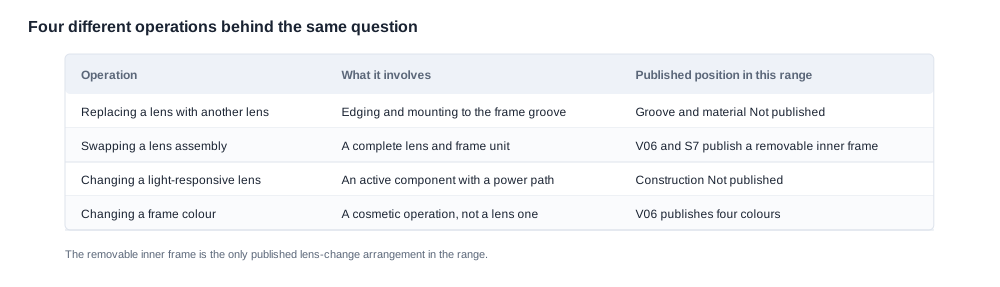
The sentence "can I change the lenses" is used for at least four operations, and they differ enormously in difficulty, cost and risk.
- Swapping a lens for a different lens. The traditional optical operation. The lens is edged to fit and mounted in the frame's groove. The questions are about material, edge thickness, whether the groove is standard, and whether the frame is a sensible carrier for a prescription at all.
- Swapping a complete lens and frame assembly. A unit rather than a lens. This is closer to changing a watch strap than to changing a lens, and it preserves whatever the original assembly provided — including any electronic function built into it.
- Changing a light-responsive lens. A different tint, a different photochromic or electrochromic module. This is a substantially harder operation, because a light-responsive lens is an active component with a power path and a control connection rather than a piece of plastic. Our catalogue does list electrochromic and AR entries, and it publishes nothing about how their lenses are constructed or mounted.
- Changing the appearance. A frame or product colour rather than a lens. It is the question buyers most often mean when they ask about lenses in a product that has colour options, and it is answered by a completely different process — a different part, a different minimum order quantity, and a different set of sample expectations.
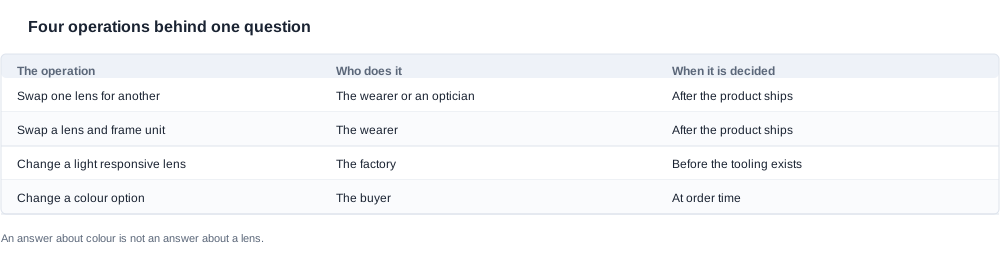
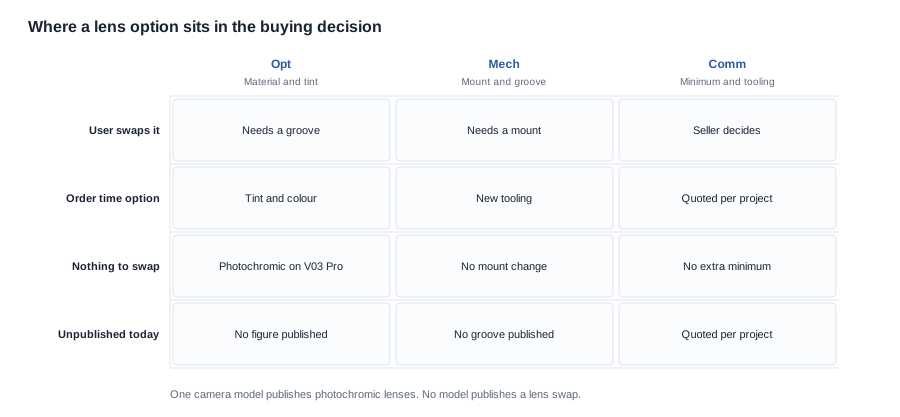
The reason to separate them is that they are decided at different times by different people. Operations one and two are end-of-life or channel decisions that happen after the product ships. Operation three is an engineering decision made before the tooling exists. Operation four is a commercial decision made at order time. A buyer who asks "can I change the lenses" and receives an answer about colour options has been answered about the wrong operation.
Why user-swappable lenses are rare in smart glasses
A standard optical frame is designed around one idea: the lens is a separate, replaceable, non-electronic component held in a groove. Almost every other constraint in a smart-glasses frame comes from the fact that the frame is not that.
The electronics change what the frame can tolerate. A smart-glasses temple carries a battery, a radio, a processor and, on the camera models, an imaging module. A frame designed for a replaceable lens is designed to open, unclip and flex. A frame with electronics inside the temple is designed to keep them closed, sealed and aligned. These two design pressures work against each other, and the winner is almost always the electronics.
Alignment is a tolerance problem, not a fitting problem. A lens that moves by a fraction of a degree changes how a wearer sees, and on a camera product it changes where the camera points relative to the eye. If the lens is user-swappable, the manufacturer has to accept that tolerance and to design the mount for it. That is a real design cost, and it is one of the reasons lens-swappable smart glasses have stayed rare.
The seal and the weight change. If a model carries an ingress marking, the lens interface is part of what that marking rests on, and a user opening it invalidates the assumption. Our catalogue publishes an ingress marking for two models only, the V06 and the S7, both of them camera models; nothing else in the catalogue carries an IP marking. Separately, a lens swap changes the mass distribution of the front of the frame, which changes how it sits on the nose and over the ears — the variables that determine whether a product is comfortable across a day of use.
The paperwork moves. A change of lens can change the product's configuration, and a change of configuration is a change to the product's conformity position, its label, its packaging and its declared characteristics. In a product with published runtime figures that are themselves published without a stated test condition, that is a change to a file whose exact contents are not published.
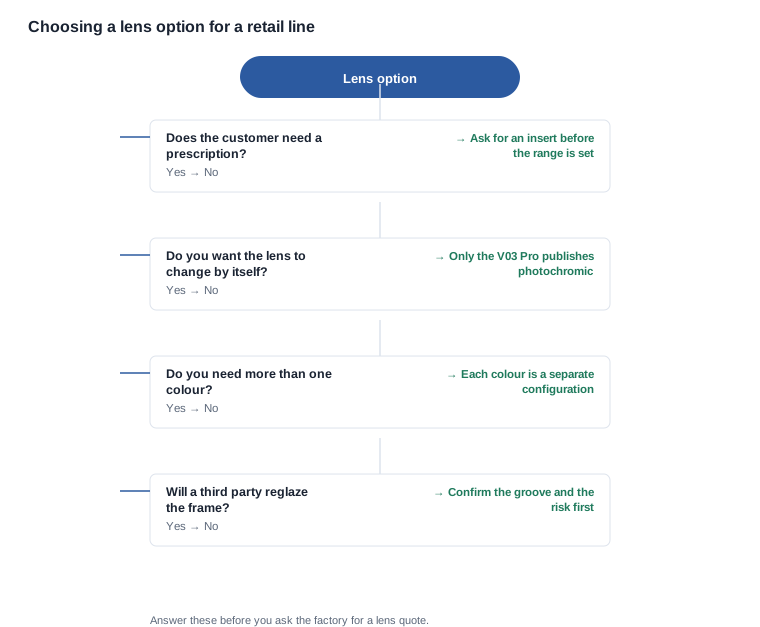
The third-party repair risk is real. The most common way a lens gets changed on a smart-glasses frame is not by the manufacturer and not by the user, but by an optician or a repair shop that has been handed a pair of glasses that look, from the outside, like an optical frame. The temple is opened, the lens is levered out of its groove, and somewhere in that process a cable that runs from the temple hinge to the battery is cut, or a microphone port is cracked, or a heat-bonded front is split. The product then fails in a way that looks like a manufacturing defect, and the buyer's aftersales cost carries a claim the factory has never seen before. This is the strongest practical argument for a buyer who intends to offer a prescription option: it is better to have the factory supply the insert than to leave the operation to a market of repair shops.
That is also why the answer for the buyer depends on which tier of the range is in question. An audio model with no imaging module and no light-responsive element has a lens that is essentially a protective window in a frame that carries electronics in the temples and a battery somewhere behind the hinge. A camera model adds an imaging module whose position relative to the eye is a calibration decision, and the camera range includes the models with the higher published sensor figures — 13 megapixels on the S7 and the L2 Utral, and the L1 Pro, and 8 megapixels across the other camera models. A model that has to be calibrated and then has its front opened is a different risk profile from one that has not.
The net effect is that in this category, the lens decision is nearly always a build-time decision made by the manufacturer, not a user-time decision made by the wearer. The buyer who wants a different lens specifies it on the order; the buyer who wants a different colour specifies it on the order; and the end user is left with what they were given.

What our catalogue publishes about lenses, and what it leaves open
Stated in full, so that nobody has to infer it from a product photograph.
What is published. The V03 Pro is the only camera model that publishes photochromic lenses, together with three colour options. The V06 publishes four colour options. The MT6 publishes a frame weight of 158 grams for the glasses only, excluding its 1200 mAh foldable charging case. Two models, the V06 and the S7, publish an IP54 marking. The camera range covers eleven models — the MT6 and the L2 Utral, the MT5 and the CY03, the CY05 and the L1 Pro, the KY06 and the V06, the V03 and the S7, and the V03 Pro — and the sport range covers three, the YKC02, the D17 and the ZH12. Note that the V06 and the S7 carry names associated with sport but sit inside the camera range; the sport range is the YKC02, the D17 and the ZH12.
What is not published. There is no lens-change row anywhere in the catalogue. There is no lens material specification, no visible light transmittance value, no groove or edge specification, no frame dimension table, and no lens interchangeability claim for any model. There is also no capacitive-touch row and no translation row anywhere in the catalogue — which matters here, because "tap the temple to swap the lens" is exactly the kind of claim that our own documentation cannot support for any model, in either direction.
What is published about certification. Our export certification page is a picture page. It shows ten patent certificate images — eight design patents and two utility models — and it carries no per-model conformity row attached to it. The catalogue body does not mention CE, FCC, RoHS, RED or EN 18031 at all. So for any model, a per-model conformity position has to be requested in writing, and a change of lens configuration is a change to that position.
There is one published lens behaviour that a user can genuinely "change", and it is the one they never touch. A photochromic lens changes tint by itself in response to light. On the V03 Pro that happens automatically, which means the product delivers a lens that changes without any user action — and that is a different proposition entirely from a lens the wearer can swap. If your commercial idea is "the lens adapts", the V03 Pro is the only published instance of that in our catalogue.
The useful discipline for a buyer here is to keep two categories apart. "Not published" means the data exists somewhere inside the factory and can be requested in writing; it does not mean the capability is absent. "Absent" means the product does not do it, and no request will change that. Conflating the two is expensive in both directions: a buyer who assumes "not published" means absent will drop a model from a shortlist for no reason, and a buyer who assumes "not published" means available will build a retail proposition on a capability that was never engineered. The cheapest correction to both errors is a short written request that names the model designation and the question, and asks for either a figure with its method or a clear statement that the feature does not exist. A factory that answers the second request as readily as the first is a factory whose due diligence answers you can rely on later.
One more published fact belongs in this section, because it changes what a lens decision costs you. The kids tier — the A05, the A06 and the A07 — is a different commercial proposition from the rest of the range, and lens tolerance is one of the reasons why. A product built for a child has a different fit requirement, a different impact expectation and a different replacement cycle, and a lens specification tuned for an adult frame will not transfer to it. Our catalogue publishes no lens specification for the kids tier either, so the same request applies there with the same expectation of an open answer.
Where a lens decision lands in a procurement file
The practical consequence of the previous section is that a lens change is a specification written at order time. Here is what that specification consists of and where it collides with procurement.
Tint and optical density. If you want a tinted product for outdoor use, that is a build option with a tooling implication and a per-variant minimum. Our catalogue publishes no visible light transmittance figure and no tint options for any model, so both are quoted per project. Ask for the transmittance and the method used to measure it, and ask whether the figure is a measured average or a nominal classification.
Colour. Colour options multiply. Our catalogue publishes colour counts for only two models — three on the V03 Pro and four on the V06 — and the rest of the range has no published colour data. Every colour you add is another variant to forecast, to photograph, to hold stock against, and to reorder. This is where the minimum order quantity question turns into a real number, because a colour is a separate build.
Prescription. If the frame is to carry a prescription insert, the insert is a new part with its own tolerance, its own fit check, and its own interaction with the frame's weight and nose fit. Whether any given model supports one is not published for any model. The prescription question in full is under prescription lenses in smart glasses, and it is worth reading before you build a retail proposition on it.
The combination problem. This is the part that catches people. Minimum order quantity, unit price, tooling cost and lead time are all not published on our side and are quoted per project. But they are quoted per configuration, and a buyer who specifies one model in four colours has asked for four configurations. The arithmetic is not complicated; it is just easy to forget. Ask for the minimum per configuration and per model separately, because a supplier who quotes one number for "the range" is usually quoting the easiest configuration.
The sample and the golden sample. Any lens, tint or colour decision needs a sample that is physically the thing you ordered, not a showroom unit of a neighbouring configuration. The colour, the tint and the fit are exactly the attributes a catalogue photograph flattens. A golden sample that survives to production is worth more than a specification sheet here, because so much of this decision is visual.
The documentation the buyer keeps. Every lens configuration you approve should arrive with a written record: the model designation, the configuration, the unit price, the minimum order quantity, the lead time, and the sample that was approved. Keep it, because the failure mode in this category is not a wrong lens arriving — it is the right lens arriving in the wrong configuration because nobody wrote down which configuration had been approved. That is a procurement records problem, and it costs more to fix later than it does to prevent at the start.
The material and ergonomic side of the same decision is covered under materials and ergonomics. The sport range, where optical requirements are usually most specific, is under sport smart glasses, and the camera range, where the lens and the imaging module interact, is under AI camera glasses.
Three failure patterns to design around
Colour proliferation. A range that starts with two colours and adds a third for a retailer, then a fourth for a marketplace channel, ends up with more variants than the order can support. The failure is not operational, it is financial: each variant carries its own minimum, its own photography, its own packaging artwork and its own forecast error. Decide the colour count against your own demand data rather than against what the factory is willing to quote.
The prescription insert that does not fit. A prescription lens changes the frame's weight, its centre of gravity and its nose contact. A buyer who has designed a retail proposition around a prescription option, without a sample worn by a real wearer for a real day, has designed a proposition rather than a product. Ask for the frame dimensions, the lens geometry and whether an insert is supported at all, and insist on a worn sample before the retail proposition is locked.
Expectations about photochromic. A photochromic lens responds to ultraviolet light, not to brightness. It darkens outdoors, it does not darken much behind a windscreen, and it responds to temperature as well as to light, so it behaves differently in a cold street and a hot car. These are properties of the material, not of the manufacturer, and a customer who expects sunglasses behaviour will be disappointed. If you sell the V03 Pro's photochromic lenses, say so in the copy in those terms.
A fourth pattern, common enough to mention: a lens or tint change alters how the camera sees the world. On a product whose published camera resolution is 8 megapixels or 13 megapixels depending on the model, a tint that is darker than the reference build will change exposure and image brightness in a way a customer reads as a quality problem. If you are changing tint on a camera model, re-check the imaging behaviour on a sample rather than assuming the electronics compensate.
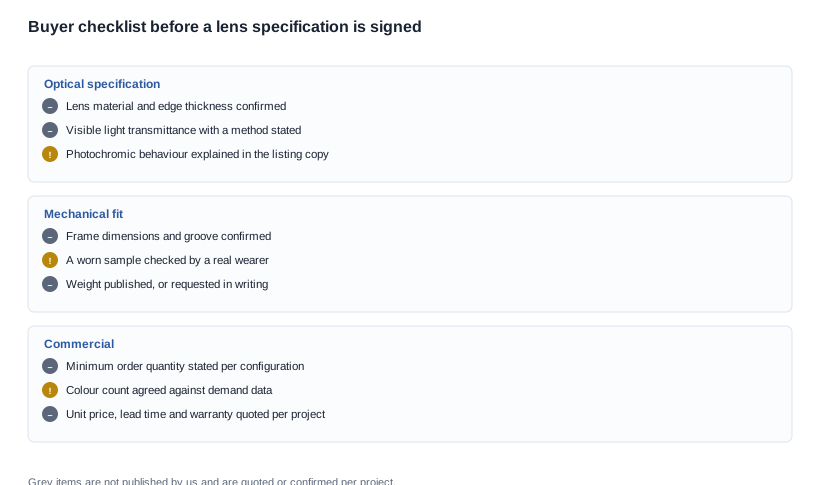
The supplier questions that settle can i change the lenses
- Is the lens a separate component in this model, or is it bonded, moulded or integrated into the frame?
- What is the lens material, and what edge thicknesses does the frame accept?
- Does the frame have a groove, and is it a standard optical groove?
- Does the model support a prescription insert, and does the factory supply one or work with a named optician?
- What is the frame weight, and what does that do to the fit with a prescription lens in it?
- What tint and colour options are available for this model, and what is the minimum order quantity per configuration?
- What is the visible light transmittance of each tint, and how was it measured?
- If the lens carries an electronic function, what is its power path and what happens to the product's behaviour if it is removed?
The shortlist criteria that follow are about specificity. A supplier that answers per model, states whether a claim applies to the current build or to a planned one, and quotes the minimum per configuration has given you something you can plan a launch on. A supplier that answers "yes, the lenses can be changed" without saying which of the four operations from the first section is meant has given you nothing, and the ambiguity will surface later as a sample that does not do what the listing said.
Our own position is narrow and we would rather state it than let it be inferred. We will tell you which models publish a lens arrangement and which publish nothing; we will not generalise from one model to another, and we will not infer a lens specification from a photograph. We publish the photochromic and colour rows we have, the one weight figure we have, and the two ingress markings we have, and we mark the rest as open. Where the lens arrangement for a model is not published, we will say that and route the question to the engineering team, because the honest answer for most models in this range is that the data does not yet exist in a form you can plan against.
The due diligence sequence we would suggest is short: fix the customer requirement first, since a lens question usually starts as a vision requirement rather than a product feature; then narrow to the models that could satisfy it; then put the same written request to each supplier, naming the model and the requirement; then require an answer at the level of a current build. Only after that does it make sense to compare shortlists on price, because two quotations that answer different questions are not comparable, and the cheaper one is usually the one that answered less. The trade-off to keep in view is that a lens option raises the number of configurations you forecast and the number of minimums you carry, which is a real cost even when nothing goes wrong.
Give us the model designation and what the customer needs — a tint, a colour, a prescription, or simply the ability to change the lens later — and we will tell you which of it we can confirm from the documentation today, and which of it has to be answered by engineering before you commit.
Related reading
- Sport smart glasses range
- Materials and ergonomics
- Prescription lenses in smart glasses
- AI camera glasses range
Tell us the model and what the customer needs and we will say what we can confirm and what has to go to the engineering team.


