
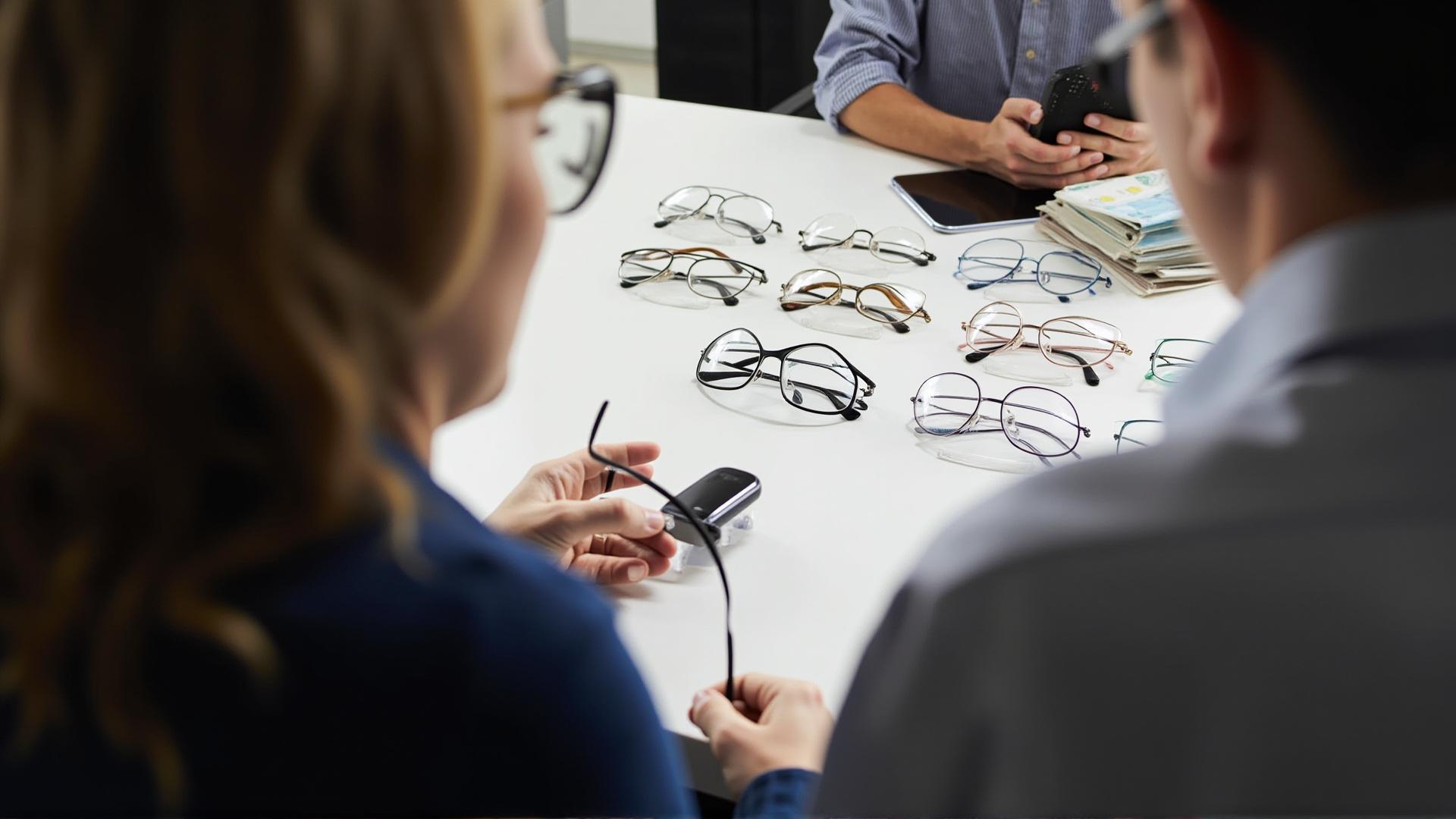
The short answer is that it depends entirely on whether your frames are fitted by an optician, and our catalogue does not tell you. We publish no lens material, no prescription range, no lens partner and no fitting standard for any of the twenty-eight models in the range. So when a buyer asks whether the product can be worn with prescription lenses, the honest answer is that the question has two halves — whether the frame physically accepts a filled lens, and whether the supplier supports it as a product — and only one of them is usually answered.
The second half is the one that decides the programme, and it is the half that gets skipped. A frame can be perfectly capable of holding a lens and still be a bad commercial proposition to sell as a prescription product, because prescription turns a hardware SKU into an optical SKU, and an optical SKU has its own minimum order quantity, its own lead time, its own cost structure and its own return profile. That is a supply-chain decision before it is an optical one.
There is also a wrinkle that only applies to the camera models, and it is the one that should make a buyer stop and think before listing anything. On a camera product the lens sits in the optical path of the camera. A filled lens changes what the camera sees: a tint reduces the light reaching the sensor, a thicker lens changes the working distance, and a different base curve moves the lens plane forward or back, which changes both the framing and the alignment between what the wearer looks at and what the camera records. Our catalogue publishes no field of view, no sensor model and no video specification for any model in the camera family, so the camera response to a fitted lens is an open row that gets harder, not easier, when you add prescription.
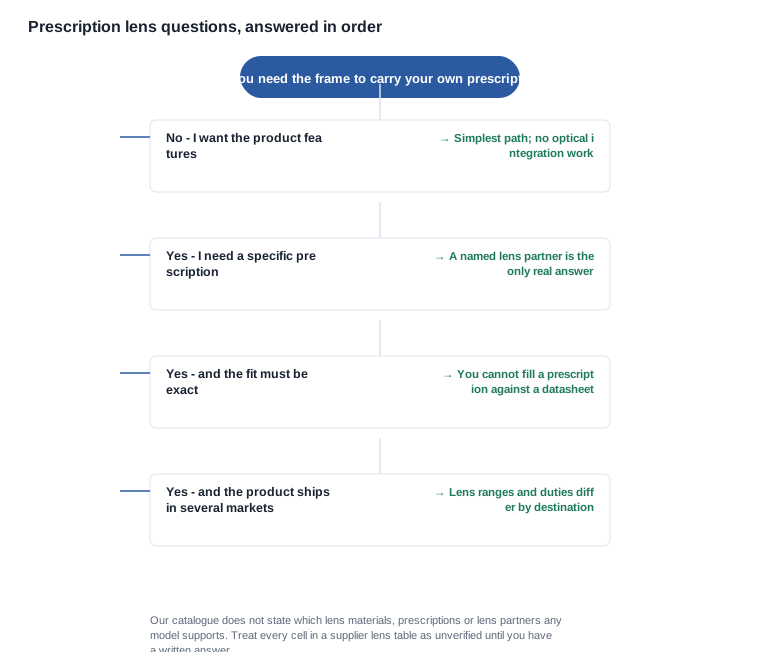
Can I wear them with prescription lenses: the two halves of the question
The mechanical half. Most full-rim frames accept a single-vision lens, and semi-rimless frames accept one with constraints on lens size and edge thickness. Our range includes both full-rim and semi-rimless constructions, and the specific geometry of any given model is not published in our source material. What that means in practice is that the frame's suitability for a lens is a question about one model at a time, answered by an optician holding the physical frame, and not by a catalogue row.
The commercial half. Prescription support is a supply-chain arrangement before it is an optical one. Does the supplier work with a lens lab, or do they fill lenses in house, or do they ship blanks? What range of prescriptions is supported, and what happens outside it? Who warrants the fit? Who owns the transit risk when a lens arrives damaged or with the wrong power? How long does the filled version take compared to the frame alone? None of these are published for any model. We are not able to tell you that prescription is available, and we are not able to tell you it is not, and the difference between those two states is the difference between a product line and a project.
The weight row makes the point neatly. The catalogue publishes a frame weight for exactly one model in the entire range — the MT6 at 158 g for the glasses alone, excluding its foldable 1200 mAh case. Every other model is unpublished on weight, as are the frame dimensions, the temple length and the temple curve. So the question "does a filled lens change the stated weight" cannot even be asked against a published figure for most of the range, and for the one model where it can, the published figure explicitly excludes everything but the glasses. A listing that quotes a weight is quoting a number that a lens will change, and the honest way to handle that is to say whether the figure is with or without lenses.
There is a third half that a buyer in a particular channel should think about, and it is about the customer rather than the product. A wearable that has to be worn all day by someone who does not need correction is a fashion accessory. A wearable that a customer needs to wear because they need to see is a medical-adjacent product, and that brings a different expectation of fit tolerance, a different expectation of service and a different regulatory conversation in some markets. Whether the product falls on one side of that line or the other depends on how you present it, which is a decision worth making deliberately.
The frame geometry, and can I read it from a catalogue
You cannot, and the specific gaps are worth naming so that a buyer knows exactly what to request instead of assuming the catalogue is merely terse.
What is not published, for every model in the range: the lens size, the bridge width, the lens height, the temple length, the temple curve, the frame dimensions, the material of the front and the material of the temple, the weight, the adjustable nose pad positions, and whether the frame has a full rim, a semi-rimless construction or a rimless one. The frame materials discussion sets out which of those variables matter and which are marketing language, and it is the right reference for a buyer who has been told something about the material and wants to know whether it helps.
The reason this matters more for prescription than for anything else is that the two questions a buyer would normally answer from a catalogue — how does it fit, and how heavy is it — are exactly the two that prescription converts from a preference into a requirement. Fit becomes a function of the customer's prescription and head shape rather than of the frame alone, and weight becomes a function of the lens material and the thickness the prescription demands.
Two geometry consequences follow that are worth putting in front of a supplier. The first is lens size: a higher prescription in a smaller lens needs a stronger base curve and a thicker centre, and a semi-rimless frame constrains the edge thickness, so the combination of a strong prescription and a semi-rimless construction is where the frame stops being suitable. The second is the position of the optical centre relative to the pupil, which is determined by the lens height, the bridge, the vertex distance and the pantoscopic tilt of the frame — and which an optician sets by adjusting the frame on the face rather than by changing the lens.
That second point is where the camera models become genuinely different from the audio models. If the frame sits differently on the wearer's face than their everyday glasses, the optical centre moves, and with it the alignment between the wearer's line of sight and what the camera frames. The wearer's experience degrades in a way that is hard to describe and easy to blame on the product: the video shows a bit of what they were not looking at, or cuts off what they were. Nothing in the catalogue would predict this, because no field of view is published for any of the eleven camera models, so a buyer cannot even reason about the size of the effect.
The practical conclusion is that the frame geometry question has to be answered with the physical frame and an optician, and that the answer will be model-specific. There is no shortcut and there is no catalogue row that substitutes for it.
The supply chain, and can I get a filled lens from the supplier
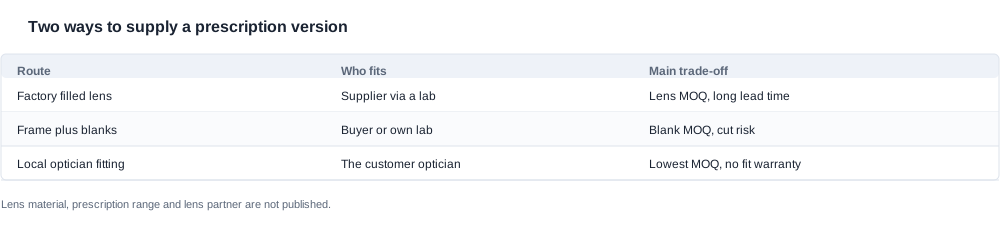
There are three routes, and they differ far more in commercial terms than in optical terms.
Factory-filled. The supplier buys the lens from a lab or fills it in house and ships a finished, corrected unit. The customer receives a product that works immediately, which is the strongest possible customer experience. The costs are substantial: a lens SKU has a minimum order quantity that is normally much higher than the frame's, the lead time runs from the lens lab rather than from the assembly line, the range of supported prescriptions is bounded by what the lab will produce, and every unit in the box is now unique. That last point is the one buyers underestimate — a filled-lens product cannot be returned and re-done without a round trip through the lab.
Frame plus blanks. The supplier ships blanks and the lens is cut and fitted by the buyer or by a lab the buyer uses. The minimum order quantity drops because blanks are easier to buy than filled lenses, but the buyer takes on the optical supply chain, and a cutting error becomes the buyer's problem rather than the factory's.
Frame for local fitting. The supplier ships the frame and the customer has it fitted by their own optician. The minimum order quantity is the frame's own, the supply chain is entirely the customer's, and the fit warranty is the optician's. The customer experience is slightly worse and the commercial risk is dramatically lower, because the frame itself is a standard, interchangeable SKU.
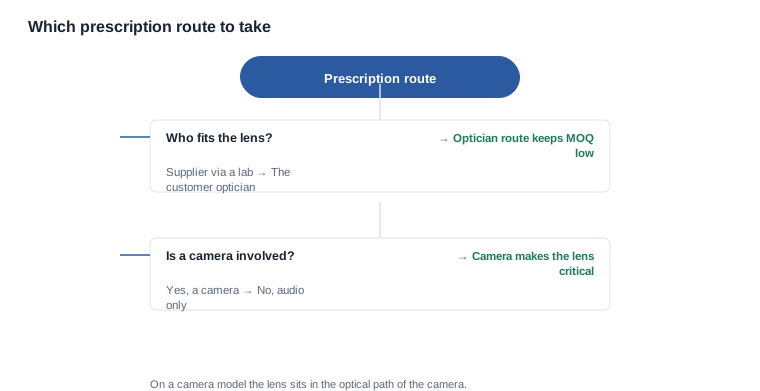
For a first programme, the third route is usually the right answer, and the reason is that it keeps the MOQ and the lead time of the hardware intact. Prescription becomes an optician service rather than a factory process, and the product stays a single SKU. The second route is the reasonable middle ground when the buyer wants a controlled lens specification but cannot commit to a lens minimum order quantity.
The questions to put to a supplier, in the order that produces the most useful answers:
- Can this exact model be supplied with a filled prescription lens, or with blanks the customer fits locally?
- Which lens materials do you support, and which lab or vendor produces them?
- What sphere and cylinder range is supported, and what happens outside it?
- Does a filled lens affect the stated product warranty?
- Does the fitted lens change the stated frame weight, and is any weight figure quoted with or without lenses?
- Is the lens fitted at your facility or by a partner, and who owns the transit risk?
- Can you supply a frame sample for an optician to measure before a specification is committed?
- What is the minimum order quantity on a lens SKU, and how does it compare with the frame minimum?
Two answers to those questions are worth having in writing whatever the route. The first is that a lens does not change the product warranty, or, if it does, precisely what changes. The second is the lens minimum order quantity, because it is the number that determines whether the route is even open to a buyer working at the volume the hardware supports.
Tint and photochromic, and can I treat them as the same question
No, and the confusion is expensive because the two features intersect in a way that is rarely considered until it is too late.
A prescription lens corrects vision. A tinted or photochromic lens changes with the light. The catalogue contains both kinds of entry, and it is worth being precise about what it publishes. The V03 Pro is the only camera model with photochromic lenses and three colour options. Our range also includes an electrochromic entry that carries no model designation at all, and the sport class describes lens configuration as customisable. What is published for none of them is the optical performance: not the tint depth, not the transition speed, not the temperature range over which the behaviour holds, and not any statement about what happens when a photochromic lens is combined with a prescription.
The photochromic discussion covers what the feature is and which of its parameters are the ones a buyer should insist on seeing before listing a claim. The important point for this article is that a photochromic lens is also available in a corrected prescription, and the combination is a single lens SKU with a single minimum order quantity and a single lead time — the sum of both features' complexity, not the complexity of either alone.
On a camera model the intersection becomes materially more expensive to ignore. A photochromic lens darkens in bright light, and the camera is behind that lens, so the recorded image changes with the ambient light in a way that the wearer's own eyes compensate for but the camera does not. The output becomes darker without the wearer noticing, and the result is footage that needs grading or that simply looks wrong in a daylight clip. Nothing in the catalogue would predict this, because no exposure behaviour is published for any of the eleven camera models.
There is one more tint consequence that is worth a line of its own, because it is the one that catches buyers out. Any coating on a lens changes what light reaches the sensor, and a coating that reduces reflection also reduces light transmission. For a camera product, that is an image quality question that sits on top of a tint question, and both of them are invisible in a specification table.
The sample programme, and can I settle the fit with an optician
Prescription is the one requirement in this category where a sample cannot be replaced by a datasheet. Fit is not a number a factory publishes; it is a measurement taken against a face, and it is the specification most likely to make a product fail in the hand of an end user.
Order a frame sample before a production specification is committed, and have it measured by an optician. A sample that fails the fit test costs a few days. A production run that fails it costs the run.
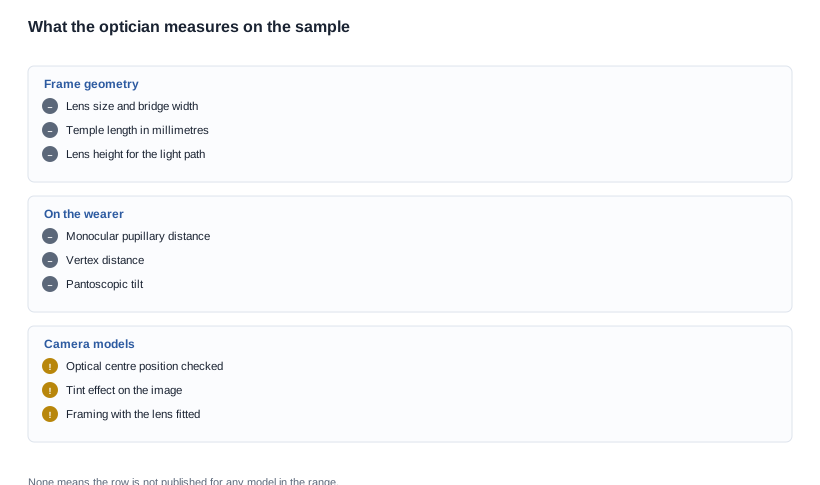
What to ask the optician to record, and why each item is on the list:
- Lens size, bridge width and lens height, so that the frame is documented for your own copy and for the returns process.
- Temple length and the bend, which are unpublished for every model and which determine whether the frame can be adjusted for a customer with an unusual fit.
- Monocular pupillary distance and the pantoscopic tilt as worn, because these determine where the optical centre sits relative to the pupil.
- The vertex distance as worn, for the same reason.
- Whether the frame can be adjusted without distorting the fit — an adjustable nose pad does a lot of work here, and the catalogue publishes nothing about nose pad adjustability.
- For a camera model: the position of the optical centre and the framing with the lens fitted, which is the row that catches a camera product whose video does not line up with the wearer's gaze.
- For a camera model: what a tint does to the recorded image, tested with the actual lens in the actual light.
The sample evaluation process is worth reading before the unit arrives, because a prescription sample is evaluated differently from a feature sample: the evaluation is a fitting exercise with an optician, it takes longer to arrange, and it needs to be scheduled rather than squeezed into a week. The audio platforms are where fitting questions arise most often, and the camera range is where the optical path makes them consequential.
One practical note on running the exercise: have the optician measure the sample and the customer's current everyday glasses. The comparison tells you whether the smart glasses frame sits closer to the face, further out, or higher than what the wearer is used to, and that difference is the mechanism behind most of the discomfort in a prescription wearable. It is a five-minute addition to the appointment and it produces the single most useful piece of information in the whole evaluation.
Two further scheduling points are worth handling before the sample is ordered, because both of them take longer than a buyer expects. The first is the optician's own availability, which in most markets means an appointment rather than a walk-in, and which in a peak season can add weeks to the evaluation timeline. The second is the customer: a prescription wearer who is willing to be measured is doing you a favour, and it is worth asking for that willingness early, because the measurement can only be taken against a face and not against a specification.
If the sample fails the fit test, there are only two honest responses. Either the model is wrong for that customer and the channel needs a different model, or the fit needs adjustment and the question is whether the frame is adjustable. The frame materials and compatibility discussion is where the adjustability question is examined in detail, because the difference between an adjustable nose pad and a fixed one decides whether a customer can be served with the standard frame or needs a variant that nobody should be carrying as standard stock.
The commercial decision, and can I plan around an open row
Let us take the position plainly. We will not tell you prescription is available on our platforms, and we will not tell you it is not. Neither statement is in our documentation, and a buyer who builds a launch plan on either one of them is building on an assumption we cannot support.
What we will do is tell you which of the eight questions above we can answer for a specific model today, and which ones need a lens partner to be engaged. For most optical questions, the honest answer at this stage is that they require a conversation with a lens lab, and we would rather you have that conversation before tooling than after it.
How to plan around an open row, in practical terms:
- Decide the route first, because it determines the minimum order quantity, the lead time and the returns process. If the route is local optician fitting, the hardware programme is unaffected and the optical question becomes a customer-service question.
- Do not let the prescription variant set a new hardware minimum order quantity. Keep the prescription version as a service attached to the standard frame SKU wherever the route allows, and the buying, the inventory and the forecasting all stay simple.
- Fix the return terms for a corrected product before the listing goes live. A customer with the wrong power cannot simply return and re-order, because the unit is unique. Say what happens, who pays for the re-cut, and how long it takes.
- Put the fit warranty where the fit happens. If the lens is fitted by an optician, the fit warranty is the optician's and the product warranty covers the electronics. If the lens is fitted by the supplier, the supplier warrants both and the agreement has to say so.
- Keep the weight and dimension figures honest in the copy, and mark them as glasses-only or as including the case, so that a customer's own measurement of the finished product does not contradict the listing.
- Treat the camera optical-path rows as blocking, not as polish. Until a fitted lens has been filmed on a camera model and the framing has been checked, the camera claim for a prescription version of that model should not be published.
The commercial framing for the negotiation is straightforward, and these are terms rather than facts, which is why they are not published: the lens minimum order quantity and its price, the tooling and any non-recurring engineering for a frame variant, the cost of a filled-lens setup, the warranty treatment of a fitted lens, the returns terms for an incorrect prescription, and the transit risk on the lens itself. Certification cost and its lead time follow the process and the testing body, and tooling is usually amortised across the first order while certification cost sits per product family — ask which one a quoted line represents.
Which model you should be evaluating is a trade-off rather than a ranking. For a pure audio product, the geometry and the lens route are the whole question. For a camera product, the lens is in the optical path and the row is harder. For the kids range — the A05, the A06 and the A07 — the question has a different shape again, because a child's prescription changes more often than an adult's and a lens that must be re-cut twice a year is a service problem rather than a product problem. Decide which of those the channel is actually buying, and shortlist on that.
Send us the model, the prescription range you need to cover and the route you are considering, and we will tell you honestly which parts of this we can answer today and which ones need a lens lab to be engaged.
Related reading
- Fit questions before you specify — smart glasses model comparison
- Optical options and their unpublished limits — photochromic smart glasses
- Sizing and what the catalogue does not state — smart glasses frame materials
- The audio platforms where fitting comes up most — bluetooth audio glasses
- Running the evaluation properly — sample evaluation
Send us the model and the prescription range you need to cover and we will tell you honestly which parts of this we can answer today.


