
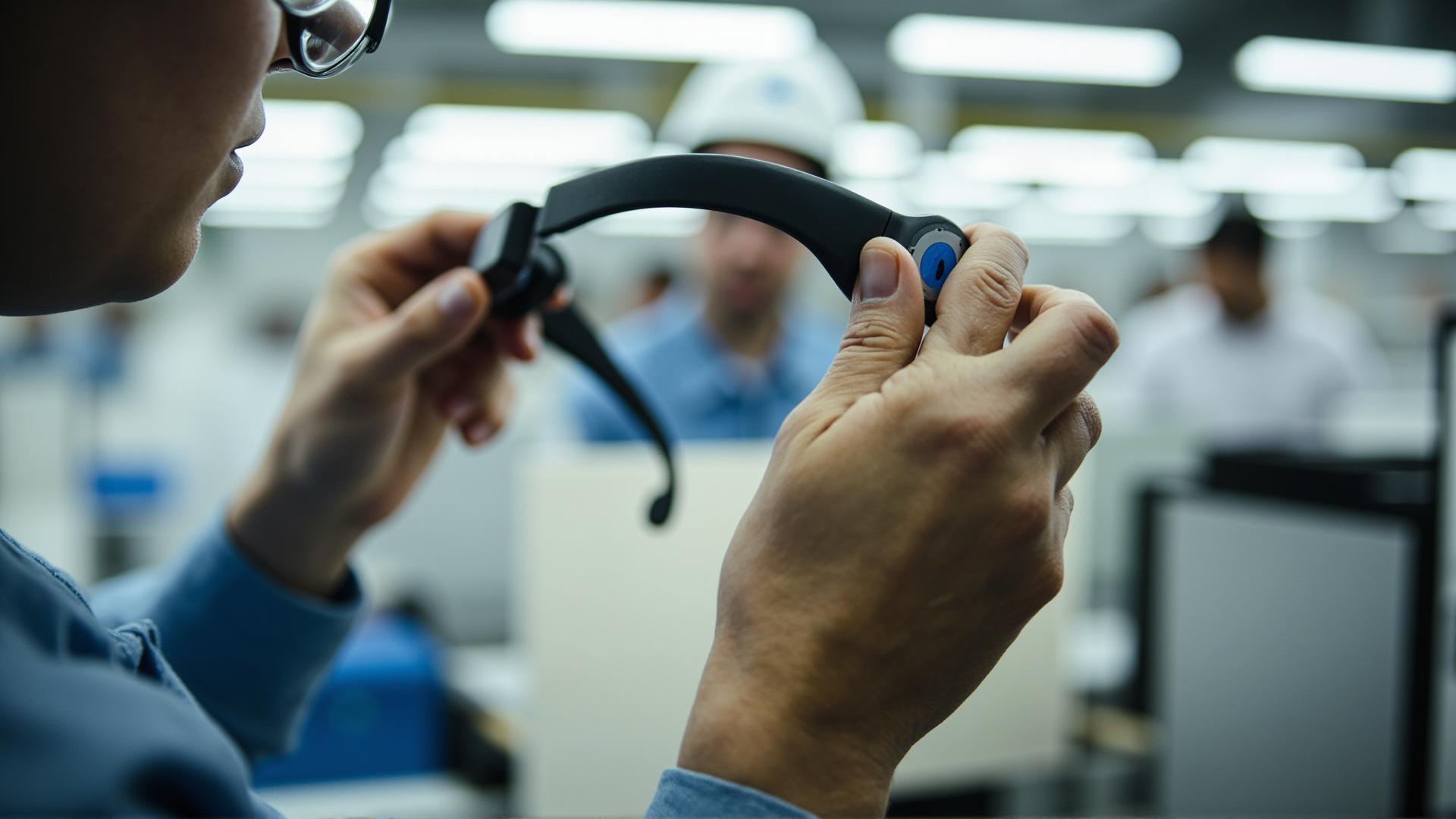
The request is reasonable and it is routinely deflected. Sometimes the deflection is legitimate; sometimes it is because the answer would be inconvenient. Since the question is usually asked by a buyer who suspects they are dealing with an intermediary rather than a factory, the useful thing to do is explain what verification actually consists of — because most buyers have not thought past the video call.
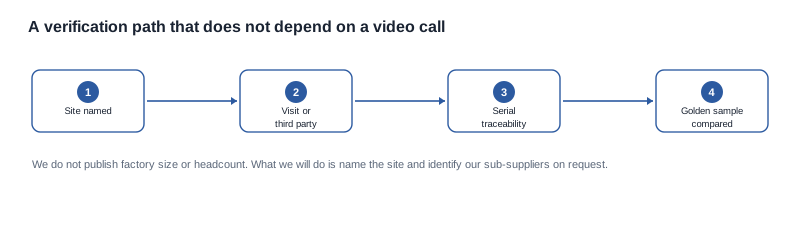
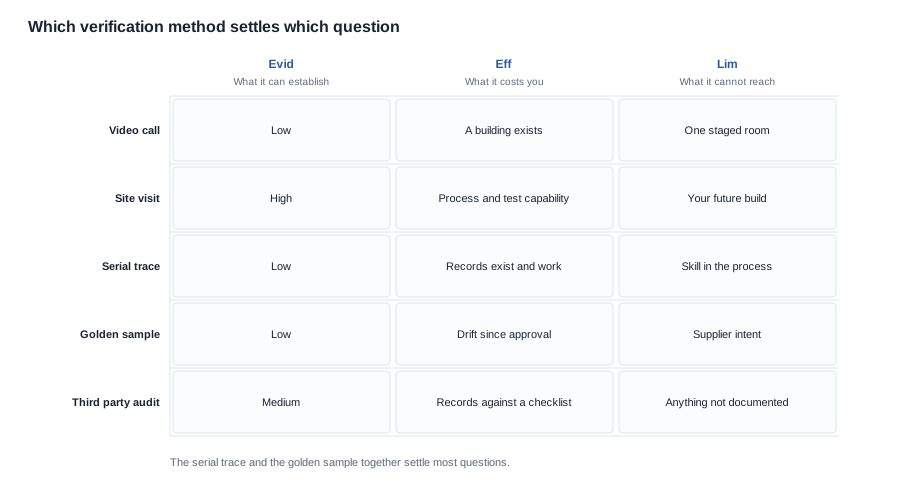
A video call is the weakest evidence available. It is staged, it shows one room, it is shot from the angle that flatters, and it proves almost nothing beyond the existence of a building. What proves something is a visit with a purpose, a serial number that traces, and a retained reference unit that production can be compared against.
That is the whole method, and it is worth stating at the top because it changes the tone of the conversation. The goal is not to catch a supplier being dishonest; it is to establish which parts of your product are built by which company, so that the responsibility for each part is attached to the right name. Suppliers understand that framing, and it opens doors that a challenge closes.
There is a version of this question that sounds trivial and is not: whether you are buying from a factory or from a company that buys from a factory. Both arrangements are legitimate and both can produce good products, but they put the responsibility in different places, they respond differently to a defect, and they have different economics. The factory carries the process and the people; the intermediary carries the coordination and the paperwork. Your contract, your conformity position and your aftersales cost all depend on which one you are dealing with, and the answer is usually visible on site in about twenty minutes if you know what to look at. The contractual version of the same question is set out under factory versus trading company, and it is worth reading alongside this one because the two answers usually agree.
can i see the workers: what a visit can and cannot show
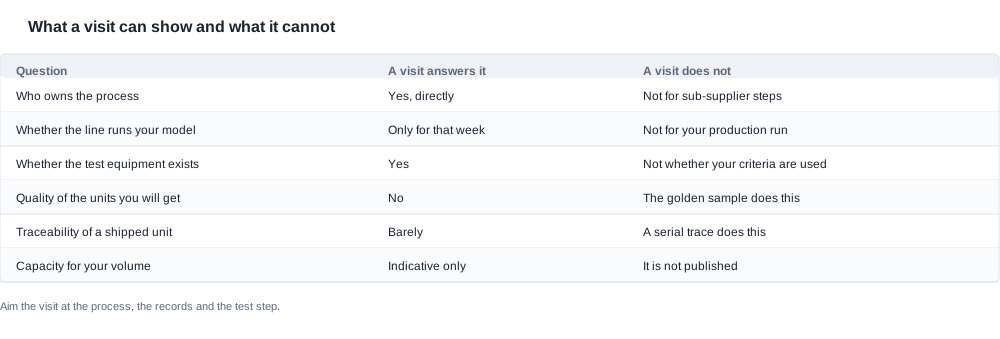
A visit proves things about a site. It does not automatically prove anything about your order, and that asymmetry is where most buyers end up disappointed.
What a visit can show. Whether the company owns or controls the processes it claims to. Whether the test equipment exists and is used. Whether the people on the floor are employees of the company or of a labour contractor. Whether the material flow makes sense. Whether the site can hold a changeover and still deliver a date. Whether the documentation you have been sent matches the paperwork on the wall. These are all real, checkable, and worth the trip.
What a visit cannot show. Whether the unit you are buying will be built on the line you were shown. Production slots move; a factory running the same product across two or three sites may genuinely be building your model elsewhere this month. Whether the workers on that line will be the workers on your production run in eight weeks — the line you saw may be a different line with different people and different supervision. Whether the quality you observed is the quality that will be measured on your delivery, which is the one thing the golden sample is for.
What a visit therefore has to be aimed at. Not at a general impression, and not at people. Aim it at the three things that determine your exposure: which steps of your product are made by this company and which are bought in, what the process actually does at each of those steps, and whether the records that connect a finished unit to a production event exist in a system rather than in someone's memory. A visit aimed at those three questions produces a useful report. A visit aimed at reassurance produces a pleasant afternoon.
What to do before you travel. Read the specification of what you are buying, so that you can ask about specifics rather than generalities. On our side that means knowing which rows are published for your model and which are not, because the unpublished rows are the questions worth asking on site: the charging method, which is not published for the MT6, the CY05 and the CY03, and the L1 Pro; the ingress marking, which only the V06 and the S7 publish, both at IP54; the frame weight, which only the MT6 publishes, at 158 grams for the glasses alone and excluding its 1200 mAh foldable case. A buyer who arrives knowing which three rows are missing gets three answers; a buyer who arrives with no preparation gets a tour.
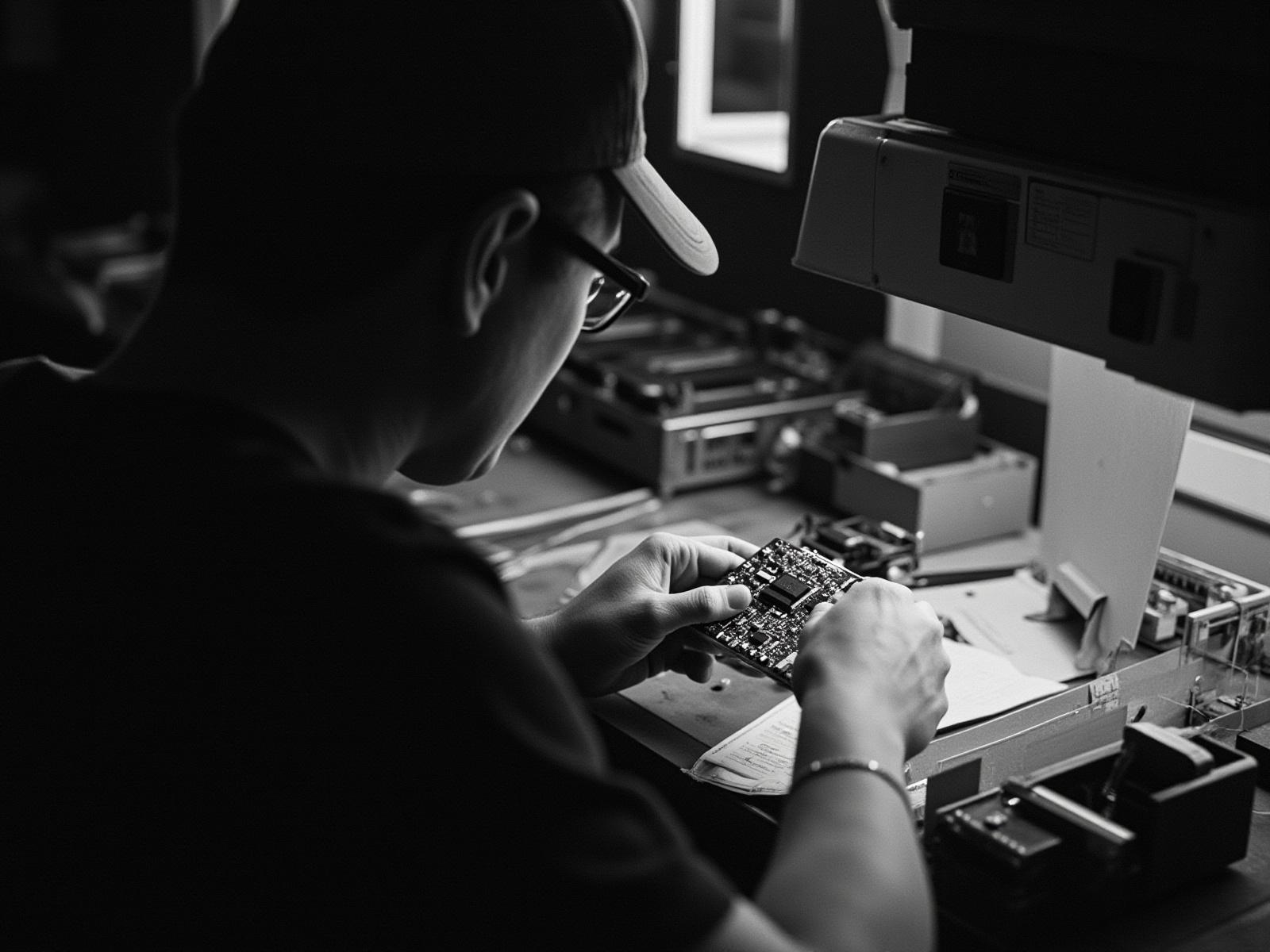
When a supplier will not show you a production line
Four reasons account for almost every deflection, and three of them are entirely reasonable.
Security and confidentiality. Some factories genuinely do not permit photography, recording or visitors on certain lines, because the lines are running another customer's product whose identity is protected, or because the site handles designs under NDA. This is a reasonable position. A visit is usually still possible with restrictions: no photographs, escorted areas only, or a walkthrough with a supervisor rather than free access.
Your product is not being built there right now. Production slots move, and a factory with several sites can honestly say that the model in question is running on a different line this month. The useful question is not "show me the line" but "show me the line that will build this model, and if that is not here today, show me the one that will".
The company is a trading company. This is the deflection that matters, and the deflection is the finding. If a company cannot show you any production at all, has no test equipment, and explains its role as sourcing and shipping, then it is not the manufacturer of your product and it should not be presenting itself as one. The contractual version of the same question is set out under factory versus trading company, and the two are worth reading together because the legal answer and the site answer usually point the same way.
The buyer asked badly. "Can I see the workers" reads as an accusation and gets treated as one. "We would like to visit the site for our programme, we can travel, we would like to see the final test and the traceability records for a finished unit" is a request that is easy to say yes to. The framing determines more of the outcome than the evidence does, and this is the single most useful piece of practical advice in this article.
There is a fifth possibility worth naming because it looks like the fourth: the supplier is happy to show you, but nothing is running. A site with an idle line and a full order book elsewhere is not necessarily dishonest, but it is not the evidence you came for, and the buyer should notice the difference between "we do not show visitors" and "there is nothing to see".
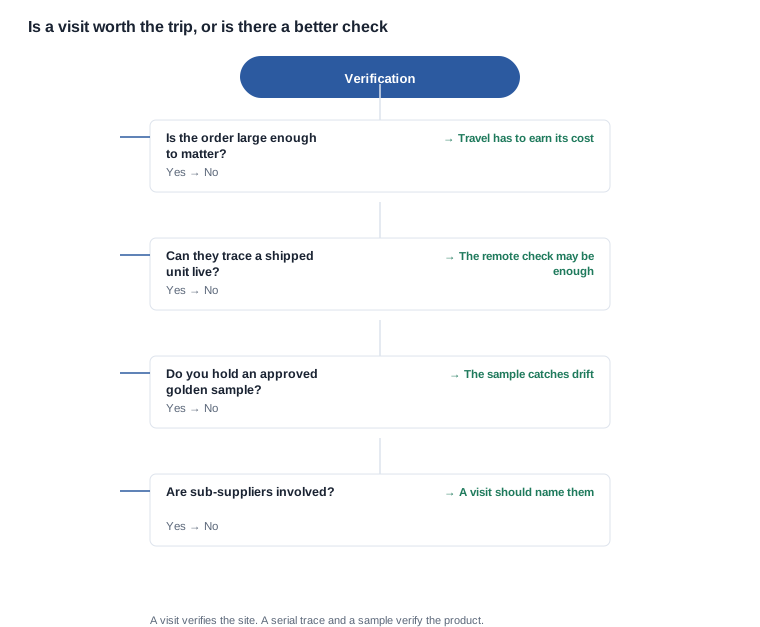
There is also a sixth case that is common in this industry and that visitors rarely anticipate: the work is done at a partner site. A company can be a genuine manufacturer in every sense — its own engineers, its own test equipment, its own quality system — while a specific step, such as moulding or a sub-assembly, is performed at a partner. That is not a secret and it is not a problem, but it does mean that a visit to the main site will not show you every step of your product, and that your supplier's sub-supplier list is part of your due diligence rather than a curiosity. Ask for it in writing, with the steps named, and then decide whether any of those steps warrant their own check.

What a visit should be aimed at
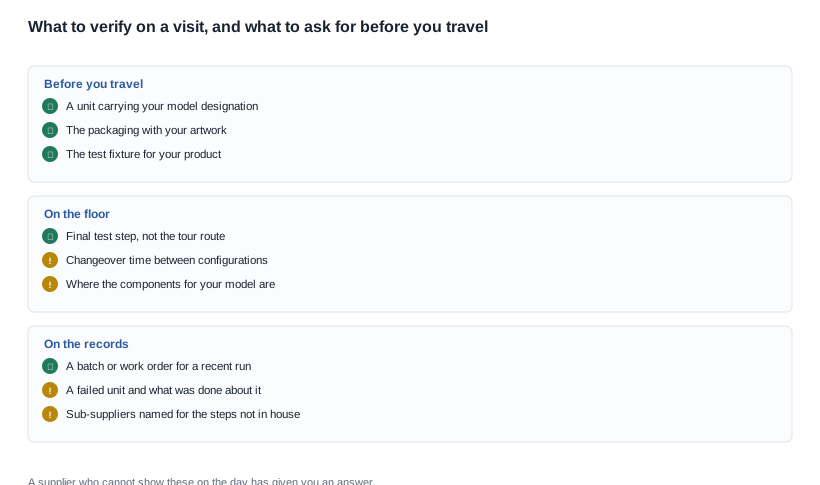
Send three specific requests before you travel, because a supplier who cannot produce those three on the day has given you an answer without needing to say it: a unit carrying your model designation, the packaging with your artwork, and the test fixture used for your product's acceptance checks. Ask to see the final test rather than the board-level line, because final test is where your product becomes your product — it is the step that decides whether the unit matches what was approved, and it is where the people who will answer for defects are standing.
Then work through four things.
The process chain. Identify every step between the component arriving and the unit being packed, and at each step establish whether it happens in this building. Injection moulding, metal stamping, PCB assembly, firmware flashing, calibration, assembly, final test, packaging. Any step that happens elsewhere is a sub-supplier, and it is a sub-supplier you need to know about because your conformity position and your aftersales exposure both run through it. Our own range makes the point: the charging method alone is magnetic on 17 models and Type-C on 7, with four camera models where it is not published at all, and a magnetic charging line is a different line from a Type-C one. If you cannot tell from the floor which process your model needs, the visit has not done its job.
The changeover. Ask what it takes to move from one configuration to another, and how long it takes. This is where a mixed order's cost actually lives, and it is invisible in a photograph.
The test capability. Not the test room as a room, but the fixtures and the records. Are the acceptance criteria for your product written down? Is there a record of every unit tested? Can you see a unit that failed and what was done about it? A factory with no failure records is a factory that has not recorded failures, which is either a very good sign about quality or a very bad sign about records, and you cannot tell which from the outside.
The material and the stock. Ask where the components for your model come from and where they are sitting. A model whose parts are visibly on the shelf is a model that can start. A model whose parts are "on the way" is a model whose lead time is somebody else's problem.
The people, because the question asked about workers. Notice whether the people on the line are employees of the company, and whether they are working the line you care about. Labour contractors are common and are not objectionable in themselves, but they change two things that matter to a buyer: the continuity of the training and the process knowledge on your product, and the confidentiality of your design. It also changes who is accountable for a quality failure, because a contractor's supervision structure is not the supplier's own. Watch for it without making a show of it, and note the answer in your report — it is one of the few observations on a visit that a supplier cannot present for you.
And when the opportunity arises, talk to the people who will run your programme rather than only to the people who host you. A short conversation with a line supervisor about how a defect is handled, and how a new model is introduced, tells you more about the real state of the process than a formal presentation does.

The serial number test, which is stronger than the visit
Here is the check that beats every visual inspection, and it can be run without travelling at all.
Ask for a unit that has already shipped, and ask them to trace it while you are on the call. The unit should resolve to a production date, a line or a shift, an order or build record, and a test record. Three questions decide the result:
- Can any unit be traced to a production date?
- Can it be traced to a specific line, shift or station?
- Is that record held in a system, or reconstructed from memory and a box label?
If the answer to the third question is "reconstructed", then a lot number is a weak control and any defect rate you are quoted should be treated as unreliable, because it cannot be tied to a production window. There is no way to isolate a bad shift, a bad component batch or a bad operator when the records do not exist.
The test can be run remotely, and for most first-time buyers that is the better first step. Ask for a unit that has already shipped to a customer, then ask the supplier to trace it with you on a call: the record, the date, the line, the test result. A supplier that hesitates because the unit is two years old is telling you something important about its record retention, and a supplier that pulls the record in a minute is telling you something better. It costs nothing, it takes half an hour, and it is a far harder test than a video tour because it cannot be staged.
If the trace fails, the remediation is not a confrontation but a structure. Hold a golden sample and compare every delivery against it. Commission a pre-shipment inspection on the first production shipments, with a written acceptance checklist and an agreed sampling level, so that the check happens against your criteria rather than against the supplier's. Ask for the documentation set — the build record, the test record, the firmware version — to be supplied with each shipment. Each of those substitutes a record for a visit, and records are what you will need anyway when something goes wrong.
The same test can be run against documentation rather than a unit. Ask for a build label, a work order or a traveller card for a recent batch and check whether it names your model, a date and a quantity. Ask whether it can be produced in five minutes without an interpreter. A supplier who pulls a batch record for a model you did not name, in under five minutes, has shown you something a tour cannot: an operating system.

How the golden sample closes the loop
Keep one approved unit. This is the only verification in the whole process that does not depend on the supplier's willingness to show you anything, and it is the one that catches drift — the slow, quiet drift where the product is still fine but is no longer the product you approved.
What the reference unit should contain matters. The unit itself, with the firmware version recorded, because firmware moves and a hardware comparison means nothing against a changed build. The accessories that ship with it, including the charger and the case, since our published case options run at 900, 1200 and 1400 mAh and the accessories are where substitution happens quietly. The packaging, including the insert, the label and the barcode, because packaging artwork is redrawn more often than hardware is. And a photograph of the unit against a ruler on a plain surface, because dimensions are easier to dispute from a photograph than from a memory.
Then compare every delivery against it. Dimensions, weight, finish, connector behaviour, firmware version, box artwork, insert content. Note that weight is worth checking specifically: our catalogue publishes a weight for exactly one model, the MT6 at 158 grams for the glasses only, excluding its 1200 mAh foldable case, so for every other model the buyer is comparing against a number only the supplier has. A weight check against a retained unit is the cheapest way to catch a component substitution.
If nothing has drifted, you have evidence that the supplier is doing what it said. If something has, you have found it before your customers do — which is the entire purpose of keeping a reference unit.
Two practical notes on keeping one. Store it away from direct sunlight and from humidity, in the packaging it arrived in, and do not use it for anything — a golden sample that is worn by an employee every day is no longer a golden sample, it is a second-hand unit. And when the supplier issues a firmware update, keep the old reference unit and record which firmware version each one carries, because a change in behaviour that arrives with an update is otherwise indistinguishable from a change in manufacture. A second reference unit is cheap insurance against the first one being lost, and it costs one unit of the test order.
What we can show a visiting buyer, and what we will not claim
We will name the site where your order is built. We will identify our sub-suppliers where you need them identified, and we will tell you which steps of the supply chain happen at a partner site rather than ours. We will arrange a visit for a programme under way, within the constraints our site places on visitors, and we will agree in advance what the visit will look at, so that the day is spent on the questions that matter rather than on a tour.
What we will not do is publish a headcount, a floor area, a line count or an output figure. Those numbers are not published on our side, and the reason is not only editorial. A factory size that has not been confirmed against a current production plan is the first thing that collapses when a buyer arrives, and a supplier whose published figures do not survive a visit has a credibility problem for the rest of the relationship. Where a figure would matter to a decision — the production capacity question, for instance — we will give you a number with its conditions attached, or tell you the conditions are not yet settled. The mechanics of that question are on production capacity.
The same principle applies to audits. We publish no audit outcomes, because an audit report belongs to the party that commissioned it and to the auditor, and a summary of somebody else's report on a website is worth very little. What a properly structured factory audit establishes, and how it is scoped, is covered under factory audit — and it is worth reading before you commission one, because a buyer who arrives with a checklist gets a better report than a buyer who arrives with an open mind and a video camera.
A first visit to a supplier's site is also a moment to understand the service model, because the same building can be doing very different things for different buyers. What the standard OEM engagement involves, and where the boundaries sit, is described under standard OEM sample process, and the wider service scope is under OEM and ODM service.
One last point on the question as it was asked. Seeing workers is not the objective. Knowing which company is responsible for which step is the objective, and that can be established without a single person being observed — from a traced serial number, a batch record, a work order and a retained reference unit. A visit is simply the fastest way to gather the rest, and it is worth making if the relationship is worth the trip and skipping if it is not.
And if you do not travel, do not leave the question unanswered. Ask, in writing, for four things: the site where your order is built, the steps performed at partner sites, the production capacity figure for your volume with its conditions attached, and a live trace of a shipped unit. The answers to those four, taken together, will tell you whether you are dealing with a factory that builds your product or with a company that sources one — and they take one email rather than one flight.
Related reading
- Why the contractual side answers the same question — factory vs trading company
- What an audit looks for when you cannot visit — factory audit
- The production question a visit is meant to settle — production capacity
- What to expect the first time you see the site — standard OEM sample process
Tell us which programme you want to verify and we will name the site and what we can show you on a visit.


