

Most of the questions we get in this category arrive as a single sentence, and this one arrives as a single sentence that hides three separate technical questions. A buyer who writes to ask whether two people can connect to one pair of smart glasses at once has usually already pictured a scenario — a rental programme, a classroom, a household where two people each want their own music — and that scenario determines which of the three questions is the one they actually need answered. The trap is that a supplier can answer all three, and still not answer the one you meant.
So this page takes the phrase apart, shows which parts of it our published rows already settle, marks the parts that only a sample can settle, and then treats the commercial consequence, because a shared-device channel is a different kind of business from a single-owner retail listing and it gets quoted on different terms.
Can two people connect at once: three different questions in one phrase
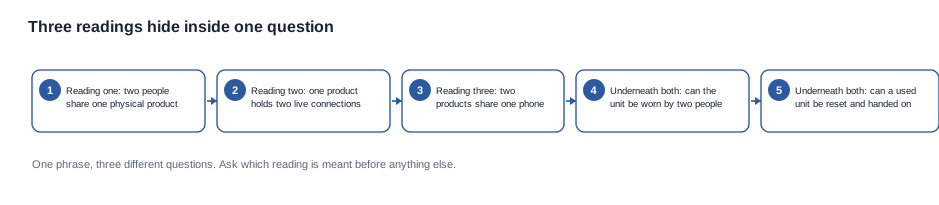
The phrase carries three readings, and they have almost nothing in common technically.
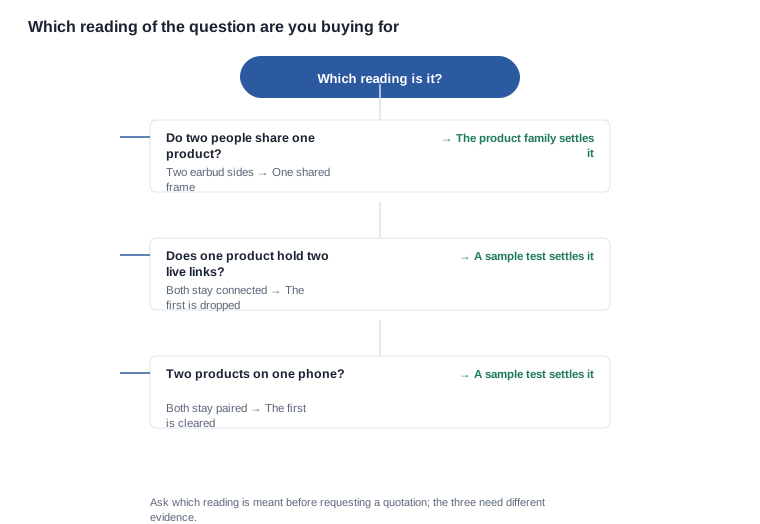
Reading one — two people share one physical product. One pair of two-earbud units, each person taking one side, both connected to one phone. This is the reading most people mean when they ask it, and it is the one with the clearest hardware answer, because it is a question about whether the product is physically two things or one thing.
Reading two — one product holds two connections at once. The glasses stay with one wearer, but two phones are connected simultaneously, so a work phone and a personal phone can both be live. This is the multipoint question. It has nothing to do with how many units are in the box and everything to do with the Bluetooth stack and the firmware that manages it.
Reading three — two people each have their own pair, on one phone. Two separate products, one handset, two paired devices. This is the least technical of the three and the one most often assumed to work, because phones do routinely hold several paired Bluetooth accessories. The part that catches people is what happens to the existing pairing when a second device is added, and whether the audio profile count is the binding constraint rather than the paired-device count.
Underneath those three sit two more that decide whether any of them is commercially usable. The first is physical: can one unit actually be worn by two people, which is a form-factor fact rather than a connection fact. The second is operational: can a unit that one person has used be reset and handed to somebody else without carrying the first person's pairing, settings or accounts across the handover.
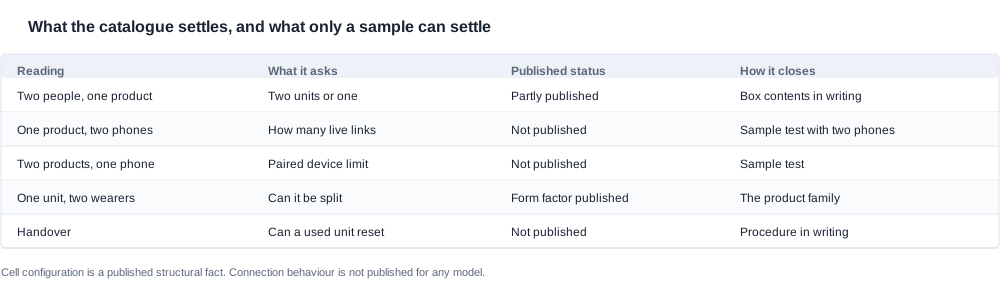
| The reading | What it actually asks | Published status | How it gets closed |
|---|---|---|---|
| Two people, one product, one phone | Is the product two independent units or one? | Partly published — the cell configuration is visible | Box contents and pairing topology, asked in writing |
| One product, two phones | How many simultaneous connections, and does the first survive the second? | Not published for any model | A sample test with two phones |
| Two people, two products, one phone | Is there a paired-device limit, and what happens to the first pairing? | Not published | A sample test, plus the phone's own limits |
| Underneath: one unit, two wearers | Can the hardware physically be split between two people? | Published indirectly by the product family | The form factor the cell configuration indicates |
| Underneath: handover | Can a used unit be reset to a clean state? | Not published | The reset procedure in writing, and a sample test |
The buyer asking the question is usually one of three, and each needs a different output from the conversation. A brand owner is deciding whether shared use is a feature to promote in the listing or a scenario to design around, and that decision sets the pairing, reset and support behaviour the product needs to have at all. A procurement manager is building a shortlist for a rental or classroom channel and needs to know which models even support the scenario, so the question is a screening filter rather than a specification. A channel buyer is writing the support copy and the thing they are defending is the return rate, because the failure mode of a shared device is a support ticket that the end customer cannot resolve and that nobody can reproduce.
Ask which of the three readings is meant before anything else, and write the answer into the quotation request. It costs one sentence and it prevents a month of work on the wrong question.

Where the published rows already answer can two people connect at once
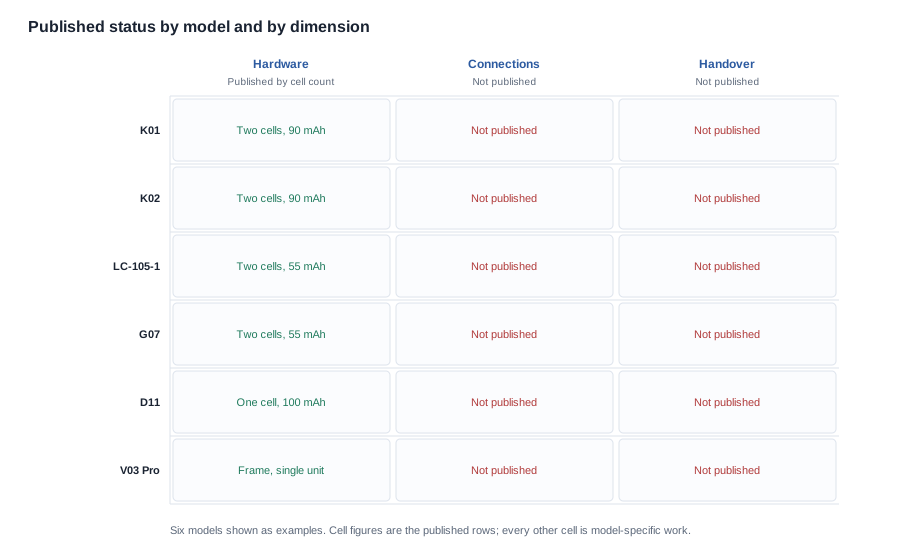
Our catalogue publishes cell configurations, and the cell configuration is the strongest structural signal available for reading one. In the audio range, the products that show a doubled cell are the two-earbud designs: the K01 and the K02 publish a doubled 90 mAh, and the LC-105-1, the LC-105-2, the G07 and the YK12 publish a doubled 55 mAh. The D11 and the D12 publish a single 100 mAh cell, which places them in the single-cell side of the family. The YKC02 is a sport model and publishes 2 × 70 mAh — it belongs in the sport range and not in the audio range, and its doubled cell is worth saying out loud here so it is not miscounted later.
That signal answers the physical question and it does not answer the commercial one, because our documentation does not publish box contents for any model. There is no row that says how many units ship inside the box, whether the two sides are packed together or sold as two products, or whether the two sides pair to each other first and then to the phone. A doubled cell tells you the hardware supports two. It does not tell you that a customer opening the box receives two things.
The camera models behave differently in a way that is easy to miss. Eleven models sit in the camera range, with published batteries between 220 and 290 mAh and a rated runtime of roughly five to eight hours, with no test condition published. Their cell sits in the frame, so there is no second side to hand to another person, and the sharing question changes character entirely: it becomes a question about one device serving two accounts or two phone profiles. The V03 Pro, the L1 Pro, the L2 Utral, the MT6 and the MT5 are among them, and the V06 and the S7 are also camera models despite the names that sound like sport. For a buyer who is deciding which family to put in a shared channel, the frame form factor ends the question before the electronics do.
Two more published facts shape the practical answer, and neither is obvious until you are planning a fleet.
Charging interface. Magnetic charging is published for 17 models, Type-C for 7, and the interface is not published for the CY03, the CY05, the L1 Pro and the MT6. In a shared channel this is a logistics fact, not a spec-sheet detail: a pool of units with mixed interfaces needs more than one charger on the bench, and a charger that goes missing turns into a unit that is out of service until it is found.
Turnaround on the charger. 26 models publish a charge time of two hours or less, which is a ceiling rather than a measurement, and only the D17 and the ZH12 publish something closer to about one hour. For a rental or classroom channel, time-to-charge is a throughput variable. A fleet that needs three hours per unit to turn around is a different unit-economics story from one that needs an hour, and the difference belongs in your capacity model before you commit to a channel.
Finally, the one thing that most often gets over-read. Bluetooth version is published for 14 of our 28 models and is not published for the eleven camera models, the A05, the A06, or the bone-conduction entries. Multipoint is a stack behaviour — how the firmware arbitrates between two active connections — and it is not implied by a Bluetooth version number. A published "5.3" is a bandwidth and profile statement. It says nothing about whether a second phone connecting displaces the first. Treat any inference from the version to the connection count as an assumption, not as a spec, and if a supplier makes one, ask them to demonstrate it on a sample instead.
To be precise about the boundary: our catalogue publishes no multipoint specification, no paired-device limit, no reset procedure, no box-contents row and no volume-register behaviour for any model. Those are the five items that have to be established per model, and none of them can be inferred from the rows we do publish.


What to test on a sample before can two people connect at once goes in your copy
Send the questions as one written request, not as a stream of follow-ups, and ask for them per model rather than per catalogue. Five questions cover the whole surface:
- How many units are in the retail box for this model, and are the two sides paired to each other before first power-on?
- How many simultaneous Bluetooth connections does this model hold, and what happens to an existing connection when a second device connects?
- Is volume, EQ and playback state stored per connected device or globally for the product?
- What is the paired-device limit on the phone side, and what happens to the existing pairing when a new device is added?
- What is the factory-reset procedure, and exactly what does it clear — pairings, settings, stored media, any pairing history?
Then run five tests on the sample. These are short, they are reproducible, and each one catches a different failure:
- Second-device test. Connect the product to a phone, then connect a second phone without unpairing the first. Note whether the first survives, whether it reconnects on its own afterwards, and how long the recovery takes.
- Volume-register test. Set a different volume on each of the two devices, disconnect and reconnect both, and check whether the levels survive independently or whether the last one wins. This is the defect customers report as a bug and cannot describe.
- Reset test. Factory-reset the unit and record what persists. For a shared channel, a reset that leaves the previous user's pairings behind is a privacy problem rather than an inconvenience.
- Handover test. Hand the unit to a second person with a different phone and let them pair from cold, without touching the first person's phone. If it fails, the failure is in the handover flow, not in the product.
- Charge-contention test. Put two units on the same interface on the same bench and confirm they can charge at the same time and that the cable set matches what you will ship.
What you end up with after the sample is what a procurement team calls a golden sample — not a photograph of the product, but the specific unit whose behaviour you have locked down in writing and can point at when the next production run is compared against it. Keep the notes in the same file as the quotation, because the two get read together during due diligence, and a behavioural note that is not attached to the quotation tends to get lost.
Two commercial points on the sample itself. The sample fee and the sample lead time are not published, so ask for both in the same message as the five questions — a supplier who quotes a sample fee without a lead time cannot be compared against a supplier who quotes both. And the sample cost is not the same line item as tooling: a sample is usually per unit, tooling and any certification work are per product family, and asking for them as three separate numbers rather than one bundled figure is the single most useful thing you can do to make the quotation comparable.
The final step before the copy is written is a boundary decision, not a writing decision. List the claims you can support today — the form factor, the charging interface, the charge time, the cell configuration, the published sound characteristics — and list the claims that stay out until the sample has answered them. The Bluetooth audio glasses range page carries the model list and the published rows for each model, and the open-ear audio specification page covers the sound and playback behaviour in more depth, including the per-device volume question. The sample evaluation protocol page sets out what a sample is meant to settle, which is worth reading before you write the request so the tests land on the right questions.

The ways can two people connect at once breaks in a shared channel
Shared-device channels fail in a small number of predictable ways, and every one of them is a documentation failure before it is a hardware failure.
The box contents were inferred from the cell figure. Symptom: a customer opens a box expecting two units and finds one. Root cause: a doubled cell was read as a doubled box. Prevention: ask for the box contents per model and print them in the listing, word for word.
Multipoint was inferred from the Bluetooth version. Symptom: an incoming call drops the moment a second device connects. Root cause: the version number was read as a connection-count feature. Prevention: test it, and do not put a multipoint claim in the listing without a test result behind it.
A shared device was sold into a household with no reset policy. Symptom: the previous user's pairing and settings survive the handover. Root cause: nobody established what a reset clears. Prevention: get the procedure in writing and test it on a sample.
The volume register is global rather than per device. Symptom: one person raises the volume and the other person's audio changes. Root cause: no one asked whether volume is stored per device. Prevention: test it, and if it is global, say so in the support copy — an undocumented behaviour reads as a defect.
A frame-form product was listed as shareable. Symptom: a customer tries to give one frame to two people. Root cause: the open-ear form factor was read as two independent units. Prevention: the product family already answers this, and the listing should describe the form factor plainly.
A rental or classroom channel was entered without a handover procedure. Symptom: units come back with the previous user's account still connected. Root cause: the handover step was never designed into the operating plan. Prevention: treat the reset procedure as an operating document, not as a product feature.
Mixed charging interfaces in one fleet. Symptom: units are unavailable because the only matching charger is in another box. Root cause: the fleet was assembled from more than one batch or model without an interface plan. Prevention: record the interface per unit in the asset register.
The support script was written for a single-owner product. Symptom: a ticket arrives describing a fault that cannot be reproduced, because the reporter used the device differently from the way it was designed. Root cause: the script assumes one owner, one phone, one pairing. Prevention: write the script against the three readings, not against one.
The commercial terms that follow from how can two people connect at once
A shared-device channel multiplies the support cost per unit, and the pairing and reset behaviour sets the multiplier. A product that survives a second device connecting and resets to a clean state can be sold into rental, classroom and household channels, because each handover is a repeat of a process that works. A product that cannot will generate a support contact per handover, which is a cost per transaction rather than per unit, and it will be invisible in the unit cost because it lands in a department that is usually not measured per product.
That is also why the spare-unit minimum order quantity matters more here than in almost any other channel. A rental programme that ships one spare for every ten units needs ten spare units minimum, and if the supplier's spare MOQ is fifty, the deal only works at a scale the channel may not reach. Ask for the spare-unit MOQ as a number, ask whether spares can ship in a separate carton from sale units, and ask whether the spare carries the same warranty position as the primary unit. This is one of the trade-offs worth real negotiation time, and it is the kind of line that is buried inside a bundled quotation.
The negotiation list for this channel, in the order we would raise it:
- Unit price by volume tier, with the tier boundaries written down rather than described.
- Spare and accessory quantities with their own minimum order quantities.
- Box contents and packaging specification, per model, confirmed in writing.
- Delivery splitting, so that a pilot can ship before the main volume run.
- Payment nodes tied to inspection rather than to dates alone.
- The warranty period with a stated response time, and who pays the freight on a warranty replacement.
- The return terms for a shared channel, where the end user is not your customer.
Certification cost and test lead time follow the process and the testing body rather than the negotiation, and they are frequently bundled into a single line that hides which is which — ask for them separately. Tooling is usually amortised across a first order while certification work is per product family, and if a supplier quotes one number for both, that number is not comparable with anyone else's.
What belongs in the agreement, for this specific channel, is short enough to write out: the published configuration rows for the model ordered, the box contents, the pairing and unpairing behaviour, the multipoint position, the volume-register behaviour, the paired-device limit, the reset procedure and what it clears, and the warranty period with a stated response. Anything in that list that has not been established on a sample should be written as a clause to be confirmed rather than as a claim, and the version of the agreement that goes out should mark which items are which.
What should stay out of the agreement and out of the listing is equally short: any multipoint claim, shareability claim or reset claim that has not been tested, and any box-contents assumption derived from a cell figure. A shared-device channel is where an untested claim becomes a return, and returns in that channel are expensive because the unit has already been out with a customer.
The practical position is that the doubled cell is a useful and honest signal and it is not a complete answer. A buyer entering a shared-device channel needs the pairing behaviour, the reset behaviour and the box contents as well, and those are product facts that have to be established per model rather than read off a spec table. What we can do is take a specific model and a specific sharing scenario, and tell you which parts of the question our documentation answers today and which have to be closed on a sample.
What to do next.
- Name the scenario — shared product, dual connections, or two products on one phone — before anything else.
- Send the five questions in one written request, with the box contents question first.
- Book a sample and run the five tests, recording results rather than impressions.
- Turn the results into a golden sample record and keep it with the quotation.
- Put the confirmed behaviours into the agreement, and describe only those behaviours in the listing.
Related reading
- The models and their published rows — Bluetooth audio glasses range
- The volume question and the open-ear specification — open-ear audio specification
- The protocol for a sample test — sample evaluation
Tell us the model and the sharing scenario, and we will say which parts of the question we can answer today.


