

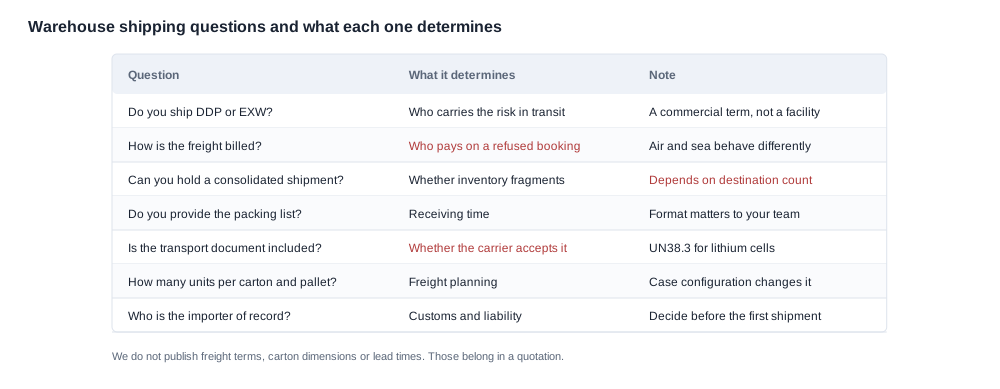
"Can you ship to my warehouse?" sounds like a question about a loading dock and it is really a question about risk, paperwork and money. A supplier who answers yes has told you that there is a road, a carrier and an address. Everything that decides whether the shipment works — who owns the goods at each point, what happens when a booking is refused, how many cartons come off the truck, whose name is on the customs declaration — is still unanswered.
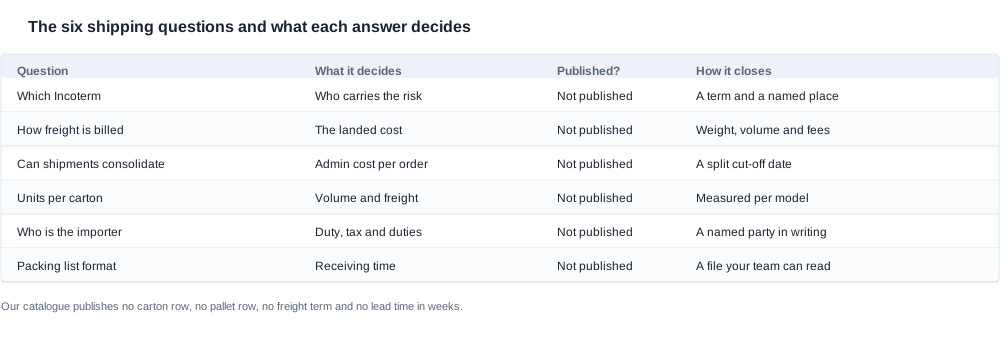
Six things decide that, and the order they come in is not accidental. The Incoterm comes first because it determines who is carrying the risk while all the other questions are being worked out. Freight billing comes next, because that is where the landed cost is set. Consolidation and carton planning follow, because they are planning decisions with a cut-off date rather than a request made at booking. The importer of record comes after that, because it is a legal and tax decision rather than a logistics one.
Can you ship to my warehouse: the Incoterm question comes first
The first question is not where. It is under which term. Under an EXW term, the risk transfers at the factory gate and the goods are yours from that moment, which means the loading, the export declaration, the main carriage and the insurance are all your problem and your cost. Under a DDP term, the supplier carries the goods to your door with the import clearance and the import duties handled and paid, which is a materially different commitment and a materially different risk profile for them.
The middle terms sit between the two and they are not interchangeable. FOB transfers cost at the port of loading and risk as soon as the goods are on the vessel. CIF adds the freight and the minimum insurance to the port of destination but leaves the risk with the seller until the goods reach the port. DAP puts the seller in charge of carriage and delivery but leaves the import clearance and duties with the buyer. Which one is right depends entirely on whether you have a freight forwarder and a customs broker, on whether you want to control the shipment, and on how much you trust the supplier to land a delivery on a specific date.
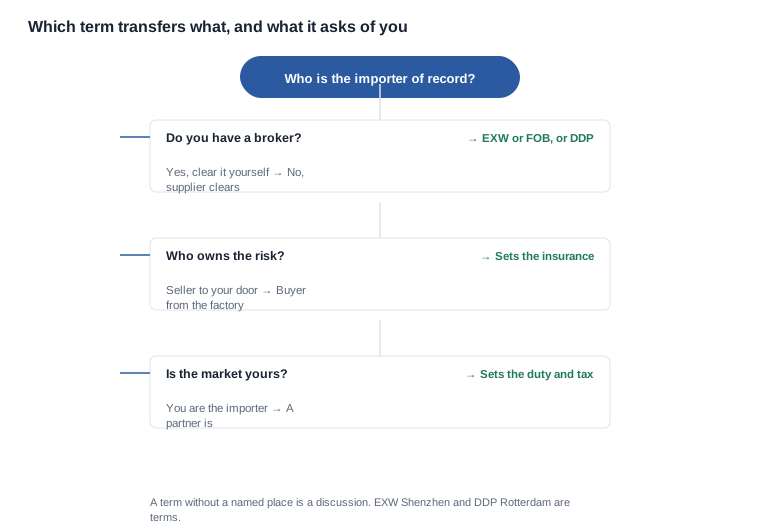
Two practical points about the term itself. First, ask for the term and the named place in the same sentence — "DDP your warehouse in Rotterdam" is a term, while "DDP Europe" is not, and the difference between a named place and a region is the difference between a price and a discussion. Second, the Incoterms allocation only works if the contract also says who the importer of record is, because DDP requires somebody to be the importer of record in your country, and for a non-resident supplier that is an arrangement with a local agent or broker rather than something the term creates on its own.
Then the warehouse itself, which is a set of requirements rather than an address. Most third-party logistics sites will want an appointment, a delivery window, an advance shipping notice, a specific pallet specification and a particular address format, and some of them charge for the first three. The supplier is not going to know your site's rules, and it is not reasonable to expect them to, so the buyer sends them. A short site requirements sheet — address format, booking contact, delivery windows, pallet spec, ASN format, carton labelling — attached to the order saves an entire class of problem at the gate, where a failed delivery costs a driver, a detention charge and a re-attempt.
One point that catches buyers out because it is invisible in the term: the delivery obligation and the clearance obligation are different things. A DDP term means the supplier delivers, cleared, to your door. It does not mean the supplier can deliver without an appointment, and it does not mean the supplier knows your site's booking rules. If your warehouse requires an ASN 48 hours ahead, that requirement sits with the buyer to communicate, and it applies identically under EXW. The terms decide who carries the risk and who pays; they do not remove the logistics work from whoever is coordinating the delivery.

What can you ship to my warehouse costs, and who pays when a booking is refused
Freight is quoted against chargeable weight, and for a small, light, bulky product chargeable weight is usually the volume rather than the mass. That makes the case configuration a freight variable, not just a packaging variable. The catalogue publishes case capacities — 1400 mAh on the CY03, the CY05 and the L1 Pro, a foldable 1200 mAh on the MT6, and 900 or 1400 mAh on the L2 Utral — but no carton dimensions, no gross weights and no units per carton. A bare pair of audio glasses and a camera model with a 1400 mAh case occupy very different volumes, and the freight quote for each is a different number that has to be measured rather than estimated.
Beyond the carriage itself, the costs that surprise buyers on a first shipment are almost all destination-side: terminal handling, customs clearance at destination, a documentation fee, and sometimes a fee for the destination charge that was not known when the goods left. Sea freight consolidated as less-than-container-load adds another set: a minimum chargeable volume per shipment, and origin and destination handling charges that are collected on the other side of the world from the person who agreed them. Model the landed cost, not the freight cost.
Then there is the refused booking, which is the failure mode that costs the most and happens most often, and it happens for a documentation reason. Lithium cells require a UN38.3 test summary to travel, and carriers check for it before loading. A booking refused at the origin because the document is missing does not cost you the freight difference; it costs you a sailing cycle, and if the goods sit while the paperwork is fixed, storage and demurrage on top. Our catalogue publishes no UN38.3 test summary for any model, so the position has to be established before the first shipment rather than discovered at the first booking. Two questions to ask before you commit: does the test summary exist for the model and the cell configuration you are ordering, and who is responsible for producing and presenting it at the time of booking.
The timing dependency here runs backwards from the shipment date, which is the part that catches people. The document has to exist, and have been issued, before the booking is accepted — not before the goods are made, and not in the week before the vessel. If the cell in a given model is being changed by the factory for cost reasons at the same time as you are placing the order, the test summary for the new cell may not exist yet, and nobody will mention it until the carrier mentions it. This is not a theoretical risk in this category: the camera models run batteries in the 220 to 290 mAh range and the audio models publish per-side cells of 55 mAh and 100 mAh, and a cell substitution is a routine manufacturing decision that carries a transport consequence.
The other refused-delivery case is at your end: the goods arrive and the receiving team rejects them. Who bears the freight, the duties and the cost of returning or disposing of them is a question the agreement should answer in advance, because the answer in the moment is always expensive. The same question applies to a delivery that is refused because the booking was refused upstream, and to a delivery that arrives damaged, where the position on inspection evidence matters more than the position on fault. For that reason, ask what evidence the receiving team should capture, and make sure the packing list, the carton marks and the photographs of a damage claim all follow the same scheme.
One more refusal cause that has nothing to do with batteries: a destination that is not properly represented. If the consignee is a warehouse in a country where the supplier has no agent, and the goods are consigned to a name that does not appear on the paperwork exactly as it appears on the customs system, the entry is held. Ask how the consignee details are formatted for the destination, and get them in writing before the booking rather than correcting them at the port.

And a smaller one that is worth asking because it is cheap to fix: who declares the value on the cargo insurance. If the supplier insures in their own name and the claim is paid to them, your recovery depends on your contract with them rather than with the insurer, which is a longer path. If you want to be the insured party, say so.
How can you ship to my warehouse handles consolidation and cartons
Consolidation is a planning decision, and that is why it has to be made long before the shipment. Grouping several destinations into one booking reduces the administrative cost per destination and simplifies the paperwork, and it usually reduces the freight per unit as well. The cost is a planning horizon and a cut-off date, and the cut-off is the part that catches people: the consolidation plan has to be fixed before the packing starts, because cartons for different destinations cannot be merged after they are sealed.
So the question for a supplier is not "can you consolidate" but "when does the split have to be decided, and what is the cost of splitting later". If the answer is that every destination ships separately regardless of volume, model that into your landed cost and stop treating consolidation as an option. If the answer is that the split has to be fixed a set number of days before production, put that date in your own plan.
A worked example, because the timing is the part that decides whether consolidation is usable. A distributor in one country is shipping to three warehouses: their own in the home market, one in the EU and one in the US. If the split can be decided after production, consolidation saves three bookings and one customs entry and the decision is easy. If the split has to be fixed before the cartons are packed, the distributor has to forecast the split three destinations' worth of demand before the goods exist, which is a different and much less comfortable decision, and the forecast error becomes excess stock in the wrong country. The question to ask is not "can you consolidate" but "when exactly does the split have to be fixed, and what happens to the cartons if the forecast is wrong". The second half of that question is where the cost of consolidation is actually located.
The carton question is the one that quietly costs money, because our catalogue publishes no carton or pallet row and every buyer needs one before freight can be booked. What to ask for: units per carton, carton dimensions, gross and net weight per carton, carton dimensions and units per pallet, pallet dimensions, and the pallet specification. The answers differ by model because of the case configuration, which is why they have to come from a measurement rather than from a rule of thumb. The MT6 with its foldable 1200 mAh case and the L1 Pro with its 1400 mAh case are different objects from a bare audio model, and the same carton count across a catalogue is a fiction.
The packing list format is boring and consequential, in that order. A packing list your receiving team has to reformat is a receiving team that takes longer, and receiving time is where inventory gets lost. Ask for the format before the first shipment and confirm it works with your system. The fields that matter to a warehouse are: your SKU, the description, the quantity, the carton number, the carton dimensions and gross weight, the country of origin, the HS code, and the carton marks. The HS code and the country of origin are the two that decide whether the goods clear without a query, and both have to be consistent across the packing list, the commercial invoice and the carton marks. A mismatch between the invoice and the packing list is a classic cause of a customs hold.
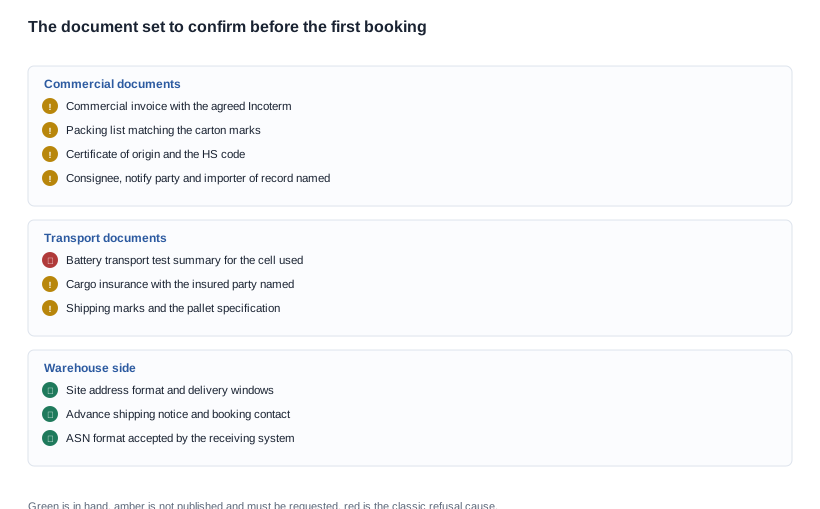
Two practical items that belong in the same conversation. First, who pays for the pallets. A standard export pallet is frequently not included in the freight quote, and it is a real cost per shipment. Second, whether the goods are shrink-wrapped and whether they carry moisture protection for a sea journey, which is a line in the freight specification rather than an assumption you make from the product.
Who is the importer of record when can you ship to my warehouse
This is a legal and tax decision, and it is the one that most often gets made by accident. The importer of record is the party named on the customs declaration. That party is responsible for the import duty and the import taxes, is the counterparty the customs authority will deal with, and in most jurisdictions carries a share of the product-safety and labelling obligations for goods placed on that market. In the European Union, the General Product Safety Regulation has applied since 13 December 2024, and its obligations attach to the economic operator who places the product on the market there, which is a very different thing from the factory that shipped the box.
There are three practical arrangements, and the choice depends on what your business already has in place.
The buyer as importer. You clear the goods, you pay the duty and the tax, and you hold the product-safety obligations for that market. This is the normal arrangement if you have a customs registration and a broker, and it gives you the control you want over classification and documentation. It also puts the compliance burden on you.
The supplier as importer. This is what a DDP term implies in practice, and it requires the supplier to have a way of acting as importer of record in your market, usually through a local agent. It is the simplest for a buyer without a customs operation, and it is the arrangement where the due diligence matters most, because the obligations sit with a party you do not control.
A third party as importer. A distributor, a fulfilment partner or a third-party logistics company can hold the importer role. This is common where the warehouse is not your warehouse but a partner's, and it needs to be written down, because an importer of record that nobody named is an importer of record that nobody prepared the paperwork for.
Alongside the importer of record, two other roles are worth distinguishing, because they are frequently confused. The consignee is who the goods are sold to and who receives them. The notify party is who the carrier informs. A shipment can be consigned to your warehouse while the importer of record is a distributor and the notify party is a forwarder, and each of the three has different consequences.
There is a further wrinkle for a buyer operating in more than one market: the importer of record is a per-market role, not a per-company role. A company that imports into its home market under its own name and imports into the EU through a partner has two different arrangements, and the EU one brings the product-safety obligations with it. Work through them one market at a time, because the customs and tax arrangements differ even where the product is identical, and a single global shipping instruction rarely survives contact with two customs systems.
What to settle before the first shipment: who the importer of record is, who pays the duty and the tax, who classifies the goods and under which HS code, who is liable for the product-safety and labelling obligations in the destination market, and what happens to all five if the arrangement changes. If you are relying on an authorised representative or an agent inside the European Union, note that our catalogue publishes no EU authorised-representative row for any model, so that arrangement has to be established in writing rather than assumed from the fact that we ship to Europe.
The commercial terms of can you ship to my warehouse, and what we will say
The numbers that decide a shipment should all appear in the quotation, in a form you can compare across suppliers. The list:
- The unit price and the Incoterm with the named place.
- The freight basis, whether it is quoted or passed through, and what it covers.
- Carton dimensions, gross weight, units per carton and units per pallet.
- The pallet specification and whether the pallet is included in the freight quote.
- The HS code and the country of origin as they will appear on the documents.
- The packing list format and the carton marking scheme.
- The lead time in weeks, and the shipment window, separately for production and for the booking.
- The position on the battery transport document, who produces it and when.
- The insurance position: who declares the value and who is the insured party.
- The warranty period and the response time, and who pays the freight on a warranty replacement.
- The payment terms, and whether any node is tied to inspection rather than to a date.
We do not publish freight terms, carton dimensions, gross weights or lead times in weeks, and our internal minimum order quantity currently carries more than one figure pending reconciliation between sources, which is precisely why we quote those against a specific configuration rather than publishing a single figure that will be revised later. A quotation that omits them is a quotation that will be revised after the first shipment, and the revision will arrive as an invoice.
Where the negotiation sits, in most cases, is not in the unit price. The trade-offs worth pricing are the ones that change the shape of the cost: air against sea, consolidated against direct, EXW with your own forwarder against DDP with the supplier's, and a delivery window that is narrow against one that is flexible. A buyer who negotiates the unit price and then leaves the freight structure untouched has negotiated the smaller half of the invoice. And because the freight terms decide who carries the risk, the trade-off is not only financial — a DDP quote on a low unit price can be worse than an EXW quote on a higher one if the DDP obligation cannot actually be met in your country.
The due diligence that matters here is short: ask which forwarder the supplier uses and how they are appointed, ask what their insurance actually covers, ask for a reference from a buyer in your own market who has shipped with them, and ask what happened the last time a shipment was refused. That last question is the one that tells you the most, and it is the one almost nobody asks.
What we will do is answer all six questions against a configuration and a destination, and tell you where the answer is a firm term and where it depends on the specific booking. The smart glasses wholesale overview sets out the commercial framework the quotation sits in, logistics for distributors and retailers covers the distribution patterns these terms have to fit, and content creation export and shipping covers the export and shipping flow for a different kind of shipment in the same category.
Related reading
- smart glasses wholesale overview
- logistics for distributors and retailers
- content creation export and shipping
Send destination, warehouse and order split and we will answer all six questions.


