The questions that separate consumer vs industrial smart glasses are not difficult, and they are not evenly distributed between the parties who could answer them. A supplier can close some of them in a single sentence, because they are questions about design intent and the supplier knows its own design intent. Others can only be closed by evidence that exists somewhere else: a report, a standard, a certificate, a test record. Conflating the two is the standard failure in this category, because a supplier asked a question it cannot actually answer will usually answer it anyway, and the answer will sound exactly like the answer to the question it could answer.
That is what this article organises. The questions are split by who can close them, not by subject area, and the split tells the buyer which answers can be taken at face value, which have to be supported by a document, and which cannot be closed at all without commissioning something. The Consumer vs Industrial Grade page sets out the two ends of the category; what follows is the evidence map a buyer needs to move a requirement from a sheet into an order.
Consumer vs industrial: who can actually answer each question
The short answer on consumer vs industrial questions
Six questions can be closed by the supplier alone, because they are questions about intent, design and commercial structure. Five can only be closed by evidence, because they are questions about physical performance that no one can answer from a drawing. Two cannot be closed by either and have to be turned into a requirement the buyer writes and the supplier prices. Getting this split right at the start of an evaluation saves most of the wasted effort, because a large share of a traditional question list belongs in the second group and is being asked of somebody who is not in a position to answer it.
The practical consequence is a change of register. Questions about intent are asked in a conversation. Questions about performance are asked for a document. Questions that belong to the buyer are not asked at all; they are written into the order. A supplier who is asked a performance question and gives a confident verbal answer has not done anything wrong, but the buyer has not gained anything either, and treating the answer as a commitment is the mistake that this split exists to prevent.
The second thing the split tells the buyer is where the programme risk sits. Where a question is closed by evidence, the risk is that the evidence does not exist or does not cover the configuration being bought. Where a question is closed by intent, the risk is that the intent changes. Where a question belongs to the buyer, the risk is that nobody writes it down, and a requirement that is not written down is not a requirement at all.
The reader and the decision in front of them
The reader is a procurement manager, a channel buyer or an importer choosing between quotations for a device that will be used in an environment rather than in a pocket. They may be opening a new programme, in which case the job is to write a requirement that a factory can quote against, or they may be comparing existing quotations, in which case the job is to find out which of them has actually been tested for the environment the buyer is buying into.
What is being managed is a mismatch that is expensive to discover late. A device specified for a consumer channel and then deployed in a workshop, a warehouse or a site is a device whose environmental performance is unknown, and the failure will surface in the field, in front of a customer who is not the original buyer and does not have consumer expectations. The cost of a mismatch is the returns, the reverse logistics and the loss of a channel relationship, and all three are larger than the difference between the two grades would ever have been.
The second thing being managed is the supplier's time. The certification checklist and the questions below are structured so that the documents are requested once, in one format, rather than chased over several rounds. A supplier that can produce its evidence in one exchange is usually a supplier whose evidence is organised; a supplier that cannot is telling the buyer that the programme behind the device is newer than the documentation around it.
What the two grades actually cost
It is worth being concrete about what separates the two grades commercially, because the difference is not mainly component quality. It is the cost of evidence, the cost of diagnosis in the field, and the cost of exposure when something fails.
The evidence cost is a project with a fixed price that does not scale with volume, and it is usually quoted as a line in the quotation or buried in a setup fee. The diagnosis cost is the larger one and it is usually invisible. A consumer device is diagnosed by the end user, who returns it or does not. An industrial device is diagnosed by a supervisor or a technician who files a report against a reference number, and that report is the only signal the supplier receives about a systematic problem. Building the reporting path into the programme costs nothing and is what turns a warranty into a feedback loop. The exposure cost is the one that separates the two channels: in a consumer channel the loss is the returned units, and in an industrial channel it is the returned units plus the relationship with the operator's employer.
All three costs are consequences of decisions that are made once, at the specification stage, and are very hard to change later. That is the whole reason the question set matters more than the unit price.

The questions the supplier can close on its own
Six questions sit in this group, and they should be asked first because they are cheap, because the answers are reliable, and because they establish the frame the rest of the evaluation runs inside.
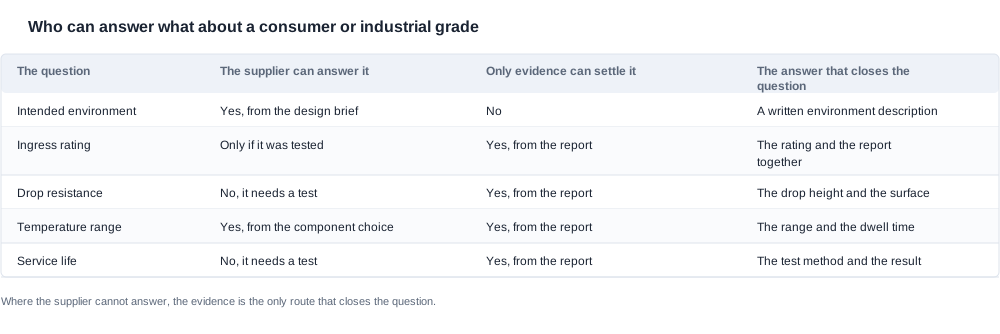
The first three are about the intended environment and the duty cycle, and they are the ones most often skipped because they sound obvious. What environment is the unit designed for, in the words of the design brief. How long is it in use each shift. Whether it is used with gloves, with a helmet, or alongside other head-mounted equipment. Each of these sounds like a detail and each of them changes the answer to a performance question, because a glove changes what a touch target has to be, a helmet changes what the headband has to hold against, and a shift length changes what the battery has to survive.
The fourth question is about the commercial structure: whether the industrial grade changes the unit price, the warranty, or both. The answer is usually that the warranty is longer, which is a real difference and one that carries cost. It is worth asking whether the warranty is longer because the product is more durable or because the supplier expects more failures, because only one of those is a benefit to the buyer.
The fifth question is about the product family. Ask which existing products in the supplier's range this configuration sits alongside, and what the supplier knows about how those perform in the same environment. This is where a buyer's own Bluetooth-enabled product families knowledge comes into play: a supplier with an established range in a category has a history of failures and a history of fixes, and that history is worth more than any datasheet.
The sixth question is the one that decides whether the rest of the evaluation is even possible: can you show the report, not the summary? A summary is a document that says what the report says, in fewer words, written by whoever owns the commercial relationship. A report is the document the test produced. Suppliers have good reasons for offering a summary first, because a summary contains no conditions and no exclusions.
The questions only evidence can close
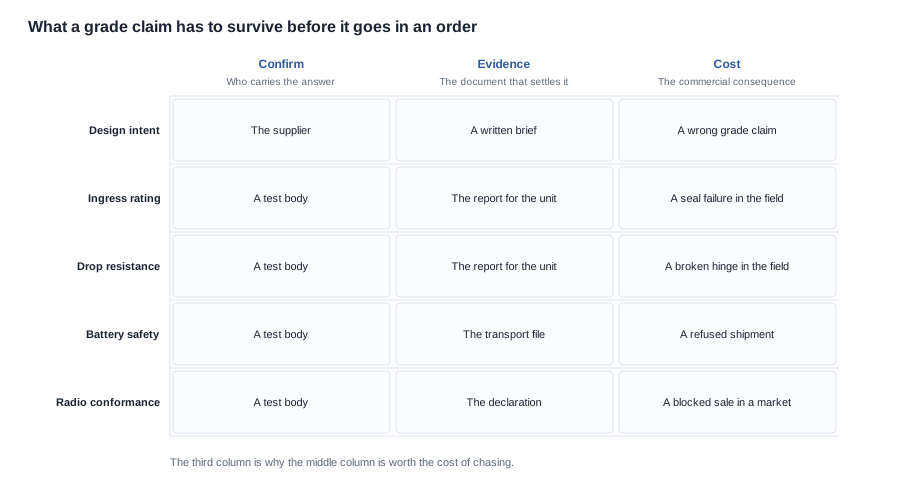
Five questions in this group cannot be closed by the supplier's word, and the only thing that closes them is a document that came out of a test.
The first is the standard question, and it has two halves that are frequently confused. What standard was the product qualified against, and against which revision? A standard without a revision is a family of standards, and the revisions differ in what they actually test. A supplier that answers with a standard number and a date has answered properly; a supplier that answers with the name of a standard family has not.
The second is the temperature question, and it has the same structure. At what temperature was the unit tested, and for how long at each extreme? A range without a dwell time is an aspiration. The dwell time, the ramp rate and the state the unit is in during the test are what turn the range into a specification, and a supplier who quotes a range without them is quoting the component tolerances rather than a tested result.
The third is the mechanical question, and it is where the conditions matter most. How is the unit attached, and what happens if it is dropped? The drop height, the surface material, the number of cycles and the orientation at each impact decide the result, and the same unit behaves differently on a hard floor and on a soft bench. The attachment question is not decorative: a head-mounted unit on a strap, on a rigid mount and on an elastic band experiences different loads, and the attachment is part of the tested configuration.
The fourth is the ingress question, and here the standard does most of the work because it prescribes the condition: how long the water is applied, from what direction, at what level, with the unit assembled in its shipping configuration or open, and with what enclosure tolerance. Quote the rating without the standard and the condition and it becomes a marketing phrase with digits in it. The materials and ergonomics decisions interact with it directly, because a change of housing material or of a seal is a change to the tested configuration.
The fifth is the service life question, which is the one most often unasked and the one with the largest commercial consequence. What is the rated service life, in hours, and against what duty cycle? A device used in an industrial setting accumulates hours quickly, and a rating expressed in years rather than in hours tells the buyer nothing about when the failure wave arrives.
There is a sixth question that sits awkwardly between the two groups, and it is worth resolving it explicitly rather than letting it sit unanswered. Does the grade change the warranty, and what does the warranty actually cover? A supplier can answer the commercial half of that question without any evidence at all, because a warranty is a promise the supplier chooses to make, and the promise costs nothing to write down. What the supplier cannot tell the buyer from its own word is whether the warranty was priced against a measured failure rate or against a marketing intention, and that is the part where the evidence group enters. A buyer who asks only the commercial question gets a warranty term and no basis for it; a buyer who asks both gets the term and the document that supports it, and can then decide whether the premium is justified.

Where the specification sheet goes quiet and how to reopen it
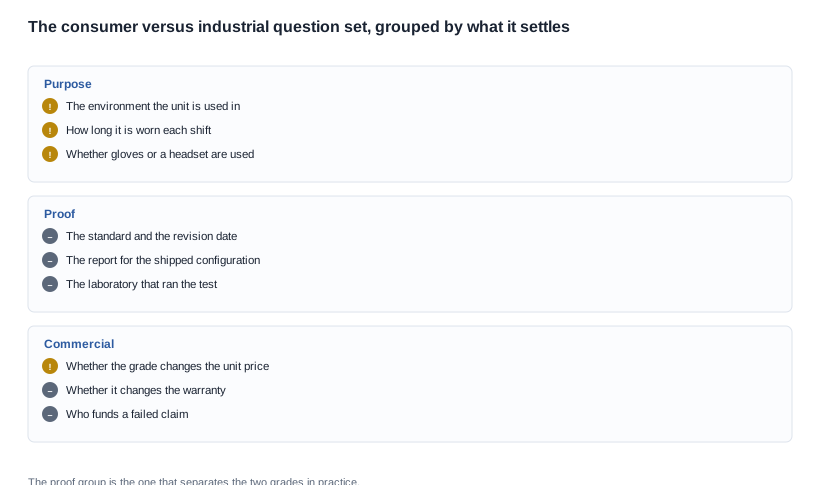
The checklist above groups the question set by what each group settles: the purpose group defines the requirement, the proof group separates the two grades in practice, and the commercial group establishes who pays when the claim fails. A sheet that has been completed against the first group and left empty against the second is the normal state of a consumer-positioned quotation, and it is the clearest single indicator of what a supplier believes has been done.
There are three places where a specification sheet goes quiet, and they are quiet for different reasons. The first is the measurement condition, which is quiet because it lives in a test document the commercial contact has never been shown. The second is the configuration, which is quiet because the configuration has drifted since the test and nobody has tracked the change. The third is the scope of the claim, which is quiet because nobody has ever asked whether the report covers the product or the part.
The way to reopen a quiet sheet is to ask for the document rather than for the answer. A buyer who asks "what is the ingress rating" gets a number. A buyer who asks "which report does that rating come from, and which revision of the standard was it run against" gets a document, and the document is what contains the conditions. This is a small change of wording and it moves the entire conversation from an assertion to an evidence exchange.
There is one more source of silence worth naming, because it is the one that most resembles good news. Some suppliers will produce a complete and excellent evidence package for a configuration that is not the configuration being quoted, and will offer it without being asked to check. The package is real, the tests were real, and it still proves nothing about the product in the order. The question that closes this is the simplest one in the whole set: does this document describe the exact configuration in the quotation, including the housing, the seal and the cell.

Turning the answers into a line in the purchase order
The purpose of the question set is not to produce a better understanding. It is to produce a requirement that a factory can quote against and that a buyer can enforce later. The translation is mechanical, and it is the step most evaluations skip.

The sequence above moves from an environment description to an enforceable line, and every step in it produces something a buyer can hold. The fourth step is where the value is: a grade, a standard with its revision, and a report reference, written together, become a requirement. A grade on its own does not, because it has no referent.
Three things belong in the order beyond the requirement itself. The first is the change clause, which states that a change to any component named in the report reopens the report and that the supplier tells the buyer before the change ships. The second is the acceptance test, which gives the buyer a defined period to test production units against the quoted figures with the method agreed in advance, rather than improvised at the factory gate. The third is the reporting path, which puts the field data somewhere to go so that a systematic problem becomes a pattern the supplier can act on rather than a series of anecdotes from a distributor.
There is also a clause worth having that is almost never requested, which is the reverse of the acceptance test: a statement of which figures the supplier is not prepared to warrant. A supplier that names its own limit — this figure is a measurement, that figure is a specification, this one depends on the revision — has given the buyer a map of the programme that costs nothing and saves a great deal of interpretation later.
The three clauses are worth setting out in the order they bite, because each one addresses a different way that a programme drifts away from its original requirement:
- The change clause. It states that a change to any component named in the report reopens the report, and that the supplier tells the buyer before the change ships rather than after. This is the clause that prevents the silent configuration drift described earlier, and it is the only one of the three that is difficult to retrofit once the programme is running.
- The acceptance test. It gives the buyer a defined period to test production units against the quoted figures, with the method agreed in advance. A test conducted at the factory gate on a day chosen by the supplier is not a test; a method agreed in advance produces a result that both parties accept, and a failure at that point costs a correction rather than an argument.
- The reporting path. It puts the field data somewhere to go, so that a systematic problem becomes a pattern the supplier can act on rather than a series of anecdotes from a distributor. This is the clause that determines whether the evidence the buyer paid for is ever actually used, and in an industrial programme it is usually the difference between a supplier who improves the product and one who ships the same unit again next year.
A fourth line is worth considering for programmes that run across more than one market, which is to require the evidence to be produced per market rather than per product. The reason is that the evidence a buyer needs for a deployment is not the same as the evidence needed to ship, and a supplier who has assembled one file for the shipping requirement has not necessarily assembled the other.
The position we take on consumer vs industrial questions
Our catalogue publishes electrical rows for every model: cell configuration, runtime, charge time, charging method and radio version. It publishes an ingress rating on two models only, the V06 and the S7, and no ingress rating for anything else. Our product catalogue contains a company-level export certification page whose content is images rather than readable text, and the catalogue text contains no reference to CE, FCC or RoHS, so we do not present those marks as evidence of anything. There is no per-model certification row in the catalogue at all.
The honest consequence is that we can answer the supplier-answerable group of questions about our own products and the environment they are designed for, and we cannot answer the evidence group from a catalogue. We will say that plainly rather than substitute a typical figure or a supplier's marketing description, and we will tell the buyer which document has to come from the component or laboratory supplier and what form it has to be in.
What we can add that a buyer cannot get from a catalogue is the structure of the answer: which of the questions above close on the supplier's own word, which require a document, and which the buyer has to write into the order itself. That is procurement information, and it is the part worth acting on before a first sample rather than after it.
The question we would apply to ourselves is the one in the proof group: does the document describe the exact configuration in the quotation. If a claim cannot be traced to a configuration, we do not make it, and we would rather tell a buyer that the evidence is not published than offer a number they cannot verify.
What to send us for a grade requirement
Send the environment, the duty cycle, the target market and the quantity, and describe how the unit will be used rather than how it should behave. We will tell you which rows exist for the models that fit that description, which figures we publish and which we do not, what would have to be obtained in writing from a component or laboratory supplier, and how that evidence would be assembled into a file before a first order. Where a claim cannot be substantiated from our published material, we will say so and tell you what to ask for instead.