
The minimum order quantity is the number a buyer is given first and least often given in a form they can plan against. Almost every customisation programme contains more than one floor, and the floors behave differently: one is a commitment on units, one is a commitment on units of a particular colour, one is a commitment on printed packaging, and one is a commitment on tooling. A single figure cannot describe them, so the useful answer to the question of how the customization options affect your minimum is a structure rather than a number — because no minimum order quantity is published anywhere in our catalogue.
What the catalogue does publish is the option space that creates floors. The published customisation list is shorter or longer depending on the category, so the number of entries a project inherits has to be asked for. The published configuration rows describe charging by magnetic on seventeen models and Type-C on seven, while four models publish neither; five models publish a case capacity of 900, 1200 and 1400 mAh; a charge time published as "2 hours or less" on twenty-six models, with the D17 and the ZH12 alone reaching approximately one hour; camera resolution shown as 8 MP on eight models and 13 MP on three; IP54 on the V06 and the S7 only; and a frame weight of 158 g published for the MT6 alone.
Every one of those rows is a configuration. Configurations are what minimums are counted in.
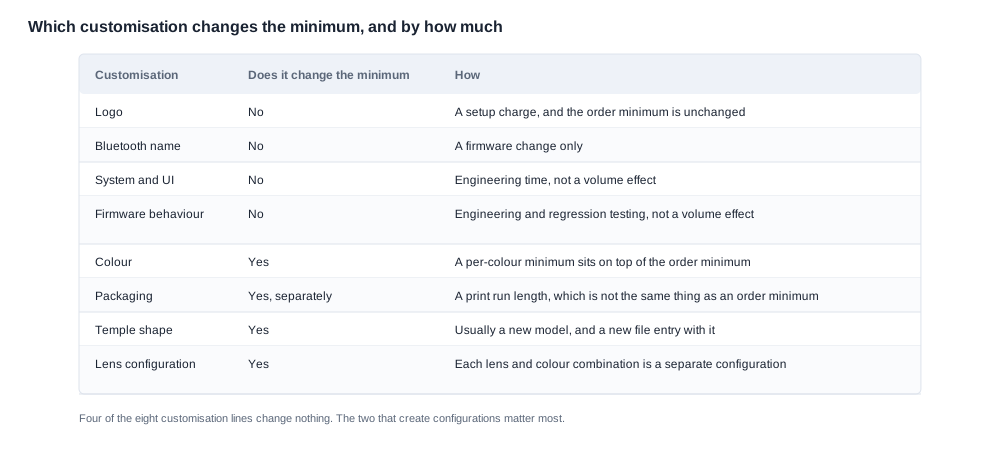
Customization options and the three floors behind every minimum
Before the individual lines, the structure. Three floors sit underneath almost every customisation programme, and they are negotiated in different ways and fail in different ways.
Floor one: the order minimum. A commitment on units of the product. This is the floor everyone quotes, and it is the one that moves least when you add a logo.
Floor two: the configuration minimum. A commitment on units of one configuration — a particular colour, a particular lens, a particular charging method, a particular case. It sits on top of the order minimum rather than replacing it, and it is the floor that catches buyers who have planned carefully on paper and then discover that a four-colour launch is four separate commitments.
Floor three: the print run length. A commitment on printed units — carton, insert, label, manual. It behaves differently again. The first run is the cheapest per unit because the setup is spread widely; each subsequent run costs more per unit because it is spread over fewer units. Three order waves can mean three print runs, and the third run can cost more per unit than the first.
There is a fourth commitment, which is not a floor on units at all but behaves like one in the cash plan: tooling and non-recurring engineering. A new temple profile, a new logo carried by the mould, a new case shell — these are one-off capital items, and whether they are amortised into the unit price or charged as a lump sum changes the shape of the second order more than any discount on the first.
The relationship between them is the thing to hold on to. The order minimum scales with units. The configuration minimum scales with units per configuration. The print run scales with waves. Tooling scales with the number of tools, not with units at all. A buyer who treats them as one number will build a plan that works for the launch and breaks on the second order.
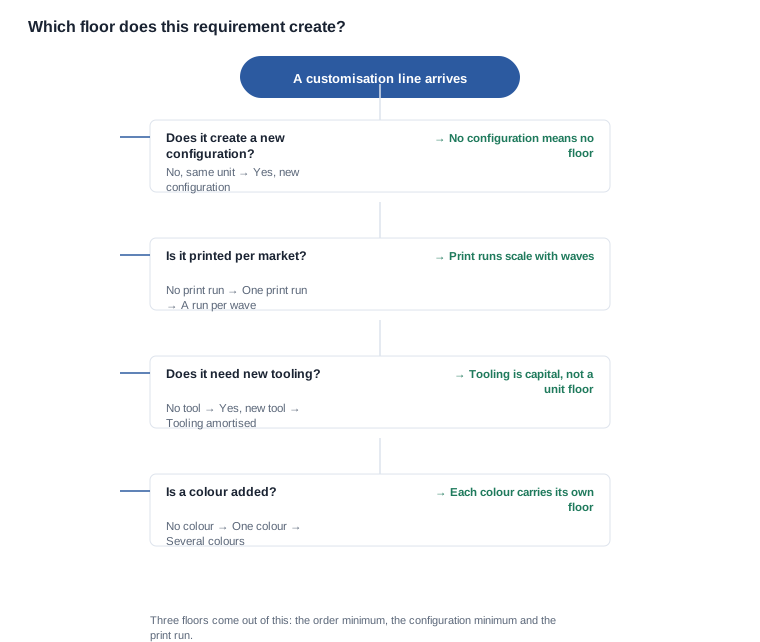
The decision path above is the shortest form of the whole subject: ask whether the requirement creates a configuration, and if it does not, it does not create a floor. The second question catches packaging, the third catches tooling, and the fourth catches the case that catches most buyers — a colour added to a range is a commitment in its own right, separate from the commitment for the product.
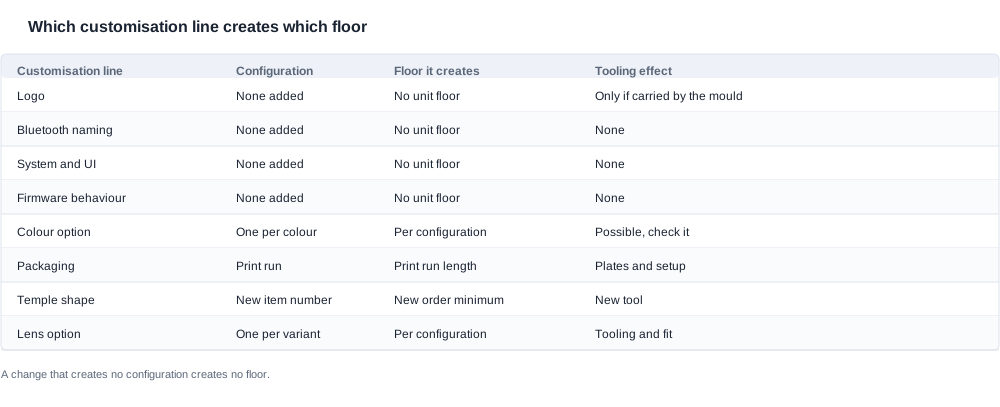

Customization options that leave the order minimum untouched
Four of the published customisation lines do not touch the volume floors, and the reason is structural rather than commercial: they do not create a new configuration on the production schedule.
Logo. A logo applied to an existing unit in an existing configuration. It adds a setup cost and it may add a lead-time effect if the process is one that runs in mould, but it does not change how many units have to be bought, and it does not create a new colour or a new SKU. It is the cheapest line in the menu in every sense, including the schedule.
Bluetooth naming. A firmware-level change. The unit is the same unit; the item number is the same item number; the packing list is unchanged. It costs engineering and a firmware build, not volume.
System and UI. Also engineering time, and in practice a recurring obligation rather than a one-off, because every firmware release carries the customisation forward. The condition is that the change does not reach the radio.
Firmware behaviour. The same condition, the same conclusion, with an additional cost in regression testing.
The common thread is worth stating plainly, because it is the answer buyers ask for: a change that does not create a configuration does not create a floor. A logo is applied to the same unit in the same colour with the same lens. A renamed device is the same device with a different name in the settings menu. Neither produces a new line on the production schedule, and neither consumes a slice of a per-configuration minimum.
There is one caveat, and it is the caveat that catches people. A logo carried by the mould is a tooling commitment. It does not raise the order minimum, but it does raise the barrier to changing the logo later, and that is a different kind of cost — a cost paid in flexibility rather than in units.

Customization options that create a new floor of their own
Colour is the one that surprises buyers. A colour option carries a floor of its own, and the floor sits on that colour rather than on the order. A brand that adds a second colour to a launch has created a second floor, and that second floor is not covered by the first order. This is why a four-colour plan and a one-colour plan are not the same commitment with different decoration — they are four commitments, one of which exists to serve the other three.
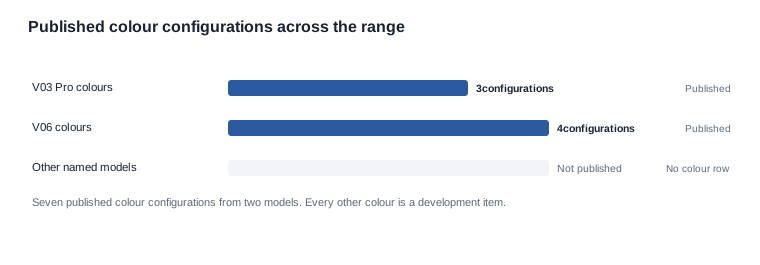
The published rows make the arithmetic concrete. Two models in the range publish colour options: the V03 Pro with three, and the V06 with four. That is seven published colour configurations from two models, and no other model publishes a colour row at all, which means every other colour in a launch is a colour that has to be developed.
Packaging is a separate mechanism again. A print run is not a minimum order quantity; it is a print run length with its own logic and its own cash profile. It interacts with the order minimum rather than following from it, which is why a launch can be volume-valid and print-invalid at the same time. The smart glasses MOQ page sets out the three floors in more detail.
Temple shape is usually a new model rather than a new configuration. That has two consequences: the new profile needs its own entry in the technical file set, and the tooling is new, irreversible and capital. The volume consequence is a new floor attached to a new item number, and the practical consequence is a second order that has to be placed separately.
Lens configuration multiplies faster than anything else in the menu. Each lens and colour combination is a separate configuration, and each one carries its own floor. On a platform that publishes three colour options and a photochromic lens, adding a clear-lens variant to the three colours takes the platform from three configurations to six. On a platform with four published colours, a lens option takes it from four to eight. The arithmetic is trivial; what it exposes is that a range plan is usually written as a list of products when it is actually a matrix of configurations.
Firmware, UI and app changes create a floor of a different kind. They do not create a unit floor, but they do create a maintenance floor: every future release, every firmware update and every app release carries the customisation. The cost is not in the order, it is in the years after it.
Customization options and the range plan that counts them
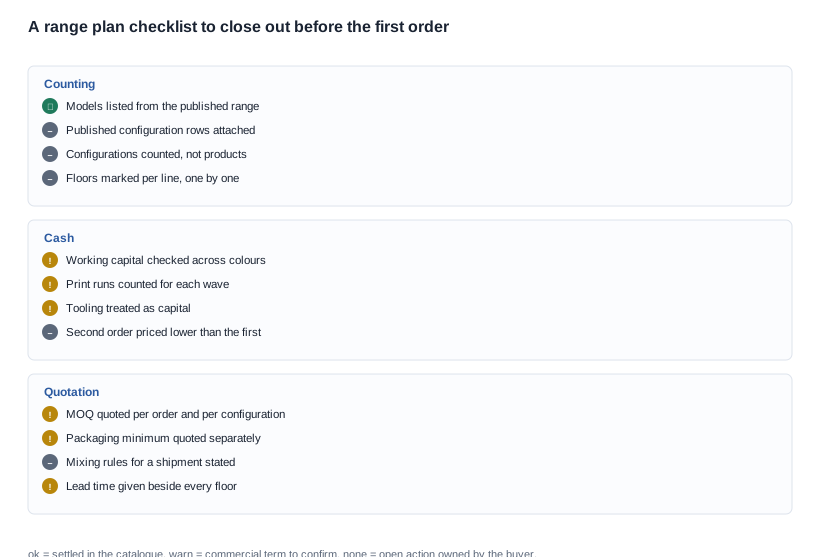
The practical method is to count configurations before counting units, and to do the counting explicitly rather than intuitively.
Step one — list the models. Start from the published range: eight audio-tier models, three sport-tier models, eleven camera-tier models, three kids-tier models, plus the AR, electrochromic and bone conduction entries. For most programmes this list is two to four models, and the exercise immediately shows how much of the catalogue is irrelevant.
Step two — attach the published configuration rows to each model. Charging method, case presence and capacity, charge time, resolution, ingress rating, weight. Where a row is published, the configuration already exists and its floor is a known quantity to be quoted. Where it is not published, the configuration is a development item and the floor is unknown.
Step three — apply the customisation lines and mark the floors. Every colour adds a configuration floor. Every packaging item adds a print run. Every temple profile adds an item number and a tool. Logo, Bluetooth naming, UI and firmware add none of those three.
Step four — multiply. Configurations = models × colours × lens variants × case options. The number that comes out is the real shape of the commitment, and it is almost never the number that appears on the quotation, because the quotation carries one order minimum.
Step five — check the cash, not just the units. A plan with seven configurations and a modest order minimum can carry a working capital requirement that a plan with three configurations and the same order minimum does not. This is the calculation the customization options checklist asks you to do before a brief is issued, and it is the reason the range plan has to be reviewed as a cash plan rather than as a product list.
Step six — test the second order. Ask whether the second order is cheaper per unit than the first. A programme whose logo is in mould and whose packaging is printed in one long run gets structurally cheaper as volume accumulates. A programme with four colours, three print waves and a separately tooled temple profile does not, because none of those floors amortises across the range. The OEM-ready platforms customization depth article sets out the same structure from the product side.
Two numbers are worth holding on to while you do this. First, the catalogue publishes no minimum order quantity, for any model, in any configuration. Second, it publishes no packaging print minimum either. Any figure you are given for either is a figure for a specific configuration, and it should be asked for as such rather than carried forward as a general rule.
Step seven — test the plan against the launch date, not only against the units. A floor with a lead time in front of it is a commitment to buy early, and the cash sits in inventory rather than in transit. Where a range plan has both a per-configuration floor and a long lead time, the two combine into a requirement to order more of each configuration, further ahead, than a plan that reads the same on paper. This is where the difference between a plan that works and a plan that works on a spreadsheet shows up, and it is the reason the launch date and the floor should be reviewed in the same conversation rather than in two.
A last, smaller point for buyers who sell bundles rather than single products. A bundle that pairs a model with a case, a cable and printed material is a further configuration, because it has its own packing list and its own item number. If the bundle is assembled by the factory, its floor is a factory floor; if it is assembled in your own warehouse, the floor is a picking problem and the components still carry their own floors separately.
Customization options and the commercial terms around a minimum
A minimum order quantity is never a standalone term. It arrives attached to a price, a lead time, a payment term and a warranty, and it means something different depending on what sits beside it.
The distinctions that matter in negotiation:
- Minimum per order versus minimum per configuration. The second is the one that constrains a range plan, and it is the one most often quoted as if it were the first.
- Minimum per colour versus minimum per product. These are separate floors and they should be quoted separately.
- Print run versus order wave. A wave is when you order; a run is when the packaging is printed. They do not have to match, and when they do not, the cost lands in inventory rather than in the shipment.
- Tooling lump sum versus amortised tooling. One is a cash event; the other is a per-unit cost that reduces as volume rises. The same programme can be structured either way, and the choice should be made with the second order in mind.
- Minimum order quantity versus lead time. A floor protects the supplier's setup; the lead time protects the launch. A programme with a high floor and a long lead time has to be ordered early and stocked, which is a different risk from a programme with a high floor and a short lead time.
The price ladder question belongs in the same conversation. The wholesale pricing tiers article covers how tiers are usually structured; the customization question is which tier you land in for which configuration, because a seven-configuration programme at one volume is commercially a different order from the same seven configurations at four times the volume.
The questions to ask the supplier, and the order in which to ask them:
- What is the minimum order quantity for the base configuration of each model in my range?
- What is the minimum order quantity per colour, and per lens configuration, and how do they differ from the base?
- What is the packaging print minimum per item, and per language or market version?
- If I order in three waves, how many print runs does that create, and how is the per-unit packaging cost calculated in each?
- Is the logo and packaging setup charged per order or amortised into the unit price?
- Is the tooling charged once or per unit, and how does it behave on the second order?
- Which configurations can be mixed within one shipment, and which have to ship separately?
- What is the unit price ladder, and at which volume does each tier start?
- How long does a configuration take to build, and does a developed configuration take longer than a standard one?
- What is the sample fee, the sample lead time and the sample count?
Questions 6 and 7 are the ones buyers skip. Question 6 decides whether the second order is cheaper, which is the single most useful number in a range plan. Question 7 decides whether your inventory can be managed as one flow or several, which is a logistics decision that the factory makes on your behalf if you do not ask.
Two red flags. The first is a single minimum quoted for a multi-configuration range; it means the configuration floors are hidden inside a blended figure, and the blended figure will not survive the first order. The second is a minimum quoted without a lead time beside it, because a floor with a long lead time is an instruction to commit cash earlier than the buyer expected.
The pitfalls are familiar: counting products instead of configurations, treating a print run as if it were an order wave, assuming a colour floor is covered by the order floor, and planning the launch against a first-order price that will not exist on the second order.
There is one more pitfall that only shows up in a range plan with several models: the floor that moves when you add a model. Adding a fifth model to a range does not only add a fifth commitment, it can change the minimum for the models already in the plan, because the production schedule is now shared between more configurations. Any range plan that has grown model by model should be re-checked against the quotation rather than assumed to have kept its original floors, and the question to ask is simple: has the minimum for the existing models changed since the last order?
The honest answer to the question in the title is a structure, not a number. Four of the published customisation lines create no floor at all, because they create no configuration. Colour and lens options create a floor per configuration. Packaging creates a print run with its own logic. A temple profile creates a new item and a new tool. And the product minimum itself, the per-configuration minimum and the packaging minimum are three separate commitments that should be negotiated separately, because a buyer who can tell them apart can plan a range, and a buyer who cannot will discover the difference in inventory.
Send the range plan — models, colours, lens options, packaging items, target launch date — and we will show you, configuration by configuration, which floors it creates and which of our customisation lines are involved. We will also tell you what each floor is quoted at for your configuration, because that number is a commercial term and it is quoted, not published.
Related reading


