

The useful checklist is not a list of what can be changed. It is a list of what each change costs, what each change leaves untouched, and which changes force the supplier to start engineering work again. Our catalogue records customisation lines per category rather than one list for the range — seven for the camera entries, five for the audio entries and two for the children's — and it also carries product-specific lines for lens configuration and a remote control on the sport range. Treating those eleven lines as one menu is how a brand ends up with a quotation that assumed a decal and receives a tooling charge. The menu is not wrong; it is simply three menus presented as one, and a buyer who asks which of the three a given line belongs to has already solved most of the problem.
What follows is the ordering we would use if we were the buyer sitting on the other side of the table, written so that each line can be marked at the point the quotation arrives rather than reconstructed afterwards. A checklist that is filled in during a quotation is worth several times one that is filled in from memory six months later, because the whole purpose of the exercise is to catch the assumption that was made quickly and without writing.
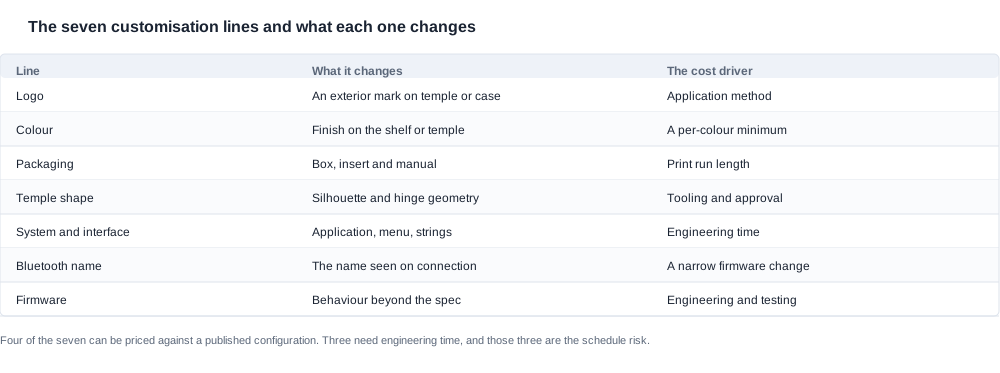
Customization options checklist: the seven lines on the main ranges
The line items worth separating on this one are the artwork preparation, the tooling or plate setup, the per-unit application, and any approval needed on the mark itself. A quotation that bundles them looks tidy and tells you nothing about which of them will grow if the mark changes in year two.
Logo. Changes an exterior mark on the temple or the case. It does not change electronics, firmware or radio behaviour, and it does not affect the certification basis, which stays with the underlying platform. The cost driver is the application method: a printed mark, a laser etch and a moulded or debossed mark are three different setup charges, and only the last one involves tooling.
Ask specifically whether the minimum is per colourway or per colour family, because a family covering two closely related shades is a different commitment from two separate colourways. Where the supplier cannot answer the difference, the safe assumption is the more expensive one.
Colour. Changes the finish on the shelf or the temple. It does not change function, and it does not by itself change the certification basis. The cost driver is that colour usually carries a per-colour minimum rather than a per-order one, which means it interacts directly with the quantity question rather than replacing it.
Two further lines belong on this one and are frequently bundled into it: the documentation set that travels in the box, and the labelling for each destination market. Both are per market rather than per order, and a programme that expands from one market to three has tripled this line without changing the hardware at all.
Packaging. Changes the retail box, the insert and the manual. The unit inside the box is untouched. The cost driver is print run length, and a brand that orders in three waves may pay three print runs. A digital or generic box is often the cheapest first step for a new brand and is worth pricing as its own line.
The question to put here is what happens to the open-ear acoustic position, because a temple change that moves the speaker relative to the ear changes the acoustic result of a platform that was designed around one geometry. That question is cheap to ask and expensive to answer after tooling.
Temple shape. Changes the frame silhouette and the hinge geometry, and therefore the tooling, the first-article approval and the relationship to the ear — which is where the speaker sits in an open-ear design. It does not change the electronics, the battery or the radio, but a temple change on an audio platform is not a cosmetic change, and treating it as one is the single most expensive error available in this menu.
Two questions separate a bounded interface change from an open one. The first is whether the change is a translation set, which is a known quantity of work, or new content and new layouts, which are not. The second is whether the strings sit inside the firmware build or inside a remote configuration file, because only the second can be corrected without a firmware release.
System and interface. Changes the application, the menu and the on-screen strings. It does not change radio behaviour, and that is the point worth noting: the radio certification sits with the radio, and interface work does not disturb it. The cost driver is engineering time, and it is the line most often underestimated because it feels like design work.
The one caveat is length. A device name has a character limit in practice as well as in protocol, and a brand name plus a model suffix can exceed it once the suffix is spelled out in full. Establish the convention early rather than discovering the truncation on a pre-production unit.
Bluetooth name. Changes the name a buyer sees during re-connection. It does not change the radio. It is a firmware change with a narrow scope, and it is one of the cheapest lines to implement — provided it is requested before the first firmware build rather than as a change to one already in production.
Keep a written record of which behaviours were in the specification at the time the file was closed, because the boundary between a firmware change and a product change is drawn by that document rather than by the intent of whoever requested the work. Where the change sits close to the line, write down which side it was placed on and why.
Firmware. Changes behaviour beyond the published hardware specification — wake words, a custom assistant workflow, capture logic. It does not change the published hardware specification, which is worth keeping in writing, because a firmware change that alters radio behaviour would need to be looked at again against the certification file set. The cost driver is engineering plus regression testing.
The product-specific lines that behave differently
Three ranges carry lines that do not follow the main pattern. Read those lines as risk statements rather than as feature statements. A customisable remote control implies a second firmware surface and a second set of documentation; lens configuration implies an optical description that has to be maintained per variant. Neither is difficult, and both are easier when they are known at the shortlist stage than when they are discovered during the specification. Switching speed is worth particular attention, because it is a parameter a customer notices immediately and a supplier measures under laboratory conditions. Where the parameter is customisable, ask for the set of values that have actually been produced and for the measurement condition behind each one, because a switching-speed figure without a condition is the kind of number that becomes a complaint., plus colour and packaging. The kids range lists colour and packaging customisation, and then marks application and firmware capability as unverified. That last statement is the one that should shorten a shortlist fastest, and it is worth being direct about why: an unpublished capability is not an absent one, but it does mean the conversation will be longer and the quotation less certain. A buyer with a fixed launch date has already paid for that uncertainty whether or not it was visible on the page.
The same logic applies within the main seven. A line that is published for one range is not published for another, and extending a capability from a range where it exists to a range where it does not is the most common way a shortlist produces a quotation that cannot be honoured.
Those four statements are more useful to a buyer than a long feature list, because they tell you where the questions are. "Application and firmware customisation is unverified for the kids range" is a real statement about project risk. "No customisation capability is published for the bone conduction entry" is a statement about how much of a design and engineering conversation you are about to have, and it is far cheaper to hear at the shortlist stage.
There is a fourth line in that group worth reading the same way. Where a range publishes a customisable parameter such as lens darkening range or switching speed, the question is what the acceptable set of values is. A parameter described as customisable without a stated range is a parameter that will be negotiated at the worst possible moment, which is usually after the marketing has committed to a figure.
An unverified line is not the same as an absent one. It means the capability may exist and has not been confirmed, which is a different problem and a much easier one — a question to be asked rather than an engineering programme to be scoped.


The order we would ask for them in
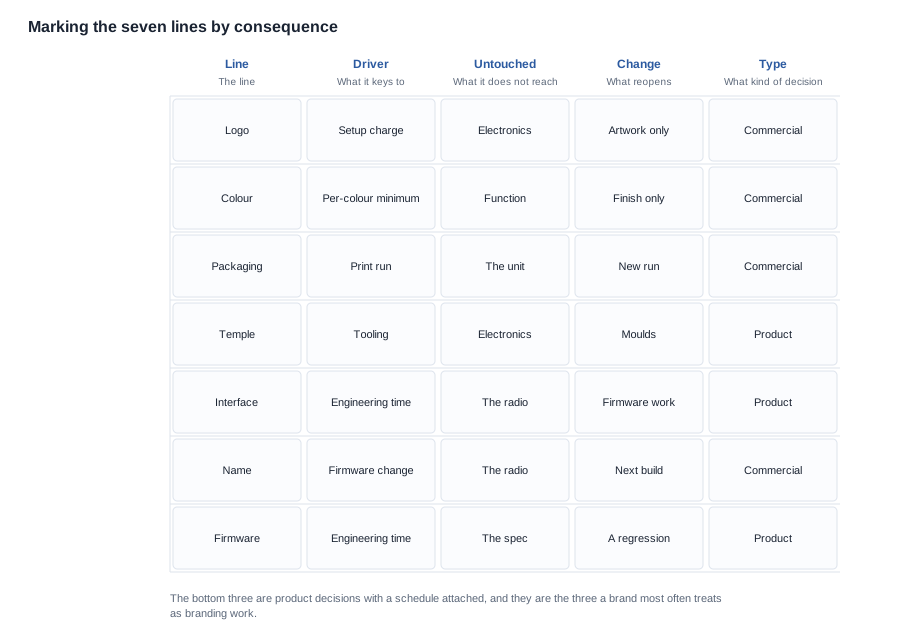
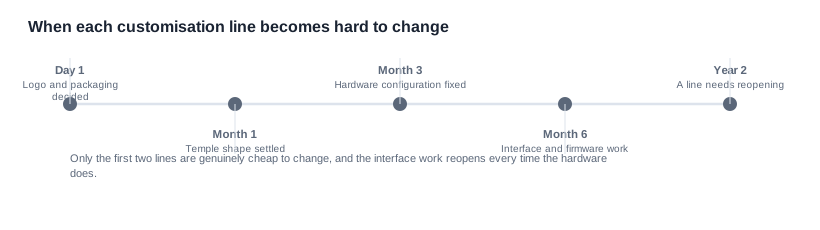
If you are starting a brand, the sequence matters more than the list. Begin with the packaging and the logo, because they are commercial decisions with a bounded cost and no engineering consequence. Add colour only once you know which colours you will actually run, because each colour carries its own minimum. Treat the temple shape as a product decision rather than a branding decision, and price the first-article approval into the schedule. Leave system, interface and firmware until the hardware and the packaging are settled, because every hardware change after that one reopens the firmware work.
The reason the order matters is that the later lines are the ones with engineering time in them, and engineering time is the component hardest to compress in a launch schedule. A logo decision made in week one and a logo decision made in week twenty produce identical artwork and completely different schedules, because the artwork has to wait for whatever else is happening at the time.
There is a second reason to fix the temple early. A temple change alters the tooling and the first-article approval, and both sit upstream of almost everything else in the schedule. Decide it against the packaging artwork rather than after it, because a temple decision taken late will reopen artwork that has already been approved.
The colour decision deserves its own rule. Add a colour only once you know which ones you will actually run, and treat the count as a commitment rather than an option: each colour carries its own minimum, so an open-ended colour list is not flexibility, it is a quantity problem that has not been priced yet.
The reason the order matters is that the later lines are the ones with engineering time in them, and engineering time is the component that is hardest to compress. A logo decision made in week one and a logo decision made in week twenty produce the same artwork and completely different schedules.
Treat it as a twelfth line on the menu even though nobody lists it. It is the line that scales with the range rather than with the order, and it is the one that a buyer adding a model in year two discovers was never scoped. The classification questions for it are set out separately. That is the line most easily missed on this menu, because it does not appear in any of the eleven entries above.
The practical test for whether a line has been settled is whether it would survive being shown to somebody who has not seen the conversation. If the answer depends on context that exists only in a meeting, the line is not settled, however much has apparently been agreed about it. That test is cheap to apply and it catches most of the disagreements that otherwise surface during production.
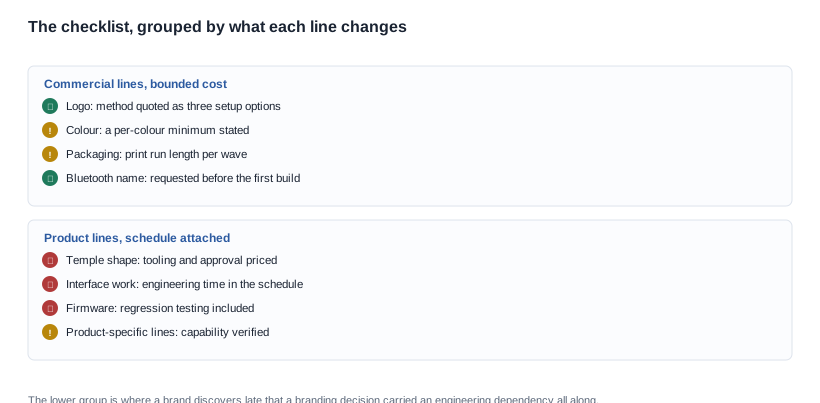

The questions behind each line
For any line you intend to use, three questions determine whether the quotation you receive is comparable to the one you expected.
- What is the cost driver? Setup charge, tooling, engineering time, or a per-colour minimum. Each behaves differently as volume rises, and a line with a per-colour minimum gets cheaper per unit with range while the others do not.
- What is left untouched? Electronics, firmware, radio, certification basis. A line that leaves all four alone is a commercial decision; a line that touches any of them is a product decision with a schedule attached. This is the question that separates the four lines we can price today from the three that need scoping, and it can be answered in a sentence per line.
- What happens if the requirement changes later? Reorder cost, retooling, or a re-quote from zero. This is the question that separates a bounded commitment from an open one, and it is the one a brand usually asks only after the first wave has shipped. Where the answer is a re-quote from zero, treat the line as a design decision rather than a production one, because it will be made once and kept for years.
A fifth question is worth asking of any line that produces an artwork file: who holds the master, and in what format. A brand whose logo exists as a PDF emailed once has no logo in any meaningful sense, and the first person who needs it will not be able to produce it at the resolution the application method requires.
The same three questions apply to the product-specific lines, and they produce the same split. A customisable remote control is a commercial line until someone specifies its behaviour, and lens configuration is a product line from the moment a value is chosen. The classification follows the commitment, not the label on the catalogue page.
A fourth question applies to the range as a whole rather than to any line: what is the maintenance obligation once several lines are combined. Each line maintained separately is straightforward; the same set of lines maintained together against a new firmware build is a different amount of work, and it is worth asking for before the combination is agreed.
What we can price now, and what needs scoping
Publishing an unverified line is more useful to a buyer than omitting it. Omission is ambiguous — it might mean the capability does not exist, or that nobody has checked — and ambiguity in a menu is expensive because it gets resolved the slow way. A line marked unverified costs a question and saves an engineering programme.
We publish the customisation lines our catalogue lists, including the two places where it says a capability is unverified or undisclosed, because those are the two lines a buyer is most likely to be asked about in a design review. We will not extend a capability from one range to another, and we will not quote a change we cannot price.
That list is a statement about our current knowledge rather than a permanent boundary, and it is worth asking us to re-confirm it at the point a programme moves from shortlist to specification, because the answer changes as tooling is reused and as new ranges are added.
We will say plainly which of the lines above are a conversation we can have now and which require engineering time to scope. The lines that can usually be priced against a published configuration are the ones recorded against that model, and the count of them varies by category rather than being fixed across the range. The lines that need engineering to scope are temple shape, system and interface, firmware behaviour, and any product-specific line such as lens configuration or a customisable remote. For those lines, the useful thing to ask for is not a price but a range, plus what would move it to the bottom of the range — because a scoped engineering estimate with its assumptions written down is worth considerably more than a single figure with no basis.
Two questions are worth putting in writing, and neither of them is about unit price. First, ask for a quotation that separates the setup from the recurring element, because a single blended figure cannot be extrapolated and the whole purpose of a first quotation is to inform a second one. Second, ask what the minimum is per line rather than per order, since a programme with two colours and three packaging waves has effectively six separate commitments and should be priced as six.
Where a brand needs all seven lines at once, the order above is still the order to negotiate them in, but it is worth asking for the whole set against a single engineering scope rather than as seven separate requests. Seven individually scoped requests will each contain their own setup, and the aggregate will be higher than the same work scoped once.
The distinction is not a way of avoiding the question. It is a way of telling you which part of the schedule is at risk, and a programme that knows that on day one plans the temple decision in month one rather than in month three.
The full scope of the menu is set out under customization options, and the commercial effect of each line is in how deep a customisation goes.
Related reading
- The brand-side of the same question: oem ready platform branding options.
- Packaging and logistics as one decision: oem ready platform logistics planning.
- What a factory needs from you before quoting: oem ready platform lead time.
- The compliance consequence of the same menu: customization options certification impact.
Send us the changes you need and we will separate the ones we can quote from the ones that need engineering to scope, with the cost of scoping quoted before the work starts, not after it.


