

Customisation depth is the question that decides whether a platform programme stays a configuration exercise or becomes an engineering programme, and it is almost always asked as a yes-or-no question that nobody can answer honestly. Can you customise? Every supplier can. The useful question is which level of change you are buying, what each level costs in engineering time and in re-validation, and where the boundary sits between a change the supplier can absorb and a change that needs new tooling, new firmware and a new set of documents.
This article sets out the five levels that describe how deep a customisation actually goes, what changes commercially when a programme moves up a level, and how to write a request that comes back with a number attached rather than a promise. It also states plainly where our own published options sit on that ladder, because the honest position is that an OEM ready platform is defined by the depth it already covers.
The question gets asked badly for a structural reason. A supplier that answers yes is describing capacity, and capacity is real: an experienced factory can engineer almost anything. A supplier that answers no is describing a catalogue, and a catalogue is real too: it is the set of things already solved, already documented and already priced. Both statements are true about the same factory on the same day, and only one of them is a plan. The useful question is not whether customisation is possible but which of the five levels below the request belongs at, because the level decides the one-off cost, the effect on the unit price, the work that has to be redone before the first shipment, and whether the change can be made twice without paying for it twice.
Establishing the level early is what turns a negotiation about scope into a negotiation both sides can reason about. Leaving it open leaves the two parties negotiating about a promise, and a promise is not something either of them can price. That is the whole argument of this article: the ladder is not a way of complicating the discussion, it is the minimum structure needed to have one.
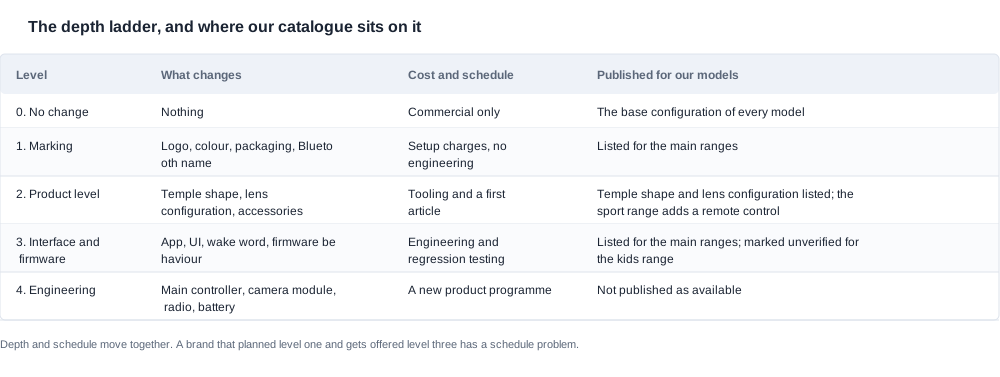
OEM ready customisation depth: the five levels a programme actually reaches
The ladder below is not a marketing scale. Each level is defined by what has to be redone to deliver it, which is the only definition a buyer can use in a negotiation.
Level one is the published configuration. The model, the colours, the marking, the packaging, the language set of the documentation, the channel-specific artwork. Nothing in the design moves, so nothing in the test plan moves, and the cost of a change is a production and artwork exercise. This is the level at which a platform is genuinely ready: the configurations are known, the cost of switching between them is predictable, and the supplier is not inventing anything while your order is being built.
Level two is the product configuration. A different case, a different charging interface, a different cell format, a different acoustic arrangement, a different optical path. The published row for the platform changes, and with it the documentation that describes that row. The engineering is modest, but the consequence is not: a variant that does not exist on the catalogue has to be created, described and evidenced, and in a regulated market that means the file has to be extended to cover it.
Level three is the interface and firmware layer. A different application, a different integration, a different control scheme, a different data path, a different update model. The hardware may be untouched, but the thing that ships to the end customer changes, and everything that depends on that thing — the onboarding flow, the instructions, the support process, the privacy and security position — has to be revisited.
Level four is the engineering layer. A new frame geometry, a new temple cross-section, a new optical path, a new electronics arrangement, a new acoustic chamber. This is the level where tooling appears, where a new programme's worth of engineering is spent before the first unit, and where the certification and conformity position has to be re-established for the new design rather than inherited from the old one.
Level five is the platform itself. A different product built on the same manufacturing and quality system, with its own specification, its own documentation, its own test plan and its own lifecycle. It shares a supplier and a process, and very little else, and a buyer who expected level one economics at level five will be disappointed in a way that is entirely predictable.
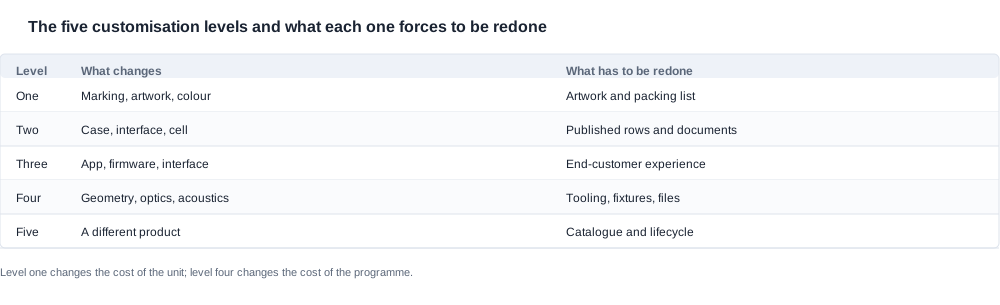

What changes when you move up a level
The commercial consequence of a level is not the engineering hours. It is the number of things that stop being true when you change them, because each of those is a document, a test, a conversation or a delay that somebody has to own.
At level one, the things that stop being true are the artwork and the packing list. The cost is a charge per unit, the lead time is a production slot, and the risk is that the change lands after a print deadline. There is no engineering risk and no conformity risk, which is exactly why this level is worth protecting: a programme that stays here can change its commercial offer between the first order and the third without reopening anything.
At level two, the things that stop being true are the published rows themselves. A case change changes the charging rows, the carton contents, the transport classification and the instructions. An interface change changes the accessory list, the certification scope and the customer's expectations of what is in the box. The supplier has to re-state the product, and the buyer has to accept that some figures in the current documentation no longer describe what will arrive.
At level three, the things that stop being true are the ones the end customer experiences. The application, the pairing behaviour, the update path, the data the device holds, the language of the interface. This is the level at which a procurement decision starts to need a technical owner on the buyer's side, because the specification stops being a catalogue line and becomes a document that somebody has to review and sign.
At level four, the things that stop being true are the ones the factory and the regulator see. The tooling, the fixtures, the inspection plan, the test samples, the design records, the conformity assessment for the new configuration. A programme that reaches level four should expect to be a programme: a specification freeze, a tooling release, a pre-production build, a first-article inspection, and a documented set of changes that were considered and accepted.
At level five, the things that stop being true are the ones the relationship is built on. The catalogue rows, the published options, the tooling you may have paid for, the platform the other programmes in your range are running on. It is a different product that happens to be made in the same building, and it should be costed as one.
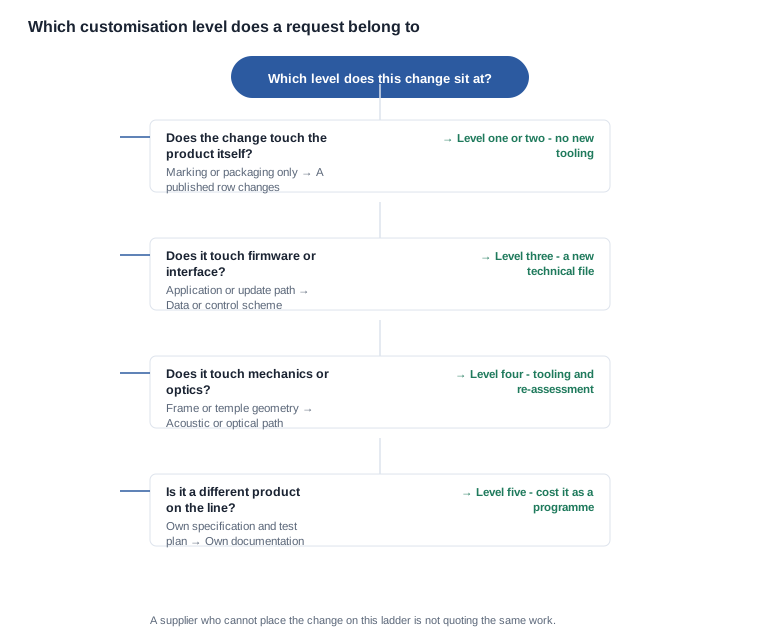
The cost of depth, and why the deepest level is rarely the right one
Depth is not free, and the price of it is paid in three currencies: engineering time before the first unit, documentary work before the first shipment, and the loss of interchangeability across the range afterwards.
Engineering time is the least visible of the three and the one most often discovered late. A level-four change does not simply cost the hours of the drawing; it costs the review cycles, the sample loops, the tooling trial and the correction work that follows a first article that did not meet the drawing. A programme that reaches level four without a written specification will pay for the specification twice, once in engineering and once in the pre-production stage where the same questions are answered again with less time available.
Documentary work is the currency that decides the launch date. Every additional row that changes is a row that has to be described, translated, printed, and evidenced, and in a regulated market it is also a row that has to be assessed for conformity. The level at which this stops being a document exercise is the level at which a launch date becomes a function of testing rather than of production. Buyers who treat a level-three change as if it were level one are the ones who discover that their first shipment is waiting on a lab.
The third currency is the one that is hardest to put in a quotation: interchangeability. The practical value of a platform is that two programmes in the same range share a case, a cable, a carton, a firmware build, a set of instructions and a service process. Every level of depth reduces that sharing, and the buyer who takes two programmes in opposite directions ends up with two supply chains where they budgeted one. This is the trade-off that a shortlist should be built around, and it is invisible if the shortlist is built on unit price alone.
The practical conclusion is that the deepest level is rarely the right one for a buyer who is buying a platform in order to move faster. Depth is worth paying for when the change is the product. It is not worth paying for when the change is a preference, because the same outcome can usually be reached by changing the artwork, the configuration or the channel approach instead.

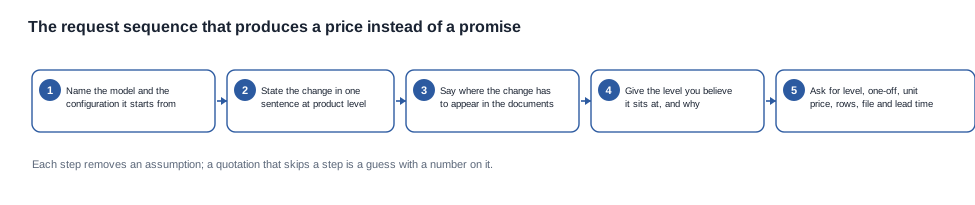
How to write a request that comes back with a price
The difference between a quotation and a promise is usually the specificity of the request. A request that says "we need customisation" produces an answer about capability; a request that names the change, the model it applies to and the document it has to appear in produces an answer about cost.
A workable request has five parts.
- The model and the configuration it starts from. Name the published model, the colour, the case and the marking that exist today, because a change is only meaningful against a stated baseline.
- The change itself, in one sentence, at product level. "A 1400 mAh case instead of the 900 mAh case" is actionable; "better battery life" is not.
- Where the change has to appear. The packaging artwork, the instructions, the online listing, the channel asset, the manual in the box. A change that does not appear in a document costs nothing and is worth nothing either.
- Which level you believe it sits at, with your reasoning. Disagreeing with the supplier about the level is cheap; the reasoning is what lets either side show its work.
- The volume band you are asking about, because depth is priced against volume and the answer at the first order is not the answer at the twelve-month figure.
The response you want back is equally specific: the level, the one-off engineering if any, the effect on unit price, the effect on the published rows, the effect on the conformity file, and the lead time. A response that gives you the unit price alone has told you the least important of those six things.

Comparing two quotations that sit at different levels
The most expensive mistake in a customisation negotiation is not choosing the deepest level. It is comparing two quotations that are priced for different work, and reading the lower number as the better offer. Two quotations for the same programme can differ by a wide margin and both be correct, because one of them is priced at level two and the other at level four, and the gap between those numbers is the engineering and the re-validation rather than any inefficiency in the factory.
Here is the sequence that makes the comparison honest.
- Put each quotation on the ladder before you put them side by side. A unit price without a level is not a comparable figure. If one quotation does not state the level, ask for it; a supplier who will not place its own work on a ladder is telling you something about how the work will be managed.
- Separate the one-off from the recurring. The engineering is a one-off; the effect on the unit price, on the documentation and on the lead time is recurring. A comparison that nets the one-off against the first order's unit price is comparing a project cost with a production cost and will always look like a bargain.
- Ask what each quotation does to the published rows. This is the item most often left out of a comparison, and it is the one that decides whether the two programmes can share a case, a cable, a carton and a firmware build later. Two quotations that look close on price can be months apart on the day your range has to be consolidated.
- Price the documentation, not just the unit. A level-three or level-four change moves the conformity file, the instructions, the artwork and the support material. Those items rarely appear on a quotation as a line of their own, and they are the part of the change that decides the launch date.
- Ask for the lead time as a consequence, not as a promise. A level-four programme has a specification freeze, a tooling release, a pre-production build and a first article before the first shipment. A level-two programme has a production slot. The two numbers are not comparable, and a buyer who compares them will be disappointed by the accurate one.
- Decide which level you actually need before you compare prices at all. The cheapest quotation is the one that does the work you need and no more. Programmes commonly lose money by buying a deeper level than the requirement, and the saving is invisible because it shows up as a supplier who was more expensive on a different programme.
The test of a good comparison is simple: two quotations, each placed on the ladder, each with its one-off separated from its recurring effect, each with its effect on the published rows stated, and each with a lead time that follows from the work described. On that basis the two offers are comparable, and the decision is a decision about the programme rather than a decision about a number.
A shortlist built this way also protects the negotiation. When you can say that a lower quotation is priced for a shallower level, the conversation stops being about discount and starts being about scope, and scope is something both sides can reason about. When you cannot say it, the lower quotation is simply an offer for a different thing, and treating it as the same thing is how buyers end up with two programmes that cannot be run as one.
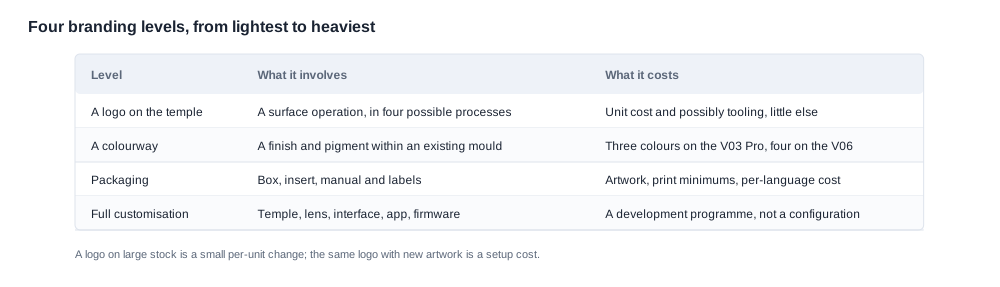
Where our published options sit, and what they do not reach
Our own range is an OEM ready platform, and it is worth being precise about what that means, because the honest answer is narrower than the marketing phrase usually suggests.
The catalogue publishes configurations and options for a range of 28 models, and the published rows include the charging case capacities that appear across the range, the cell capacities for the camera models, the charging interfaces by model, and the ingress rating where a model publishes one. Two models publish an IP rating, and the range does not generalise it to the others. The customization options page sets out the menu as it stands, and the customization options checklist is the shorter version of the same list for a buyer who wants a working sheet rather than a catalogue.
Two limits are as important as the contents. First, we do not publish a customisation catalogue, a fixture list or a tooling list, and we do not publish a per-model certification row for any model in the range. A buyer who needs to know whether a specific mark can be applied to a specific variant, or whether a specific variant holds a conformity document, has to ask for that specific answer rather than infer it from a table. Second, the range is a platform in the level-one and level-two sense: the configurations, the cases, the interfaces and the marking options are the depth we support without becoming an engineering programme. Moving beyond that is possible, and it is quoted as a project rather than as an option, because that is what it is.
We will tell you which level a change sits at, and we will say so before you commit to it rather than after the quotation. The certification impact of a customisation page covers the documentary consequence of each level, and how deep a customisation goes is the longer discussion of the same ladder from the programme side. Where a document does not exist for a request, we will say that rather than offer a near equivalent, because a buyer planning a launch date needs the absence more than they need the reassurance.
The decision is not which level is best. It is which level your programme needs, and whether the supplier will tell you which level you are buying before the order is placed rather than after the tooling is paid for.
Related reading
- The options as published — customization options
- The working sheet — customization options checklist
- The documentary consequence — customization options certification impact
- The programme side of the ladder — how deep a customisation goes
- The platform itself — OEM ready products
Send us the model, the configuration it starts from and the change in one sentence, and we will tell you which level it sits at, what it does to the published rows, and what it costs as a one-off, as a unit price, and in lead time.


