

A pricing tier table is a compression device. It takes a structure that genuinely varies from one order to the next and flattens it into a small number of published figures, and that flattening is exactly what makes the table useful to a buyer and dangerous to rely on. Smart glasses wholesale pricing tiers are worth reading for what they encode and, more importantly, for what they leave out, because in this category the variables that decide the landed figure sit mostly outside the table rather than inside it.
This catalogue publishes no unit rate, no tier table, no price band and no volume break, and none is stated in this article. What follows is the anatomy of a tier table: the four definitions it needs before it can be read at all, which of those definitions the catalogue itself constrains, which decisions have to be taken before the table can be applied to a specific basket, and what two quotations have to state before they can be placed on one basis for comparison.
The catalogue's published detail is what makes the anatomy concrete. Twenty-eight models, of which eleven are camera models, eight are audio models, three are sport models and three are children's models, with three entries that have no formal SKU. Six different case states sit inside the camera range, charging method is published for all but four camera models, two models publish a colour split, two publish an IP54 marking, every model publishes a charge time and a rated runtime, exactly one model publishes a weight, and no model publishes a certification row.
Smart glasses wholesale pricing tiers: what a tier table actually encodes
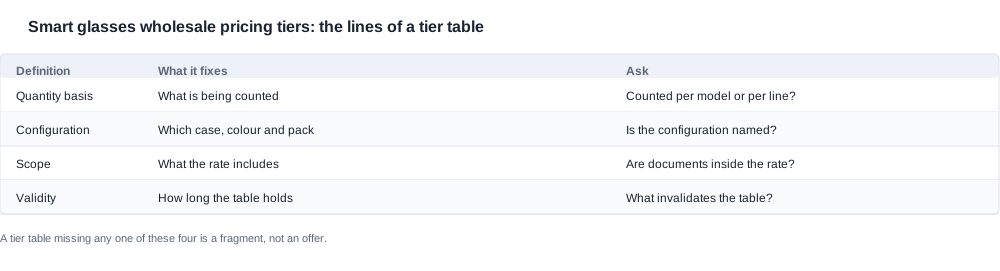
A tier table answers one question: at what quantity does the unit rate change. It does not answer the question a buyer actually has, which is what a specific basket will cost to deliver. Between those two questions there are four definitions, and a table that omits any one of them is a fragment rather than a usable instrument.
The first definition is the quantity basis: what is being counted. The second is the configuration basis: which model, which case state, which colour split and which packaging the rate assumes. The third is the scope basis: what the rate includes, such as documentation, packaging, inspection, freight, warranty and the terms attached to it. The fourth is the validity basis: how long the table holds, and what invalidates it.
Two features of a well-built table are worth checking for, because their absence tells the buyer something about how the table was constructed. The first is that the tier breaks usually correspond to changes in how production is batched internally, since that is what creates a break in the first place. The second is that the table is normally presented in tiers of the quantity axis alone, with the configuration and scope fixed for the whole table. Both features are useful to interrogate, because the question that follows from each is more informative than the rate itself.
The question to ask of any break is therefore what changes inside the supplier's process at that point, and the answer is usually more useful than the number because it tells the buyer which orders the break was designed for. A break that appears at a quantity the buyer's programme will never reach is a break the buyer is paying for in the table but not using.
A third feature is worth noting, because it determines how much of the table is real. Some tables carry a small opening section that records the assumptions on which the rest depends — the model list the table was built for, the packaging it assumes, the market it was quoted into. Where that section exists, the table is a document with a scope. Where it does not, the table is a set of numbers with no scope at all, and every figure in it has to be re-established before use.
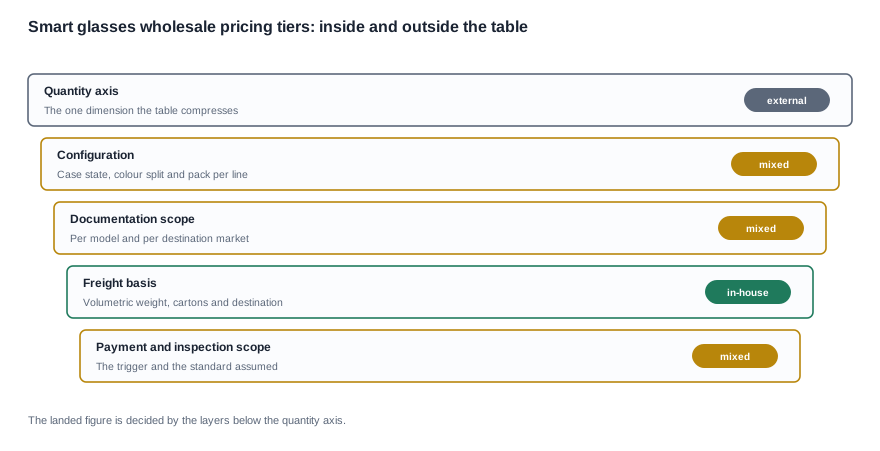
There is also a structural point about tier tables that is easy to miss. A table compresses one dimension, and in this category the dimension that varies most from order to order is configuration rather than quantity. A buyer who treats the tier table as the complete commercial offer is working with the one dimension the supplier found convenient to publish.

Smart glasses wholesale pricing tiers: the quantity axis is the one that looks settled
The quantity axis is the part of a tier table that looks unambiguous and usually is not, because the word quantity can refer to at least five different things in a wholesale order.
It can mean units of one model across the whole order. It can mean units of one line, where a line is a model plus a configuration. It can mean units of one colour split. It can mean units of one case configuration, which in a camera basket can be several configurations of the same model. And it can mean the order as a single quantity, in which case a basket of four models counts as four.

The same basket can therefore land in different tiers under different counting bases, which is why the basis has to be stated rather than inferred. A basket of four models across three colour splits and two case states could be counted as four units, as twelve lines, as twenty-four colour lines or as one order, and those four readings do not produce the same tier.
The second definition that matters is whether the tiers are cumulative or all-or-nothing. A cumulative table applies the first tier rate to the first tranche of the quantity and the next rate to the balance. An all-or-nothing table applies the rate of the tier reached to the whole quantity. For a buyer, the difference between the two is not a rounding detail: on a large order it can account for a meaningful share of the total, and it is the kind of difference that never appears on the page.
The third question is what happens to the tier when a line is added or removed, and whether a line that falls below a break drops out of the tier for the whole order or only for itself. A supplier who measures the tier across the order treats a small line as a subsidy for the large ones; a supplier who measures it line by line treats it as a separate commercial object. Neither behaviour is wrong, and a buyer who does not know which one applies cannot predict the total of the next order.
Smart glasses wholesale pricing tiers: the variables that sit outside the table
These are the variables a tier table cannot see, and in this category they are where a buyer's landed figure is actually decided.
The case configuration is the first of them, and in this catalogue it is unusually varied. Seven of the camera models come with a charging case, and they are not the same case: three publish a 1400 mAh case, a fourth publishes two capacities of 900 and 1400 mAh, a fifth publishes a foldable 1200 mAh case, and the remaining two publish a case without publishing its capacity. Of the rest, four publish no case row whatsoever — the V06 and the S7, and the V03 and the V03 Pro — and no model in the range is published as having no case. A table that assumes one case configuration across the camera range is assuming something the catalogue does not support.
The colour split is the second. Only two models in the whole catalogue publish colours, one with three options and one with four, so for every other model a colour-led order is an arrangement the table has not priced.
The packaging configuration and its recurrence is the third, and the recurrence question matters more than the pack. Whether artwork setup is a one-off, a per-version charge or a per-order charge changes the total of the second order rather than the first, and the tier table says nothing about it because artwork is not a quantity.
The documentation scope is the fourth, and it is the one most often assumed to be included. The catalogue publishes no per-model certification row, its export certification page is company-level and built from images rather than a per-model record, and the pictures on it are ten patent certificates, of which eight are appearance-design and two are utility-model patents. Documentation is therefore produced per model and per market, and whether that work is inside the rate is a question rather than an assumption.
The freight basis is the fifth, and the table normally excludes it. The volumetric weight of the pack, the units per master carton and the destination all sit outside a unit rate, and the packaging decisions that affect them are the buyer's decisions.
The payment structure and the inspection scope are the sixth and seventh. A rate quoted against a different trigger from the one the buyer intends is a different rate, and an inspection standard that is more demanding than the one the table assumes carries a cost that is usually absorbed silently rather than priced.
The practical conclusion is that a tier table describes the quantity axis and leaves everything else to a conversation. A buyer who treats it as a complete offer will find the rest of the cost arriving later, itemised, in a quotation.
It is worth being precise about what that late arrival looks like in practice, because it is not a single extra line. A tier table priced against a plain configuration produces a quotation that adds a case variant, then adds a colour split, then adds per-model documentation, then adds a packaging version, and each of those additions arrives as its own item rather than as a revision to the tier structure. A buyer who expected the table to cover the basket will read the quotation as a price increase, when in fact the basket is simply the first one to include the variables the table was silent about. Naming those variables at the quotation stage, rather than discovering them one at a time, is what keeps the comparison honest.

Smart glasses wholesale pricing tiers: the catalogue rows that shape which tier applies
The published rows have a diagnostic use that has nothing to do with arithmetic, and it is worth being explicit about it because it is the part of the catalogue a buyer can use without any commercial information at all.
Charging method divides the range three ways. Seventeen models publish magnetic charging, seven publish Type-C charging, and four camera models simply publish no charging-method row. That last group is the diagnostically interesting one: four lines in a camera basket each require a configuration confirmation before they can be ordered, and each confirmation is work that a rate may or may not include.
Case coverage does the same thing more visibly, because six states inside eleven camera models means a basket that mixes them contains at least six structurally different configurations.
The runtime and charge-time rows add a third dimension. Every model publishes both, and for twenty-six of them the charge time is a ceiling of two hours or less rather than a measured figure, with two sport models publishing about an hour. A buyer should treat those rows as order-of-magnitude planning data, because neither figure comes with a start state, an end criterion or a duty cycle.
Two further rows narrow the field further. Only two models publish an IP54 marking, and the catalogue carries no third-party test report reference for either. Only one model in the whole catalogue publishes a weight. And no model publishes a certification row, which means that for every model in every basket, the compliance position is an open item until a supplier confirms it in writing.
The practical use of these rows is to let a buyer identify which lines in a basket are structurally distinct from the others, and therefore where the supplier's own setup work is likely to sit. The question that follows is the useful one: which of these lines carry configuration work that is charged once per model and which are charged once per order.
There is a practical exercise that turns these published rows into a working hypothesis without any commercial information at all. Take the proposed basket, group the lines by their published configuration, and count how many distinct groups there are. That number is the smallest possible number of distinct production set-ups the order will involve, because lines sharing a case state, a charging method and a colour split are unlikely to be built as different things. A basket of twelve lines that resolves into four groups is a materially different commercial object from a basket of twelve lines that resolves into twelve, and the tier table treats both as twelve.

Smart glasses wholesale pricing tiers: putting two tier tables on one basis
Two tier tables cannot be compared until they are aligned on the same definitions, and the alignment is mechanical once the definitions above have been asked for.
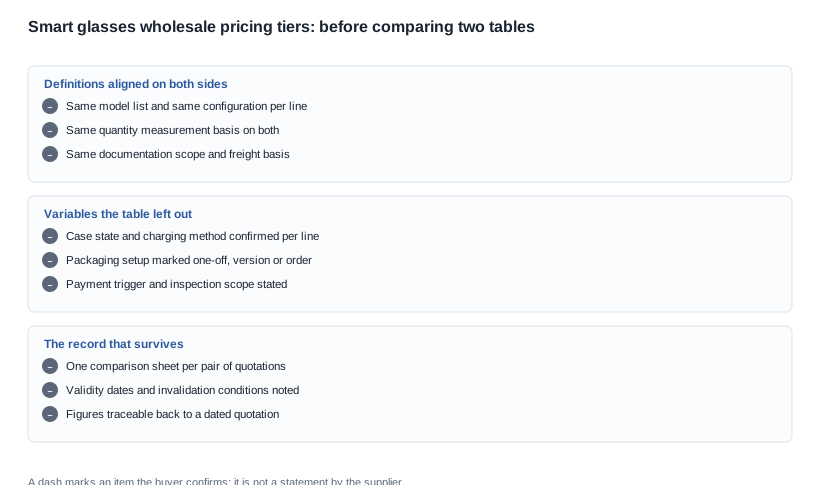
Align the model list first, because two tables over different model lists are not two prices for the same thing. Align the configuration of every line: the case state, the charging method and the colour split have to be the same on both sides. Align the documentation scope, so that one table's inclusion of per-model documentation is matched or excluded on the other side. Align the freight basis. Align the payment trigger, because a rate quoted against a different trigger is not the same rate. Align the validity period, and align the quantity measurement basis last, because it is the one that decides which tier each offer lands in.
Once aligned, the comparison becomes readable in three blocks rather than one: the per-line rates with the tier each line lands in, the shared block that applies to the whole basket, and the basket-level items that sit outside the rate altogether. The difference between two offers then has a location, and the location is the thing worth negotiating.
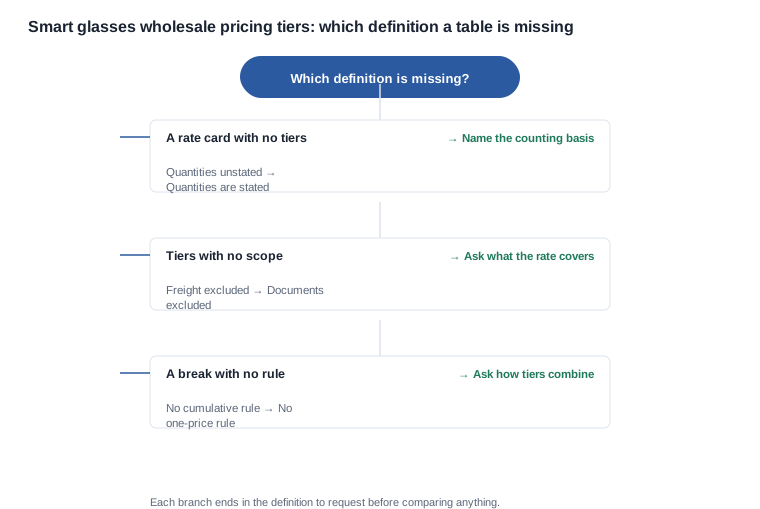
Two comparison errors recur. The first is comparing headline tier rates that were measured against different quantity bases, which produces a difference that belongs to the definitions rather than to the offers. The second is comparing a bundled table with an itemised one, where the bundled table hides the shared block inside the rate and the itemised table shows it separately. Both are avoidable, and both are avoided by asking for the four definitions in writing before any comparison is attempted.
The record that makes the comparison durable is a comparison sheet: one line per model and configuration, the tier each line lands in, the shared block, the basket block, and the date and validity on which the figures were given. A comparison that exists only in a set of emails cannot be re-run, and the second order needs it to be re-run.
There is one further comparison habit worth forming, and it costs nothing. Record the assumptions beside the figures rather than above them: which model list, which configuration basis, which scope, which date. A comparison sheet whose assumptions are recorded can be re-run against a new quotation in a few minutes, and one whose assumptions are not has to be rebuilt from scratch every time the offer changes, which is exactly the moment when a buyer has least time to do it.
Smart glasses wholesale pricing tiers: what the quotation must state
A quotation that a procurement team can use has nine things in it, and each one exists because a tier table leaves it out.
- The quantity measurement basis, stated explicitly as one of the five possible readings.
- Whether the tiers are cumulative or all-or-nothing, and how a line below a break is treated.
- The model list, one line per model and per configuration, with the case state and the charging method on the line.
- The colour split per line, wherever the catalogue publishes one.
- The packaging configuration, and whether its setup is a one-off, a per-version charge or a per-order charge.
- The documentation scope per model, including what is produced for the destination market and what the buyer holds afterwards.
- The freight basis, the payment trigger and the terms attached to the rate.
- The validity period of the figures and what invalidates them.
- The inspection scope and the acceptance threshold assumed by the price.
What CYNRIN publishes for smart glasses wholesale pricing questions
The published side of this article is the structure a tier table has to be reconciled with: a catalogue of twenty-eight entries split between four families and three without a formal SKU, six published case states across the camera range, charging published on all but four camera models, colours on two models, one charge time and one rated runtime per model, an IP54 marking on two models, a single published weight figure, and the absence of any per-model certification row.
We do not publish a unit rate, a tier table, a price band or a volume break for this range. Those figures are not published values, and planning against an unverified one means planning against the wrong one. What we will do is map a basket against the published rows, identify which of its lines are structurally distinct from each other, and state which variables have to come from a supplier's own quotation before two offers can be compared on one basis.
Two supporting readings sit either side of this one: standard OEM pricing covers the structure a tier table is usually read from, and stock availability covers the variable that decides whether a quoted lead time is the one a buyer will actually get. The procurement pricing page carries the commercial frame, and the wholesale programme entry point is where the commercial conversation starts.
Smart glasses wholesale pricing tiers are a statement about the quantity axis and nothing else. Read the four definitions off the table, then go and find the variables it left out — because that is where the landed figure lives.


