

Buying custom-built smart glasses is mostly a question of what a supplier will commit to and how a buyer can test that commitment before paying for volume. Every customization options sheet is a set of promises, and each promise is only worth what the sample stage can prove. That is why the sample process and the option list need to be designed together rather than settled one after the other: an option that cannot be checked on a sample becomes a surprise at production inspection, which is the most expensive place in a schedule to discover it.
The buyers who get this wrong are rarely the ones who care least about quality. They are usually buying under time pressure from a competitor who has already launched, so the sample is treated as a formality — a photograph and a hand-off to the production line. The buyers who get it right treat the sample as the one place where the programme can still be changed cheaply. They arrive with a written scope, a pass criterion for every item on it, and a record of what was tested.
This guide is written for brand owners, channel partners and marketplace sellers who are deciding how to structure a sample request, how to judge what comes back, and what to put into the quotation so that the answer survives into the first production order. It uses our own published catalogue as the worked example, because the catalogue is where most of these decisions are actually made: what is published can be tested, what is blank has to be asked for, and what is claimed without a document has to be verified before you rely on it.
Customization options and the sample process: what a sample can settle
A sample settles questions about one object, made one way. That is a much narrower claim than it first appears, and understanding the boundary is what separates a useful sample programme from an expensive demonstration.
The distinction worth drawing is between three kinds of option. The first is measurable: anything that can be reduced to a number — a weight in grams, a charging time in hours, a resolution in megapixels, a dimension in millimetres. A sample settles these against the published figure, and where the catalogue publishes no figure for the model in front of you, the sample itself becomes the only baseline you will ever have. The second is observable but not measurable: finish and colour depth under a defined light, hinge play, the feel of a temple on the head, the behaviour of a physical control, the sound of a microphone in a quiet room. These can be approved by a person, but only if that person is told in advance what they are approving. The third cannot be settled on a single unit at all: batch-to-batch consistency, certification status, packaging performance, freight behaviour, and anything whose answer depends on volume.
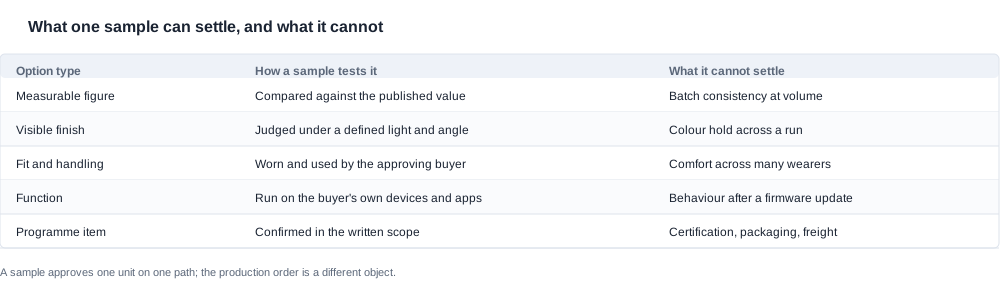
The table above sorts the questions a typical request contains into that structure. Its purpose is not to describe what happens on our own sample desk — it is to show why a buyer who expects one sample to answer every customization options question will eventually get a vague answer on the options that matter most.
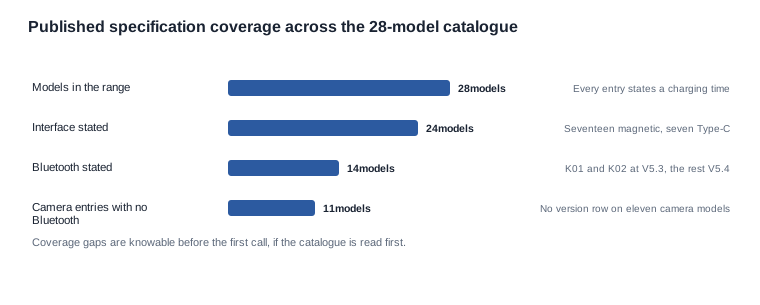
Our published catalogue gives a useful starting point for the measurable column, because it is specific in places and empty in others. Charging time is published for every model in the range, with twenty-six of the twenty-eight entries carrying two hours or less as an upper limit, and D17 and ZH12 sitting around one hour. Charging interface is published for twenty-four models — seventeen magnetic and seven Type-C — while L1 Pro and CY05, and CY03 and MT6 have no interface line at all. Bluetooth version is published for only fourteen models, with K01 and K02 at V5.3 and the rest of the published set at V5.4, and eleven camera models carry no version row. Resolution splits into eight models at 8MP and three at 13MP, which are S7 and L1 Pro, and L2 Utral. An IP rating appears against two entries, V06 and S7. Weight is stated for one model only, MT6 at 158 g. Colour is stated for two models only, V03 Pro with three colours and V06 with four.
Those figures decide what you can hold a supplier to. Where the catalogue publishes a value, a sample either matches it or it does not, and the conversation is short. Where the row is blank, the sample is your first data point rather than a check on one, so it needs a record attached or it will be lost with the packaging.
There is a second boundary that buyers regularly miss. A sample built by hand, or on a single-off path, can look and behave differently from the unit that eventually comes off the line, because the production route may use different process steps, a different source for the same component, and different tolerances. A sample that passes tells you less than it appears to unless you know which route it was built on. Ask which path it was built on, and ask what will be identical at volume and what will only be close. If the answer is that the sample and the production unit are made the same way, that answer is worth more than a glossy inspection report.
The three questions a sample request has to close first
Before a supplier can quote or build a sample, three things have to be answered, and all three are questions the buyer has to ask. None of them can be inferred from a product page, and each one changes the sample that gets built.
- What is in scope for this sample, and what is explicitly out of scope? A request that says "one of your camera models with our branding" gives the supplier licence to interpret every customization options field in the way that is easiest for them. A request that lists the options in and the options out gives them nothing to interpret.
- What is the acceptance criterion for each item on that list? "Looks right" is not a criterion. A weight in grams, a photograph under a fixed light and angle, a charging time measured over a stated cycle, a pairing sequence that completes with the buyer's own devices — these are criteria, and they can be signed off by a person who is not the person who wrote them.
- What happens to the finding when the sample does not pass? If the answer is that the sample is rebuilt at the supplier's cost until it passes, the buyer should know that in advance, because the alternative — that the option is simply dropped from the programme — changes the commercial picture completely.

The sequence in the diagram is deliberately short, because the most common failure in a sample programme is not a bad result but an unusable one: a unit arrives, opinions are exchanged, and nobody can say afterwards whether it passed. Written scope first, criterion second, path third, test fourth, signed record fifth. In that order, a failed sample is a cheap event. Out of that order, a failed sample is an argument.
Two traps deserve naming. The first is the scope trap, where a request lists eight customization options and the supplier builds one, leaving the buyer with a unit that demonstrates almost nothing while still consuming the whole sample budget. The second is the criterion trap, where the criterion is defined after the unit is in the buyer's hands — at that point the criterion becomes whatever the buyer hopes the answer will be. Both traps have a simple remedy, which is to decide, before anything is built, which options carry the programme's real risk, and to spend the sample effort on those.
The trade-offs here are genuine. A narrow sample is faster, cheaper and easier to approve, but it leaves the risky options untested; a wide sample tests more and arrives later, when the programme may already have committed to a launch date. There is no formula for the balance. What there is, and what a good supplier should be able to tell you, is which options they consider low risk because the process is stable, and which ones they consider variable because the process is not.
There is a fourth question worth adding in practice, even though it is not about the sample itself: what will be done with a negative answer. A buyer who intends to treat an unfavourable result as a reason to stop should say so at the start, because a supplier who believes the sample is a formality will manage its contents accordingly, while one who believes it is a genuine gate will manage it very differently. Stating the consequence in advance is what makes the sample credible rather than decorative.

What the catalogue publishes on the custom line, and what stays blank
Buyers reading a catalogue quickly learn to distinguish between a specification that is published, a specification that is claimed, and a specification that is missing. Treating those three states as equivalent is the source of most supplier disputes, because each state carries a different burden of proof.
On our own range, charging time is published for every entry and charging interface for twenty-four. Bluetooth version, charging case capacity, weight and colour are published for parts of the range only. Certification is a separate matter: the old site and this independent site both claim CE, FCC and RoHS, but the specific models and the certificate numbers remain to be confirmed by the enterprise, and the catalogue PDF itself contains no CE, FCC or RoHS text at all. The export certification page in that PDF is an image page, and what it carries is ten patent certificates — eight design patents and two utility models. For the sports line, IP54 is marked in the catalogue without a third-party test report number. For the children's line, certification status is not provided in any form. Those are three different states, and a buyer should hold each of them at its true weight.
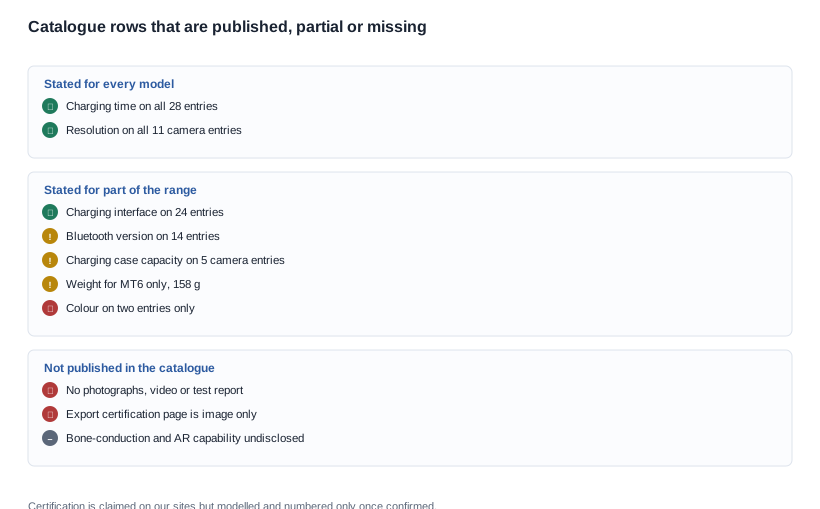
The checklist above groups the coverage of the published range into the three states a buyer actually has to work with. The point of drawing it this way is not to criticise the catalogue but to show that the gaps are knowable in advance. A buyer who reads the coverage before the first call knows exactly which questions to ask, and can tell within a single exchange whether the supplier on the other end knows their own specification or is reading from a sheet.
Some gaps are clerical and worth listing so that nobody treats them as substantive. A05 and A06 carry identical parameters, with the difference still to be confirmed. L2 Utral's name appears to be a typo for Ultra, and what Pro Max denotes is not defined. MT5 has an anomalous page reference in the catalogue and its product classification, camera or sports, is in doubt. V06 and S7 have page references that are also marked as anomalous. The electrochromic, bone-conduction and AR entries have no formal model number. None of the twenty-eight entries carries a real photograph, a video or a test report. Each of these is an item to resolve in writing, and none of them changes the shape of the programme on its own.
The other set of limits matters more to a buyer planning a launch claim. Comparative advantage in parameters can only be asserted against competitor units actually in hand, not on paper. Acoustic performance is not supported by a third-party measurement report. An IP rating needs its test report before it can be stated publicly. The electrochromic entry has no performance parameters published at all, which leaves no room for a differentiated claim. The bone-conduction entry carries a 35dB figure that raises the highest compliance question in the range, and the children's line carries the highest safety and health-claim risk. These limits are the reason a sample programme should be planned around evidence rather than around marketing copy.
The custom line itself is described internally by a count, not by a list. The AI camera line records seven customization axes, the Bluetooth audio line five, the sports line five and the children's line two, while the electrochromic entry records three. The bone-conduction entry discloses no customisation capability at all, and the AR entry is not described. The three families are not subsets of one another, so a buyer cannot carry an assumption from one category into another. For the children's line, the table itself marks the application and firmware capability as to be verified rather than confirmed. The right way to use these counts is as a prompt: for each recorded axis, ask what is actually buildable, what it depends on, and how it would be evidenced.
How to run a sample so the answer survives the next order
A sample is worth what its record is worth. The unit itself is consumed by the first inspection and then lies in a drawer; the record is what a production inspector, a compliance file and a customer complaint can be checked against months later.
Start by making the record the deliverable. When the unit arrives, photograph it in a fixed position under a fixed light: front, both profiles, the hinge, the charging interface, and the underside of any removable part. Weigh it and record the number rather than the impression. If a specification exists in the catalogue, compare against it and write down the result in the same sentence, including a disagreement. Note the serial or batch identifier, the firmware or application version, and the accessories that were in the box. A sample record that captures those items can be re-read by somebody who was not in the room; one that captures only impressions cannot.
The next decision is what the approved unit is used for. The most useful arrangement is for the buyer to keep the sample as the reference object and require that the first production units be checked against it — with a stated tolerance on the dimensions that matter, and a stated procedure for anything visual. Where a production unit departs from the approved reference, the contract should say who decides whether the departure is acceptable. This is a small sentence with a large effect, because without it every batch difference becomes a fresh negotiation.
Total cost is worth doing properly here, because sample programmes are usually judged on the unit price and are actually paid for in several currencies. There is the unit and any engineering time charged to build it, freight and duty both ways, the internal hours spent writing the brief, testing, recording and reporting, and the schedule cost of waiting. The last one is usually the largest and the least visible. A buyer who has budgeted only for the unit price will find that the programme quietly consumed three weeks of launch preparation. Ask for the whole figure, not the first line of it, and ask whether sample cost is credited against the order if the programme proceeds.
The same discipline applies to what happens after the sample is approved. Keep the approved unit. Keep the specification sheet it was built to. Ask that the supplier file the same sheet with the first batch so that the factory, the inspection and the buyer's warehouse are working from one document rather than three versions of it. And where an option was excluded from the sample for cost or timing reasons, write down that exclusion and its reason; the most common late-stage dispute in a custom programme is not a defective unit but an option that was quietly dropped between the sample and the purchase order.
Two units of one configuration are worth more than one unit of two configurations, and the reason is narrow enough to be actionable. A single unit proves that something can be made. Two units of the same build prove that it can be made again, which is a different and much more useful claim, and it is the claim a production order is actually resting on. Where the budget allows only one unit, the cheapest way to get some of the same information is to require a written statement of the process steps and the tolerances used, so that the repeatability question can at least be answered on paper rather than left open.
The questions to put in the quotation before a sample is built
A quotation that is going to be worked against should carry its own instruction set. The questions below are the ones we would expect a serious buyer to put in writing before a sample is built, and we have grouped them by the decision they unblock. They are questions, not answers: the commercial terms behind each of them belong to the supplier's quotation, and the right way to use this list is to send it and require a written response.
- Which customization options in our scope are built at sample stage, and which only become available at production stage?
- Which process path will the sample be built on, and what will be identical at volume and what will only be close?
- What is the acceptance criterion for each item in the scope — a measured figure, a photograph, or a behaviour?
- What is charged for the sample, and is that amount credited against the order if the programme proceeds?
- Does a customisation on this line carry a separate tooling or setup charge, and is it refundable?
- What is the minimum order quantity for the customised configuration, and how does that quantity change if the scope is reduced?
- Which certification testing is already held, which models it covers, and where are the certificate numbers recorded?
- Which of our scope items require third-party testing before they can be stated publicly?
- What is the process if the sample fails, and who bears the cost of a second unit?
- What is the approved reference unit used for at production inspection, and what tolerance applies to each dimension?
- What is included in the delivered configuration — packaging, inserts, charging case, cables — and which of those are also customisable?
- What is the earliest date the first production units could be inspected, and what drives it?
Read the answers for the shape rather than for the words. An answer that is precise about process and vague about evidence — for example, a confident statement about certification with no model list and no certificate number — is telling you where the risk sits. An answer that is precise about evidence and vague about process is telling you something else: that the documentation is thorough and the build path is not yet fixed. Both are workable, but they need different contingencies, and you cannot build either contingency until you know which one you are looking at.
One last point on how these questions should be recorded. A quotation that answers nine of the twelve above, with the other three written as "to be confirmed", is more useful than one that answers all twelve in language that says nothing. The unanswered items tell you what to watch, and the programme is built around watching them. We hold that a supplier should be willing to say "not published" or "to be confirmed" where that is the truth, because the alternative moves the discovery into your warehouse or your customer's hands. Our position is that the sample programme is the cheapest place in the whole cycle to find an unresolved question, and a sample process designed on that assumption protects both sides.
If you want the option set assessed before a sample is even scoped, the customization options overview on this site sets out how the range is structured and which parts of it are published in full. For the questions a procurement team should have answered before any supplier conversation begins, the sample and stock planning notes are written for that handover.
Related reading
- How the catalogue's coverage gaps are recorded — what a published spec, a claimed spec and a blank row each obliges a buyer to do.
- Cost factors that sit outside the sample — where the money goes once the unit price has been agreed.
- A programme checklist you can run stage by stage — the gate structure a custom programme is usually measured against.
- Sample and stock planning questions for procurement — what to settle before a supplier is asked to build anything.
For a programme that needs the option set, the sample scope and the production route handled as one plan rather than three conversations, the customization options line on this site is the place to start.


