

Two properties of this cost structure are worth naming before the lines themselves. The first is that most of the cost is fixed at the moment the decision is taken and variable only afterwards, which means the timing of a decision matters more than its size. The second is that the lines interact: a colour that needs new tooling also creates a new variant, and a new variant creates an assembly scope that did not exist before. Treating the four lines as a menu rather than as a chain is the most common way a quotation comes in lower than the programme turns out to cost.
Cost factors in this category reduce to four lines, and only one of them is usually discussed: tooling, material, assembly scope and volume. The one nobody raises in the first meeting is certification scope — the change you make to a finished product can invalidate the compliance work already done, and that re-run is a real cost line that has nothing to do with the factory. Evaluating customization options cost factors properly means pricing all five, because the fifth is the one that arrives after the order rather than with the quotation.
Customization options cost factors: the four lines that move the number
Sample cost sits in the same conversation as tooling and is usually left out of it. A sample has three components that behave differently: the engineering time to build the first unit, the material to build it, and the schedule slot it occupies before anyone is sure the requirement is right. Only the first two are money; the third is usually the expensive one, because a slot consumed by a sample that turns out to need a second iteration is a production slot nobody planned for.
The way to reduce that cost is to decide what a sample is for before ordering one. A sample for fit and finish can often be an existing unit with a surface treatment applied. A sample for a structural change cannot, and treating the second as though it were the first produces a unit that looks right and does not prove anything. Ask what each sample demonstrates, and refuse any sample whose purpose cannot be stated in one sentence.
On amortisation, the useful question is not who owns the mould but who benefits as the volume grows. Where the supplier owns it, the amortisation has to appear as a declining unit cost rather than as a fixed one, and a quotation that shows a flat unit cost across tiers has hidden the tool cost somewhere else — usually in the unit price, where it becomes invisible.
There is a third element that is worth getting into the same conversation: who absorbs a change in the specification after the mould has been cut. Where the answer is nobody in particular, the cost lands on whichever party argues least forcefully, which is rarely the right way to allocate it.
The reason to negotiate tooling separately from the unit price is that the two behave differently over time. The unit price is a commercial position and it can move with negotiation; the tooling is a sunk cost that has already been paid for by the time anybody discovers it, and it is only useful to the buyer if the amortisation schedule says who benefits when volume beats the estimate.
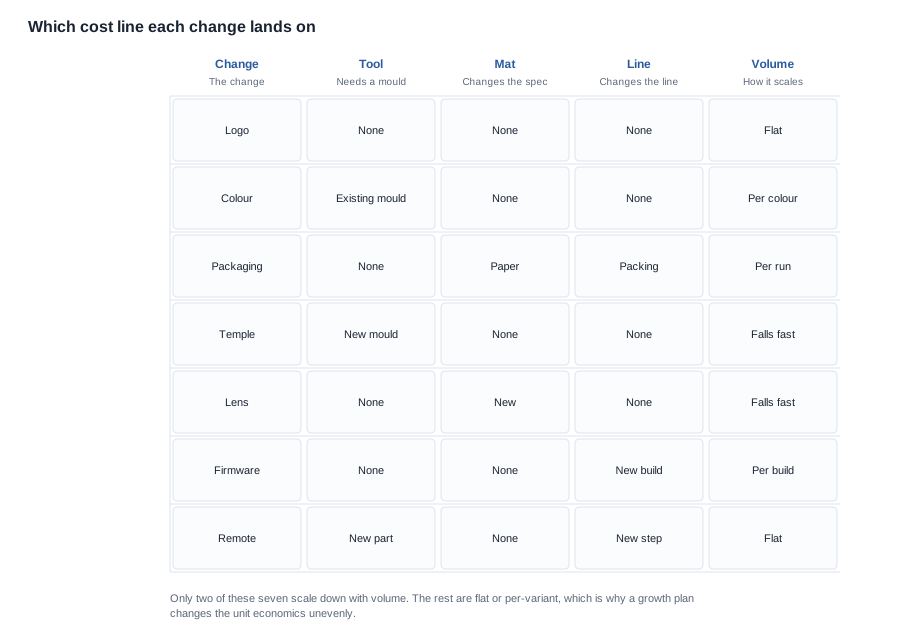
Tooling is fixed cost spread across volume. A new temple shape needs a mould. A new frame colour needs tooling changes on existing moulds, which is cheaper. The practical consequence is that the per-unit customisation cost falls sharply as volume rises, and a customisation that looks ruinous at pilot volume can look reasonable at production volume — and the reverse is also true for anything that scales with a per-variant minimum.
Material also carries the longest lead time of the four, because a new material has to be qualified against the product rather than merely ordered. That is why a material change is a scheduling decision even when it looks like a small specification edit.
Material is the least negotiable line. Lens material and lens configuration change what the product is. On our sport class the catalogue lists lens configuration as a customisable item; on the camera class lens configuration is not listed at all. A request that falls outside what the source lists is not automatically impossible, but it is a request that changes the specification, and it should be quoted as new work rather than treated as a colour change.
A useful way to size assembly scope is to count changeovers rather than operations. One operation performed twenty times a day is cheap; four variants performed in sequence are expensive, because every changeover carries setup, first-piece and verification. A supplier who quotes labour per operation rather than per changeover has quoted a number that will move as soon as the variant count does. A build sequence set up for four variants does not absorb a fifth cheaply, because the changeover pattern rather than the operation is what takes the time. Each of these is small on its own. The cost driver is not the operation, it is the number of distinct variants — because ten colourways and ten firmware builds are twenty build combinations rather than two, and variant complexity is the item that quietly destroys a delivery schedule.
Where the difference is genuine rather than an artefact of assumptions, it is usually in material rather than in labour, because labour at this scale is a smaller share of the unit cost than buyers expect and material is a larger one. Ask which material is being used and who specified it. Ask each of them what unit cost they used to derive the figure, and the difference will usually explain most of the gap.
The multiplier behaves differently for each line, and a growth plan that assumes they move together will be wrong. Tooling falls fastest per unit and stops falling once the mould is amortised. Material does not fall at all unless the supplier renegotiates it. Assembly scope falls only if the variant count stays fixed while volume rises, and rises sharply if it does not. Compliance scope does not fall under any circumstances, because it is per change rather than per unit.
The follow-on question is how much volume a given customisation needs before it is worth having at all, and the honest answer is that it depends on which cost line it lands on. A printed logo pays back almost immediately because its setup is small and its per-unit cost is nearly zero. A new mould pays back only when the volume behind it is sufficient, and the threshold is set by the tooling cost rather than by the factory. A new lens configuration may never pay back in a single model, because it may exist to complete a range rather than to serve volume.
None of those thresholds is published here, and they should not be, because each one depends on the quotation being discussed. What can be said is the structure: payback follows the ratio between a one-time cost and a per-unit saving, so the customisations worth committing to at pilot volume are the ones with a small one-time cost, and the ones worth deferring are those with a large one.
That is also why the sequencing advice above works. Decide the cheap-to-reverse customisations early because they are cheap either way, and decide the expensive ones early because you need the time to earn them back.
That last point is the one most growth plans get wrong. A programme that doubles volume and adds a colour has not halved its customisation cost; it has held it roughly flat and added a new line.
Volume interacts with everything above. This is not a separate line; it is the multiplier on the other three. A buyer who changes a colourway after tooling has been cut pays for the cut. A buyer who adds a variant after the first production run pays for the new line setup and the requalification.
The questions worth asking a supplier are narrow enough to be asked in a single call and specific enough to be answered yes or no. Can you separate the tooling from the unit price? What volume did you amortise over? What does this change do to the technical file? What happens to the cost if the variant count doubles? Where does the tooling belong if the programme ends?
The fifth question is the one that most often gets a non-answer, and a non-answer is itself informative. It usually means the supplier has not decided, which means the question will return at the end of the programme rather than at the beginning.
Read that table before accepting a blended figure. A quotation that gives one number for a colourway and a temple change is describing a different thing from one that separates the mould from the pigment, and the two are not comparable even when the totals happen to match.
It is also worth using the table as a negotiation map. Every line marked flat is a line that stays the same as the programme grows, and every line marked per variant is a line that gets more expensive the more variants a brand adds. A brand considering four colourways can calculate the second-order cost of that decision before it makes it.

The line that is not on anyone's quotation
This is the one we raise early, because it surprises buyers who assume compliance is a one-time cost.
If you change a printed logo, that is a graphics change and typically carries no regulatory consequence. If you change the temple shape, you may have changed the acoustic path on an open-ear platform. If you change the Bluetooth name or the system image, you may have changed what the radio transmits and what the software declares. If you add a lens tint range, you have changed an optical parameter.
The decision itself is usually quick; the schedule around it is not. Somebody has to establish what the file said, compare it against what the product now is, and conclude either that nothing material has moved or that an assessment is needed. The first outcome takes an hour if the file is well organised and a week if it is not, which is a useful way to judge the state of a supplier's documentation before you rely on it.
There is a fourth consequence that is less obvious. A compliance re-run has a lead time of its own, and it usually has to complete before units can move in that market. A programme that discovers this in month four discovers it after the launch date has been committed to publicly. Re-running compliance after production has started costs more than doing it before tooling, and it also costs more than doing it before the claim is made in the first place. The cost is not only the assessment; it is the production slot that goes into holding units while the question is open.
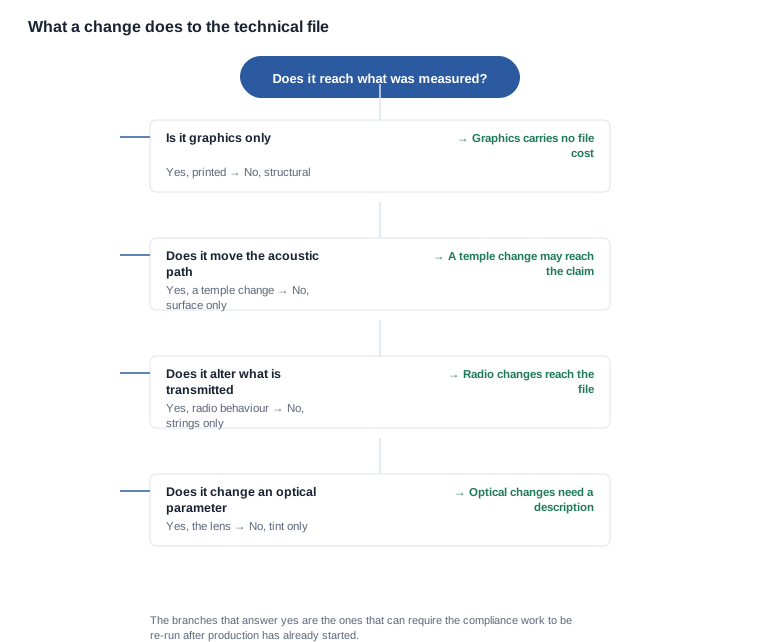
The order of those questions is deliberate, because the cost of getting one wrong rises sharply from the bottom to the top. A graphics change that turns out to matter is an afternoon. A temple change that turns out to move an acoustic path is a tooling decision, a sample cycle and a documentation review, and it is discovered at the worst possible point in the programme.
There is a failure mode here that deserves naming because it is quiet. A programme that treats compliance as a one-time cost will keep making changes and keep assuming the existing position still holds, and the discovery will come from a market rather than from the factory. The remedy is unglamorous: put the classification question in the change process rather than in the compliance process, so it is answered before a request is accepted rather than after it is built.
A second failure mode is the reverse one. A programme that assumes every change requires a full re-run will avoid useful changes entirely and end up with a product nobody wanted, because the cost of caution was never measured against the cost of the feature it prevented.
That asymmetry is the argument for asking the questions before the tooling cut rather than after, and it is the reason this line belongs in a cost discussion rather than only in a compliance one.

How to sequence a customisation request
The distinction between a specification and a mood is easy to recognise in a quotation. A specification produces a single figure that can be checked against a later order. A mood produces a range, and a range cannot be amortised, cannot be compared across suppliers, and cannot be attached to a purchase order with any confidence.
The practical test is whether two people reading the document separately would write the same specification back. If they would not, it is a mood.
A specification is not a formality. It is the document that determines whether a quotation can be compared with a later one, whether a reorder is a reorder or a renegotiation, and whether a disputed unit can be examined rather than argued about.
- Write the request as a specification, not a mood. "Blue, matte finish, temple logo" is actionable. "More premium" is a conversation that will produce two quotes and a dispute. The reason to split them is that the two paths have different approval times and different failure costs. Cosmetic work can usually be approved by a person. Structural work generally needs a sample, a tolerance and a sign-off, and it is the sample step that consumes calendar time. Colour, packaging and printed logo are one approval path. Temple geometry, lens material and assembly changes are another. Ask for the second path priced and timed separately. Ask the question in the form that can be answered in a sentence: does this change alter anything that was measured? A supplier who has to consult three documents to reply is telling you something useful about how the file is maintained. This is a specific question, and a specific supplier should be able to answer it in a sentence. The freeze date matters more than the freeze itself, because a freeze with no date is a suggestion. Put a date on it, attach it to the purchase order, and make it explicit that anything later is priced as new work rather than absorbed.
In practice the freeze date should sit a little before the first production run rather than after it, because the window between the freeze and the run is where the last-minute additions arrive, and each one of them is cheap to refuse while production has not started.
- Fix the variant list and its freeze date. Every variant added after the freeze date is a change order, priced as one. Ownership has three parts and the middle one is the one that is usually missing: who owns the mould, who pays to modify it, and what happens to it when the programme ends. The third is the part that decides whether a second order can be produced on the same tooling or has to start again, and it is worth settling before anyone is emotionally invested in the first order. Who owns the mould, who pays to modify it, and how the unit cost is derived at each volume tier.

The sequence above is deliberately ordered by how expensive it is to reverse. The specification is free and hard to unwrite. The tooling split is a negotiation and it becomes harder once the mould is cut. The variant freeze is a decision and it becomes expensive once production has started. The freight question is a clarification and it becomes a re-quote if it is left until a shipment is booked.
Read that way, the order of the questions is itself a risk assessment, and it is the part most suppliers will not volunteer.
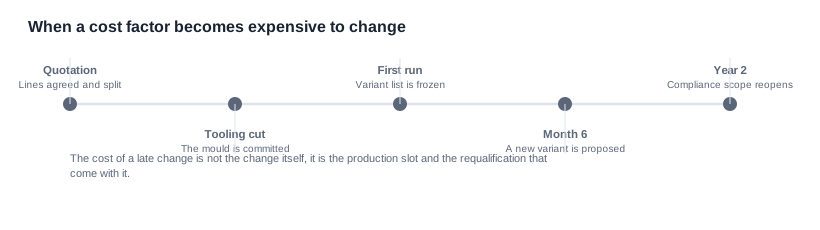
Steps four and five are the two that protect a programme after launch. A frozen variant list is what stops a well-intentioned addition in month six from becoming a re-quote nobody budgeted, and a written amortisation schedule is what makes a second order comparable to the first rather than a fresh negotiation.
Where the answer differs by market, that difference is a real cost rather than an artefact, and it belongs in the comparison. Two suppliers quoting the same unit price for different delivered positions are not quoting the same thing. A quoted freight cost is usually calculated on a full container, and a programme ordering half a container is either paying for space it is not using or being quoted on a basis that will change at the second order. A unit price that excludes duty is not a unit price; it is a starting point with a question attached, and the question is answered by a broker rather than by a supplier.
For a programme shipping a cased, branded product into several markets, ask for the delivered figure per market and ask which incoterms it assumes. That single question frequently resolves an apparent price difference that had nothing to do with the factory at all.
There is a sixth step that belongs for any multi-market programme: confirm the freight and duty treatment per destination before the quotation is accepted, because the delivered cost of a cased, branded product differs enough between markets that a unit price comparison across suppliers can be misleading.

What our position sits on
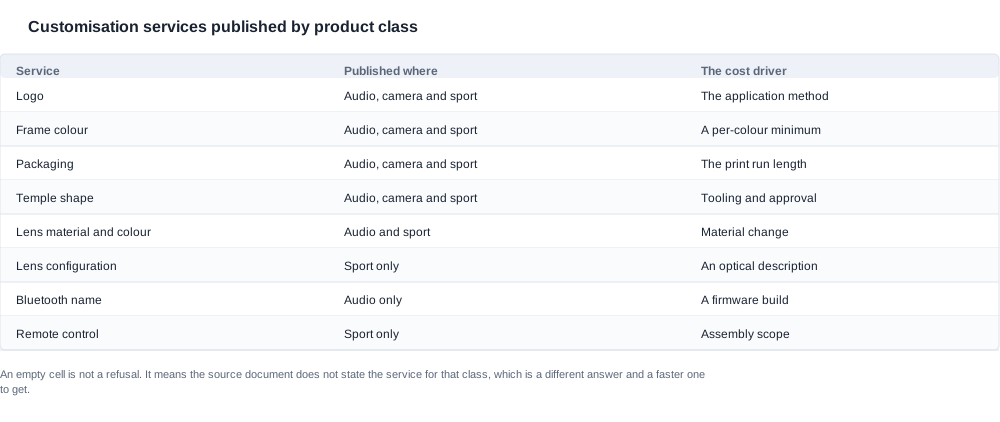
Our published customisation lists differ by product class, and we publish them as they are rather than as a single generous list. Logo, frame colour, packaging and temple shape are stated across the audio, camera and sport classes. Lens material and colour are stated for audio and sport. Lens configuration is stated for sport. Bluetooth name and system customisation are stated for the audio class. The remote control is a sport-class item.
The reason to publish the lists by class rather than as one consolidated table is that a consolidated table is a claim about capability and a per-class table is a statement about what has been documented. The distinction matters commercially, because a buyer who relies on a consolidated reading will order something we have never described as available. We would rather be found short of the list than long of the capability.
The same reasoning applies in reverse. Where a class lists a capability, that is a reasonably firm basis for a quotation against it. Where a class is silent, we would rather treat the request as new work and price it properly than discover the gap during tooling.
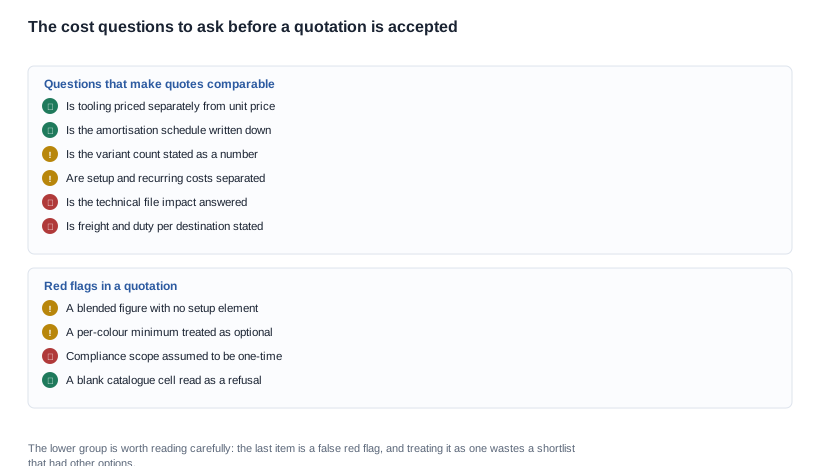
Where a list is empty, that means the source document does not state that service for that class. It does not mean we would refuse. And for two entries in our catalogue — the bone conduction platform and the AR entry — no customisation capability is disclosed at all, which is a considerably more significant gap than an empty cell in a table, because it means the whole conversation has not started.
There is also a commercial reason for the per-class presentation, and it is the one that matters at quotation stage. A consolidated capability statement is easier to sell and harder to honour. Presenting the lists as they are costs us a few shortlist conversations and saves us every conversation that would have ended in a dispute about what was agreed. The full scope of what we can change sits under customization options, and the audio platforms where most customisation lines are published are on the bluetooth audio glasses range page.
The same principle applies to the certification line specifically. We do not publish a compliance cost, because it depends on what has to be re-run and on which market requires it, and a published figure would be applied to a requirement it was not calculated for. What we can do is tell you what the change touches and therefore which assessments are candidates for a re-run, which is the part that actually helps you plan.
That principle has a practical consequence worth naming. It means some of the answers we give will be slower than a buyer expects, because confirming a figure against a component supply position takes longer than reading one off a page. It also means the figures we do give can be relied on, which is the trade a serious programme should prefer.
Where a figure depends on configuration, quantity and a supply position, we will say so and put the confirmed value in the purchase order. Where it does not depend on those things, we will publish it, and the ones we publish are the ones listed above.
One position worth stating plainly: we will not quote a cost factor we cannot evidence. Where a figure depends on configuration, quantity and a component supply position, we will say so and put the confirmed value in the purchase order rather than publishing a number that belongs to one configuration and gets applied to another.
Related reading
- Structuring a supplier conversation before quoting: smart glasses OEM risk factors.
- What changes when a product moves between classes: photochromic lens options.
- What the same set of options does to compliance: customization options certification impact.
Send us your customisation list as a specification and we will tell you which lines we can quote, which need new work, and which affect your existing compliance file.


