

The CY05 publishes four numbers that touch its power system — a 290 mAh frame cell, a charge time of two hours or less, roughly 7 hours of rated use and a 1400 mAh charging case — and not one of them is qualified by a test condition. There is no starting state, no statement of what the camera was doing, no radio duty cycle and no indication of whether the figure came from one unit or from a batch.
That is the single most useful thing about this model's battery rows, and it is also the thing that decides what you do next. A runtime figure without a condition is a marketing number, and a runtime figure with a condition is a specification you can defend to a customer, a retailer and a freight forwarder. The missing condition is therefore not a footnote to chase; it is the thing to get a supplier to supply, in writing, before the quotation rather than after the first order.
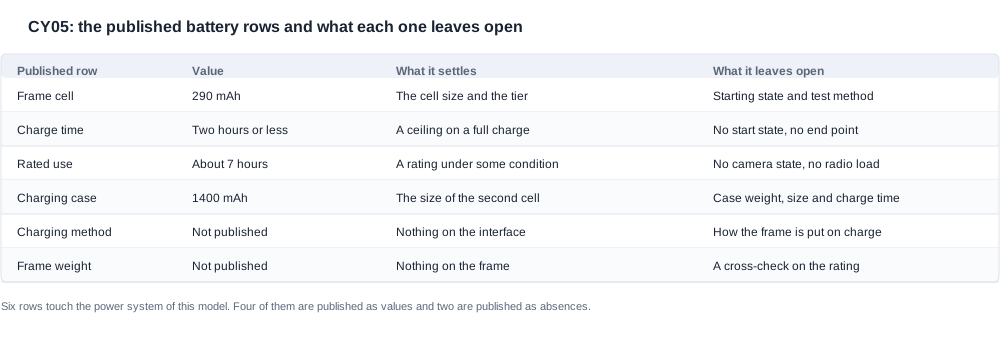
Read the roughly 7 hours as a rating taken under favourable conditions rather than as a working day, until somebody tells you how it was measured. Everything below is about how to get that answer, how to verify it on a sample, and how to avoid the specific mistake of comparing this figure with a figure from a different product class.
CY05 battery life: the four published numbers and what each one is worth
290 mAh is a capacity, not a runtime. It tells you the size of the cell and nothing about what drains it. On a camera product the camera is the dominant draw; on the same hardware with the camera idle, the number changes completely. The catalogue pairs this cell with roughly 7 hours of rated use, which is a plausible relationship for a light-load duty cycle and a generous one for continuous capture. It is the top cell tier in the camera range, shared with the L2 Utral and the L1 Pro, and the CY03.
Two hours or less to charge is genuinely useful, and precisely worded. It is a ceiling, not a measurement: the wording permits exactly two hours and does not permit a stricter claim. In a retail context it means an overnight charge is enough, and in a channel context it means the product does not need a second cable in the box to be viable. Because no starting state and no end point are published, the figure cannot be turned into "the product is unavailable for two hours during a shift" — the real interruption depends on what the battery was at when the shift started and what counts as finished.
Roughly 7 hours is a rating, and a rating is a statement about a duty cycle. No test condition is published, so the number cannot be compared with another supplier's number without knowing both methods. This is the row that most often gets read as a promise.
The 1400 mAh charging case is the commercially significant row. It is close to five times the frame cell, and it is the largest case capacity published anywhere in the camera range — the next largest is the MT6's 1200 mAh folding case. It changes the proposition from "charge it daily" to "charge it twice a week", and it changes the parcel, the freight class and the battery transport scope. For an e-commerce buyer that single row often carries more conversion value than the camera resolution does.

CY05 capacity is a ceiling, not a runtime
The chain that produces a published runtime figure has four links, and it is worth being able to name them because each one is a question you can ask.

Cell capacity sets the ceiling. The 290 mAh figure is the amount of charge available at the start of a run, and no amount of efficiency turns that into more than 290 mAh of work.
Average power draw sets the outcome. A camera that records continuously, a radio that stays connected and a display that is on are all continuous loads, and their sum is what the cell is actually working against. The catalogue publishes no power figure for any of them.
The duty cycle decides the rest. A device that is asleep most of the time and wakes periodically draws a completely different profile from one that is processing continuously, and this is why the same catalogue can publish a 20-hour rating on a 40 mAh cell in its children's models and roughly 7 hours on a 290 mAh cell in its camera models without either figure being wrong.
The test condition fixes the published number. No condition is published for the CY05. So the number exists, the method behind it does not, and a buyer who wants to rely on it has to create the method themselves.
That last link is where the commercial risk sits, because a rating is transferable between suppliers only when the condition travels with it. If your channel's specification sheet is going to carry a runtime figure, the figure has to arrive with the duty cycle, the starting state and the sample size attached, or it should arrive with no figure at all.
The rows that would cross-check the rating
Two unpublished rows would tell you whether the roughly 7 hours was measured on a realistic build.
Frame weight. Not published for the CY05, and not published for any camera model in the catalogue except the MT6 at 158 grams for the glasses body with the cell and camera fitted, excluding its folding charging case. A heavier frame demands more power for the same electronics, so an unrealistically light rating is a possibility a cross-check would rule out — and the MT6 figure cannot be used as a proxy.
The sensor and the video specification. Also not published. A larger sensor and continuous video capture both consume more power than the configuration a light-duty rating was taken from, which means the rating and the product a customer buys may not be the same configuration.
This is the general point about rated runtime in this category, and it applies to any supplier you are comparing: a single number without a condition is not comparable between suppliers, and comparing two suppliers' figures tells you about their marketing rather than about the hardware. Our wider treatment of how these numbers are produced is in smart glasses battery life, and the effect of sensor choice on draw is covered in AI camera glasses imaging.
The three questions that turn the rating into a decision
Ask these in writing, before the quotation rather than after the first order. Each one is a question about a method rather than about a product, and a supplier who answers all three has given you something you can repeat.
- Was the camera powered during the runtime measurement? If yes, the 7 hours describes the heavier duty cycle and you can plan against it. If no, treat it as an audio-class number that will not survive contact with a customer who records video daily.
- What was the Bluetooth duty cycle? Connected and idle is not the same as connected with calls and syncing. A number measured with the radio idle is close to a best case, and the difference between the two is the difference between a rating and a claim.
- What was the starting state, and what counted as the end? A rating from a partly discharged cell, or to a fixed voltage cut-off, is not comparable with another manufacturer's rating even where the numbers look identical.
There is a fourth question that is cheap to ask and that settles a commercial point rather than a technical one: does the 1400 mAh case ship in the box for the configuration you are quoting, and does the quotation treat it as part of the configuration or as an optional line? A case quoted as an accessory is a case the end customer may not have, and the endurance story on the product page then describes a product that does not exist.
When the answer is that the figure cannot be reproduced
Some suppliers will not give you a test condition, and that is a legitimate commercial position. The correct response is not to argue and not to accept the number: it is to measure it yourself on the sample and publish your own figure with your own condition attached.
The measurement is straightforward. Charge the sample from a fixed state, run it in the condition a customer will create, record the camera state and the screen state throughout, note the time until the product stops doing what the customer bought it to do, and repeat the run on a second unit so that you have a spread rather than a single observation. Write the condition next to the number every time you use it.
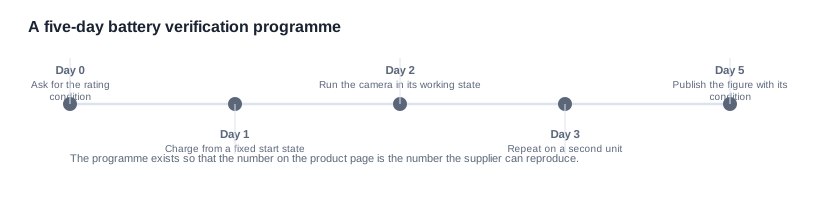
This is not a large piece of work — it is a few days and a disciplined note-keeping habit — and it is the difference between a product page that can be defended and one that cannot. The evaluation criteria for whether a figure is fit to publish are simple: a named start state, a named workload, a named end condition and a sample size. Four of them, and all four have to be present.
How the figure is written into the specification sheet
Whatever the measurement produces, it has to be written in a way that survives a review by somebody who was not in the room. That means the condition travels with the number, on every surface where the number appears — the specification sheet, the carton artwork, the product listing and the quotation.
Three phrasings recur in this category and two of them are wrong. "Up to 7 hours" overstates, because it claims a ceiling the documentation does not establish. "Seven hours of battery life" is the worst of the three, because it asserts a point figure without a condition and invites a comparison against a competitor who did publish a condition. The defensible phrasing is the conditional one — roughly 7 hours of rated use under a stated workload — with the workload named in the same sentence. A procurement reviewer reading that line can check it against the sample; a customer reading it can only take it on trust, which is why the condition belongs on the page rather than in a file.
The same discipline applies to the charge time. Two hours or less is the ceiling as published, and a specification that says under two hours says something stricter than our documentation supports. A buyer who compares the two documents will find the discrepancy, and the discrepancy lands on the specification rather than on the catalogue.
The compliance dimension of a two-cell configuration
There is a second reason to get the case rows answered early, and it is not a customer-facing one. A configuration that ships with the 1400 mAh case contains two lithium cells in the carton rather than one, and that changes what the shipment is.
The practical consequences are ordinary and they belong in the supplier's quotation rather than in a discovery at the freight forwarder's desk. The battery transport documentation has to describe the configuration that actually travels, which means the cell and the case have to be covered together. The declared weight changes, which changes the freight class and the insurance treatment of the consignment. The shelf life and the storage conditions of the cells become a warehousing question rather than a technical one. And a configuration change between the sample and the production run — a different case, a different cell — reopens the file, which is why the cell and case part numbers belong on the purchase order as controlled items rather than as a general description.
For a buyer running due diligence on a new supplier, this is the cheapest place to find out whether the supplier has actually run the assessment for the configuration you intend to buy, or whether it is still ahead of you. A supplier who can produce the transport summary for the two-cell configuration in the same week as the quotation is telling you something about how the programme will run later. The battery transport framework covers the documents themselves.
Running a measurement on the sample
The sample measurement is worth doing as a small protocol rather than as a single run, because the most common battery failure in this category is not a flat cell. It is a figure that was true for a light workload and is quoted as though it were true for a heavy one.
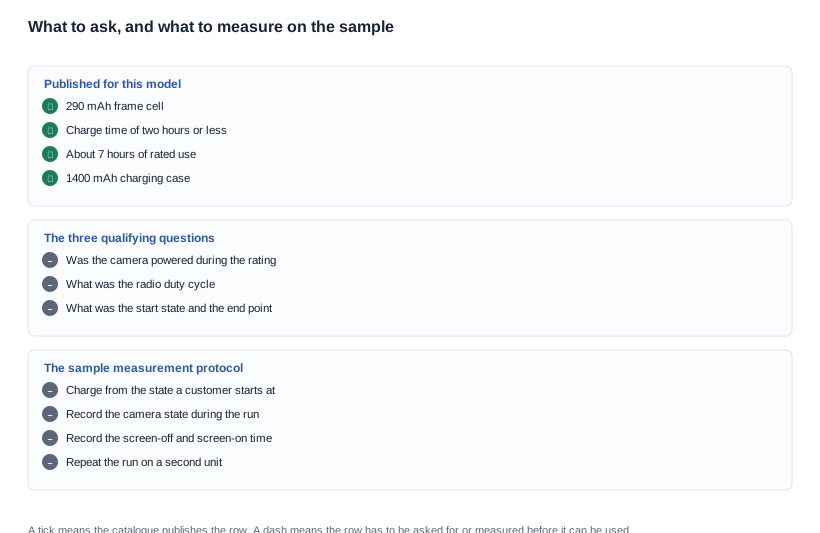
The protocol below is the version that produces a number a customer can be told about.
- Charge from a defined state. Not "fully charged" as an assumption, but the state you can name and repeat, and record the time taken to reach it. The charge-time ceiling of two hours or less belongs to this step, and it belongs to the charger that was supplied.
- Start the workload. Record the camera state, the connection state and the display state at the start, and leave them in that state for the run. A run that mixes states produces a number that describes nothing.
- Record the endpoint as a behaviour, not a percentage. "Stopped recording" or "stopped playing" is an endpoint a customer recognises. A voltage reading at an internal test point is not.
- Repeat on a second unit. Two units give you a spread, and the spread is what tells you whether the published figure is a typical result or a best one.
- Write the condition next to the number, every time. Including on the carton artwork and the listing. A figure without its condition reverts to being a marketing number the moment it is copied.
Two questions about the case belong in the same exercise, because the case is where the second cell lives. How long does the case itself take to refill, and does it carry a visible charge indicator? Neither is published for the CY05, and both of them decide whether the customer's second charge of the week happens at a socket or at a desk. The charging solutions guidance covers the range-wide picture.
Why the CY05 rating cannot be compared with an audio model
This is the mistake that produces the most confident and most wrong buyer statement in this category: comparing a camera glasses figure with an audio glasses figure and concluding that one product is better on battery.
The numbers are not comparable, because the work is not comparable. Against the camera models' 220 mAh, 260 mAh, 265 mAh and 290 mAh cells, the audio models in this catalogue carry smaller cells — 55 mAh × 2 on the LC-105 series, the G07 and the YK12, 90 mAh × 2 on the K01 and the K02, 100 mAh on the D11 and the D12, 115 mAh on the D17 — and publish rated use figures of roughly six to eight hours. A camera that records continuously and a speaker playing audio draw completely different currents, so a shorter figure on a bigger cell is not a contradiction. It is two different products being measured for two different jobs. The Bluetooth audio glasses range is worth reading if battery life is your primary criterion rather than your second.
The same trap exists inside this catalogue, in the other direction. The children's models publish roughly 20 hours on 40 mAh cells, because their workload is a periodic sensing and reminder cycle rather than continuous capture. A buyer comparing a 20-hour figure with a 7-hour figure is comparing two duty cycles and concluding that the smaller cell is better.
What is legitimate is comparing like with like: the CY05 against the other camera models, where the workload is comparable even though the cell size is not. On that basis the CY05's roughly 7 hours sits with the CY03 and the L1 Pro, and the MT6 and the L2 Utral, and the bracket-style figures on the V06, the V03 Pro and the V03, and the S7 at five to eight hours are not better or worse numbers — they are numbers written by a different hand.
The shared-platform consequence
The CY05 publishes rows identical to the CY03 — same camera tier, same cell, same charge ceiling, same runtime rating, same case capacity — and the catalogue does not state what separates them. If you are comparing this model against the CY03, you are comparing two specifications that match on every published row, and the difference you are looking for is a commercial term, a colour, an order quantity position or a lead time. Ask what actually differs; if the answer is that nothing does, that is useful to know before you build two SKUs.
What the CY05 battery rows do and do not settle
A runtime figure without a test condition should be treated as a marketing number, not a specification, however reasonable it looks on a product page. The CY05's published rows are internally consistent, the 1400 mAh case is a genuine commercial asset, and the charge-time ceiling of two hours or less is a genuinely useful row — provided it is written as a ceiling, with no starting state claimed and no interruption window derived from it.
We will not tell you the battery life is seven hours in real use, because nobody — including us — has published the condition that would make that claim defensible. We will not quote a frame weight, a case weight, a charging interface or a test method that the documentation does not contain, and we will not compare the CY05's runtime with an audio model's runtime in a way that treats two duty cycles as one measurement.
Ask us for the test condition and we will tell you whether we have it. If we do not, we will say so rather than estimate it, and that answer is more useful to you than a confident number would be — because it tells you that the number you are comparing against is also unverified, and that the sample measurement is the only way to break the tie.
Related reading
- How runtime is actually measured on camera glasses — smart glasses battery life
- The full camera model range — AI camera glasses
- Why the case capacity changes your landed cost — charging solutions
Share the target market, the quantity and the required configuration, and we will come back with what is available and what is not.


