

The D11 and the K01 look like two closely related models and are actually two different power architectures, and the difference propagates into almost every downstream decision a buyer makes. The D11 carries a single 100 mAh cell, charges over Type-C and rates about seven hours of use. The K01 carries 90mAh*2 cells, charges magnetically and rates about eight hours. The radios differ too, with the D11 publishing Bluetooth V5.4 and the K01 publishing V5.3. Read as a size comparison, the K01 looks like the model with more capacity and more endurance, and a straight line-by-line spec table will carry a buyer straight to that reading. Read as an architecture comparison, the same rows say something else entirely: the D11 is a single-cell product that a customer charges with a cable they own, and the K01 is a two-cell product that a customer charges on a dock that has to exist somewhere in the supply chain. The K01 also publishes no feature line at all, while the D11 publishes a surround-sound line and a long-battery-life line. This page works through the rows one at a time, because that is the only way the two models can be compared without one of them being misunderstood.
D11 and K01: a comparison read row by row
The rows, exactly as published
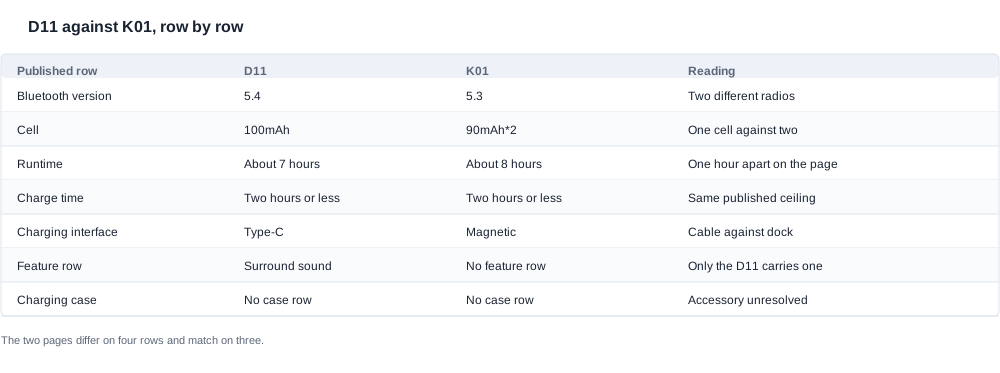
The D11 publishes Bluetooth V5.4, a charge time of two hours or less, a 100 mAh cell, a rated runtime of about seven hours, Type-C charging, and two feature lines: a surround-sound line and a long-battery-life line. The K01 publishes Bluetooth V5.3, 90mAh*2, a charge time of two hours or less, a rated runtime of about eight hours, magnetic charging, and no feature lines.
Seven rows each, four differences, three matches. The differences are the radio, the cell, the charging method and the feature lines. The matches are the charge time, the runtime band and the absence of a charging case row. Neither model publishes a frame weight, an acoustic measurement, a microphone specification, a battery cycle life, an ingress rating, a per-model certification row or a price.
The four differences, and what each one commits you to
The radio. V5.4 against V5.3 is a generation apart, and it is a compatibility statement rather than a performance claim. It affects which devices a customer expects to pair with, which matters in a channel where the return rate is driven by pairing failures rather than by sound.
The cell. A single 100 mAh cell against two 90 mAh cells is not a capacity difference, it is a packaging difference. It decides the number of cells to assemble, to balance, to protect and to age, and it decides whether the pack has one serviceable element or two.
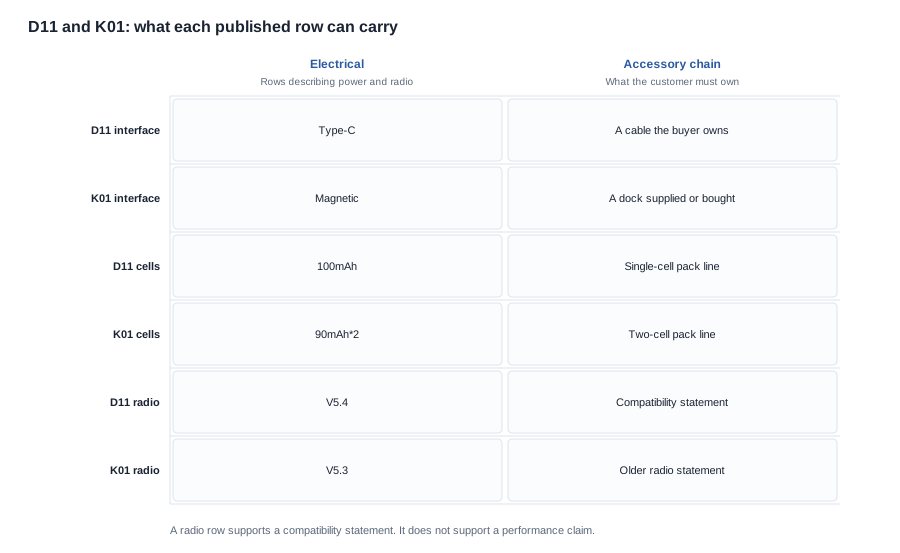
The charging method. Type-C against magnetic is the difference between a cable the customer owns and a dock that has to be in the box or on an accessory list.
The feature lines. The D11 publishes a surround-sound line and a long-battery-life line. The K01 publishes nothing on that line. That is a documentary difference, and it is the only difference in the pair that a listing page can act on directly.
The three matches, and why they are not neutral
The charge time matches at two hours or less on both, and the absence of a charging case row matches too, but the shared charge time is reached by completely different routes. On the D11, a Type-C connector has to be found on a frame and plugged in. On the K01, the frames have to be seated on a dock, and seating is an alignment act that can be done incorrectly. A buyer who reads the matched charge time as "identical charging experience" is reading a specification where the experience is not specified at all.
The matched absence of a case row is equally consequential. It means that for both models, the accessory content is a quotation item rather than a published fact, and a buyer who compares the two products on the published sheet will not see the dock that one of them needs.
The radio row: what a version number settles
Compatibility, and only compatibility
The K01's Bluetooth V5.3 is a legitimate compatibility statement and nothing more. No codec list is published for either model, no pairing behaviour is described, no multi-point behaviour is stated, and no connection stability figure exists. So the D11 can be described as carrying the newer radio in the range and the K01 as carrying the previous one, and neither can be described as better connected, more stable or faster to pair.
The commercial relevance of that distinction depends on the market. A channel whose customers pair with recent handsets may treat the older radio as an expectation, and a channel selling into markets with a long tail of older devices may see the reverse. That is a market judgement, not a catalogue fact, and it is exactly the kind of judgement that should be written down as an assumption with a source attached.
What the radio row does not settle
There is a category of claims the radio row is often used to support and cannot. Audio quality, call clarity and range are all affected by the radio in practice, but none of them is published for either model, and the D11 publishes no microphone pickup distance at all, which matters more for open-ear designs than buyers expect. A listing that says "clearer calls" needs a microphone figure, and a listing that says "stable connection" needs a behaviour statement. The catalogue has neither, for either model, and the D11's surround-sound feature line does not fill the gap.
A question that is worth asking anyway
The radio version is published for both models, which makes it one of the few rows a buyer can discuss with a supplier on evidence. The useful question is not about the version but about the implementation: which chipset sits behind the published version, and whether a firmware or module change has been made for a private-label order. A module change is the kind of modification that can affect the compliance file, so the two questions belong in the same request.
Cell architecture: one cell against two
Reading 100mAh against 90mAh*2 correctly
The catalogue publishes the D11 as 100mAh and the K01 as 90mAh*2, and it publishes them that way for a reason: the first number is one cell and the second is two cells of a stated size. In a table, those forms should be kept exactly as published, because a bare total is a derived figure and a derived figure in a specification table reads as an official one. In analysis, the totals can be used, provided they are labelled as derived: 180 mAh in total for the K01 against 100 mAh for the D11.
What the derived total does not settle is endurance, and this is where the pair becomes instructive. The K01 has a larger total and a longer published runtime, which is the intuitive result. But the two-cell end of the audio range is not consistent: the LC-105-1 and the LC-105-2 publish 55mAh2 with about eight hours, and the G07 and the YK12 publish 55mAh2 with about six hours, while the K01 and the K02 publish 90mAh*2 with about eight hours. A cell size that spans a two-hour spread in published runtime means that cell size is not what drives the outcome. Amplifier efficiency, firmware power management and the test conditions are the likely drivers, and none of them is published for any model in the range.
Why the architecture still matters commercially
Even though the runtime rows resist comparison, the architecture difference is worth a lot in three specific places.
In the pack. One cell or two changes the assembly, the balancing, the protection circuitry and the failure behaviour. A two-cell pack has two cells that can age at different rates, and a buyer who is planning a long product life has to ask about cell matching and about what happens when one cell degrades.
In the shipping documentation. Two cells means a different transport file. The rules that apply to lithium batteries in transit attach to the cell and the quantity, and the battery transport compliance guidance covers what a buyer needs to request. A buyer who changes the pack configuration without revisiting the transport file is carrying a documentation risk.
In the charging accessory. Two cells means more current to move, which usually means a dock with more capability, and the catalogue publishes nothing about the K01's dock beyond the word magnetic.

The charging interface and the parcel it implies
Type-C and magnetic are different supply chains
The D11 charges over Type-C. For a buyer this is the cheapest possible accessory story: most end customers already own at least one Type-C cable, the channel can put a cable in the box from existing stock, and the parcel can stay small. The cost of the interface is low and predictable.
The K01 charges magnetically. The K01 therefore implies a dock, and the dock has to be sourced, packed, stocked or sold. That is a supply chain the buyer has to build or buy, and nothing in the catalogue tells them what it contains, what it costs or whether it is included. Both models publish no charging case row, so for the D11 there is no case either, but the difference matters: a D11 needs no accessory at all, while a K01 needs at least one that the catalogue does not describe.
What the interface does to the customer
Both interfaces create a learning moment, and they create different ones. The Type-C customer has to find a port on a frame. The magnetic customer has to discover alignment. The first fails loudly, the second fails quietly, and a quiet failure is the one that generates a support contact rather than a return. For a channel writing quick-start material, that is a real difference in the instruction pages, and it is a difference in the box contents as well.
What to ask about both
- Is a charging cable or dock supplied with the product, and in which markets.
- What the cable or dock specification is, and whether the buyer may substitute its own.
- Whether the frames can be charged with a partially fitted or removed temple, where a detachable design exists.
- How the magnetic contact is protected in the box and in transit.

How to compare two quotations from different architectures
A comparison protocol that does not reward the bigger number
How to compare a single-cell product and a two-cell product on price is a question that comes up in almost every quotation round in this category, and the answer has to begin by refusing the headline number. The two products are not comparable on the sheet, so the comparison has to be built on the line items, and the line items have to be requested in the same form from every supplier.
The protocol we would use has five steps.
- Fix the requirement set first. Write down the working period, the customer profile, the market, the accessory expectation and the documentation requirement, before any quotation is read.
- Map each requirement to a published row or a written answer. A requirement that maps to a published row is already settled for both models, and it is where the two are most alike.
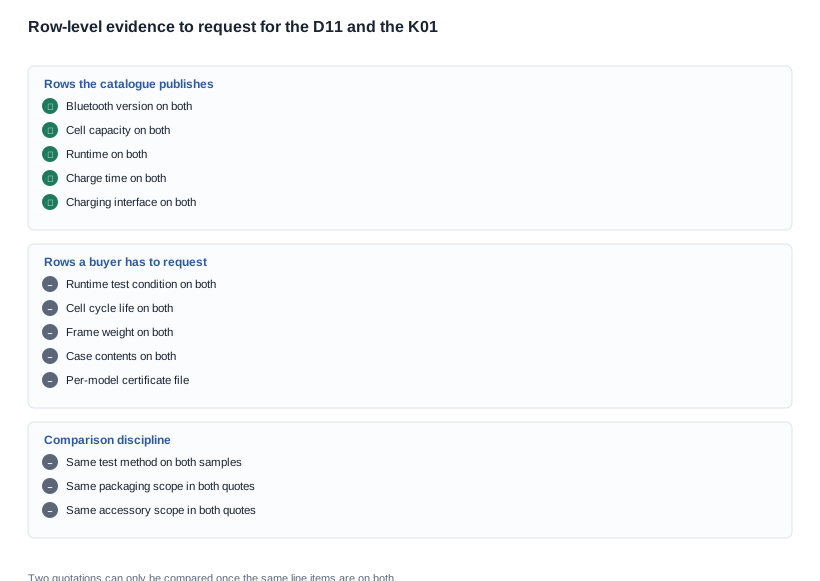
- Ask both suppliers the same eight questions. Acoustic configuration, runtime workload, charge time condition, frame weight, box contents, certification file, cell specification, material and hinge description.
- Rebuild both quotations on the same scope. The accessory content, the packaging, the documentation and the freight have to be inside both totals, or the comparison is meaningless.
- Compare the answers line by line. A supplier that answers the runtime workload question has produced a claim the buyer can repeat; a supplier that answers with a number alone has produced a figure.

The request form, in the order it works
The eight questions above are not a checklist to be sent once and filed. The order matters, because a buyer who sends all eight at the start gets a partial answer to a long form, and a partial answer to a long form is harder to act on than a complete answer to a short one. The order below is the one that works.
Round one, two questions. The acoustic configuration of each model, and the runtime workload behind each endurance figure. These two determine whether the two products differ in any way that a listing can state, and until they are answered the rest of the comparison is a comparison of packaging.
Round two, three questions. The charge time under a stated start state with its end-point definition, the measured frame weight and packed weight, and the exact box contents including whether a cable or a dock is supplied. These are the questions that change the landed cost of each product, and they are the questions a supplier can usually answer from records.
Round three, three questions. The certification file that names each exact model designation, the cell specification with its cycle life if a document exists, and the material and hinge description in enough detail to write a listing page. These take longer because they need documents, which is exactly why they need to be requested early.
Two rules apply to every round. A figure without a method does not close the question, and a statement that a document exists does not close it either; what closes it is the document. And a refusal to answer is a legitimate answer that goes into the comparison as a refusal, because a supplier who will not state the workload behind an endurance figure has told the buyer something important about how that figure was produced.
What a sample adds to a row-by-row comparison
A sample cannot add a specification row, and it is worth being clear about that before a buyer spends money on one. What a sample does add is the measurement of the rows the catalogue leaves open, and a repeated observation of the behaviours the catalogue leaves undescribed: how the two interfaces charge in the hand, how much the two frames weigh, how the two sound in the same room and how long each takes to run under a stated workload. Used that way, the sample converts open questions into closed ones, and a buyer who records the results on the same sheet as the published rows ends up with a document that can be re-checked when the next shipment arrives. A sample used only to admire the product closes nothing at all, and the difference between those two uses is the difference between a sampling cost that reduces risk and one that does not.
The K01 and the K02 reminder
One point deserves repeating for anyone comparing the D11 against a magnetic-charging two-cell model, because it is easy to lose. The K01 and the K02 publish identical rows: Bluetooth V5.3, 90mAh*2, a charge time of two hours or less, about eight hours, magnetic charging, and no feature lines. The catalogue does not publish what separates them. So a buyer who receives quotations for the K01 and the K02 and wants to know which one to order has a question for the supplier, not a comparison, and the D11 against K02 discussion works through how to handle that kind of pair.
Criteria that decide the pair, in order
The criteria that decide a D11 against a K01 are short and they are not about the biggest number.
- The charging expectation of the channel. If the channel already ships cables, the D11 needs no new accessory supply and the K01 does. This is usually the first filter, because it is a cost and a logistics filter rather than a product filter.
- The documentation requirement of the market. Both models have the same documentary position, since neither publishes a per-model certification row, so this criterion does not separate them, but it does set the timetable for both.
- The accessory story in the listing copy. The D11 has a surround-sound feature line to work with, and the K01 has nothing on that line, so a channel that intends to make an audio claim has to source a documented description for the K01 before it can write one.
- The working period. About seven hours against about eight hours, subject to the workload question, and a buyer should treat the difference as unproven until a common workload is supplied.
Where our published rows stop
We publish the electrical rows and the feature rows for every model in the catalogue, and for this pair that means everything stated above and nothing else. We publish no price, no minimum quantity, no delivery schedule, no warranty term and no production capacity figure, so we cannot tell a buyer which of the two models is the better commercial value, and we will not divide them into price tiers, because the boundaries would have to come from numbers we do not publish. We publish no frame weight for either model, so no claim about how either feels to carry all day can be made from this page. We publish no acoustic measurement, so the D11's surround-sound line can be quoted as a feature and cannot be turned into a sound quality comparison. And the catalogue publishes no touch row for any model in the range, so the interaction method on either product is a question for the supplier rather than a specification to compare.
We will answer the practical version of the comparison. Send us the models, the quantities, the target market and the channel, and we will tell you which rows are published for each model, which of your requirements are already answered, which are questions, and where a two-cell and a single-cell architecture would force a different accessory and documentation plan. That is a more durable basis for a shortlist than a ranking we are not able to evidence, and it is the same basis we use for every model we list.


