

The honest answer to the question of which of these two models to choose is that the published specification cannot answer it, and any answer that appears to answer it is doing something else. We publish no price for the D11 or the K02, no minimum quantity, no delivery schedule and no warranty term, so we cannot rank them commercially without inventing the numbers that would make the ranking meaningful. What we can do is something more durable: lay out the two routes a buying decision can take through this pair, show which published rows each route depends on, show which rows are identical, and identify the four questions that a buyer has to answer in writing before either model can be chosen on evidence. The D11 publishes a single 100 mAh cell, Type-C charging, about seven hours of rated use, Bluetooth V5.4, and two feature lines including a surround-sound line. The K02 publishes 90mAh*2 cells, magnetic charging, about eight hours of rated use, Bluetooth V5.3, and no feature lines at all. That is the whole of the difference, and it is a difference of architecture rather than of scale.
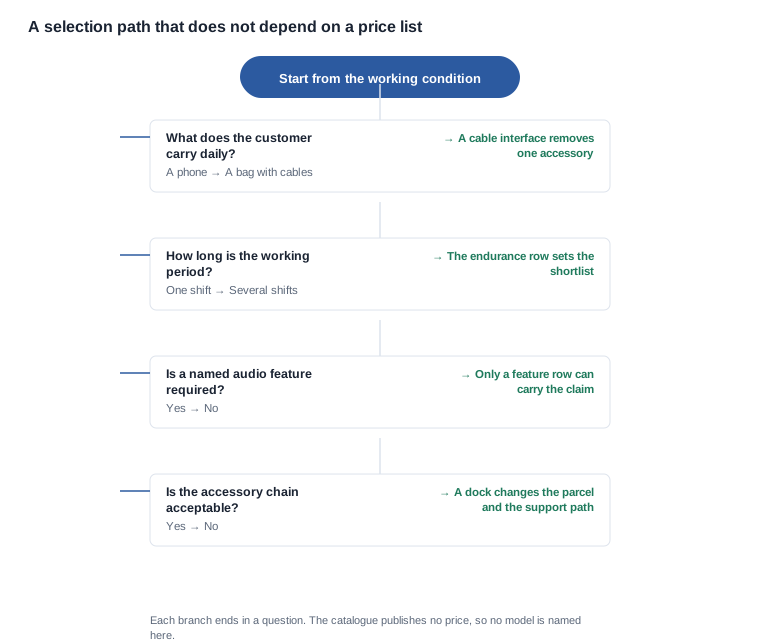
D11 and K02: two routes to the same buying decision
Route one: the channel already ships cables
If the channel already puts a Type-C cable in every parcel, or if the target customers routinely carry one, the D11's charging story closes itself. No dock has to be sourced, no dock has to be stocked, no alignment has to be explained in the quick-start material, and the accessory content of the box stays as small as the product itself. The K02's magnetic charging implies all of those things, and the catalogue publishes no dock, no dock contents and no case row for either model.
This route is decided by logistics rather than by the product, and it is a legitimate way to decide. It also has a limit worth stating: it settles the accessory question and nothing else. It does not settle the runtime question, because the two endurance figures carry no published workload. It does not settle the acoustic question, because only one of the two models has any acoustic line at all. And it does not settle the documentation question, because neither model publishes a per-model certification row.
Route two: the customer's working period is the constraint
If the product is going into a working environment where a charging opportunity is not guaranteed, the endurance row becomes the filter, and here the two models are separated by about one hour on the page: roughly seven hours for the D11 and roughly eight hours for the K02. That separation is not usable yet, because no test condition is published for either figure and the range contains cases where identical cell configurations publish different runtimes. So the correct use of this route is not to pick the longer figure but to ask for the workload behind each, and to require the same workload for both.
The battery comparison across the range sets out why the published runtime rows cannot be compared without a common condition, and the outcome is that a buyer who asks for the condition gains a comparison while a buyer who does not is left with two numbers that resemble a ranking and are not one.
Route three: the listing needs a named audio feature
The D11 publishes a surround-sound line and a long-battery-life line. The K02 publishes no feature line, which makes it one of the only models in the audio range with nothing on that line at all. A channel that intends to write a specific audio claim therefore has something to work with on one model and a request to make on the other. Whether the K02 has an equivalent configuration is a question the catalogue does not answer in either direction, and it should be asked in writing rather than inferred from the absence of a line.
The route that does not exist
There is no price route, because there is no published price, and there is no popularity route, because the catalogue publishes no sales data, no ranking and no market information. Any comparison that claims to run on those grounds is using information that came from outside the catalogue, and that information is perfectly legitimate to use provided it is recorded as an input with a source and a date attached. What it cannot do is be presented as a published specification, and it cannot be used to reverse-engineer a price band that we have not published.

Where the D11 and the K02 actually differ
Four differences, and the order they matter in
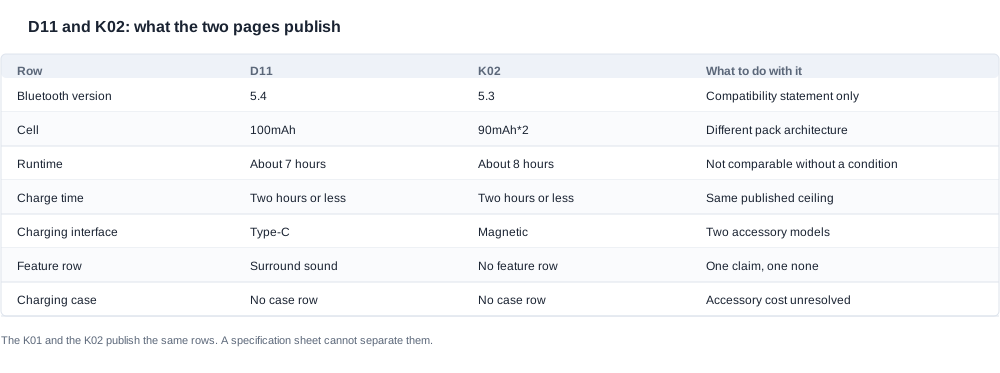
First, the charging interface. Type-C against magnetic. This decides the accessory chain, the box contents, the customer instruction pages and, quietly, the support profile, because a customer who cannot seat a magnetic contact may not discover that it was charging at all.
Second, the cell architecture. A single 100 mAh cell against two 90 mAh cells. This decides the pack, the number of cells to assemble and protect, the ageing behaviour over a product life and the transport documentation that travels with the shipment.
Third, the radio. Bluetooth V5.4 against V5.3. This decides the compatibility statement a channel can make, and it is the difference most likely to matter in a market with a long tail of older handsets.
Fourth, the feature lines. The D11 carries a surround-sound line and a long-battery-life line; the K02 carries neither. This is the only difference that can be used directly in a listing, and only within the limits of a feature line, which is a configuration statement rather than a measurement.
The three rows they share
The charge time matches at two hours or less, the runtime band is close, and neither model publishes a charging case row. The charge time match is a coincidence of ceilings rather than a shared design, because the two models are charged by completely different means and the customer experience is not the same. The absence of a case row matters for the K02 in a way it does not matter for the D11, because the K02 needs a dock and the D11 does not.
Building a shortlist without a price comparison
The criteria, split into the negotiable and the fixed
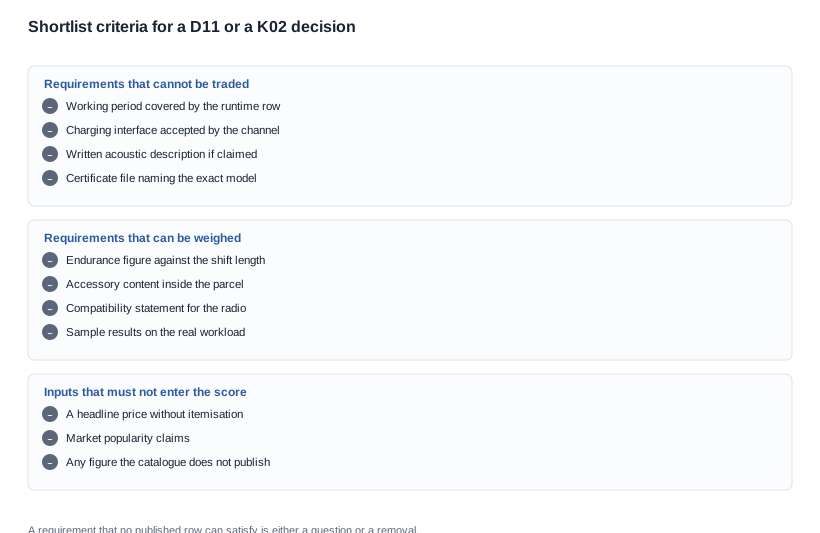
A shortlist is useful only when it distinguishes the requirements from the preferences, because the whole purpose of the exercise is to stop a buyer negotiating on the things that do not matter.
The requirements that cannot be traded are the ones where a failure makes the product unusable in its market. For this pair they are: the certification file for the target market, the accessory content the parcel plan assumes, the charging interface the channel is already standardised on, and the endurance the customer's working period requires. Every one of these has to be closed in writing before an order.
The requirements that can be weighed are the ones where a difference is a benefit rather than a condition. For this pair they are: the feature line available for listing copy, the radio generation, the size of the cell pack, and the measured weight once it is known.
What must not enter the score
Some inputs look like criteria and are not, and excluding them is what keeps a shortlist honest. A headline price without a line-item breakdown is not a criterion, because the two products differ in accessory content and the totals are not comparable. A durability or reliability impression taken from a single sample is not a criterion, because nothing published supports it. A market popularity claim is not a criterion, because the catalogue publishes no sales information and a claim without a source is an assumption. And any figure attributed to us that is not in the published rows is not a criterion either, which is a good discipline to apply to every number in a supplier's presentation.
A shortlist with one entry is a valid outcome
A shortlist that ends with a single model and a written rationale is a better outcome than a shortlist with two entries and no decision. Where the two models publish the same rows, as the K01 and the K02 do, a buyer who keeps both on the list is carrying a decision that has not been made, and the ambiguity shows up later as two different listings, two sets of packaging and two support scripts for what may be one product. The catalogue publishes no row that separates the K01 from the K02, so the separation has to come from the supplier, and if it does not come, consolidating is the correct commercial action.

The decision path, question by question
Six questions, in the order they should be asked
How to choose between these two models is a sequence, and the sequence below is the one that produces a decision a buyer can defend later.
- What is the binding constraint in the channel? Accessory supply, working period, listing copy, or market access. This question is asked first because it eliminates one of the two models in most cases, and it eliminates them on grounds that are published rather than assumed.
- Which published rows does the constraint depend on? If the constraint is accessory supply, the charging interface row decides it. If it is the working period, the runtime row starts the process but cannot finish it. If it is listing copy, the feature lines decide it.
- What has to be obtained in writing for the surviving model? The answer is always the same list: acoustic configuration, runtime workload, charge time condition, measured weight, box contents, certification file, cell specification, material and hinge description.
- What can the sample settle, and what can it not? The sample settles weight, geometry, sound and charging behaviour. It settles nothing about cost, documentation or market access.
- What does the comparison look like with both answers in hand? Rebuild both quotations on the same scope, with the same accessory content and the same documentation, and compare the line items. Only then does a price comparison become meaningful.
- What stays open, and what happens if it stays open? Every unanswered row is either removed from the requirement, or written into the order as a condition, or escalated. It is never left in the middle, because a question left in the middle is the one that costs money.

The two failure modes this pair invites
The first is comparing the endurance numbers directly, which produces a one-hour advantage on the page and no usable information in the field. The second is writing listing copy from a template, because the D11's feature lines travel across into the K02's copy automatically. Both are avoidable with a written requirement set and a copy review that traces every claim back to a published row, and the certification status for this model family covers the third failure mode, which is treating a company-level certification page as a model-level file.

What the quotation has to contain for either model
The line items that make two quotations comparable
A comparison between a single-cell Type-C product and a two-cell magnetic product fails on paperwork far more often than on specifications, because the two products generate different accessory and documentation costs and most quotations record them differently. The line items below are the ones that have to be present, and separate, in any quotation the buyer intends to compare.
- The unit price, stated on its own. Not a package price, not a price including accessories, and not a price that silently includes the dock.
- The accessory content, itemised. Cable, dock, case, printed material, and whether each is included or sold separately.
- The packaging cost, itemised. Retail box, insert, and any branded print on either.
- The tooling and any one-off charges. Stated as amounts with the conditions attached, so a second order can be costed differently from the first.
- The documentation pack, itemised. Which files are supplied, in which language, and whether preparing a per-model certification file is included or charged separately.
- The freight terms. Incoterm, destination, and whether the shipping weight is the buyer's declared value or the supplier's.
- The inspection terms. What is inspected, by whom, and against which accepted sample.
- The payment milestones and the delivery schedule. Staged against what, with what consequence if a stage slips.
The commercial conditions worth negotiating separately
Some terms in this category are structural and some are situational, and a buyer who treats them as one list will negotiate the wrong ones first.
The structural terms are the ones that follow from the architecture. A two-cell product carries a transport documentation obligation that a single-cell product carries in a different form, and that obligation belongs in the quotation rather than in a later conversation. A magnetically charged product carries an accessory obligation that a Type-C product does not, and if the dock is to be bundled, its cost belongs on its own line. A private-label configuration carries a re-check of the compliance position, because a change of module, cell or enclosure can change the answer, and that re-check has a cost and a lead time.
The situational terms are the ones that depend on the buyer's own situation: the quantity at which the tooling is amortised, whether a first order can be split across two deliveries, whether the payment milestones can be tied to inspection rather than to dispatch, and whether the after-sales scope covers replacement units in the first shipment. These are the terms a buyer should push on, because they are the ones where the supplier has genuine flexibility and the buyer has genuine need.
The acceptance test for a quotation
A quotation is ready to compare when a second buyer, given only that document, could work out what would arrive, what it would cost and what would have to be checked on arrival. If any of those three is still unclear, the quotation is not ready, no matter how complete it looks. The range buying guide applies the same test to a whole order rather than to a single product line, and the bulk ordering guidance covers how the same line items behave at different quantities.
A worked example: a channel choosing between the two
The following is a constructed situation rather than a customer project, and it is included because the reasoning travels better than any conclusion would.
A reseller sells connected audio accessories into two markets, one with current handsets and one with a long tail of older devices. The channel's existing parcels contain a Type-C cable, which it can add to a box at negligible cost. Its customers work in shifts of up to eight hours, and the product is not expected to survive a shift without a charge. Its listings are written by one copywriter who works from a template per model family.
The first requirement to test is the working period, because it is the one the copywriter cannot influence. The D11 rates about seven hours and the K02 about eight, so on the page the K02 appears adequate and the D11 appears short. But the shift is eight hours, not seven, and the published figures carry no workload, so the buyer asks both suppliers what workload produces the published number, and in what conditions. The answers arrive with different test loads, which means the figures cannot be compared and the one-hour advantage cannot be used. The buyer then asks a different question that both suppliers can answer: how many hours does the product run under a stated workload, with the volume and connected-device state written down. The K02 does not win the comparison on the published row, and the D11 does not lose it either.
The second requirement is the accessory chain, and here the channel's own parcel history decides it. A Type-C product needs a cable the channel already owns and stocks, so the D11 adds no new accessory line and no new failure mode in the instructions. A magnetic product needs a dock, and the dock is not published in any list, so the K02 introduces a cost, a stock line and an instruction page. For this channel, in this parcel structure, that is a real and quantified consequence rather than a preference.
The third requirement is the copy. The copywriter works from a template, which is precisely how a feature line travels from one model to another. The D11 has a surround-sound line that can be quoted as a configuration; the K02 has no feature line at all. So the K02 would need a documented acoustic description from the supplier before the copywriter could write anything specific, and the D11 could use the published line straight away with attribution.
The result of the exercise is a requirement set rather than a product: a decision to pursue the D11 for this channel, a list of written answers still required before the order, a decision to remove any working-day claim from the copy until the workload question is closed, and a note that the K02 may be reconsidered if a dock cost is quantified and a workload figure is supplied on a common basis. Nothing in that result came from a price comparison, because no price was published, and nothing in it was a claim that the catalogue does not support.
What we will not decide for you
We publish the electrical rows and the feature rows for every model in the range. For the D11 that means Bluetooth V5.4, a 100 mAh cell, a charge time of two hours or less, about seven hours of rated use, Type-C charging, a surround-sound line and a long-battery-life line. For the K02 it means Bluetooth V5.3, 90mAh*2, a charge time of two hours or less, about eight hours of rated use, magnetic charging, and no feature lines. We publish no price, no minimum quantity, no delivery schedule, no warranty term and no production capacity figure, so we cannot tell you which model is the better value, and we will not name one as the right choice for a scenario, because that answer depends on the constraint you are actually optimising for and on commercial terms we have not published. We also publish no frame weight for either model, so neither can be described as the lighter option from this page.
What we will do is give you the decision path with the published rows attached, so that whichever model your requirement set lands on, you will know exactly which rows support it and which questions remain open before the order. Send us the channel, the customer profile, the target market and the quantity you are working with, and we will map the requirement set onto the two models, show where the published rows decide the question, and list the written answers you still need. On a question like this, a documented path is worth more than a verdict, and we would rather hand a buyer a decision they can defend than one they have to trust.


