

Use case fit for a pair like the D11 and the LC-105-1 is a strange thing to write about, because a working condition is not a specification and cannot be settled by one row. It is settled by a combination: a published row that constrains the condition, a written answer from a supplier about the parts the catalogue leaves open, and a sample that behaves the way the documentation said it would. The two models in this pair are closer than most of the audio range on the rows a buyer can read, and further apart than the sheet suggests on the rows that actually run through a working day. The D11 publishes a single 100 mAh cell, Type-C charging, about seven hours of rated use, Bluetooth V5.4, and two feature lines including a surround-sound line. The LC-105-1 publishes 55mAh*2, magnetic charging, about eight hours of rated use, Bluetooth V5.4, and no feature lines at all. Same radio, different power architecture, one extra hour on the page, and one product that a customer charges with a cable they own and one that a customer charges on a dock that has to be in the parcel. That is the difference a working day is made of.
D11 and LC-105-1: matching a specification to a working day
The published rows, and the working conditions they touch
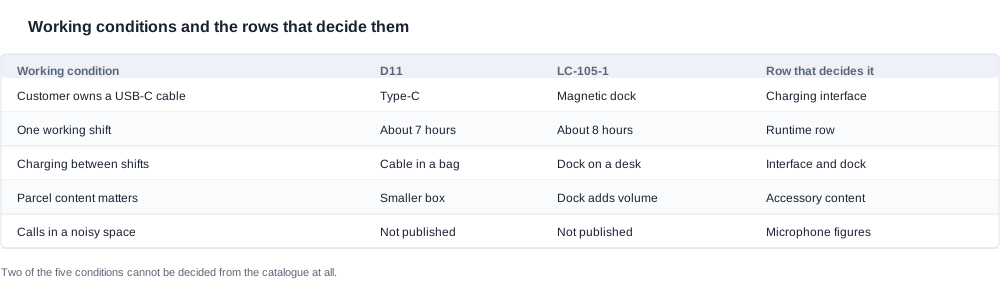
The comparison below is organised by working condition rather than by model, because that is the direction in which the decision actually runs. A condition is something the customer's day imposes; a row is something the catalogue publishes; the question is which rows the condition depends on, and what is still missing where the condition depends on something the catalogue does not publish.
| Working condition | What the D11 publishes | What the LC-105-1 publishes | The gap |
|---|---|---|---|
| Charging during a shift | Type-C, two hours or less | Magnetic, two hours or less | Dock content is unpublished |
| A single working shift | About 7 hours | About 8 hours | No workload is published |
| Parcel contents | No case row | No case row | Dock and cable are quotation items |
| Calls in an open environment | No microphone figures | No microphone figures | No call claim is possible |
| Frame weight | Not published | Not published | Fit risk is unquantified |
Two of those five rows cannot be settled from the catalogue by either model. That is the starting position for any scenario assessment, and it is worth saying plainly, because a guide that pretends otherwise is just a spec sheet with a story attached.
Why a scenario guide is not a recommendation
A recommendation is a conclusion that one model serves a condition better than the other, and to draw it you need a price, a cost, a demand estimate and the unpublished rows. We publish none of those. What we can publish is the structure of the decision: which conditions each published row constrains, which conditions are constrained by rows we do not have, and what a buyer has to obtain in writing before a condition can be closed.
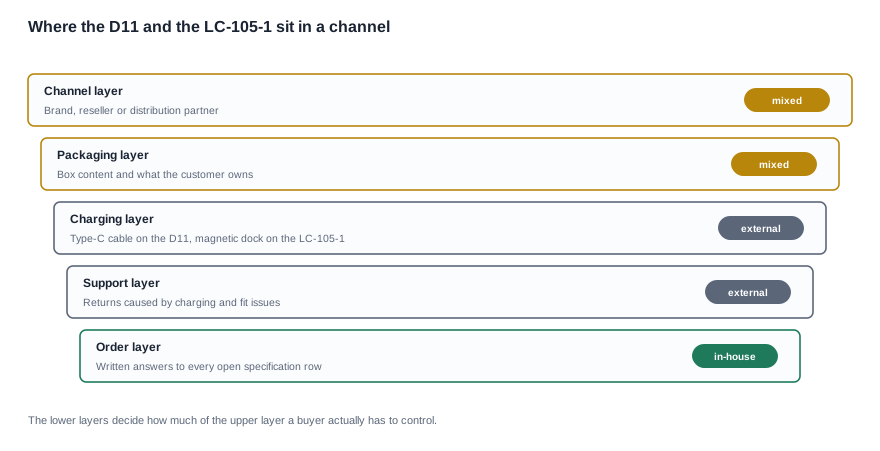
There is a second reason to keep the distinction. A conclusion that a buyer cannot reproduce is a conclusion they cannot use in a negotiation with their own management or with a second supplier. The value of the assessment is that it can be re-run, and that means it has to be expressed in terms of rows, conditions and questions rather than in terms of a product name.

Three working conditions that decide the pair
Condition one: the customer is away from a socket
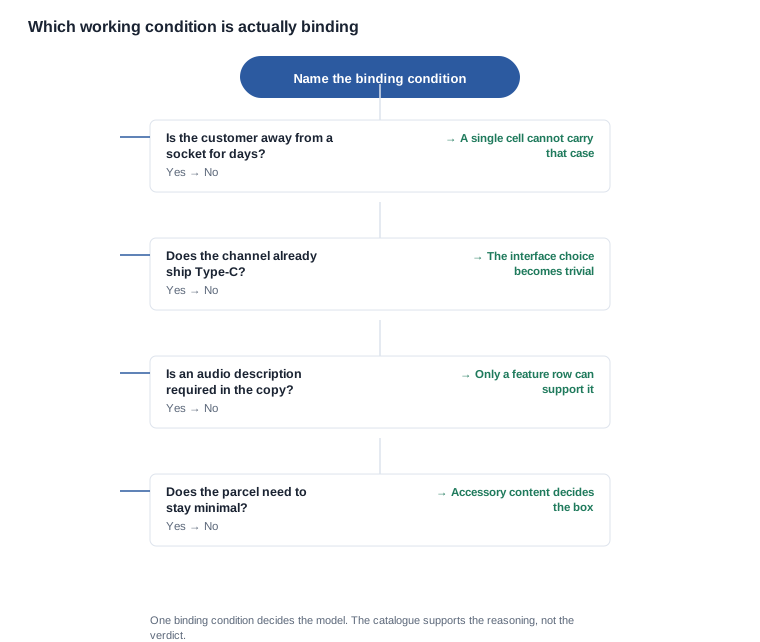
This is the condition that separates the two models most sharply, and it is worth being careful about which published row speaks to it.
The D11's about seven hours is described in the catalogue against a single 100 mAh cell and a Type-C interface. The LC-105-1's about eight hours is described against 55mAh*2 and a magnetic interface. Neither figure carries a workload, a volume level or a connection state, so the extra hour is not yet a usable advantage. But the shape of the two products is: a customer with a Type-C device can charge it from a phone, a laptop, a power bank or a wall socket, almost anywhere, while a customer with a magnetically charged device can charge it only where a dock happens to be.
That difference is invisible in the specification table and enormous in a working day. A field sales channel, a warehouse channel or a channel whose customers move between sites is a cable environment. A channel whose customers sit at a fixed desk is a dock environment. Neither of those statements is a claim about the products; both are statements about which published row the condition depends on, and about what has to be true for the condition to be met.
Condition two: the parcel is the product for thirty seconds
A second condition is the parcel. The D11 needs a cable, which a channel either already stocks or can add at negligible cost, and the catalogue publishes no case row for it. The LC-105-1 charges magnetically, so a dock has to be in the box or on the accessory list, and the catalogue publishes neither the dock nor a case row for it.
For a direct-to-consumer channel, the parcel is the customer's first experience of the product, and the cost of the parcel is one of the few costs in this category that the buyer controls. A smaller box lowers the freight class, lowers the packaging material and lowers the damage rate. A dock in the box reverses all three. That is a commercial difference with a number attached, and the number comes from the buyer's own logistics model rather than from our catalogue.
Condition three: the listing copy has to say something specific
The third condition is the one that catches buyers who have not planned for it. The D11 publishes a surround-sound line and a long-battery-life line. The LC-105-1 publishes no feature line at all, which places it among the models in this range with nothing on that line. If the channel's listing copy needs a named audio configuration, the D11 has a published one that can be quoted with attribution, and the LC-105-1 has a request to make.
The absence of a row is not the absence of a configuration, and it should not be read as one. But it is the absence of something a copywriter can use, and in a channel where several models are listed side by side, that difference shows up in the listing page.
Where the two products are hardest to tell apart
The rows that match, and the matching that misleads
The radio matches: both publish Bluetooth V5.4. That makes the pair the easiest to present together and the easiest to confuse in a warehouse. A SKU system that relies on the published radio to tell the two products apart will fail, because it is identical.
The charge time matches as a ceiling: two hours or less on both. The route to that ceiling is entirely different, because one is a cable into a socket and the other is a placement on a dock. A buyer who reads the matched ceiling as a matched charging experience has read a specification where the experience is not specified at all.
The runtime band is close: about seven hours against about eight hours. The cell architecture is not close at all: a single 100 mAh cell against two cells of 55 mAh each. That is the inversion that makes this pair instructive: the product with the larger single cell publishes the shorter figure, and the product with two smaller cells publishes the longer one. Across the range, paired 55 mAh cells produce published runtimes from about six hours on the G07 to about eight on the LC-105 series, which means cell size and cell count are not what sets the outcome, and the two figures cannot be compared until somebody explains how they were measured.
The two rows that are hardest to compare at all
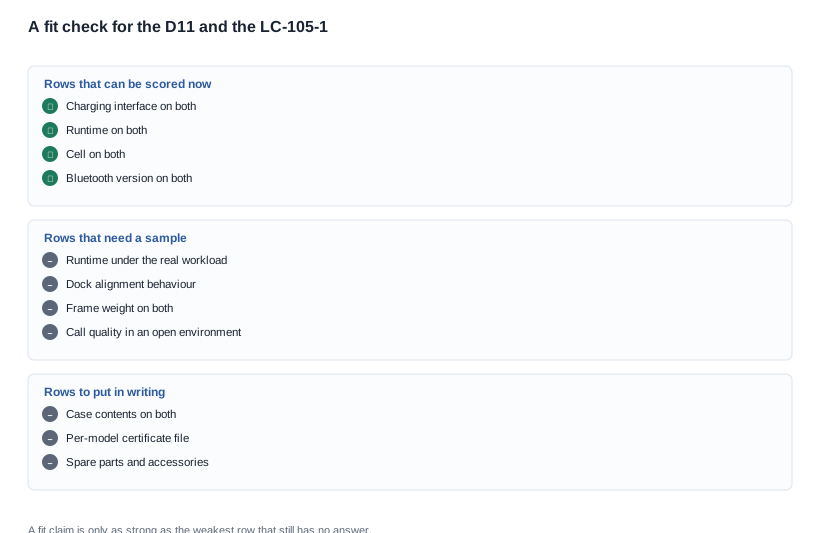
Call quality in an open environment. Neither model publishes a microphone specification, and no microphone figure is published for any model in the range. For open-ear audio products, this is the gap buyers most often discover late, because the audio rows appear complete while the call path is not described. A listing that promises call quality is a promise neither model can support from the catalogue.
Frame weight. Neither model publishes a weight, and no model in the range publishes a weight except one camera model where the catalogue states it. Any assessment of how either product sits over a long shift is therefore a sample-based judgement, and the sample has to be measured with a scale rather than estimated.

Testing the scenario before volume, not after
The sample protocol that matches the conditions
A scenario test that does not reproduce the working condition proves nothing, and this is the most common reason an assessment fails after a shipment has already been placed. The protocol below is designed to reproduce conditions rather than to admire products.
- Reconstruct the charging moment. Charge each model the way the intended customer would: the D11 from a phone or a wall socket at a break, the LC-105-1 from a dock at a fixed point. Record the elapsed time to a usable state and the number of interruptions required.
- Run the workload, not the idle. A product that stands by for eight hours and a product that runs a full shift with continuous audio are different products. Write the workload down and run it on every unit in the sample, not on one.
- Measure the parcel. Weigh and measure the packed box for each model with the contents the buyer intends to ship, and compare against the channel's own freight model.
- Exercise the interface repeatedly. Dock alignment and connector handling fail in ways that a first-time sample rarely reveals.
- Check the copy against the sample. Whatever the listing page says about sound, charging or endurance has to survive contact with the unit in the hand.
The results to record
The output of the test should be a table, not an impression. For each model: measured frame weight, measured packed weight, elapsed charge time under the reconstructed condition, elapsed runtime under the stated workload, the box contents actually supplied, and a note on the interface behaviour after repeated use. Six rows, two models, and the table is the evidence a buyer can put next to a quotation and use.
What the sample cannot settle, and what it leaves open
A sample settles experience, not cost and not compliance. It does not produce a unit price, a minimum quantity, a delivery schedule or a certification file. It does not tell you whether the model designation on a document matches the model in the box. A buyer who runs a careful scenario test and then skips the documentation check has closed half the question, and the half that remains is the half that stops a shipment in a customs office or a market inspection. The certification status for this range covers what has to be requested and how to read what arrives.

The conditions to write into the order file
Turning the assessment into order conditions
An assessment that stays in a report is a report. The conditions that make it operational belong in the order file, written as terms the supplier accepts, and they should be short enough that a supplier can confirm them all in one reply. For this pair, the conditions are of three kinds.
Conditions on the configuration. The exact model designation, the cell configuration, the charging interface, and the box contents including whether a dock is supplied. Each of these should be stated as a number or a named item, because a configuration described in prose is a configuration that can be interpreted two ways on the packing line.
Conditions on the evidence. The certification file that names the exact model designation, the acoustic configuration of each model, the runtime workload behind the published figure, and the measured weight. Where a supplier cannot provide one, the condition should be removed from the requirement rather than left in place.
Conditions on the measurement. The inspection method, the number of units inspected, the accepted reference, and the remedy if a unit falls outside the stated figures. This is where the assessment becomes enforceable, because the judgement is subjective and the measurement is not.
The question of how many samples are enough
There is no published answer to this and no supplier is going to give one, so the useful approach is to tie the number to the risk rather than to a rule. Where a condition is published and stable, a small sample confirms the configuration. Where a condition is unpublished and drives the working day, the sample has to cover enough units to expose variation in the measured weight, the charge time and the interface behaviour, and the number of units is a function of how much variation the channel can absorb. A buyer who accepts a single unit as evidence for an unpublished row is accepting a risk that the next shipment may not be the same product.
The criteria that decide which model survives
Before the conditions can be written, the buyer has to know how to choose between the two, and the criteria below are the ones that hold up when the comparison is challenged. They are written as criteria rather than as preferences so that the shortlist survives a second round of questioning.
The criteria that cannot be traded are the ones where a failure makes the product unusable in its market: the certification file for the target market, the accessory content the parcel plan assumes, the charging interface the channel has already standardised on, and the endurance the customer's working period needs. If one of these cannot be closed for a model, that model leaves the shortlist regardless of how attractive the remaining points are.
The criteria that can be weighed are the ones where a difference is a benefit rather than a condition: the published audio configuration available for listing copy, the radio generation, the size of the cell pack and the measured weight once it exists. A weighted criterion still needs a written answer behind it, otherwise it is an impression, and impressions do not survive the procurement review.
The inputs that must not be weighed are the ones that look like criteria and are not: a headline price without a line-item breakdown, because the two products carry different accessory content and the totals are not comparable; a market popularity claim, because no sales information is published; and any figure attributed to this catalogue that does not appear in the published rows, which is a discipline worth applying to every number in a supplier presentation.
A shortlist of one is a legitimate result. Where the working condition removes one of the two models on published grounds, the remaining shortlist is the decision, and the trade-offs worth writing down are short: a cable against a dock, one published audio configuration against none, and one published endurance figure against another. Total cost analysis, in other words, includes the accessory and documentation lines that both products generate, and those lines come from the quotation rather than from us.
Three failure modes worth naming
Failing to reproduce the condition. The most expensive failure in a scenario assessment is testing a product in a way that resembles the working condition without matching it. A product tested at a desk for a full shift tells a buyer nothing about a customer who is on the move, and the gap shows up in returns rather than in the test report.
Copy that outruns the documentation. A listing page written from a template carries the feature line of whichever model wrote the template. Since only the D11 publishes an audio configuration here, the risk is specific and directional, and the control is a copy review that traces every claim to a published row on the correct model.
Treating the absence of a row as a negative fact. The LC-105-1 publishes no feature line, and it is tempting to conclude that it has no such configuration. The catalogue does not say that, and the two conclusions lead to opposite commercial responses: one removes the model from a channel that needs a documented audio description, the other sends a request for the description. Which of the two is right depends entirely on what the supplier can document, and that is a question, not a conclusion.
What the assessment can and cannot conclude
The assessment for this pair can conclude several things, and they are worth listing because they are what a buyer is actually seeking. It can conclude that the radio row is identical and therefore useless for telling the two products apart in a warehouse, and that a distinguishing code has to be created. It can conclude that the D11's accessory chain is shorter, because a cable is a smaller commitment than a dock, and that this is a parcel and logistics difference rather than a product difference. It can conclude that the LC-105-1 publishes the longer endurance figure, and that the figure cannot be used until a workload is supplied for both. It can conclude that only the D11 has a published audio configuration to work with in listing copy. And it can conclude that two rows, call quality and weight, are outside what either model can tell a buyer.
What it cannot conclude is which product is better for a given channel, and that is because the deciding inputs are not published. We publish no price, no minimum quantity, no delivery schedule, no warranty term and no production capacity figure, so no cost comparison can be drawn from this page. We publish no weight for either model, so no claim about either being easier to carry through a shift is available. We publish no per-model certification row, so market access has to start with a document request rather than a catalogue reference.
We will, however, run the assessment with you. Send us the channel, the customer profile, the target market, the quantity and the working conditions the product has to survive, and we will map each condition onto the published rows, tell you which conditions are already closed for each model, which need written answers, and which can only be settled on a sample. That output is a defensible assessment without a single invented number, and it is the same standard we apply to every model in the range.


