

Certification is the part of a sourcing file that is easiest to talk about and hardest to evidence, and this model shows why. The catalogue carries an export certification page at company level, but its content is images rather than text, the catalogue text names no CE, FCC or RoHS, and there is no per-model certification row anywhere — including for this model. What follows is therefore the honest position rather than a reassuring one: the certification status of this model is not published, and the work of an importer or a channel buyer is to convert an unknown into a document set. The sequence below is ordered so that the requests which change the shipment plan are sent first.
D11 certification status: what the catalogue publishes
The rows the catalogue does publish for this model are product rows, and they are worth writing out once, because they are what a buyer finds on the product page and what a compliance conversation has to work around. The published set is a Bluetooth version of V5.4, a 100 mAh cell fitted on its own, a charge time given as two hours or less, a stated use time of roughly seven hours, Type-C charging, and a surround-sound feature line. Every one of those is a product description. None of them is a conformity record, and the certification file built for this model has to stand on its own documents rather than on any of them.
The three states of a certification row
Across this catalogue, a certification item for a specific model appears in one of three states. It is published for the model, which means a document or a reference exists and can be asked for by name. It is published at company level, which means the company has a statement but no per-model row. Or it is not published at all, which means nothing in the catalogue supports a claim and the item has to be opened as a question. Only the first state can be quoted on a product page.
Why "not published" is the status for this model
This model sits in the third state for every regulatory item a buyer will ask about. The catalogue publishes its electrical rows — the radio version, the cell, the charging method, the charge time and the rated runtime — and publishes two feature lines. It publishes no per-model certification row, no certificate reference, no test report identifier and no expiry date for anything. The correct sentence for a specification file is therefore that the certification status of this model is not published, and the correct next sentence is that it has to be requested in writing.
The published specification list is the row-by-row baseline for what does exist, and the general certification notes for this range cover the range-level position.
What a buyer may and may not write today
Until the documents arrive, a product page may state the published rows and may state that the model is a Bluetooth audio product with a radio version of V5.4. It may not state that the product is certified, approved or compliant with anything, because no such statement is supported by the documentation. A buyer who writes a compliance sentence into a listing before the evidence exists is not making a marketing error; in most destination markets that sentence is a regulatory statement, and the importer of record is the party that carries it.

D11 export page: images, not a certification record
What the page actually contains
The catalogue has an export certification page at company level, and it contains ten patent certificates: eight of them appearance designs, two utility models. The extractable text on that page is the title and the page number; the rest is images. That distinction is the whole point, because a patent certificate is evidence of intellectual property rather than evidence of regulatory conformity, and a page made of images cannot be quoted as a certification row for any model.
Why a company-level page cannot be read down to a model
A company-level statement cannot be turned into a per-model claim by inference, however reasonable the inference looks. The catalogue contains models with different cells, different charging methods, different feature rows and different accessory configurations, so a statement about the company is compatible with a model that has never been tested. The reverse also holds: a model may hold documents that nobody has published, and the absence of a row tells a buyer nothing about whether the documents exist — only that the catalogue does not carry them.
The questions that page should trigger
A reasonable due diligence request asks what the page covers, which models the patents and any other evidence relate to, and whether a separate conformity file exists for this model. The export considerations for this range set out how that request is usually answered and where importers lose time.

D11 evidence requests, in the order that works
Start with the destination markets
The first question in any certification conversation is which markets the product is intended for, because the answer determines which frameworks apply and which do not. A product sold into the European Union raises the Radio Equipment Directive (EU) 2014/53/EU for the radio side, and a product sold into the United States raises the FCC framework for the radio side as well. Both are questions about the destination, not claims about this model.
The request list, in sequence

The order above matters because the early answers determine the shape of the later requests. A declaration of conformity names the standards and the model, which tells the buyer which test reports to ask for; without it, a request for "the certificates" returns a folder of unrelated documents. The battery summary comes late in the list because it depends on the cell configuration being settled, and this model publishes no charging case row, so the cell and any accessory have to be established first.
Three tests that separate a usable answer from a complete one
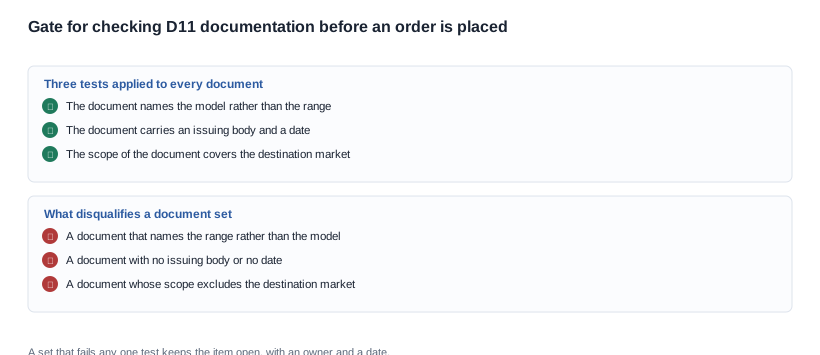
A response can be complete and still unusable, and the buyer needs a way to tell. Three tests apply to every document: does it name the model, does it carry an issuing body and a date, and does its scope cover the destination market. A document that fails the first test is about the range; a document that fails the second cannot be tracked; a document that fails the third may be irrelevant to the shipment that is actually planned. The OEM-ready platform export documentation covers what a complete set looks like from the buyer's side.
D11 battery, radio and ingress documents
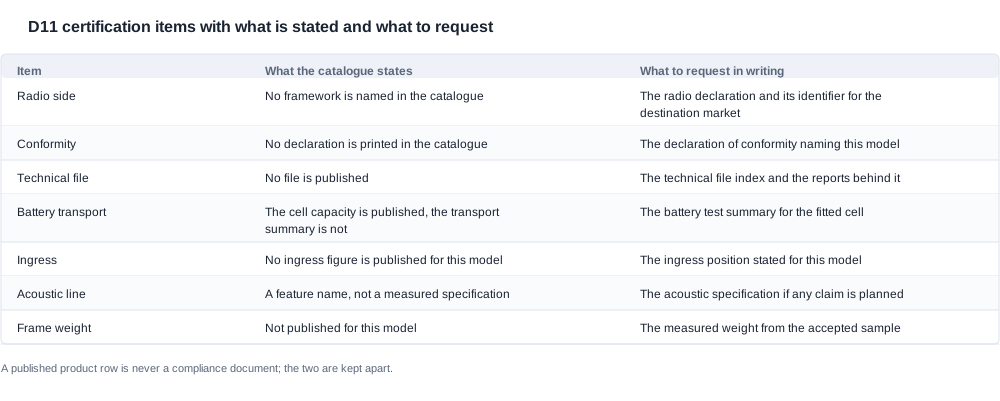
The battery transport chain
The battery is a separate workstream with its own document chain, and for this model it starts with a single 100 mAh cell. The chain runs: cell specification, cell test summary, the watt-hour rating derived from it, the packing instruction that follows from that rating, and the packing list stating what is actually in the carton. A buyer who treats the battery paperwork as part of the general certification request gets it last, and gets it late. The battery transport document chain sets out the document chain in full.
The radio declaration
The radio version is published for this model, which makes the radio file easier to request precisely than for a model with no published radio row at all. Ask for the declaration identifier, the qualified body record where one applies, and the test reports the declaration depends on, then check that the model designation on each document matches the model in the order.
The ingress question
No ingress rating is published for this model, and an ingress claim is a laboratory matter rather than a listing matter. If the channel's proposition depends on outdoor use, the answer has to come from a report; if it does not, the correct action is to make sure no listing implies one. The IP rating testing notes explain the standard to ask for. Note that only two models in the whole catalogue publish an ingress rating, so an assumption borrowed from elsewhere in the range is worth nothing here.
The acoustic and weight rows are not certification items
Two published rows are often confused with compliance items. The surround-sound feature line is a product description, not a measured acoustic specification, and no acoustic figure is published for any model in the range. The frame weight is not published either, and its absence has nothing to do with conformity — it simply has to be measured. Keeping these apart from the certification file saves a buyer from chasing documents that do not exist.
D11 document register and the acceptance rule
The register structure
A document register is one line per document: the item, the document title, the issuing body, the date, the expiry or review date, the model designation it names, and where the file is stored. It is deliberately dull, because its only job is to make the file auditable by someone who was not in the room when the documents arrived. Where a model publishes no charging case row, the register also carries a line for the packing list, because that list is the only evidence of what is in the carton.
What disqualifies a document set
Three things disqualify a set and each of them is common. A document that names the range rather than the model. A document with no issuing body or no date, which cannot be tracked or renewed. And a document whose scope does not include the destination market. Where the set fails on any of the three, the item stays open on the register with an owner and a date, and the shipping plan is adjusted rather than the document being assumed.
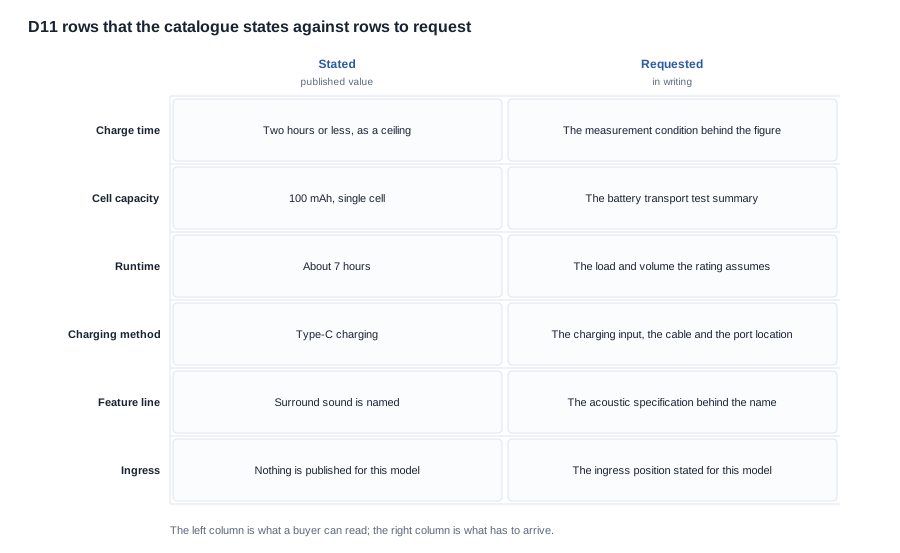
The split between the two columns above is the practical heart of this file. Five rows are readable from the product page today and can be quoted as published. Three more are the ones a buyer has to open as requests, and they are exactly the rows that a compliance-aware buyer will be asked about by a customer, a marketplace or a customs officer.
A hypothetical request cycle
Consider a hypothetical importer preparing a launch in two destination markets. The importer sends the market question first and receives an answer that the product will be placed on the market in the European Union and in the United States. The importer then requests the declaration of conformity and the technical file index, receives both, and reads the model designation on each one before anything else — which immediately shows that the file covers a range rather than this model, and turns one request into two. The importer adds the radio declaration, the battery transport summary and the ingress question in a single second request, records everything on the register, and marks the two range-level documents as open items with an owner.
The outcome is not a compliance statement; it is a register that says what is held, what is missing and who is chasing it, which is what a customs conversation and an internal review both require.
The buyer decision checklist
The criteria for deciding whether a document set is good enough to ship are worth writing down, because the total cost of an incomplete file lands at the worst possible moment. The questions to ask are short; the red flags are obvious once they are named.
- How to choose between a range-level file and a model-level file? Model-level, always. How to evaluate a range-level document is simple: it is not evidence about this model, however complete it looks.
- What to ask before you order: the declaration of conformity, the technical file index, the test reports behind it, the radio declaration identifier, the battery test summary for the fitted cell, and the ingress position.
- What are the red flags? A supplier who offers a general statement instead of a document, who cannot say which document covers which model, or who delivers a document with no issuing body or date.
- What is the total cost of an open item? A missing radio file stops the shipment at the border rather than in the office; a missing battery summary stops the consignment before it is loaded.
- Which trade-offs are acceptable? A channel that can hold stock in a single market can sequence the requests by market priority. A channel shipping into several markets cannot, and needs the full set before the first order.
- What should you verify before you order? Model designation, issuer, date, expiry and scope on every document, against a register rather than against memory.
Where the accessory sits in the chain
This model publishes no charging case row, so a buyer has to establish from the packing list whether a case or any other powered accessory travels with the unit. That distinction matters for the battery chain because a second cell in an accessory is a second item with its own test summary and its own packing instruction, and it may carry a different watt-hour rating from the frame cell. A buyer who treats the accessory as part of the model without treating it as a separate cell in the chain ends up with a file that covers one cell and a shipment that carries two.
The same logic applies to the cable and the power supply. A power supply that ships in the box falls within the scope of the electrical safety documentation; a power supply that the channel stocks separately is the channel's own file to manage. Asking which of the three is which — frame cell, accessory cell, channel-side supply — is a single question that makes the rest of the battery documentation legible.
Who signs, and what they sign
A conformity document has a signatory and a scope, and the buyer needs both before the file is accepted. In the European framework the declaration of conformity is signed by the party placing the product on the market, which for an imported product is the importer of record or the party acting as manufacturer under the applicable rules. In the United States the responsible party for the equipment authorisation carries a similar duty. The practical question for a buyer is not a legal one but an operational one: who in this transaction is signing, on whose name, and for which model designation.
Three warnings follow. A declaration signed by a party that is not placing the product on the market in that market is a document to escalate rather than one to file. A declaration that lists several models covers only those models that are actually listed; a model described as similar or equivalent is not covered. And the date on the declaration matters for the shelf life of the file, because the standards it cites change and a file that was valid two years ago may not support a shipment today.
The buyer's due diligence is therefore short: ask who signs, ask for the signature block, and check that the model designation on the signed document matches the model in the order.
How the register is reviewed before a shipment
The register is only useful if it is reviewed at a moment when a decision is still available, which means before the shipment rather than after it. A short pre-shipment review looks at four things. Every item marked open has either been closed or has a named owner and a date. Every held document names this model. Every document covers the destination market of this shipment. And every claim written in the product listing maps either to a published row or to a document in the register.
That last check catches the most problems. A listing is usually written by a different team from the one that assembled the register, and a compliance sentence can enter a listing without anybody noticing that no document behind it exists. Mapping every claim back to its source before the shipment is booked costs an hour and prevents the most expensive error in this category: a published claim that has to be withdrawn after the product is already on sale.
What a request schedule looks like in practice
Certification evidence arrives in a predictable order, because the questions themselves are ordered. A workable schedule starts with the market list and the model designation, because nothing else can be written until both are fixed. The first written request carries the destination markets and asks the supplier to name, in a single reply, which documents exist for this model and which of them are issued at range level. A supplier who answers that question precisely has already saved the buyer the slowest part of the exchange.
The second request is the technical bundle: the declaration of conformity with its signature block, the index of the technical file, and the test reports behind the rows that the catalogue publishes. This is the request that decides whether the published rows can be quoted on a product page. A published charge-time ceiling, a cell capacity and a charging method are product rows; they become claimable documentation only when a test report states the condition they were measured under. If the reports do not cover those rows, the rows stay catalogue statements and the listing says exactly that.
The third request covers the battery and the radio side, and it is the one that has to close before the goods are loaded rather than before they are sold. The battery summary is tied to the fitted cell, so it has to name the cell in the units that will actually ship. The radio declaration is tied to the destination market, so a channel selling into more than one market needs a declaration per market rather than one declaration for the range.
Two schedule rules keep this workable. First, an open item is recorded with an owner and a date at the moment it is raised, not at the end of the chase, because an open item without an owner is a document that will be missed. Second, the review happens while a decision is still open, which means before the shipment is booked and not after the consignment has left the warehouse. A register reviewed too late is a list of things that went wrong rather than a plan.
The cost of getting this wrong is asymmetric. A file that arrives late but complete costs a week. A file that arrives complete but names the range costs the model its evidence and the shipment its clearance, because the only remedy is a fresh request and a fresh wait.
The limits of this position
Our position on certification is that we publish a specification sheet and not a conformity claim: the catalogue contains no per-model certification row for this model or for any other, and the text contains no reference to CE, FCC or RoHS. What the catalogue does carry is an export certification page at company level whose content is ten patent certificates — eight for the appearance designs, two for the utility models — rendered as images. We will not present that page as evidence that any model is certified, and we will not print a certificate number, a test report reference or an expiry date that our documentation does not contain. The certification status of this model is not published, and the honest answer to any importer who asks is that the documents have to be requested, checked against the model designation, and registered before the shipment is planned.


