

A smart glasses development programme is not a calendar, and treating it as one is the single most common planning error a brand-side buyer makes. The instinct is understandable — you have a launch window, a trade show, a channel commitment, and a board that wants a date. But a date tells you when somebody said something would happen. It does not tell you whether the thing that must exist before that date actually exists yet. The alternative is a different kind of plan, and a better one: a programme measured by gates, where each gate closes only when it produces a document.
The six gates of a smart glasses development are fixed and they run in a fixed order: requirements frozen, feasibility reviewed, engineering and tooling, samples built and verified, compliance file closed, and a pilot run before mass production. What is not fixed is the calendar attached to them. A programme with a simple configuration in a single market and a programme with a camera variant sold into several markets are different in kind, and the second one will not fit the first one's plan. We will not publish a duration for any gate here, and we will not publish a lead time, because publishing either would be publishing an average over programmes that are not yours.
What we publish instead is the sequence, the dependency structure, and the questions that let you read the state of a programme from the documents it has produced. That is a more useful thing to hold than a number, because a number goes out of date the moment your programme takes one unusual decision, whereas the dependency structure holds for every programme.
This matters commercially. A buyer planning a channel programme — sample ordering for a reseller, listing copy for a marketplace, training material for a sales team, spares stock for after-sales — needs to know what can be started now and what has to wait. A gate-based plan answers that question precisely. A date-based plan answers it approximately, and approximately is what causes the channel partner to receive product before the paperwork that lets them sell it.
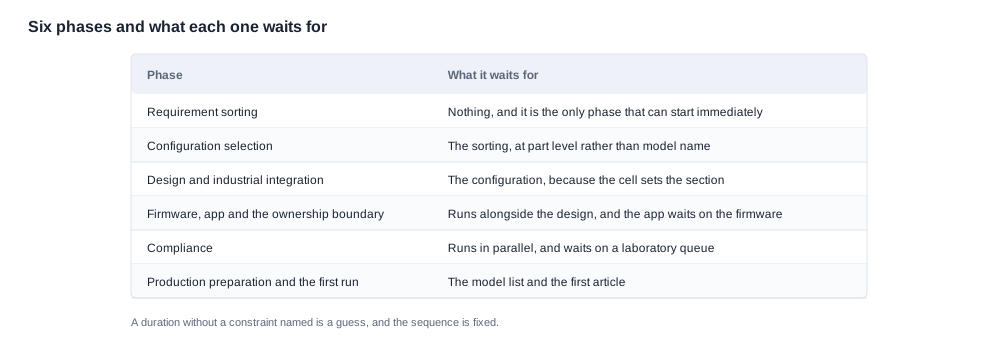
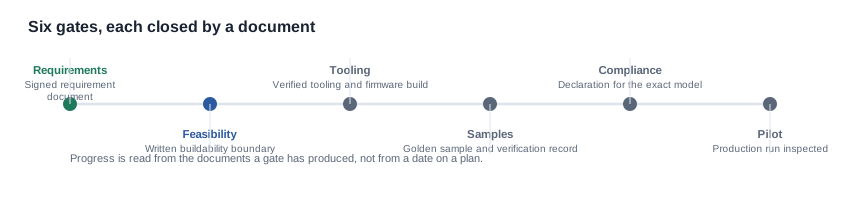
Development process timeline: the gates in order
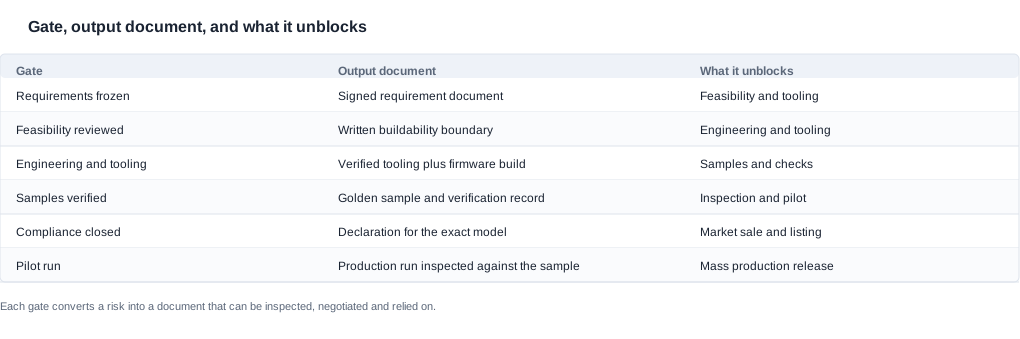
Each gate has one output, and the output is a document. That is the whole discipline. A stage is finished when it produces a document, not when a date arrives, and not when a status update is sent. The document is what the next gate consumes, and it is what you can look at. When we describe a gate we will name the document it produces rather than a duration, because the document is the part of the gate that transfers reliably from one team to the next.
Gate one — requirements frozen. The output is a signed requirement document: the target market, the models and configurations in scope, the packaging and what ships in the box, the branding and marking rules, the claims the product is allowed to make, the documentation to be delivered, and the acceptance criteria. What it hands over is a definition of the product that nobody has to guess at. The document is what every later gate is measured against, including the inspection at the pilot gate.
Gate two — feasibility reviewed. The output is a written answer on whether the request can be built and what it costs in engineering and tooling. The shape of that answer is a boundary rather than a yes or no: what can be taken as commercial, what needs engineering work, and the earliest date on which a responsible answer can be given. What it hands over is permission to spend, because nobody should release tooling against a requirement that has not been tested for buildability. It also hands over the first honest statement of trade-offs, which is where the negotiation about what the product is really going to be should happen.
Gate three — engineering and tooling. The output is completed and verified tooling plus a firmware build that matches the frozen requirement. Tooling is where the cash goes and the least reversible step in the entire programme, which is why the written agreement about what happens to tooling cost if the project stops here belongs to this gate rather than to a later one. What it hands over is a physical product that can be built consistently, and a build that either matches the requirement or visibly does not.
Gate four — samples built and verified. The output is a signed golden sample plus a verification record covering pairing, audio, charging, any camera function and control behaviour. The golden sample is not a display unit. It is a reference that defines the boundary between acceptable and not acceptable, and the verification record is the evidence that the sample met the acceptance criteria in the frozen requirement. What it hands over is a definition of good, in physical form, that anyone can hold.
Gate five — compliance file closed. The output is a declaration of conformity covering the exact model string that will ship, the underlying reports, and the market-specific requirements. A declaration that covers a product family rather than a model is not a declaration for your SKU, and that distinction is the difference between paperwork you can file and paperwork you cannot. What it hands over is a lawful, documented product in a named market, and a certification evidence trail a channel partner can actually use.
Gate six — pilot run before mass production. The output is a production run on production tooling at production volume, inspected against the golden sample. What it hands over is evidence that the line makes the product the golden sample describes. The pilot run catches the substitution problems that engineering samples never see — a changed component, a different supplier batch, a modified assembly step, an operator shortcut — because those problems only appear when the line runs at production volume under production conditions.
Read in order, the sequence makes sense: define it, check it can be built, build the means of building it, prove the product, prove the paperwork, prove the line. Remove any one of these and something is left unproven that will surface later, in a more expensive place. That is why we describe the gates in this order rather than presenting them as a menu of options.
There is a second way of reading the same sequence, and it is the way a procurement manager should read it. Each gate converts a risk into a document. The risk of building the wrong thing is converted into the requirement document. The risk of building something impossible is converted into the feasibility answer. The risk of an unrepeatable product is converted into the verified tooling and the matching firmware build. The risk of an unpredictable product is converted into the golden sample and its verification record. The risk of an unsellable product is converted into the closed compliance file. The risk of an unbuildable product is converted into the pilot run. A risk that has been converted into a document is a risk you can inspect, negotiate, and rely on.
What can run in parallel and what cannot
Parallel work is not free. It is a bet that a predecessor decision will not move. The useful question for a buyer is not "can this start early" but "what is this work dependent on, and is that dependency closed with a document". If the dependency is closed, parallel work accelerates the programme. If it is not closed, parallel work produces output that will be redone, and in the case of packaging artwork or compliance paperwork the redo happens after money has already been committed.
Tooling and firmware are parallel to each other once the requirement is frozen. Both depend on the same document — the frozen requirement — and neither depends on the other. Tooling can be released while firmware is still being developed, and firmware can be developed while tooling is being cut. This is the most valuable parallelism in the programme because it is the parallelism that overlaps the two longest stretches of work.
Tooling is not parallel to the requirements gate. Tooling cuts metal against a specification. If the specification is still moving, the mould is being cut against a moving target, and the rework is expensive and the tooling cost is already spent. This is the clearest example in the whole programme of a dependency that is not negotiable, because the irreversibility of a mould does not care what the commercial team hoped for.
Compliance work can begin in parallel with early engineering, but closure cannot. The evidence-gathering work — arranging test work against the configuration that will ship, drafting the documentation set, checking the market-specific requirements for each destination — can start once the configuration is fixed. The compliance file closes only after the exact model string that will ship is settled, because the declaration of conformity is written against that model string. A model string that changes after the declaration is signed invalidates it, and reissuing it delays everything downstream of it.
Packaging artwork is parallel to tooling, with one hard condition. Artwork development can run alongside tooling, which is usually worth doing because artwork is iterative and physical packaging is not forgiving of late change. The hard condition is the claims section: the artwork cannot be released to print until the claims it carries are frozen, because the claims on the carton are the claims your organisation has made to every market the box enters. This is the specific reason the claims section of the requirement document is the most important section — it has the longest tail, reaching past the pilot gate into the shelf and the listing page.
The pilot run cannot be parallel to anything, because it depends on all five previous gates. A pilot run needs production tooling, a golden sample to inspect against, a closed compliance file for the model being produced, and a frozen requirement to measure against. It is a verification step, and verification cannot be parallel to the things it verifies. The same is true in reverse: the compliance file closure cannot be parallel to the pilot, because the pilot is the last opportunity to observe a substitution problem before it becomes a shipment.
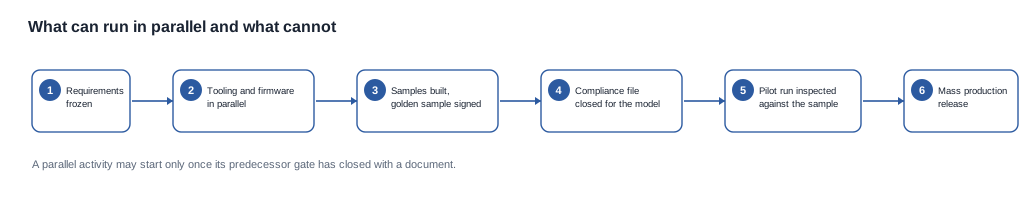
A practical rule falls out of this. A parallel activity may start when its predecessor gate has closed with a document, and not before. It may start when a predecessor gate is "nearly done", because nearly done is a status rather than a fact. Teams that break this rule do not save time; they convert a sequence into a negotiation. The document is what tells you the dependency is genuinely closed, and that is the entire reason for insisting on documents as gate outputs rather than on status reports. We will start a parallel activity against a closed document, and we will not start one against a verbal assurance that the other side believes is finished.
There is also a category of work that is often mistaken for parallelisable because it involves no tooling and no hardware. That is the commercial and contractual layer: the purchase order, the incoterms, the MOQ, the spares quantity, the warranty handling, the sample order for a reseller. These can move in parallel with the gates because they do not depend on tooling — but they do depend on the requirement document, and the quotation you negotiate against will only be reliable once the scope inside it is fixed. A negotiation conducted against an unfixed scope produces a price for something that has not been specified, and the revision that follows is where the commercial relationship is usually decided.

How progress is visible without a published schedule
If the programme is not measured in dates, progress has to be visible some other way, and it is. It is visible in the set of documents the programme has produced. A programme with five signed artefacts has five closed gates and an open sixth. A programme with two signed artefacts has two closed gates and a stall somewhere in the third. The trail of documents is the status report, and it cannot be inflated by optimism because a document either exists or it does not.
Three questions read that state reliably, and we will use them in every status conversation:
- Which gate is open right now? Not "where are we" in general, but which of the six gates is currently consuming effort.
- What is the output document of that gate, and where is it? A named artefact with a version and a location. If the answer is a folder of drafts, the gate is not close to closing.
- What is blocking it? The specific unresolved input — a missing decision, an unconfirmed configuration, a claim awaiting an owner, a model string awaiting confirmation. "Waiting on the customer" is not a blocker description; "waiting for the buyer to confirm whether the camera variant is in scope for the first destination market" is.
Progress read this way has a property a calendar does not have: it cannot be confused with activity. A programme can be busy for a long time and still be on gate one, and a programme can move three gates in a short period if the documents are quick to produce. Only the artefact count distinguishes the two. This is also why a status request that arrives with no document attached is worth answering with a question rather than with an update.
A stall has a recognisable shape: no gate is open and no document has been produced. That is different from a programme that is blocked in the middle of a gate, and the two call for different responses. A stall is usually a governance problem — nobody owns the decision, or a signature is missing. A blocked gate is usually an input problem. Distinguishing them early is the most useful thing a procurement manager can do, because a governance stall is fixed by escalating to a decision-maker, and an input problem is fixed by supplying an input.
Planning a channel programme around gates instead of dates. The practical version of this is to attach your channel commitments to gates rather than to calendar slots, and the mapping is straightforward because each gate corresponds to a different kind of readiness.
- Reseller sample sets become meaningful after the samples gate has closed and the golden sample is signed. A sample sent before the golden sample is signed teaches your channel partner a specification that may still change, and the correction lands on them rather than on you. This is the most common channel mistake in hardware launches.
- Listing copy and marketing artwork become safe to finalise after the claims section is frozen, and not before. Copy written against claims that are still conditional is copy you may have to retract from a live listing.
- Training material and sales documentation should follow the golden sample and the closed compliance file, because those two together define what your salespeople can truthfully say and what the reseller can truthfully demonstrate.
- Spares and after-sales stock planning becomes reliable after the pilot run, because the pilot is where you learn what actually varies in production and what your after-sales exposure looks like. Ordering spares earlier means guessing.
- The purchase order and the production release sit after the pilot run, and the pilot order itself is the first order that exercises the full commercial path, including incoterms and the delivery documentation set.
Mapping commitments to gates also changes the nature of the conversation with a channel partner. Instead of "will it be ready by the show", the question becomes "the programme is at the compliance gate with the declaration in review, and the golden sample is signed; the samples can be produced now". That answer is checkable, and it survives the programme changing.
What we are not going to give you is a published schedule, because we do not publish one and because a schedule for a programme that is not yours is not information. What to ask the supplier instead is the state of the gates, the identity of the open document, and the specific blocker. Those three answers, given honestly, tell you more than any lead time quoted in advance.

Questions to ask about the sequence
These are the questions that let you read a programme without being given a schedule, and they work whether or not the programme is yours. In practice we will ask them at every gate transition, because a gate that closes without the answers simply reopens.
- Which gate is open, and what is the document that closes it? Ask for the artefact, not the activity. "We are on tooling" is an activity; "the tooling verification report is being signed off" is an artefact.
- Who signs that document, and has it been signed? A gate that is waiting on a signature is one step away from closing and one step from being blocked. You want to know which.
- What is blocking the open gate, in one sentence, and who owns the blocker? A named owner with a named input is a manageable blocker. An unnamed one is a schedule risk dressed as a status update.
- Which activities are running in parallel right now, and against which closed gate? This question checks that the parallelism is legal. If the answer is that artwork is being finalised while the claims section is still open, you have found your rework.
- Has the model string that will ship changed since the last gate? The model string is the key the compliance paperwork and the marking are written against. If it has changed, ask what has to be reissued as a result.
- Does the golden sample still match the current requirement document? Ask this at the transition out of the samples gate. The golden sample is the reference for the pilot inspection, and a stale golden sample makes the pilot meaningless.
- What evidence supports the claims in the current artwork? Ask for certification evidence covering the exact model string rather than a general assurance, and ask which market-specific requirement applies to the destination of the first shipment.
- What happens to the tooling cost if the programme stops at this gate? Ask it before the gate closes, not after. The answer belongs in writing, and it is much easier to agree before the tooling is released than after it is paid for.
- What does the pilot order include, and against which golden sample will it be inspected? Ask what the pilot proves and what it does not. A pilot that is inspected against a display unit rather than the signed golden sample is a sample run with extra paperwork.
- Which commercial terms are settled and which are still open? Ask about MOQ, incoterms, spares, purchase order terms, warranty handling, and the delivery documentation set. These are not published as standard, so they need to be in the commercial agreement that accompanies the programme rather than assumed from a quotation.
Two closing observations. The first is that a gate-based programme is not slower than a date-based one. It is slower only in the sense that it refuses to pretend. A programme measured by documents surfaces its problems while the problems are still cheap to fix, and the artefacts it produces are exactly what you need for the next decision — the next model's requirement document, the next channel conversation, the next claim decision.
The second is that this framework belongs to both sides of the table. A buyer who asks which gate is open and what its document is, and a manufacturer who answers with a named artefact and a named blocker, are having a conversation that can survive a change of plan. That is the point of sequencing a programme by gates rather than by dates.
For the stage-by-stage detail behind each gate, see the development process stage by stage breakdown and the quality gates article, which covers how each gate is evidenced. A wider view of how development work sits inside a wider engagement model is on the OEM and ODM process pillar, and the ODM development timeline overview covers the same sequencing from the model-builder's side.


