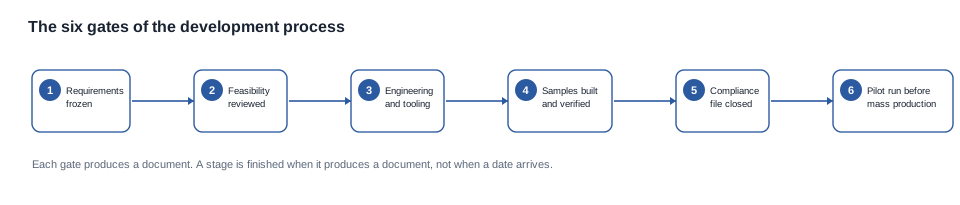
Most buyers arrive at an OEM conversation with a product idea, a target market and a price expectation, and they expect the development process to be a sequence of waiting. It is not. It is a sequence of six gates, and each gate is crossed by producing a document rather than by reaching a date. The distinction is not administrative. A stage that ends with a calendar entry and no document has not settled anything, and the cost of that unsettled question appears later, usually at the compliance gate, usually with a shipment attached.
This article walks the six gates one at a time. For each one it states what the gate is, the document it produces, what it settles, what it cannot settle, and what the buyer should do while standing at that gate. It is written for the brand-side buyer and the channel procurement manager who will be asked to sign at each one, and for the person who has to explain to a customer why a programme took the shape it did.
The framework is fixed and it does not vary by project: requirements frozen, feasibility reviewed, engineering and tooling, samples built and verified, compliance file closed, pilot run before mass production. Six gates, in that order, each producing its own document. The value of the model is that it makes the invisible parts of a development programme explicit. A feasibility review that answered only "yes, we can build it" produced no gate output, because a gate output has to be a boundary — what is commercial, what needs new engineering, and the earliest date a real answer can be given.
A word on what this article deliberately does not contain. Production capacity figures, stage lead times, indicative schedules, price, MOQ, lead time, sample fees, warranty terms, certificate numbers, certification status per model, factory size, employee count, annual output, customer names, order volumes and percentages are all not published. Where a buyer needs one of those, the answer is not a guess but a question, and each gate below closes with the question to ask the supplier. We will convert every gap into something specific to ask rather than filling it with a plausible-sounding number.
Development process stage-by-stage: the first three gates
The first three gates are about deciding what to build, whether it can be built, and what it costs to get there. None of them involve a finished unit, and all three of them are places where a programme can be saved or sunk, and we will spend more attention here than anywhere else in the sequence.
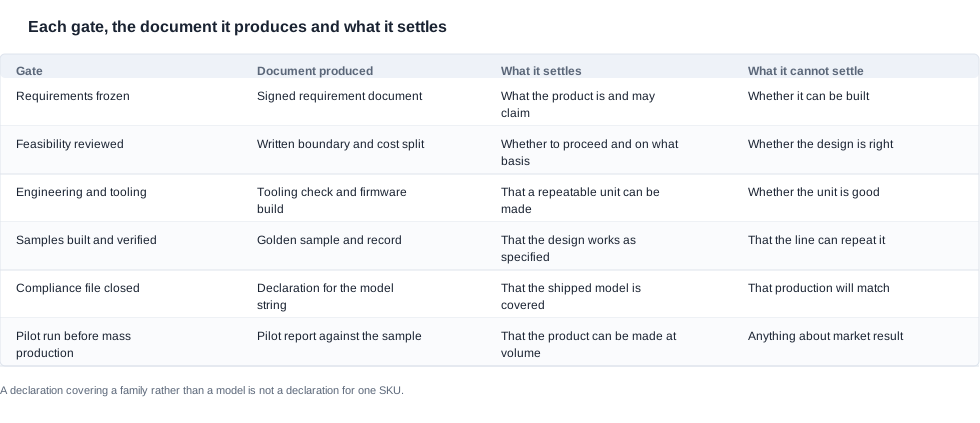
Gate one: requirements frozen. The output document is a signed written requirement document. It states the target market, the models in scope, the configuration of each model, the packaging, the delivery documentation, and — the part most requirement documents leave out — which claims the product is allowed to make. That last clause is not marketing language; it is the clause that determines whether the compliance gate will later be a formality or an emergency.
What this gate settles: what the product is. What it cannot settle: whether it is buildable, what it costs, and how long it takes. Those are gates two and three, and a requirement document that tries to answer them is a requirement document that will be quietly rewritten once engineering pushes back.
What the buyer should do here: write the claims clause. The catalogue is a useful starting point for this because it shows how a specification base can be honest about what it does not know. Twenty-eight models are covered, with eight audio models listed by number, three sport models, eleven camera models, three kids models and three entries carrying no model number. Bluetooth version is published for fourteen models and is not published for the eleven camera models or for A05, A06 and the bone conduction reference. Remote control shutter is published only on D17 and ZH12. IP54 is published only on V06 and S7. That pattern is exactly what a requirement document should look like: a claim attaches to a named model or it does not appear at all. Where your product needs a claim that the supplier's published detail does not make, that is a question to ask the supplier, and the answer belongs in the requirement document.
Gate two: feasibility reviewed. The output document is a written answer on whether the request can be built and what it costs in engineering and tooling. The output is a boundary, not a yes or a no. Specifically, the document separates three things: what is already within commercial reach, what needs new engineering work, and the earliest date on which a real answer can be given. A feasibility review that says "yes" has answered a question nobody asked.
What this gate settles: whether to proceed, and on what basis. What it cannot settle: whether the design is right. Feasibility is about buildability and cost, not about whether the product will meet the requirement once built. That is what the sample gate and the golden sample are for.
What the buyer should do here: read the boundary, not the yes. If a document does not separate the commercial case from the engineering case, ask for it to be separated, because a blended answer hides the cost of the parts of your request that are not standard. This is also the natural place to put the commercial questions the quotation has to answer — tooling cost, incoterms, what happens to tooling cost if the project stops, and how sample charges will be treated against the eventual purchase order — because feasibility is the gate where the supplier first tells you what your request actually costs, and because the terms you negotiate here are the ones you live with later.
Gate three: engineering and tooling. The output document covers tooling completed and verified, plus a firmware build matching the frozen requirement. Tooling is where the cash goes and it is the least reversible step in the process. The document that matters most at this gate is the written agreement about what happens to tooling cost if the project stops here, because after this gate the buyer has less optionality than at any earlier point and the supplier knows it.
What this gate settles: that a repeatable unit can be produced, and that the firmware behaves as the frozen requirement describes. What it cannot settle: whether the unit is good. Engineering proves the process can produce something; the sample gate proves something specific about what it produced.
What the buyer should do here: confirm the agreement on tooling cost before it is signed, and confirm that the firmware build under test is the build that will ship rather than a development branch. Our design and prototype note covers the work that sits immediately before this gate.
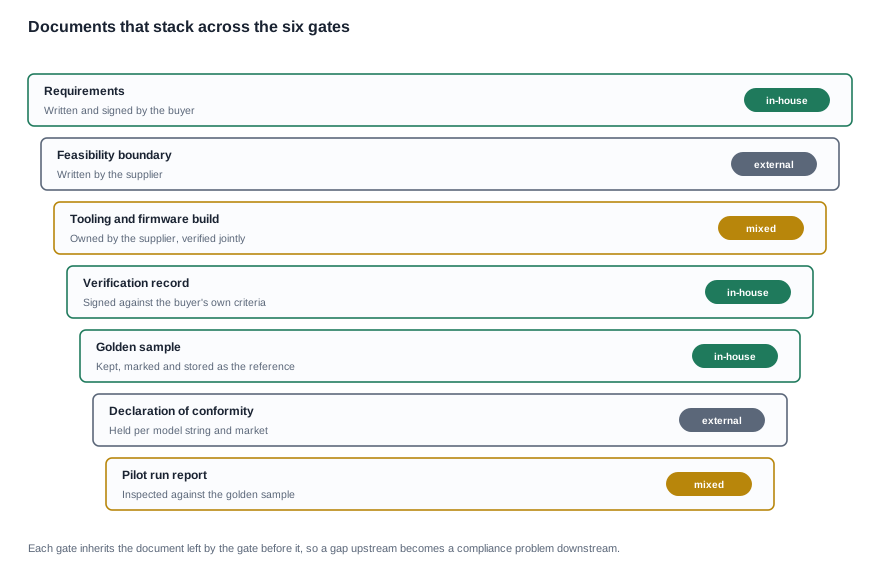
The transition across the first three gates is worth naming, because it is where most programmes go wrong. The requirement document is written by the buyer, the feasibility document is written by the supplier, and the tooling document is jointly owned. If the requirement document does not survive unchanged into the feasibility review, the programme has silently re-specified itself, and every later gate is now verifying something nobody agreed to.

The last three gates
The last three gates are about proving the product: first that the design behaves, then that it complies, then that it can be made again at volume, and we will ask for the evidence at each one rather than a summary of it.
Gate four: samples built and verified. The output documents are a signed golden sample and a verification record covering pairing, audio, charging, any camera function and control behaviour. The golden sample is a reference that defines the boundary between acceptable and not acceptable, and the verification record is the written evidence that a particular unit met the written criteria.
What this gate settles: that the design works as specified, on the actual tooling, with the actual firmware build. What it cannot settle: that the factory can repeat it, and that the product is compliant. A sample is a unit, not a run.
What the buyer should do here: decide the acceptance criteria yourself and write them into the requirement document, because a supplier asked to "assess quality" will assess against its own habits rather than yours. Ask for the golden sample to be marked and stored with its identity written on it, and ask for failed units to be retained so a later failure can be reproduced. Our separate article on how sample validation should work covers the verification record in detail, including the verdict vocabulary and the failure loop.
Gate five: compliance file closed. The output document is a declaration of conformity covering the exact model string that will ship, together with the underlying reports and the market-specific requirements that apply. The distinction in that sentence does the work: a declaration covering a product family rather than a model is not a declaration for your SKU. It is a shared letter between products that happen to share a shell, and it does not travel with your model string into a channel partner's file.
What this gate settles: that the specific model you are about to ship is covered by the evidence for the specific market you are about to ship into. What it cannot settle: that production units will match the sample, and that nothing will change between the file being closed and the shipment leaving.
What the buyer should do here: check the model string on the declaration against the model string on the purchase order, character by character, and check the market scope against your actual sales territory. The catalogue here publishes no certification status at all — CE, FCC, RoHS, RED and EN 18031 do not appear anywhere in the catalogue body — so certification evidence has to be requested from the supplier for your model and your market specifically. That is what to ask the supplier.
Gate six: pilot run before mass production. The output document is the pilot run report: a production run on production tooling at production volume, inspected against the golden sample. Pilot runs catch the substitution problems that engineering samples never see. An engineering sample is built with attention; a pilot run is built the way the line builds, and the difference between those two is exactly where component substitutions, line-worker variations and process drift surface.
What this gate settles: that the product can be made again, at volume, to the standard the golden sample defines. What it cannot settle: anything about the finished market outcome — that is beyond the supplier's control entirely.
What the buyer should do here: inspect against the golden sample rather than against a fresh checklist, and be present for the inspection rather than receiving a summary. A pilot order should be placed with the same care as the eventual purchase order, because the pilot order and the first commercial order are usually built by the same line in the same way, and if the pilot order is treated as throwaway the line will treat it that way too.
Across the last three gates there is a recurring theme: each of them is a comparison. The sample compares against the requirement and the golden sample; the compliance file compares the model string against the evidence; the pilot run compares the production unit against the golden sample. A gate with no reference to compare against cannot produce a pass or a fail, which is why a document-free gate produces only a feeling.

What each gate hands to the next
The gates are not just stages; they are handovers, and the handover is the thing that carries a programme forward. Each gate hands the next one three things: a document, a defined reference, and an explicit list of what is still open.
- Requirements frozen, handing to feasibility reviewed. A written requirement, including the clause that says which claims the product is allowed to make.
- Feasibility reviewed, handing to engineering and tooling. A costed boundary and a clear answer on what is standard and what needs new engineering work.
- Engineering and tooling, handing to samples built and verified. A verified tooling set and a firmware build that matches the frozen requirement.
- Samples built and verified, handing to compliance file closed. A specific model string, with a golden sample and a verification record behind it.
- Compliance file closed, handing to pilot run. A model whose conformity declaration covers the exact string being produced.
- Pilot run, handing to the purchase order. A production-proven unit and a report showing the golden sample was held.
That chain is the point of "a stage is finished when it produces a document, not when a date arrives". A date arrives regardless. A document arrives only if somebody wrote it. When a stage ends on a date with no document, the next stage inherits an open question and no way to answer it. The result is a programme where each stage looks busy and the total is slower than a programme that front-loaded its decisions.
The second thing that gets handed forward, and the thing that causes the most damage, is the list of open items. Every gate should close with an explicit list: what is decided, what is deferred, who owns the deferred item, and what document it will appear in. A deferred item with no owner is a defect waiting for a downstream stage to discover it, and the discovery always happens at the worst possible moment.
An informal gate is invisible while it is happening and expensive afterwards. This is the failure pattern worth understanding, because it is extremely common and almost never called a failure at the time.
Consider a gate that was passed verbally. The requirement was agreed in a meeting, so no requirement document was issued. The supplier built to the meeting. At the compliance gate, the declaration is prepared against the model string from the sample paperwork, which came from the buyer's verbal instruction. The declaration is fine. The declaration covers a model that nobody has a written definition of, so when the channel partner asks what the product is specified to do, the answer is a set of recollections. The problem was created at gate one and surfaced at gate five.
The same pattern appears in a written requirement that was changed by email after it was signed, so the sample was verified against one version and the tooling was cut for another. It appears when compliance evidence is filed against a product family rather than a model string, so that a later order for a second variant under the same family name has no declaration of its own. It appears when the pilot run is inspected against a checklist that somebody wrote afterwards rather than against the golden sample, so a unit that drifts slightly passes, and the drift continues until it reaches a channel partner.
In every case the cost lands late and lands on someone who was not present at the informal gate. The mitigation is not vigilance; it is a rule. If a gate has no document, it has not been passed, and the next gate cannot start on an oral handover. We will hold the programme at the gate until the document exists, and we will accept the delay that this creates as cheaper than the delay it prevents.
There is also a version of this that is not anybody's fault. Schedules move. Tooling takes longer than the first estimate. A buyer changes a requirement under commercial pressure. What matters is not that the programme deviates from the plan; it is that the deviation is recorded, so the next gate knows which document it is working from. A programme that records its deviations moves faster than a programme that pretends it has none, because nobody has to reconstruct the history when something needs to be explained.

Questions to ask at each gate
The purpose of this section is practical. At each gate there is a small set of questions that, if asked at that gate, prevent a much larger set of problems later. The trade-off behind every one of them is the same: information now, or rework later. We have kept them specific, and we have kept them to things that are actually answerable by a supplier.
At requirements frozen, ask: which claims is this product allowed to make, and which are explicitly out of scope. Which model strings are in scope. What is the packaging and what delivery documentation ships with the unit. What must be true about the device name, pairing behaviour and control behaviour. Which specifications are not yet defined, and when they will be. And what to ask the supplier: for the written specification behind each model in scope, so that the requirement document and the supplier's own description do not drift apart.
At feasibility reviewed, ask: which parts of the request are standard and which need new engineering. What the engineering and tooling cost looks like, and how it is split. What happens to the tooling cost if the programme stops here. What the commercial terms would be, including incoterms, MOQ and the treatment of sample charges against the purchase order. What the warranty would cover. And what to ask the supplier: the earliest point at which a firm answer can be given, since "it depends" without a date is not an answer.
At engineering and tooling, ask: which firmware build is under test and will it be the build that ships. Which tooling is verified and against which criteria. What was changed since the frozen requirement, if anything. What the spares position is. And what to ask the supplier: what the verification of the tooling actually demonstrated, and what it did not.
At samples built and verified, ask: the written criteria for each verification item, the results, and the golden sample identity and storage location. Which units failed and why, and whether the failed units are retained. Whether any item was passed with a recorded limitation, and who accepted it. And what to ask the supplier: the supplier's own specification for anything the published catalogue does not state for your model.
At compliance file closed, ask: which exact model string the declaration covers, which market scope it covers, and which underlying reports support it. Whether the declaration is per model or per family, and if per model, whether yours is the one on file. What to ask the supplier: the certification evidence for your model string and your destination market, since no certification status is published for any model in our catalogue.
At pilot run before mass production, ask: what was inspected, how many units, and against which reference. Whether the units inspected came from production tooling at production volume. Which deviations were found, and how they were classified. And what to ask the supplier: how the golden sample was held during the run, and what the process is for detecting a substitution before a shipment leaves.
Two of these questions are worth repeating because they are the ones buyers skip. The first is the model string on the declaration. A conformity declaration that covers a family rather than your model is not a declaration for your SKU, and finding that out after the channel partner has asked for the file is a much worse position than finding it out at the gate. The second is the golden sample storage location. A golden sample that cannot be found is functionally the same as a gate that was never passed, because the next stage has nothing to compare against.
The development process described here is the one we run, and the way we run it is what we will support a buyer through: six gates, six documents, and a rule that no gate closes without its output. For the shape of the whole programme, the OEM and ODM process pillar page is the place to start. Design and prototype covers the first engineering step, our note on development process documentation covers why the documents carry the weight, and our piece on quality gates looks at what a gate looks like when it is under pressure.