

The question has a real answer, and the answer depends less on where your factory is than on who is putting the product on the market under whose name. What makes it worth taking seriously is the failure mode: getting it wrong does not produce a customs hold at the border, it produces a problem months later, when an authority asks who is responsible for a product that is already on sale in twenty member states.
So this page describes the structure — who can hold the role, what holding it actually commits a party to, and how the requirement interacts with the rest of the compliance file. The specific obligation for your product, in your market, is a question for an adviser in that market. What follows is the part a buyer can act on without one.
Do I need a representative in the EU: what the requirement is actually about
For consumer products placed on the EU market, the framework is the General Product Safety Regulation, which has applied since 13 December 2024. Its structure requires a named economic operator established in the EU, identified on the product or its documentation, who carries a defined set of duties.
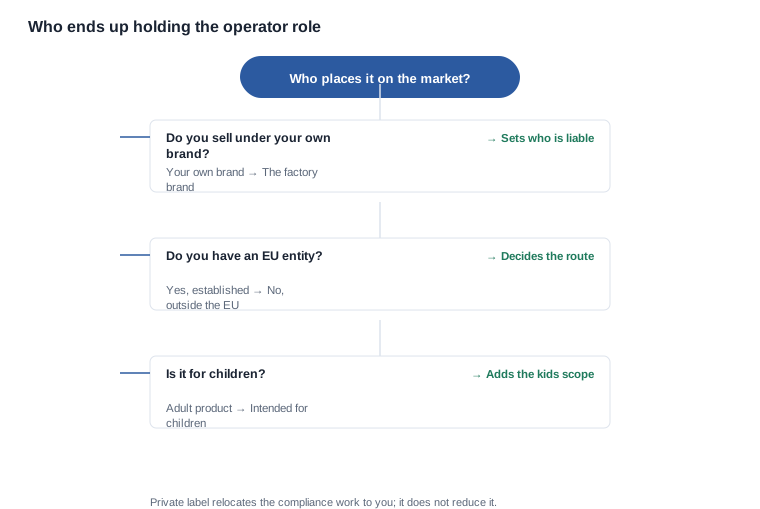
The requirement is about having an identifiable party in the jurisdiction with the capacity to act, not about having an address there. That distinction is the one that causes the most trouble, so it is worth making concrete. A fulfilment warehouse in one member state does not by itself make you an economic operator established in the EU, because storing and despatching goods is a service you buy, not an establishment you hold. A registered office address on a letterhead is not an establishment either. What the requirement is reaching for is a party that can be contacted, that can act on a non-compliant product, that can produce records, and that cannot simply point back at you.
Three further points about the structure, each of which changes what you need to do.
It sits alongside the conformity requirements, not instead of them. A radio product also has to satisfy the radio equipment framework applicable to it, which brings its own conformity assessment, its own declaration of conformity and its own technical documentation. The economic operator is not a substitute for any of that. The GPSR obligations for EU sales page sets out the safety framework separately for that reason, and the two sets of obligations have different owners and different evidence.
Children's products are a distinct scope. Where a product is intended for children, additional requirements apply, and the EU position diverges most sharply from general consumer product rules exactly there. Our range includes three kids models, the A05, the A06 and the A07, and the kids certification requirements by market page covers how the position differs between markets. If any of those models are in your plan, this is a scope question to settle before you appoint anyone.
The EU is one answer, not the only one. An EU operator satisfies nothing for the United Kingdom, the United States, Japan or anywhere else. Every destination market has its own importer-of-record and responsible-party regime, and a product sold in five markets is a compliance file with five sections, not one. Buyers who plan the EU properly and then discover that each other market needs its own appointment tend to discover it on a timeline they did not have.
And one point that changes the answer depending on your business model, which is worth putting early because it is frequently misread. The obligation attaches to whoever places the product on the market in the EU. If you buy a finished product and sell it under your own brand, you are placing it on the market, and in many structures that is a different party from the factory. Private label does not reduce the compliance work; it relocates it, and it relocates it to you. That is also why the packaging, the inserts and the online listing have to agree with whoever the operator turns out to be.
Two practical details sit inside the requirement and both are visible to a buyer long before anything is enforced.
Where the identification has to appear. "Identified on the product or its documentation" means the details have to be findable: on the product itself where that is what the rules require, on the packaging or the insert or the manual where that is where it is permitted, and on the online listing where the listing rules require it. In practice that means the operator's name and contact details become part of your packaging artwork, which means they are decided before the print run, not after the enquiry. If you have private label packaging, this is a packaging input, and it needs to be on the artwork before the proof is approved.
What the duties actually demand. The role is not a signature on a document. It is an obligation to be reachable, to keep or be able to produce the relevant records, to cooperate with a market surveillance authority, and to act on a product found non-compliant — which can mean withdrawing it from sale, notifying the channel, and correcting the underlying cause. A party that will not take an enquiry promptly, or that cannot act without an instruction from a factory in another time zone, is a weak choice for the role, and that is a question you can ask a candidate before you appoint them.

The routes available when you ask do I need a representative in the EU
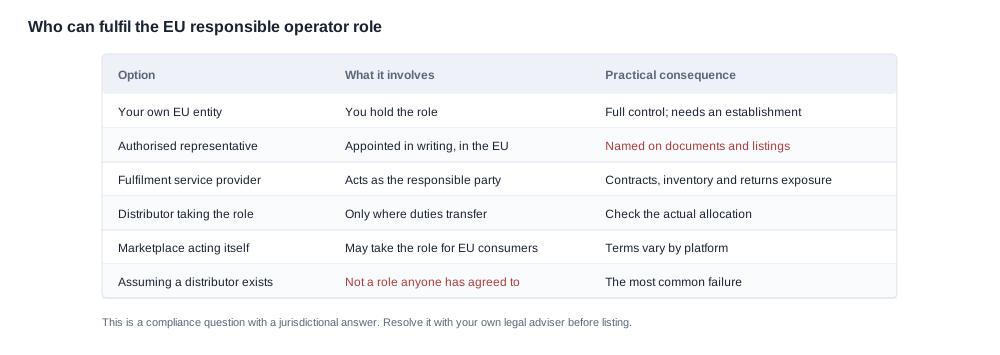
There are five routes in practice, and the differences between them are commercial as much as legal.
Your own EU entity. You hold the role yourself. This is the cleanest arrangement if you already have a company established in the EU, because there is no third party to pay and no delay in an enforcement action. It is not a paperwork exercise: the role means being reachable for market surveillance and being able to act on a product found non-compliant, and for a company whose operational centre is elsewhere that is a genuine commitment of resources.
An authorised representative. A party appointed in writing, established in the EU, who performs defined functions on your behalf. This is the route most non-EU manufacturers take, and the detail that matters is the writing. The appointment has to be a document, the representative has to be identified where the obligations require it, and their mandate has to cover the functions they are taking on. A distributor who has not agreed to anything in writing is not a representative, however willing they are.
A fulfilment service provider taking the responsible-party role. This exists and it works, but read the commercial terms before assuming it is neutral. In this arrangement the service provider is carrying a compliance role and the obligations that go with it, and they will price that risk. It is also the arrangement most likely to be offered as a free add-on and least likely to have been negotiated by anyone who knows what it contains.
A distributor taking the role. In some structures duties do transfer to a distributor, but only where the transfer has actually been agreed and documented. This is the arrangement most often assumed and least often written down, and it is the gap that the market surveillance enquiry finds.
A professional service provider appointed under a mandate. A compliance firm or a law practice can take the role as a paid mandate, with defined scope and a defined response time. This is a common and often sensible route for a first shipment, because the mandate can be narrow — one product, one market, one year — and it can be expanded as the sales footprint grows.
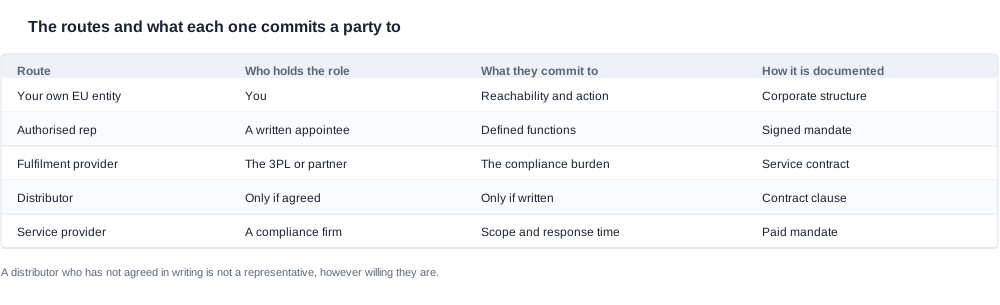
The comparison that matters is not the headline fee. It is the combination of the annual retainer, the response time promised when an authority makes an enquiry, the languages covered, what happens to the role if the arrangement ends, and whether the mandate covers the models you are actually going to sell. A cheap arrangement that covers three models is more expensive than a slightly dearer one that covers the range, because you will pay twice.
One question worth asking every candidate, whoever they are: what happens on the day an authority asks a question? An answer that describes a process with a named person, a response time and an escalation route is worth more than a lower retainer. The whole point of the role is that somebody can do something on a Tuesday afternoon.
Three more questions that decide the arrangement rather than the price.
Does the mandate cover several brands or models? If you run more than one brand, or plan to, an operator appointed for a single product is an appointment you will replace. Ask what a wider mandate costs, because the difference is usually small and the difference between re-appointing twice and appointing once is a project of its own.
What happens on exit? If the mandate runs for a fixed period, the identification on your packaging has to change at some point, and that means new artwork, new inserts and possibly new labels. A clause that lets you appoint a successor, and a stated period in which the packaging can still carry the outgoing operator's details, is worth having — otherwise the packaging changes force a decision you would rather make later.
Does the operator also do the customs clearance? Sometimes, sometimes not, and the two roles are frequently confused. The party that clears the goods and pays the duty is the importer of record; the economic operator is the party responsible for the product in the market. They are not necessarily the same party, and an importer being in the EU does not make it the operator any more than the operator being in the EU makes it the importer.

Where buyers misread do i need a representative in the eu
The classic pattern goes like this. A manufacturer appoints a distributor, treats the appointment as satisfying the requirement, lists on a marketplace, and discovers during a market surveillance enquiry that no party in the EU ever agreed in writing to hold a compliance role. The distributor was, in the end, a commercial partner who was perfectly happy to sell the product and never had any idea they were being treated as the responsible operator.
The gap is always the same one, and it is worth naming it precisely. "We sell in the EU through a partner" is a commercial arrangement. "A party in the EU has agreed in writing to hold a compliance role" is a legal one. The first does not create the second, and the distance between them is invisible until somebody asks.
Other misreadings that come up regularly.
That the factory will handle it. We are a manufacturer outside the EU. We do not hold an EU establishment and we will not present our commercial arrangement as if we did. We can supply documentation and we can cooperate with whoever holds the role, but the role itself has to be filled by a party established in the EU, and that is a decision for you.
That a warehouse address is enough. A fulfilment centre in one member state stores and despatches; it does not hold the role unless it has expressly agreed to, in writing, to be the economic operator, with a mandate that covers it.
That the marketplace's compliance check satisfies the obligation. Online platforms impose their own content and traceability requirements, and they are strict about them. Passing a platform's onboarding is not the same as discharging the underlying obligation, and in the cases where they diverge the platform requirement is the one that gets enforced first and the underlying one is the one that gets discovered later.
That it only matters if you sell physical retail. Online sales carry their own content, traceability and listing requirements, and they are usually the larger part of a new brand's European business.
That it is a one-off appointment. The role is continuous. It carries a duty to be reachable, to keep records, to act on a non-compliant product and to cooperate with an authority. An appointment made once for a first shipment, with no review, drifts out of date exactly when something goes wrong.
That the importer of record and the economic operator are the same thing. They are different roles and they are frequently held by the same company by convenience. The confusion is harmless until the moment the party clearing your goods has no role in product compliance and you assumed it did.
That an EU arrangement will cover the UK later. The United Kingdom is a separate market with its own requirements, and an EU operator does not extend to it. If the UK is on the plan, it is a separate appointment and a separate set of marking questions.
That the supplier's answer settles it. A supplier who tells you that your distributor arrangement handles the requirement is offering you a convenient answer rather than a correct one, and it is worth testing every supplier answer against the same question: who is the named economic operator established in the EU, in which document did they agree to it, and on what date.

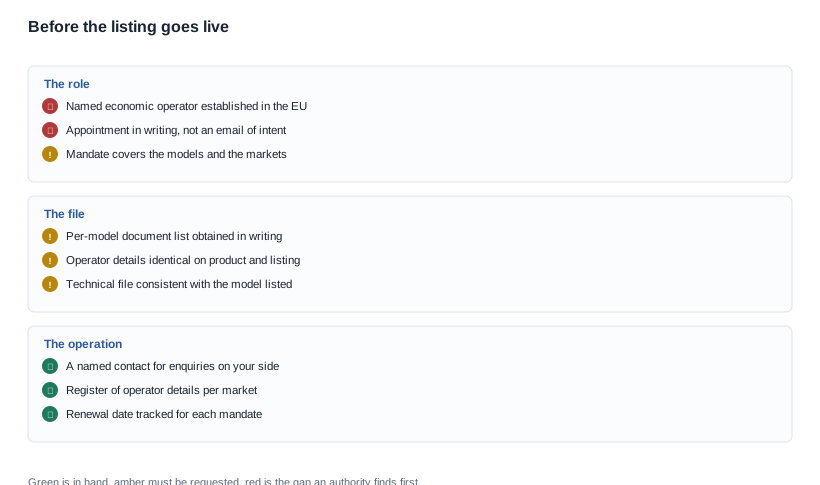
The pre-listing sequence when do i need a representative in the eu is answered yes
The order matters here, because each step depends on the one before it. Work through it before the listing goes live, not after.
- Determine who the responsible operator will be, for each market you intend to sell into — and note that "each market" includes every market, not only the EU.
- Have the arrangement documented. An appointment or a contract, with a named party, not an email confirming interest. Get the mandate to cover the models, the markets and the functions.
- Confirm where the details have to appear — on the product, on its documentation and on the online listing, as applicable — and make sure the operator's details on the listing, on the packaging and in the technical file are the same details.
- Check the listing requirements separately. Platforms impose their own content and traceability rules, and meeting them does not discharge the underlying obligation.
- Establish whether children's requirements are in scope if the product is intended for children. Our range includes the A05, the A06 and the A07, and this is where the EU position diverges most.
- Align the file with the model. Ask which documents exist for the specific model, with which scopes, and get the answers in writing. The certification checklist sets out the document set that has to be consistent, including how long a certificate stays valid and what evidence is dated.
- Get the adviser's answer in the target market before the listing goes live, and record it.

Two operational points that are easy to leave until they matter. First, name a person on your own side who is contactable when an authority makes an enquiry, and who knows who the operator is and how to reach them — because the first call will usually come to your customer service address, not to your compliance file. Second, keep a single register of the operator details per market, with the date of the appointment, the models covered and the renewal date, so that a second brand or a second channel does not quietly end up with a different operator than the first.
A third point belongs on the packaging side, and it is the one that catches buyers who appoint an operator early and then print. The operator's details are artwork. They have to be agreed before the artwork is released, they have to be identical on the packaging, on the insert and on the online listing, and they have to match the details in the mandate and in the technical file. Changing them later means a reprint, and a reprint is not a small thing — it is a new minimum print run, a new packaging cost and a stock reconciliation. If the operator is likely to change during the life of the packaging, plan the identification so that it can be covered by a label or an insert rather than by the printed carton.
On point six, it is worth being precise about what our documentation can and cannot support. Our export-certification page is a picture page: it carries ten patent certificate images, eight design patents and two utility models, and no per-model test report. The catalogue publishes no per-model certification row for any model, and the catalogue body does not publish a CE, FCC, RoHS or RED marking for any model. That is not a gap we can fill with a general claim; it means the per-model position has to be established for the model you are actually listing, in writing, as part of the file — which is a reason to ask for that document early rather than to assume it exists.
What a supplier can and cannot tell you about do i need a representative in the eu
We are a manufacturer outside the EU. We do not hold an EU establishment, and we will not present our business arrangement as if we did. It is also worth saying that we cannot appoint ourselves as your operator, cannot fill the role on your behalf, and cannot tell you that the requirement is satisfied for you.
What we can do is specific and useful. We can tell you what documentation we hold for a given model and what we can add to your compliance file. We can supply the model identification, the technical and specification material for the model you are listing, and the artwork and insert content that carries whatever responsible-party details you specify. We can make sure the identification on the product, on the packaging and in the documentation matches the model on your file rather than a neighbouring model — which matters more than it sounds, because a documentation set that names the wrong model is a document set with no evidential value.
What we cannot do is give you legal advice, and this question in particular should be answered with an adviser in the target market before a listing goes live. The role is created by an appointment, and the appointment has to be made by whoever is going to hold it.
For due diligence, two questions go to the supplier and one goes to the candidate operator. To the supplier: which documents exist for this model, with which scopes, and can they be provided in a form your file can hold. To the candidate operator: can we see a sample written mandate, what is the response time when an authority makes an enquiry, what is the annual cost, and which models and which markets does it cover. The third question — which models it covers — is the one that determines whether the arrangement scales or whether you will be appointing again in six months.
The commercial framing, if it helps: this is an ongoing cost that scales with the number of markets and the number of models rather than with the number of units, which means it belongs in the market-entry calculation alongside the packaging cost, the certification work and the first shipment. A buyer who treats it as a small compliance line item tends to be surprised by it in the second market rather than the first.
Tell us the markets and the channels you intend to use, and we will tell you what documentation we can provide to support your compliance file — and where the answer to your question has to come from an adviser rather than from a supplier.
Related reading
- GPSR obligations for EU sales
- how long a certificate stays valid
- kids certification requirements by market
Tell us your markets and channels and we will say what documentation we can provide.


