
We are a manufacturing business and we do not run a direct-to-consumer operation. Every unit we make leaves through a business arrangement — a brand owner, a distributor or wholesaler, an online seller, a retailer buying through one of those, or an institution going through a procurement route.
If you are an individual looking to buy one pair, we are the wrong place, and we would rather say that in the first message than after a long exchange. If you are buying for a business, this article sets out how the arrangement works, what each kind of buyer needs, and what to ask for at the start.
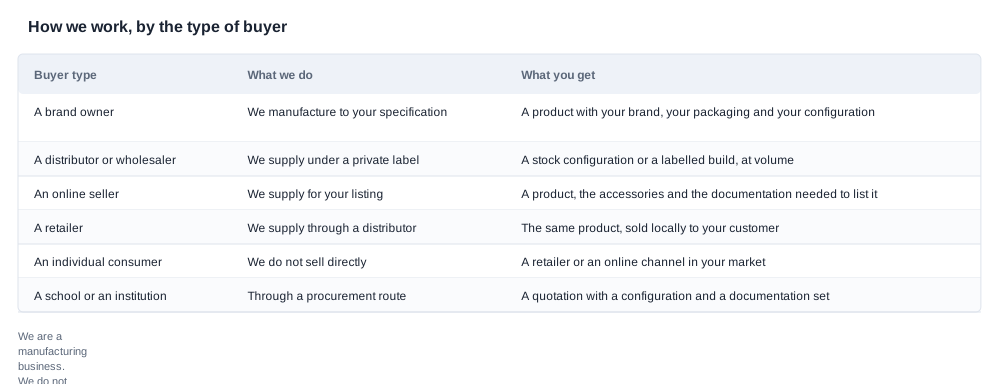
Do you buy one pair, or do you buy a programme?
That is the first question to ask yourself, because the answer determines whether this conversation is useful to you at all.
We do not operate a consumer shop, we do not run a marketplace, and we do not sell a single unit at a retail price to an individual. We do not publish unit prices, minimum order quantities or lead times either, because each of those depends on the configuration, the quantity, the mix and the current production schedule — and a general figure would be wrong in a way that matters to somebody planning a budget.
That is not fastidiousness about a number. It is a direct consequence of how the business works. A consumer sale carries a per-unit cost of support, returns, consumer protection, payment processing and a customer service function. Those costs are designed into a retail price, and they are the reason the retail price of a product in this category is a multiple of what the same product costs in a business transaction. A manufacturer that sells single units to consumers has to become a retailer to do it, and most manufacturers that try end up doing it badly for everyone — the channel partners notice, the price structure becomes incoherent, and the manufacturing business ends up subsidising a retail operation it did not want.
So the honest answer has two halves. If you want one pair for yourself, the routes that will actually work are a retailer in your market, a distributor who sells to consumers, or the marketplace where the brand is listed — and we are happy to tell you which of our customers operates in your market if you ask. If you are buying for a business, the conversation is a different one and it is the one this article is about.
There is a third category that gets confused with the first, and it is worth naming. A small business buying for resale — a shop, a content creator selling on a marketplace, a small retailer — is a business buyer even if the volume is modest, and the questions in this article apply to them. What changes at small volume is the structure of the commercial terms rather than the nature of the arrangement.

Do you need a factory, a trading partner or a distributor?
There are three ways to buy smart glasses, and they are genuinely different propositions for the buyer, and the difference matters more than most buyers expect at the start of a relationship.
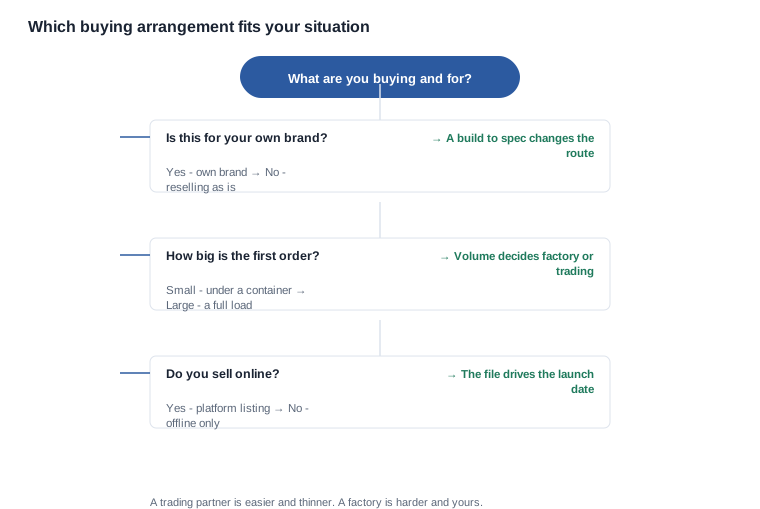
A factory builds to your specification and sells to you. You hold the relationship, the branding, the customer relationship and the pricing, and you carry the quality, the certification and the inventory decisions. The trade-off is that you need the volume and the operational capability to make that work, and the relationship carries all of the risk.
A trading partner buys finished goods and resells them, sometimes with a private label and sometimes not. The economics are simpler: you take a per-unit price on a known product and you have almost no operational involvement. The trade-off is that your differentiation is thin, your margin is set by a difference you did not negotiate, and your dependence on the supplier is high because they control the product, the documentation and the supply.
A distributor sits between a manufacturer and a regional market, holding stock and serving resellers. For a buyer in a market where you are not established, this is often the practical route, and it can be a good one. The trade-off is that the manufacturer does not know you, so the question of what happens to your programme if you outgrow the distributor is a real one, and it is worth raising before it matters.
The most common mistake in this category is buying through a trading partner because it is faster, and then discovering in month eight that the supplier has a catalogue rather than a capability. The questions in the last section of this article are the ones that separate the three before you commit, and they cost a single email.
There is a version of this decision that is really about the buyer's own operating capacity rather than about the supplier, and it is worth being honest about it. A factory relationship requires someone in your organisation to own the specification, the artwork, the documentation and the quality feedback. If nobody does, the relationship does not work, and the failures show up in the same places every time: artwork that is approved verbally, a documentation file that is assembled the week before shipping, and a quality issue that is noticed by a customer rather than by you. A trading partner absorbs that work because it is already doing it for many buyers. That is not a lesser arrangement, it is a different allocation of work, and the mistake is to take a factory relationship without the capacity to run it.
The reverse mistake is worth naming as well. A brand with real differentiation — a distinctive design, a specific audience, a channel relationship that a distributor cannot serve — buys through a trading partner and discovers that its one competitive advantage is being sold alongside somebody else's. If your differentiation is in the product, the route through a factory is worth the extra operational work. If your differentiation is in the channel or the content, a trading partner may be entirely sufficient, and the money you save on the per-unit price may be better spent on the channel.
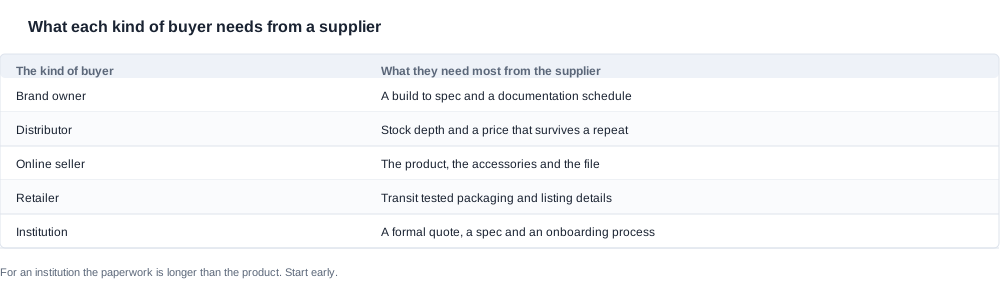
The table above is worth reading as a specification for the first conversation rather than as a comparison. A brand owner needs a factory that can build to a spec and hold a documentation schedule. A distributor needs depth of stock, consistency and a price structure that survives a repeat order. An online seller needs a product, the accessories, the documentation and a supply position that will not run out during a promotion. A retailer needs transit-tested packaging and listing information, decided before the product reaches the shelf. An institution needs a formal quotation, a specification, a documentation set and an onboarding process — and the paperwork there is longer than the product, which is why that conversation starts early.

Do you want the catalogue, or do you want a build to your spec?
We manufacture a catalogue of twenty-eight models across seven categories, and most programmes start by choosing one of them and then branding it. That is the faster route, and for a first order it is usually the right one, because the product is already built, the documentation already exists, and the lead time is shorter.
The alternative is a build to your specification, and the specification has to be assembled from something. Our published customisation scope across the audio, camera and sport classes covers the logo, the frame colour, the packaging and the temple shape. For the audio and sport classes, the lens material and the lens colour are also customisable, and for the sport class the lens configuration is. The Bluetooth device name and the system customisation sit on the audio class, and the remote control on the sport class. For two entries in the range — the bone conduction platform and the AR entry — no customisation capability is disclosed at all, so if your project depends on modifying those two, they are not currently candidates on the strength of our published documentation.
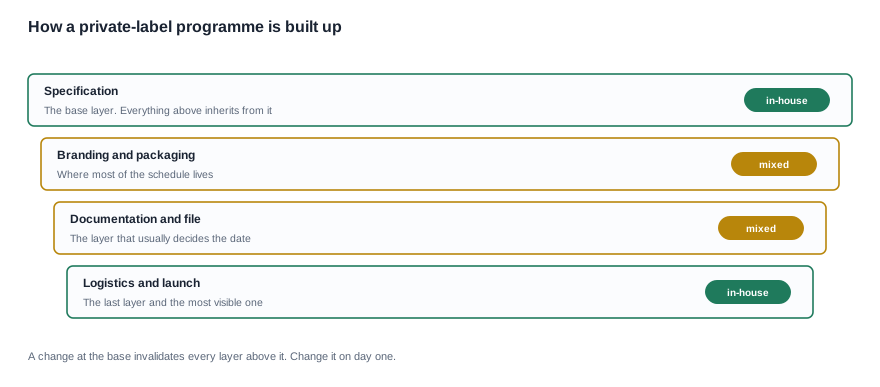
The layering in that diagram is roughly the order things have to happen in, and it is worth noticing which layer sits where. The specification is the base, because everything above it inherits from it — the packaging artwork, the label copy, the documentation and the listing all describe the product as specified, and a change at the base invalidates everything above it. Branding and packaging come next, and they are where most of the schedule lives, because packaging has its own supplier and its own lead time. Documentation and the channel file sit above that, and they are the layer most often under-resourced, because it is invisible until a platform rejects a listing. Logistics and launch sit on top.
Two things in that stack are worth flagging for a buyer starting out. The first is that the specification layer is cheap to change on day one and expensive on day forty, and the moment the packaging is tooled the cost of a change rises by an order of magnitude. The second is that the documentation layer is the one that usually determines whether the launch date holds, and it is the layer most likely to be discovered late, because the factory does not experience it as a delay — the product is finished and sitting in a warehouse.
The practical consequence is that the first order is worth spending more time on than the second. Get the specification, the packaging and the documentation right on a smaller order, and the repeats become straightforward transactions. Get them wrong on a large order, and the problem arrives at the scale where it is most expensive to fix.
Which model you start from matters less than buyers think, and more in a specific way than they expect. The published data does not distribute evenly across the range, and the gaps are informative rather than inconvenient. Every model in the audio class publishes a Bluetooth version, because that is the specification that class is bought on. Every one of the eleven camera models publishes a rated runtime, with the camera batteries in the 220 to 290 mAh range and runtimes of roughly five to eight hours, although the test condition behind those figures is not published. Resolution splits the camera class into eight megapixels across most of it and thirteen for the S7 and the L2 Utral, and the L1 Pro.
The gaps are where you need to ask. The charging method is published as magnetic on seventeen models and Type-C on seven, and it is not published for the MT6 and the L1 Pro, and the CY03 and the CY05. The charging case capacity is published for five models, with two more having a case whose capacity is not published, and three having no case row at all. Only the V06 and the S7 carry an ingress marking, and only the MT6 publishes a frame weight, at 158 g for the glasses alone, excluding its 1200 mAh foldable case. If a particular figure matters to your listing, ask about that model rather than assuming the range behaves the same way — and treat a model with an open row as one where the figure needs confirming, not as one where you can interpolate.

Do you have the paperwork your channel will ask for?
Every route into a market has its own document requirement, and a product can be finished, packed and shipped and still be unable to be sold. That is the situation most first-time exporters in this category find themselves in, and it is worth walking through what is actually required.
In the European Union, the General Product Safety Regulation has applied since 13 December 2024, and an online listing has to carry the required information rather than relying on the box. A named party in the Union has to be identified for a product made outside it, and the technical documentation, the risk assessment and the batch traceability have to support that party. The Radio Equipment Directive's cybersecurity requirements have been a mandatory part of CE marking since 1 August 2025, with the EN 18031 series of harmonised standards behind them. The United Kingdom has its own conformity route following the transition away from CE recognition, and somebody has to sign the declaration under it.
On our own documentation, we should be straight about where it ends. Our product catalogue does not carry a per-model certification row, and our export-certification page is a picture page showing ten patent certificate images — eight design patents and two utility models — rather than a register of model certificates. The model-level certificate numbers, the test report numbers, the minimum order quantities and the lead times are all not published. What that means practically is that the document work for a specific model has to be done with the manufacturer, and it has to be scheduled, not assumed.
The marketplaces add a layer on top of the legal position, and it is a layer buyers regularly underestimate. A platform can require a named responsible person visible on the listing, in a particular field, in a particular format, and its own review cycle runs on its own clock. A product that satisfies the regulation can still be blocked by a channel that wanted more, and the delay lands between the product being ready and the product being sellable.
It is worth adding the retailer's requirements to that picture, because they are decided earlier than buyers expect and they are not optional. Transit testing on the outer packaging, the shipping marks, the carton and pallet configuration and the listing information are all set before the product reaches the shelf, and a buyer who discovers them after the packaging is printed discovers them too late to change anything without a reprint. The retailer's requirement travels back through the distributor in most arrangements, which means it reaches the manufacturer as a set of changes to artwork and packing rather than as a request, and it is much easier to absorb before the artwork is final.

The sequence above is the one we would propose, and the order is deliberate. The market and the channel come first because they determine the documentation scope, and the documentation scope determines the specification, and the specification determines everything else. Working backwards from the product to the market is how a programme ends up with a file that does not match the product.
Do you know which supplier question is worth asking first?
A buyer should be asking about the supplier as well as about the product, and the questions worth asking are the ones that can be checked.
Are you the factory or a trading company? This is the most important question in the category, and there are concrete ways to test it. Ask about the production line, ask for a video walk-through, ask which models are running, and ask a question only somebody inside the operation would be able to answer. The distinction between a factory and a trading company is not a matter of principle — it changes who is liable when a batch fails, who owns the tooling, and how long your order takes when something goes wrong. We have written about it separately because it comes up in almost every enquiry we receive.
What is published and what is not? Our documentation is deliberately uneven, and the unevenness is informative. We publish the product data: the battery capacities, the rated runtimes, the charging interfaces, the camera tiers, the structural features, the colour options, the case capacities and the charge times. We do not publish the model-level certificate numbers, the test report numbers, the minimum order quantities, the capacity or the lead times, and where a row is open we mark it as open rather than filling it with a typical value. A supplier whose documentation is smooth everywhere is either unusually complete or filling gaps. A supplier whose documentation shows exactly where the gaps are is telling you something useful about the state of their internal records.
Will you say what you do not know? A supplier that answers every question is either extraordinarily well documented or is guessing. The more useful behaviour, and the one we would look for on a shortlist, is a supplier that answers most questions and is precise about the rest.
What happens if the specification changes after the first run? The honest answer here tells you more about the working relationship than any number in a quotation, because it describes whether the supplier has a change process or an improvisation habit.
And the practical request that gets a quotation you can plan against: the model code, the configuration, the minimum, the factors driving it, the certification position for that exact code, and a schedule with the dependencies named. A quotation that does not carry those six things is a number, and you will spend the first month of the programme working out what it assumed.
On our own position, then: we are a manufacturer, our customers are businesses, and the best way to work with us is with a specification rather than with a shopping list. We will not pretend to be a retailer, and we will not publish a price list that would be wrong for most of the configurations we actually make. What we will do is take your market, your channel, your volume and your configuration, and come back with a quotation that names the model code, the configuration, the minimum, the factors driving it, the certification position for that exact code, and a schedule with the dependencies named.
The models we manufacture are on the oem ready platforms page, the customisation points a brand can choose are set out in standard OEM options, the way to check a factory rather than a trader is in factory vs trading company, and the documents a listing needs are collected in the certification checklist.
Related reading
- The models we manufacture — OEM ready platforms
- The customisation points a brand can choose — standard OEM options
- How to check a factory rather than a trader — verifying a factory
- The documents a listing needs — certification checklist
Send us the market, the channel, the volume and the configuration, and we will come back with a quotation you can plan against.