

Yes, and the reason it catches people out is that the answer is not conditional on the channel. The General Product Safety Regulation does not distinguish between a unit sold in a shop, a unit sold through a marketplace and a unit sold on your own website. It does not distinguish between a product made inside the European Union and one made anywhere else in the world. If you are a business placing consumer products on the European Union market and you are selling online, the regulation reaches you.
What online selling changes is not the scope but the form. The information a customer needs has to travel with the listing rather than with the box, because the customer sees the listing and not the packaging. The identity of the party answerable for the product has to be discoverable from the listing, because in a cross-border online transaction it is otherwise not clear who is responsible. Those are two operational consequences of the same legal obligation, not two different legal obligations, and a supplier who treats them as separate regimes is going to cost you a listing rejection at the worst possible moment.
There is a second reason to read this carefully, and it is about us rather than about you. Our published catalogue body does not name CE, FCC, RoHS, RED or EN 18031 anywhere. Our export-certification page is a picture page carrying ten patent certificates, eight design patents and two utility models. There is no per-model certification row in the catalogue, no published certificate numbers, no published test report numbers and no published certification lead time. Our documentation does not currently include a General Product Safety Regulation file.
So this article will tell you precisely what the regulation asks of you, how it relates to the CE marking you may already hold, which business situations change the answer, and what to have ready before a listing goes live — and it will be explicit about which parts of that we can answer from our own documentation today and which parts we cannot.
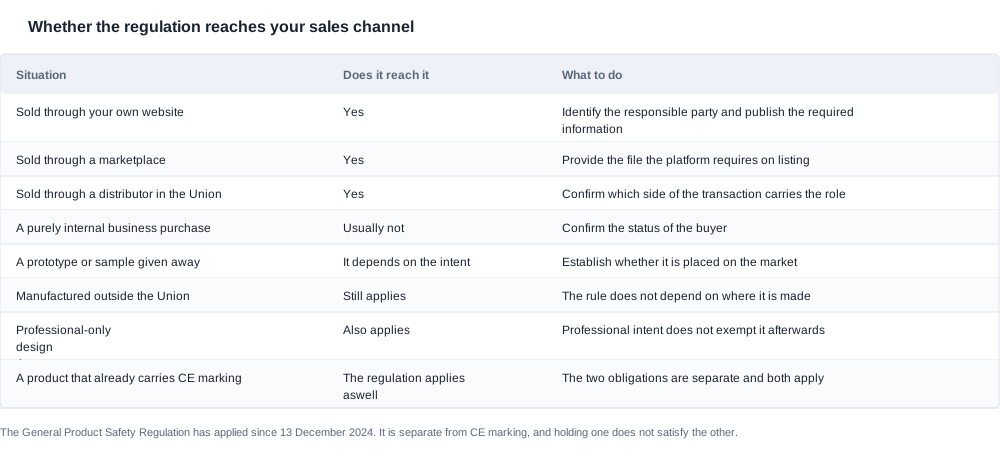
Does gpsr apply to online sales: why it is not a special case
The regulation, (EU) 2023/988, has applied since 13 December 2024. It replaced the General Product Safety Directive, and it applies to consumer products made available on the market, which includes distance selling. Its reach is deliberately broad: it applies to products designed exclusively for professional use if they subsequently reach the consumer market, and it applies regardless of where the product was manufactured.
That last point is the one that matters most for a buyer sourcing from Shenzhen. The rule does not depend on the place of manufacture. It is the reason a factory partner will be asked for European Union documentation rather than local documentation, and the reason a Chinese factory partner cannot answer your compliance questions with a domestic certificate.
Three ideas do the work of why the channel makes no difference:
The trigger is making a product available on the market. Whether that happens on your own site, through a marketplace, or through a distributor who then sells online, the product has been made available. The channel is a description of how, not a legal category that switches the rules off.
The obligation follows the economic operator placing the product on the market. This is the practical point, and it is the reason the answer to your question is not always "yes, for you". If you are the importer of record, the obligations are largely yours. If your distributor is the importer of record and sells onward, the obligations sit with them, and your job becomes making sure the file they need actually exists and covers your model code. Where the answer sits determines who has to do the work, not whether the regulation applies.
Online adds two delivery problems, not two legal regimes. The first is that safety information and identifying details have to reach the customer before they commit, through the listing, not only inside the box. The second is that the responsible party has to be discoverable from the listing, because the customer has no other way of finding out who stands behind the product they are about to buy. Everything else in the regulation works the same way online as in a shop.

What does gpsr apply to online sales actually ask of the seller
Six obligations matter in practice. For a buyer, the useful move is to know which one your supplier holds and which one you hold, because the gap between the two is where the dispute lands.
A named, identifiable party. Where the manufacturer is established outside the European Union, a person or entity established within the Union has to be identified on the product and in the accompanying documentation, and has to carry out the tasks the regulation assigns. That is what people mean by an EU responsible person or an authorised representative. It is a legal role with a technical file behind it, a point of contact for a market surveillance authority, and a duty to act on a corrective action if the product is found unsafe.
A product safety file. A risk assessment, the information a user needs in order to use the product safely, and the supporting technical documentation. This is where the technical file, the risk assessment, the instructions and the batch traceability come together. It is a different document set from the CE marking technical file, and the confusion between the two is one of the most common causes of a rejected listing.
Traceability. A way to identify the product, the batch and the economic operator. This is the row that online selling tests hardest, because a marketplace listing, the packaging and the paperwork all have to agree about which model, which batch and which party is responsible. Three documents, one set of facts, no room for a mismatch.
Information with the product. Instructions, warnings and identifying details. Online, this has to be available before the customer commits to the purchase, which means it has to exist in a form that can be published, not only a printed manual in a box.
A corrective-action route. If the product is found unsafe, somebody has to be able to act: withdraw it, notify the customer, inform the authority. This is the task the responsible person exists to perform, and it is worth understanding before it is needed rather than during a listing suspension.
A manufacturer identification that survives the chain. The name and address of the manufacturer or the party placing the product on the market, on the product and in the accompanying documentation.
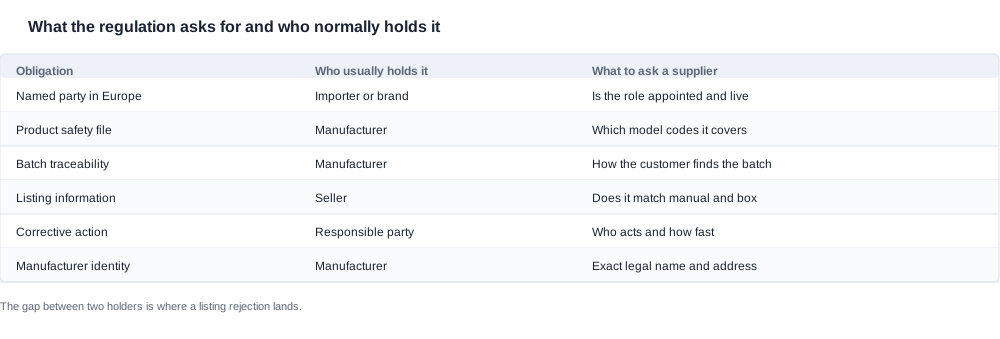
For a buyer, the practical form of this is a question set for the supplier. Which of the six do you hold today? Which are held by the customer of record? Where does the safety file live, and who maintains it when the firmware changes? A supplier that answers with "we have CE" has answered a different question entirely, and the gap between that answer and the one you need is the first due diligence item on the list.
How does gpsr apply to online sales relate to CE marking you already hold
This is the most useful distinction to hold, because the two obligations are constantly confused and the confusion is expensive.
CE marking is a product-level conformity assessment. It says the product meets the applicable European Union legislation — for a radio-enabled pair of glasses, principally the Radio Equipment Directive 2014/53/EU — and it is carried by the product itself. It is a statement about the product's design and its emissions and its radio behaviour.
The General Product Safety Regulation is about the product's safety, its traceability and the identity of the economic operator responsible for it. A product can carry a legitimate CE mark and still be a GPSR problem, because the CE mark says nothing about who is answerable for it in the European Union, nothing about batch traceability, and nothing about the distance-selling information a customer needs before they buy.
There is also a date dimension on the cybersecurity side of the radio requirements. From 1 August 2025 the cybersecurity requirements of the Radio Equipment Directive become a mandatory part of CE marking, described by the EN 18031 series of harmonised standards, and they are a separate obligation from the general product safety requirements. Two obligations, two document sets, two owners.
The practical consequence for a shortlist is a sharper criterion. Do not treat "CE certified" as a single line in a supplier comparison. Break it into at least four lines — the product conformity assessment, the cybersecurity conformity assessment, the product safety file, and the responsible party — and ask which of them the supplier holds, for which model code, and whether the file describes the configuration you are actually ordering. A supplier with a strong position on the first and nothing on the second, third and fourth is a supplier who will pass a technical due diligence and then fail a listing review in your market.
That is also where the commercial value of the question sits. The regulation's own detail is a given; the question for a buyer is whether the file behind the answer covers the SKU that will be listed. Our certification checklist sets out the document types to request, and the way to read a model list when a document covers a family rather than a named model, which is the most common reason a file turns out not to cover the thing you are about to sell.

Six business situations where does gpsr apply to online sales changes the answer
The regulation is channel-neutral, but your obligations are not, because they follow the legal structure of how the product reaches a customer. Six situations deserve a check against your own business.
Your own website. The listing has to carry the identifying information and make the responsible party discoverable, and the file has to exist behind it. This is the straightforward case, and it is the one where the mismatch between the listing and the file is immediately visible.
A marketplace. Platforms operate their own document checks, and several require responsible party details at listing level regardless of the legal position. A product that satisfies the regulation can still be rejected by a channel that wants more. Treat the platform's requirements as an additional specification layered on top of the legal one, not as a substitute for it.
A distributor in the European Union. The obligation follows the party placing the product on the market, so establish who your importer of record is in each market before assuming the obligation sits with you. If the distributor is the importer of record and sells online, they need the file as much as you do — which means either they produce it or you hand it over in a state they can use.
A sample or a prototype given away. Whether something is placed on the market depends on intent and circumstances, and a free sample to a customer is treated differently from a unit given to a reviewer or a trade show visitor. This is a common practice with a treatment that is not obvious, so it deserves a written position from your legal adviser rather than an assumption.
A business-to-business sale of a professional product. Usually outside the consumer scope, but confirm the status of the buyer rather than assuming it. The professional use case and the consumer market both appear in this category, and a product can cross from one to the other.
A product made outside the European Union. The rule does not depend on the place of manufacture, which is the point of it. That is the answer to the question a Chinese factory partner will be asked most often.
Two model-specific notes for this catalogue. The kids models A05, A06 and A07 are children's products, and child-product safety carries its own considerations that sit on top of the general obligation; our child product compliance page is the right place to start that conversation. And the ingress marking in this range sits only on V06 and S7, which publish IP54, so if your listing makes a water-resistance claim it rests on one of two models rather than on the range as a whole — see our IP ratings guide for how that claim should be worded.

Preparing the does gpsr apply to online sales file before the listing goes live
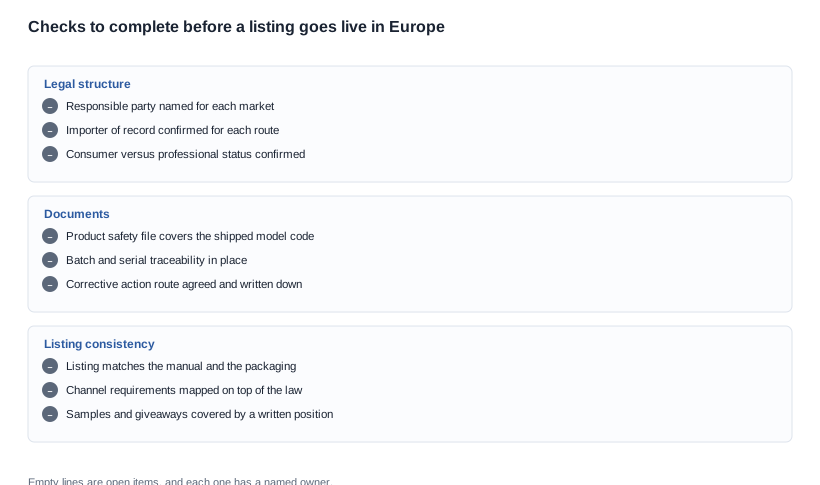
The work is not large, but it has to be done before the listing is published rather than after it is suspended. Six questions, each with a finite answer:
- Who is the party responsible for the product in each European Union market you sell into? Settle this first, because it determines which routes are open to you and it determines who has to do the work. For a Shenzhen manufacturer selling under your own brand, this is usually a role you appoint and pay for; for a distributor model, it is usually their role, and your job is to make sure the file supports it.
- Does the technical file describe the exact model code and configuration you ship? A mismatch between the file and the box is the most common reason a listing gets rejected. Check the model code, the colour variant, the charging configuration and the packaging against each other — the CE marking file is a separate document and the two documents can drift apart without anyone noticing.
- What is the batch and serial traceability, and how does the customer find it? The regulatory question is one half; the operational question is whether the customer can find it from the listing, which is the half most often missing.
- What information appears in the listing, and does it match the manual and the packaging? Three documents with three sets of wording, and the test is whether they agree.
- What does the channel require on top of the regulation? Often more than the regulation, and the requirement changes without notice.
- What is the corrective-action route if a product is found unsafe? Who is contacted, who pulls the listing, who notifies the customer, and how fast. Write it down before it is needed.

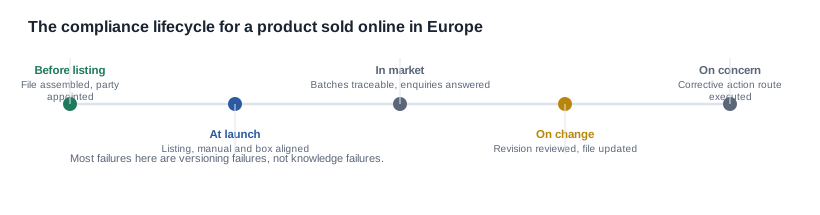
The lifecycle picture above is worth sitting with for a moment. The file is not a document you produce once at the start and file away; it is a living set that has to be re-checked when the configuration changes, when the firmware changes, when the packaging changes and when the responsible party changes. In practice that means a named owner, a review trigger on every product revision, and a record of which listing versions were live against which file versions. Most compliance failures in this category are not failures of knowledge; they are failures of versioning.
The same discipline applies on the supplier side of the relationship, and for a buyer it is the part worth negotiating. When a supplier quotes a configuration change, ask whether the change touches anything inside the file: the radio behaviour, the firmware, the charging circuit, the battery, the enclosure material, the packaging, the model code on the label. A cosmetic change is not a compliance event. A colour variant on a model that also publishes photochromic lenses may be, if the test was performed on a specific optical configuration. This is the same distinction that matters for CE, and it is the one that decides whether a late change is a marketing decision or a re-test. Put it in the development agreement as a notification obligation with a named contact on both sides, so that the answer to "does this change affect the file" has a deadline and an owner rather than being settled by whoever picks up the message first.
Two further points belong in the same working session. First, keep the listing text, the manual and the packaging under version control as a set, because a mismatch between any two of them is what a reviewer finds first and it is far cheaper to fix before publication than after. Second, decide early who in your organisation owns this, because in a small team the obligation tends to sit with whoever is nearest to the marketplace listing, and that is rarely the person who can answer a market surveillance question.
Our market selection guidance covers how the requirements differ between destination markets, which is the other half of the same question. A product that is compliant for one European Union market is not automatically compliant for another, and a business that has solved the regulation for one country has not solved it for the second.
What we publish about does gpsr apply to online sales today
The position, stated plainly so that you can put it in front of your own legal adviser or your compliance lead.
Published: the hardware facts for each model — the range, the Bluetooth version where it is published, the charging method where it is published, the case and its capacity where it is published, the charge time where it is published, the camera resolution where it is published, the ingress marking for the two models that publish one, and the weight for the single model that publishes one. Also published: the fact that our export-certification page carries ten patent certificates, eight of them design patents and two utility models.
Not published, for any model: certificate numbers, test report numbers, laboratory names, test conditions, certification lead times, and a General Product Safety Regulation file. None of those appears in the catalogue, and we are not going to imply otherwise with a summary line.
What we will do, and this is the useful part, is work the six questions above against a specific model, a specific set of destination markets and a specific channel. For each one we will say whether we can answer it from our documentation today or whether it needs a document we still have to obtain. Where we hold the answer, you get it. Where we do not, you get the honest version, which is more useful than a paraphrase of a document nobody has read.
Send us the models, the destination markets, the channels you sell through, and whether the product carries your own brand or ours. We will tell you which of the six questions we can answer today and which remain open on our side, and we will put our remaining work on the record so you can plan around it.
Related reading
- The regulation and what a file contains — GPSR obligations
- The document set behind the listing — certification checklist
- The named party the regulation needs — a named party in the European Union
- The markets where the rules differ — market selection
Tell us the markets, the channels and whether the product carries your own brand, and we will say which of the six questions we can answer today and which remain open on our side.


