

A firmware change is not a line of code. Inside an engineering customisation programme it is a controlled change to a published behaviour, and that behaviour is what a buyer tests, signs off against, and eventually declares. Most procurement disputes about firmware start from a simple misreading: someone treats a firmware request as a configuration adjustment, and only discovers the difference when the sample behaves in a way the specification sheet never described. This article sets out what a firmware change actually touches inside a customisation programme, why the firmware build functions as a gate in its own right, how the behaviour gets verified at the sample stage, and what a buyer should put in writing before the change starts.
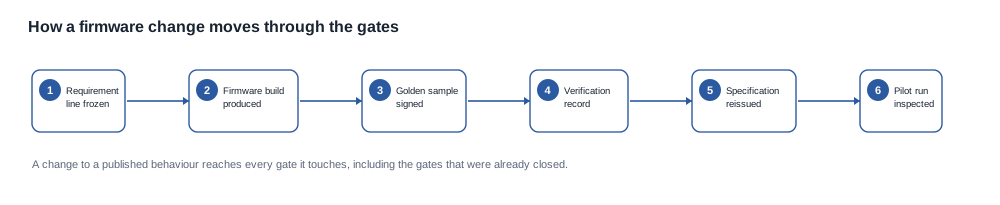
The six-gate framework used in engineering customisation programmes runs in a fixed order: requirements frozen, feasibility reviewed, engineering and tooling, samples built and verified, compliance file closed, and a pilot run before mass production. A stage is finished when it produces a document, not when a date arrives. Firmware work sits inside the third gate and produces one of that gate's two outputs: the tooling completed and verified, plus a firmware build matching the frozen requirement. This article stays deliberately inside that gate and its consequences.
Engineering customization: what a firmware change touches
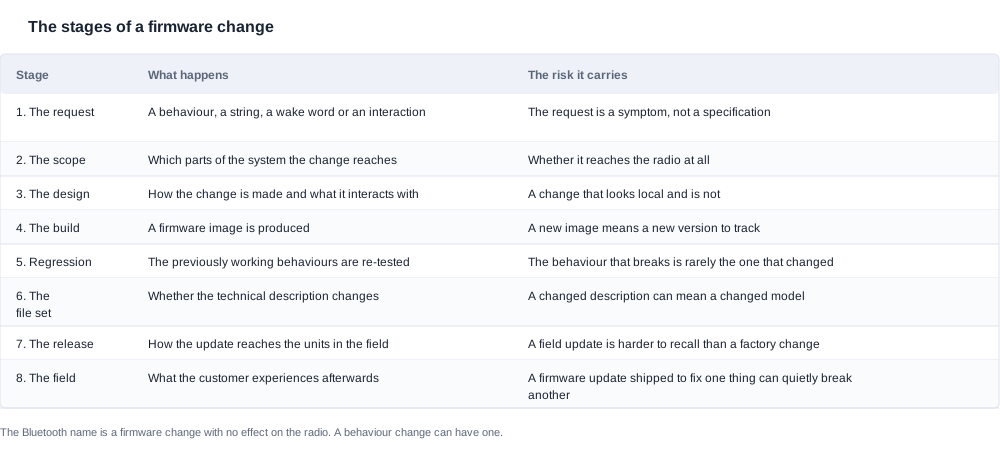
The first thing to separate is a configuration change from a firmware change. A configuration change alters a setting that already exists in the shipped software: a device name chosen from a supported list, a language pack, a stored pairing record, a default volume curve. The behaviour set does not move; you are selecting within it. A firmware change alters the behaviour set itself. The moment you ask for something the current software does not do, or asks for something it does in a way your market will not accept, you have entered firmware territory and the engineering and tooling gate applies.
The practical way to draw the line is to ask a single question: does the shipped software do this today, in a way your market can accept? If the answer is yes, it is configuration. If the answer is no, it is a firmware change. If the answer is "it does something, but not the way we need", it is a firmware change, and it is worth recognising that this middle case is where the majority of misclassified requests sit.
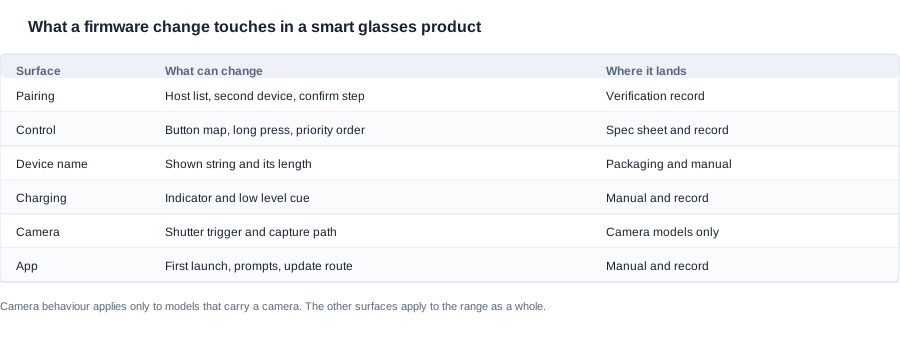
On a smart glasses product, the surface area a firmware change can touch is well defined, and it is worth walking through it item by item because buyers routinely discover these items one at a time, late. In this section we will take the surfaces in turn and note what each one drags along with it.
- Pairing behaviour. How the device announces itself, how many host devices it will hold, what happens when a second phone tries to connect, whether a re-pair requires physical confirmation, and what the user sees when the pairing is rejected. A change here alters the first five minutes of the user's experience and is very visible in returns.
- Control behaviour. Button mapping, long-press versus short-press, gesture surfaces if any exist on the model, and the order in which actions are prioritised when a control event and an incoming call collide. Control changes are the most commonly requested and the most commonly under-specified request in the whole programme.
- Device name. The string shown in the host's Bluetooth list, the length it may occupy, and whether it carries a model or brand suffix. This looks cosmetic, but it is what the end user types into support requests, and in some markets it is what the importer's documentation refers to.
- Charging and battery indication behaviour. The charging indicator behaviour, the low-battery threshold, and what the device reports about its own charge level to the host. These interact with the power-management behaviour of the model and, on some designs, with the behaviour of the charging case.
- The camera function, on camera models only. For products in the catalogue that carry a camera, a firmware change can alter shutter triggering, capture timing, whether a still capture happens at all, the behaviour of the indicator when the camera is active, and the storage and transfer path for captured media. Audio, sport and kids models do not carry this surface.
- App behaviour. The companion application that ships with the product, including the screens shown at first launch, the permission prompts, the account handling, and the update mechanism.
Every one of these items is a published behaviour. That is the phrase that matters most in this article, because the whole downstream structure follows from it. Published behaviour means the software ships with that behaviour and the customer can observe it; it is not a promise about what the software might do under different conditions.
Reading the catalogue as a map of what can be asked about
The product catalogue is a useful structural tool here, because it tells a buyer which surfaces exist on which model and — just as importantly — which attributes are simply not published for a given model. A buyer who knows the shape of the catalogue can turn "I am not sure" into a specific question.
Across the range there are twenty-eight models: eight in the audio category, three sport models, eleven camera models, three kids models, and three listed without a model number. Bluetooth version is published for fourteen of them and is not published for the eleven camera models, for A05, for A06, or for the bone-conduction entries. Remote control shutter is published only on D17 and on ZH12. An IP rating of IP54 is published only on V06 and on S7. No capacitive-touch attribute and no translation attribute appear anywhere in the catalogue.
None of that is a weakness of the catalogue. It is a map of where a customisation conversation becomes a firmware conversation. If you want to change the shutter trigger behaviour, the camera surface applies and eleven models are candidates; the two models with a published remote shutter control show where a control design already exists that could be referenced. If you want to change pairing, the audio and sport surfaces behave differently and the fact that Bluetooth version is not published for a specific model means the radio configuration you are reasoning about is not a published fact for that model — which is exactly the kind of item to put on a written question list rather than assume.
We will use this catalogue as structure evidence throughout, and we will not treat any attribute as a marketing claim. Where a figure or a status is not published, the answer is a question to the supplier.
The ripple from behaviour into the specification sheet
When a firmware change modifies a published behaviour, it ripples into the written specification, and the specification ripples into the compliance file. The mechanism is straightforward and it is exactly why a firmware change cannot be treated as a late-stage tweak.
The frozen requirement document states what the product does, including the behaviours listed above. A firmware change alters one of those statements. The specification sheet therefore has to be reissued to describe the new behaviour accurately, because the specification sheet is what the verification record is written against and what the declaration of conformity is scoped to. The declaration of conformity covers the exact model string that will ship, the underlying reports, and market-specific requirements; if the behaviour behind that model string has changed, the evidence behind the declaration has to be re-checked, and where the change touches a characteristic that the evidence relies on, the evidence itself has to be refreshed.
The consequence for a buyer is a rule worth stating plainly: a firmware change requested after the requirements were frozen is not a small change. It is a change that reopens earlier gates to the extent that the changed behaviour touches what those gates certified. That is a commercial fact and it should be priced into the negotiation, not discovered at the end of it.
Three practical habits follow from this, and each one costs nothing to adopt:
- Record the behaviour at the requirement stage, not the request stage. If a behaviour is written down and frozen, a later change to it is visible as a change. If it was never written down, a later change is invisible, and the specification sheet silently stops matching the product.
- Name the affected surfaces when requesting a change. A request that says "change the pairing" and a request that says "change the pairing so that a second host device cannot silently take over an active connection" are not the same amount of work, and only one of them can be estimated.
- Ask what else the change touches. A supplier who answers "this affects pairing and the app's first-launch flow" is giving you information you can plan with. A supplier who answers "no impact" to an open-ended question is usually answering the question you asked rather than the one you meant.
The wider point about how specification changes ripple through a programme is covered in more detail in our discussion of customization options and their certification impact.
Why a firmware build is a gate and not a version number
A firmware build in this framework is not a version string. The distinction is the difference between a label and an artifact.
A version number identifies something. A build artifact is something you can install, run, test against, sign off, and later reproduce. The gate output is a firmware build matching the frozen requirement. Matching means verifiable correspondence between the frozen requirement document and the installed software, demonstrated by evidence rather than asserted.
The engineering and tooling gate has two outputs. The first is tooling, completed and verified. Tooling is the least reversible step in the entire programme, because the moulds and the production fixtures represent sunk capital that cannot be recovered by simply asking nicely. The second output is the firmware build. Between them, the gate means: the physical production tools exist and have been proven, and the software that will run on the units those tools produce exists and matches the agreed requirement.
There is a further reason the build sits at a gate rather than being bundled into "engineering". Firmware is the one part of a smart glasses product that can change after the physical tooling has been committed. A tool that has been cut for a housing cannot be un-cut, but a build can be rebuilt in hours. That asymmetry makes the build the natural control point in the whole programme: it is the cheapest place to detect that something has drifted, and the place where the requirement, the engineering work and the future verification record all meet.
What "matching the frozen requirement" has to mean in practice
For a build to be accepted as matching, three things need to be true, and a buyer should be able to ask for all three without a drawn-out negotiation.
- The build is identified unambiguously. A build identifier that maps to exactly one software artifact, with a recorded relationship to the requirement document version it was built against.
- The change is traceable. Every custom behaviour requested can be traced from the requirement line, through the build, to the test that demonstrates it. Where a request was partially delivered or interpreted differently, that gap is visible in the record rather than discovered at the sample stage.
- The build is reproducible. The same source state and the same tool chain produce the same artifact, or the deviation is documented. Without this, a regression discovered in the field cannot be attributed to a cause.
The difference between a build and a version number matters most in the failure case, and this is where the buyer should insist on discipline. When a build has to be withdrawn, the question is not who is embarrassed. The questions are: which units carry which build, which ones have shipped, what mechanism stops the withdrawn build being re-flashed onto replacement units, and what is the correction path for units already in the field. A supplier who has a build identification scheme can answer those questions in a sentence. A supplier who treats the build as a version number cannot answer them at all.
Version control and rollback discipline worth asking about
Buyers often ask about version control as though they were asking about source code management, which is the wrong level of attention. The useful questions are about the operational discipline that surrounds the build, and in this section we will frame them as questions rather than as a checklist of expected answers.
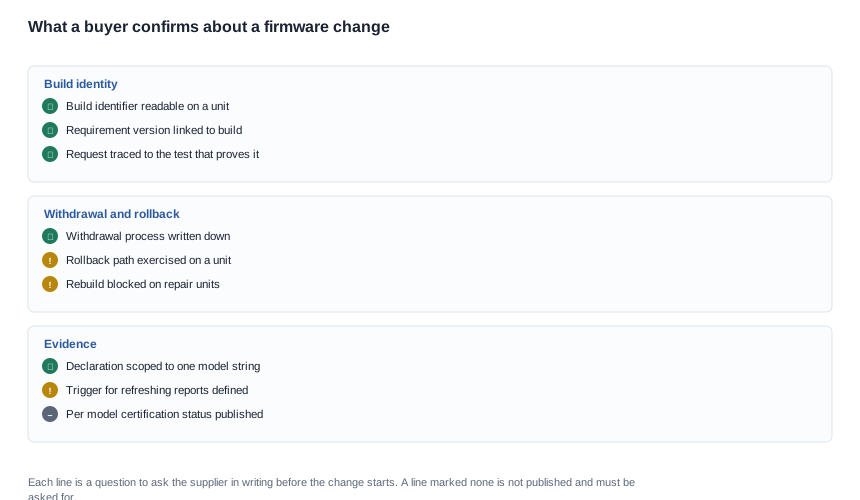
- How is a build identified, and where does that identifier live so that it can be read from a unit in the field rather than from a spreadsheet?
- How is a regression traced back to a specific build, and how long does that trace take?
- What happens when a build has to be withdrawn — how are affected units identified, and what stops the withdrawn build returning through the repair and refurbishment route?
- What is the rollback target, and is a rollback path verified, or merely intended?
Rollback is worth particular attention because it is routinely assumed and rarely tested. A rollback path that has never been exercised on a production unit is a plan, not a capability. The spares you buy for the programme, and the units your support team holds, are part of the same question. Ask specifically whether the rollback has been performed on a unit from the same model and build family, and whether the unit returned to the previous behaviour exactly, including the indicator and pairing behaviour.
Two further questions round out the discipline. First, how are custom changes separated from upstream platform updates, so that a routine platform update cannot silently overwrite a behaviour you paid for? Second, what is the mechanism by which a build reaches a unit in the field — is it a controlled server-side push, a local file, or an engineering unit with a cable — and who can trigger it? Each mechanism has a different failure mode, and each one has a different answer for warranty and liability.
None of this can be answered from a catalogue. It can only be answered by the supplier, in writing, and it belongs in the purchase order rather than in a meeting note.
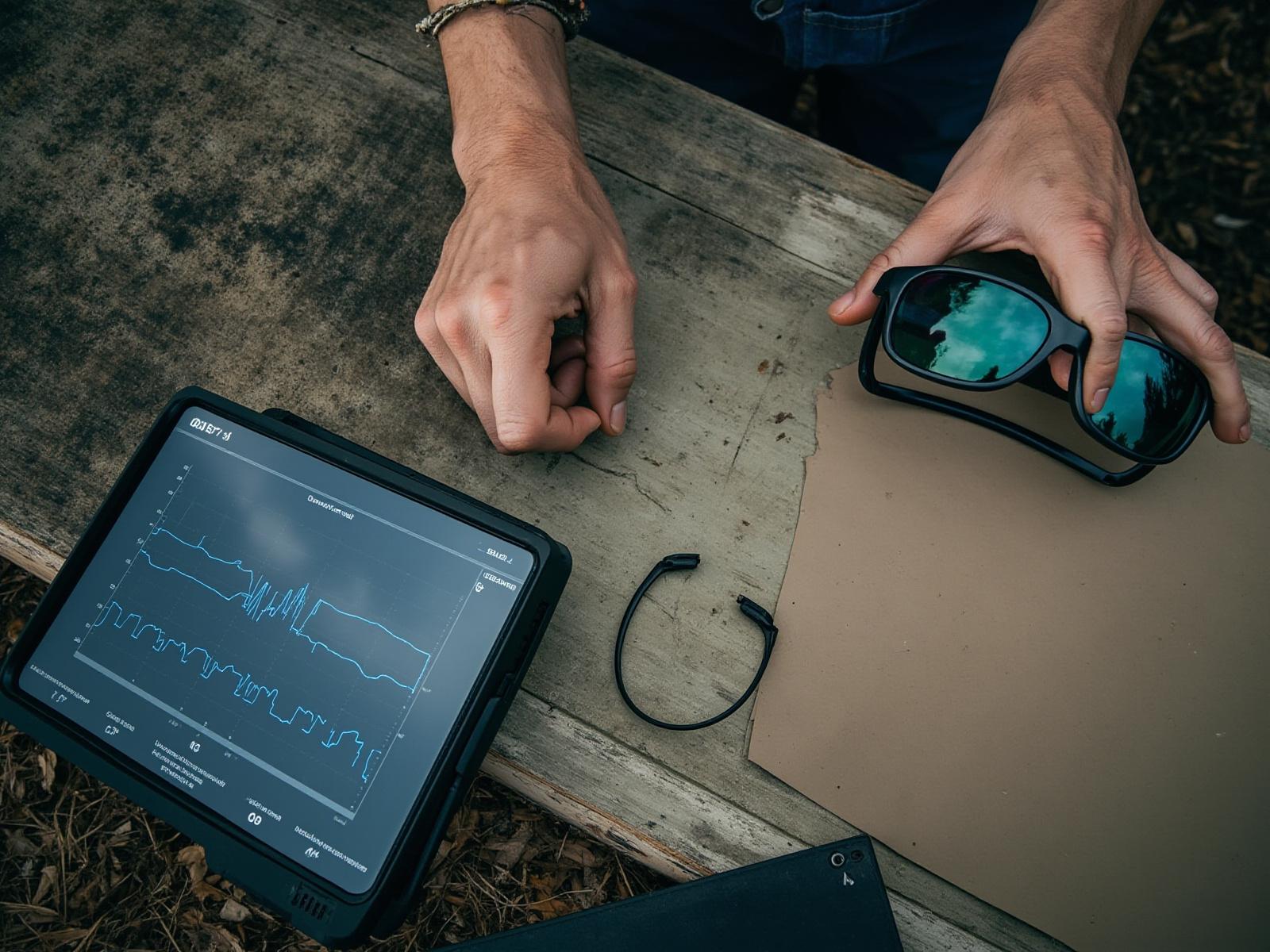
How firmware behaviour is verified
Verification happens at the samples built and verified gate, and it has a specific shape: a signed golden sample plus a verification record covering pairing, audio, charging, any camera function and control behaviour.
In this gate we will treat the golden sample and the verification record as a single piece of evidence, because either one on its own proves very little. The golden sample is the reference unit. It is signed, it is retained, and it is the thing every later unit is compared against — including the units produced during the pilot run before mass production. The logic is straightforward: if the golden sample is the definition of correct behaviour, then any later deviation is detectable, and the pilot run inspection against the golden sample has something concrete to inspect against.
The verification record is the document, and the distinction between it and a pass/fail note matters. A verification record for firmware behaviour should state, for each behaviour in scope, what the expected behaviour is, what was observed on which unit, which build identifier was installed, and who signed. It should also state which behaviours were not in scope, because silence about a behaviour is often read as a claim that it was fine.
The five behaviours named above are the backbone of that record, and they map onto the firmware surfaces from earlier in this article. Pairing, audio, charging, camera where the model has one, and control behaviour are the five places where a firmware change is most likely to produce a defect that a casual visual check will not catch. Audio in particular deserves a written acceptance criterion rather than a subjective judgement, because "the sound is fine" is not a testable statement.
Writing acceptance criteria that survive contact with a real device
The most common cause of a stalled sample gate is not a bad build. It is an acceptance criterion that could never have been met, because it was written as an impression rather than as an observation. A criterion is only useful if two people could look at the same unit and record the same result.
Good firmware acceptance criteria describe a stimulus, an expected response, and an observable condition:
- Stimulus. What is done to the device — for example, hold the control for a defined interval while a call is active.
- Expected response. What the device does, in behavioural terms, not implementation terms. "The call takes priority" rather than "the interrupt handler is re-prioritised".
- Observable condition. What a witness can see, hear or read — an indicator pattern, an audible cue, a line in the host's device list.
Applied to the catalogue, the camera surface shows how criteria differ by model. On the two models where a remote shutter control is published, a shutter-trigger criterion can be written against an existing physical control. On the eleven camera models where the shutter and Bluetooth version are not published, the criterion has to be agreed from the requirement stage, because there is no published control to reference. On the audio models, the pairing and audio criteria can be written against a phone; on the kids models, the same surfaces apply with different expectations about volume limiting and about how easily a child can trigger a restart.
Where the change meets the compliance file
The verification record and the golden sample also feed the next gate, the compliance file closed. A declaration of conformity covering the exact model string that will ship is only meaningful if the behaviour behind that model string is the behaviour that was tested. A firmware change that alters a behaviour covered by the evidence forces a review of the evidence, and where the review finds that the change touches a characteristic the underlying reports rely on, the reports need to be refreshed before the declaration is issued.
A declaration covering a product family rather than a model is not a declaration for your SKU. Buyers should check the exact model string on the declaration against the exact model string that will be printed on the box and shipped. Where the firmware change has introduced a new behaviour, the declaration needs to reflect the model as it will actually leave the factory.
This is where a buyer who has been careful about documentation gets a genuine advantage. A programme in which every behaviour change was recorded against the requirement document can be re-checked against the evidence in an afternoon. A programme in which changes arrived by email and were absorbed silently cannot be re-checked at all, and the only honest answer available to the compliance file gate is that the evidence does not cover the current behaviour.
The final gate, the pilot run before mass production, closes the loop. A production run on production tooling at production volume, inspected against the golden sample, is the last point at which a behaviour divergence is cheap to fix. If the pilot run exposes a firmware regression, the correction is a new build, a new verification record, a new golden sample, and a refreshed look at the compliance file — which is why the firmware build is treated as a gate output rather than a delivery detail.

Questions to ask about a firmware change
The purpose of this section is to convert gaps into questions. Where a figure, a status or a commitment is not published, the buyer's move is to ask, in writing, so that the answer becomes part of the programme record. In practice we will frame them as a working question set rather than as a template, because the useful version of this list is the one you adapt to your own programme.
- What is the distinction you apply between a configuration change and a firmware change, and which of our requested items fall on each side? The answer should name specific items rather than restate the definition.
- Which firmware behaviours are in scope for this model, and which are fixed by the underlying platform and cannot be changed? The catalogue publishes which models carry a camera, so the camera-related items have a natural boundary; the control, pairing and app behaviours need an explicit answer.
- How is a build identified, and can the identifier be read from a unit in the field?
- What is the rollback path to the previous accepted build, and has it been exercised on a production unit?
- What is the process when a build has to be withdrawn — how are affected units identified, and what prevents the withdrawn build returning through repair and refurbishment?
- Which document tells us the reissue path for the specification sheet when a published behaviour changes, and what triggers a refresh of the underlying reports behind the declaration?
- What does the verification record contain for each behaviour, and who signs the golden sample?
- What do you need from us to begin — the behaviour specification, the test accounts, and the written acceptance criteria? Any change we request needs a stated expected behaviour, otherwise it cannot be tested and cannot be signed.
On the commercial side, a firmware change usually arrives as a request against a quotation, with a trade-off attached. The trade-off is not only money: it is the reopening of a closed gate, the possibility that a refresh of the underlying reports is required, and the calendar effect on the pilot run. Buyers should negotiate the trade-off explicitly — what is included, what is quoted separately, what happens to the tooling cost if the programme stops — and confirm in the purchase order which build identifier the first production order is accepted against.
Three commercial items deserve specific wording rather than general negotiation, because they are the ones most often left ambiguous:
- The change request itself. A per-change process with a defined scope, a defined acceptance test, and a defined effect on the pilot order, is worth more than a general commitment to accommodate requests.
- The tooling cost if the programme stops. Tooling is the least reversible step, and the agreement about what happens to tooling cost if the project stops should be written before anything is cut, not after a decision has gone the other way.
- The sample and pilot order terms. Ask for the sample terms, the pilot order terms, and the incoterms that will apply to the pilot order specifically, so that the pilot is a genuine rehearsal of the commercial arrangement rather than a friendly sample.
Finally, the question that most often turns out to matter: certification evidence. Ask for the evidence, in the form of reports and a declaration scoped to the exact model string that will ship, and check the scope rather than accepting a family-level document. Where a model has no published certification status, the correct response is to request the evidence and verify its scope, not to assume either presence or absence.
The same discipline — asking for scope rather than accepting a family-level answer — is the one that separates a workable programme from an awkward one. Our related reading goes deeper on the same themes: what to avoid in a smart glasses OEM engagement, the development risk factors that surface in ODM programmes, how customization options affect certification impact, and the engineering customisation pillar itself, where the six gates are set out in full. All of it arrives at the same recommendation: make the supplier's obligations specific in writing, at the point where the specific is still cheap to provide.


