

Quality assurance in a customised product is not the same activity as quality assurance in a standard one, and the difference is easy to underestimate. A factory running a well-controlled standard product has checks that already fit that product: an incoming inspection on the battery, a functional test on the radio, a cosmetic check on the frame, an assembly verification, a packing check. Add a customisation and the product changes, but the checks do not automatically change with it. The unit can pass every check the factory has and still fail the buyer's requirement, because the buyer's requirement is about the configuration, and the configuration is what the checks were not written to look at.
That gap is the whole subject of this article. It is also, in our experience, the reason the first quality problem in a customised programme is usually found by somebody other than the factory — a distributor who opens a box and finds the wrong device name, a reviewer who cannot find the feature in the setup screens, or an end customer whose unit will not charge.
The other thing to be honest about is what the published catalogue can and cannot support as a quality reference. CYNRIN publishes no per-model certification row, no capacitive-touch row, no translation row, no AI-feature row, no codec row and no microphone row. The export-certification page is a picture page showing ten patent certificates, eight design patents and two utility models, which is a different kind of evidence from a regulatory test report. A buyer therefore cannot audit quality from the catalogue alone. What they can do is require a specific set of checks, define the acceptance criteria for their own configuration, and ask for the evidence.
This matters more than it first appears, because the features buyers most often want to check are exactly the ones the catalogue does not describe. A buyer who wants a capacitive touch panel, a translation function, an AI feature, a microphone or a particular codec has no published row to compare against, for any model. That is not an obstacle to the programme; it is simply a change in who defines the requirement. The buyer has to write the expected behaviour down, and the factory has to test against that wording, and the wording has to end up in the acceptance criteria. Where nobody writes it down, the disagreement at acceptance is not about quality at all. It is about two different specifications.
The same logic applies to measurements. Camera models in the range carry batteries between 220 mAh and 290 mAh with a rated runtime of about five to eight hours, and no test condition is published for that runtime. Resolution is 8 MP on eight models and 13 MP on three, namely L1 Pro and L2 Utral, and S7. A buyer who writes an acceptance test for a camera model therefore has to specify the condition as well as the threshold, because a runtime measured under one protocol and a runtime measured under another are not comparable numbers. The requirement is small to write and it removes the most common cause of a rejected batch.
The third thing worth saying before the detail is that quality assurance in this category is usually an inspection function, and inspections only work against something specific. A unit can be inspected for conformity, for function and for appearance, and each of those is meaningful only when there is an agreed reference. Most of what follows is about establishing those references so that the inspection has something to measure.
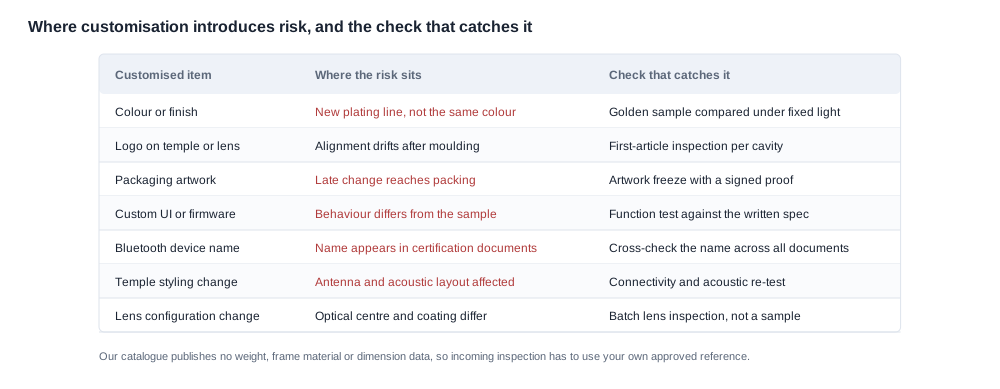
Engineering customization quality assurance: the three checks that catch problems
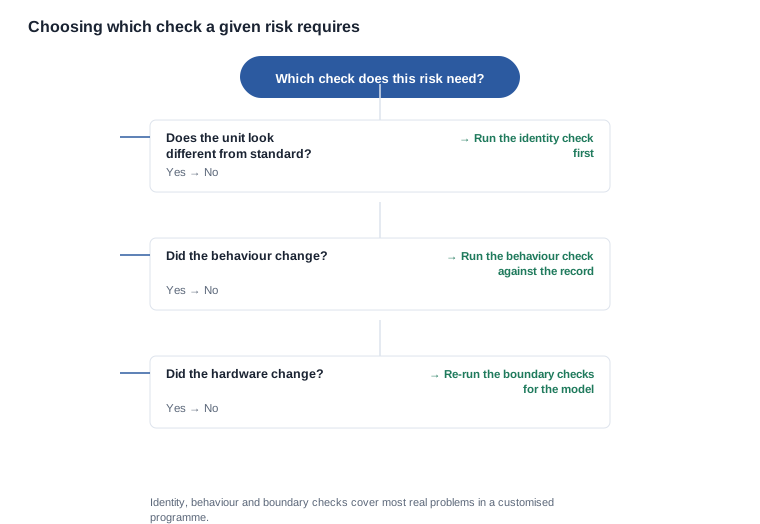
Most real problems found in customised programmes are caught by one of three checks. Running them consistently, against the correct configuration rather than against a generic product, catches the large majority of what goes wrong.
The identity check. Does this unit match the configuration that was ordered? A device name, a logo placement, a colour against its reference, an insert in the box, a firmware build number. This check sounds trivial and it is the one most often left implicit, because a standard unit passes every identity check the factory already has. The customisation is precisely what those checks do not cover. The failure mode is not dramatic: units arrive that look right, pass the standard inspection, and reach the distributor with the wrong name or the previous client's colour, and the cost is a return, a rework or a written-off batch.
The behaviour check. Does the changed behaviour do what the change record says it does? This applies to firmware, to the setup screens, to the pairing behaviour, to anything a customer can observe. A behaviour check is a test, not an inspection, and it needs a written expectation: what should happen, on which input, with which observable result. The most common failure here is a feature that works in the factory build and does not work in the shipped build, because the factory tested a different revision from the one that was packed.
The boundary check. Does the customised unit still pass the checks that applied to the standard product? This is the one that protects the buyer from a change that quietly degrades something else. A new colour batch, a different temple part, a different battery cell, a revised charging case or a firmware change all sit inside a product that had a set of passing checks, and the customised unit has to earn those checks again. The catalogue shows how uneven this area can be. Charging method is magnetic on 17 models and Type-C on 7, and is not published at all for CY03 and MT6, and CY05 and L1 Pro, so a charging check applies to a specific subset of models rather than to the range. An ingress rating appears on only two rows in the entire catalogue, V06 and S7 at IP54, so a buyer requiring ingress protection on another model is asking for something the published data does not cover and must be treated as unverified until the supplier provides evidence.
A fourth check runs across all three, and it is the one most often skipped: documentation consistency. Does the manual, the packaging artwork, the quick start card, the regulatory insert and the listing match the unit in the box? A customised product has more paperwork than a standard one and more opportunity for the paperwork to be wrong, because the paperwork was produced at a different moment from the product.
Each of the three checks is cheap to specify and expensive to retrofit. The identity check needs a configuration record with the customised elements listed by name, and it needs to be run against the unit rather than against the paperwork, because the paperwork is exactly what is in doubt. The behaviour check needs a written expectation, and the discipline it imposes is that the expectation names an input and an observable result rather than a feature name, because a feature name is a label and an observable result is a test. The boundary check needs a list of which base-model checks apply, and that list is longer than most buyers expect: a colour change affects the appearance standard, a temple or hinge change affects the mechanical checks, a battery or case change affects the charge and endurance checks, and a firmware change affects the radio and power checks at once.
The three checks also fail in different ways, which is why they should be reported separately. An identity failure is a mismatch, and it is usually correctable by reworking or re-packing the affected units. A behaviour failure is a design or build failure, and it is not correctable at inspection level at all. A boundary failure is a change-control failure, and it is the one that should trigger a review of the change record rather than a review of the units. Reporting them as a single defect number loses that distinction, and the distinction is what determines what action follows.

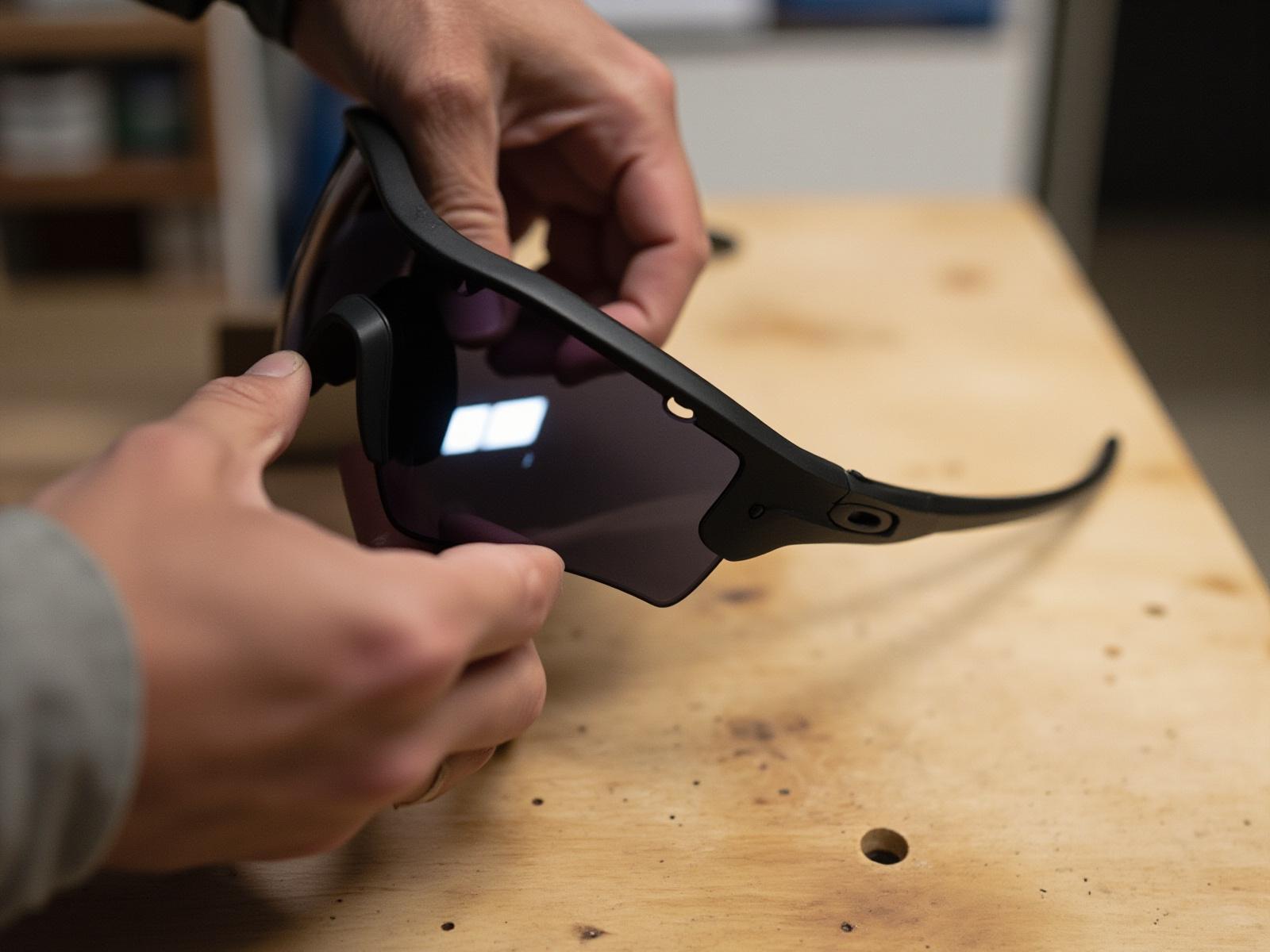
Engineering customization and the reference unit that defines good
Quality needs an object to measure against, and in a customised programme that object is a specific, agreed unit rather than a product description. If the reference is a phrase in a quotation, every inspection becomes an argument about interpretation. If the reference is a physical unit with a serial number that both sides have seen, every inspection becomes a comparison.
The reference unit is usually called the golden sample, and the name is accurate. It is the agreed instance of correct. It is produced by the factory, reviewed by the buyer, signed off, and then kept as the standard against which production units are compared. Three properties matter, and all three have to be agreed rather than assumed.
It is identified. The sample has a serial number, a build identifier and a date, and those identifiers tie to the version of the specification and the version of the artwork it was made against. Without that linkage, a sample becomes a general idea of the product rather than a record of a decision, and after two production runs nobody can say which one it represents.
It is seen by the buyer. A sample the factory approves on its own is a sample the buyer has not verified. For a customisation, buyer verification means holding the physical unit, checking the name in the pairing list, looking at the logo under the same light as a retail environment, reading the manual end to end and trying the changed behaviour.
It is frozen. The sample represents a version. When something changes — a colour, a name, an artwork revision, a firmware build — a new sample is made and the old one is retired, with both retained and marked. A programme with one undated golden sample and no version history cannot demonstrate that anything is under control, because there is nothing to compare against.
There is a practical point about what a sample can and cannot settle. It settles appearance, identity and behaviour. It does not settle endurance, because a sample is not a test article, and it does not settle anything the buyer has not defined. The published catalogue rows are a good illustration of the limit: charge time is published as two hours or less for 26 models, which is a ceiling rather than a measurement, and only D17 and ZH12 publish a figure of about one hour. A golden sample can confirm a unit charges within the agreed ceiling; it cannot produce a trustworthy battery-life comparison across models, and a buyer who tries to build one from samples will be disappointed.
A related question is what happens when the sample and the production unit differ. They will differ eventually, and the honest answer is that a difference is not automatically a defect. It becomes a defect when it falls outside the tolerance that was agreed when the sample was approved. The tolerance is what protects both sides: the buyer gets a repeatable product rather than a nominal one, and the factory is not held to a standard that was never written down. This is why a golden sample approval should be accompanied by a short tolerance note covering the elements that vary in production — shade, fit, print registration, surface finish — and by an explicit statement of the elements that must not vary at all, such as the device name and the build identifier.
The one element that should never be allowed to vary is the identity of the product, and it is worth being blunt about it. A unit that reports the wrong device name in the pairing list is not a cosmetic deviation, it is a different product from the point of view of the end customer, and it creates support and paperwork problems that no inspection tolerance can absorb. We treat the name, the firmware build identifier and the artwork version as exact-match items in every customised inspection.
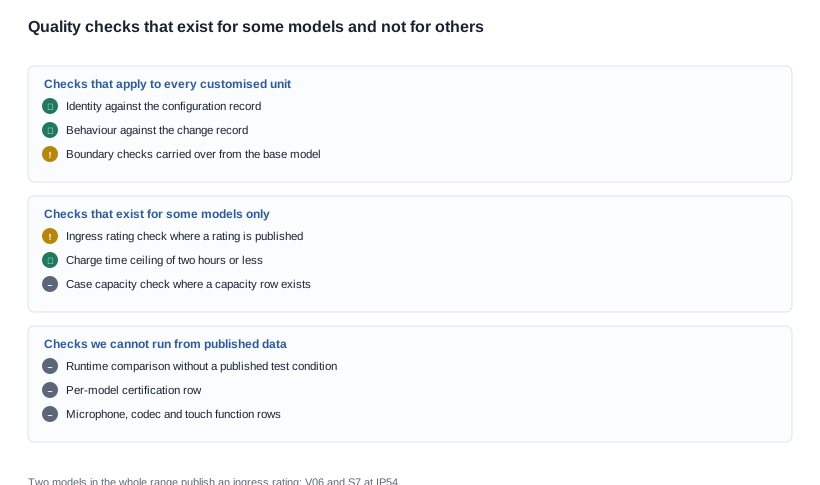

Engineering customization and the freeze points that control cost
Quality problems and cost problems are usually the same problem seen at different times. A change that arrives after a freeze point is not forbidden, it is expensive, because the work behind it has to be repeated, re-verified and sometimes re-tooled. Naming the freeze points in advance is the cheapest quality control available to a buyer.
There are four of them in most programmes, and each should have a trigger, an owner and a stated consequence.
- The configuration freeze. The point at which the feature set, the behaviour and the options are fixed for the programme. Before it, changes are absorbed by engineering. After it, a change is a new build with a new version, a new verification cycle and a new baseline.
- The artwork freeze. The point at which the packaging, the manual, the inserts and the listing images are final. Print and translation lead times sit behind this, so a change here has a schedule cost even when the engineering cost is zero.
- The software freeze. The point at which the build for production is fixed and identified. After it, a fix is a maintenance release, and a maintenance release is a decision about who updates which units already in the field.
- The order freeze. The point at which the quantity, the configuration and the target date are fixed for a production run, after which changes are handled as a change request rather than as an amendment.
The buyer's part is to know which freeze has passed when a request arrives, and to have agreed in advance what happens when something must change after it. The alternative is the pattern that costs the most: a change requested late, absorbed informally, never written down, and discovered at the next audit when the paperwork describes a product that was never built.
Two trade-offs are worth naming explicitly. Freezing early protects the schedule and the budget but risks building the wrong thing, so the freeze should come after the requirement is genuinely settled rather than after a deadline. Freezing late protects flexibility but moves cost into change requests, and a change request that is cheap individually can become expensive in aggregate because each one reopens verification.
The mechanism that makes a freeze real is a change request, and it is worth describing what a usable one contains: the request in one sentence, the reason, the elements of the configuration affected, the work reopened as a consequence, the revised verification that follows, and the date the request was raised and decided. The point of the request is not to slow the programme down. It is to make the consequence visible while there is still time to absorb it. A change that arrives verbally on the day of packing is not a change request; it is a decision taken without a record, and it will be discovered again at the next inspection or the next audit.
Buyers often ask whether a freeze can be relaxed. Sometimes it can, and that is fine, provided the relaxation is a recorded event with a consequence attached. The alternative — treating every freeze as inviolable — produces a different kind of failure, in which the team stops asking for the changes it actually needs and the requirement quietly becomes wrong while the paperwork stays tidy.
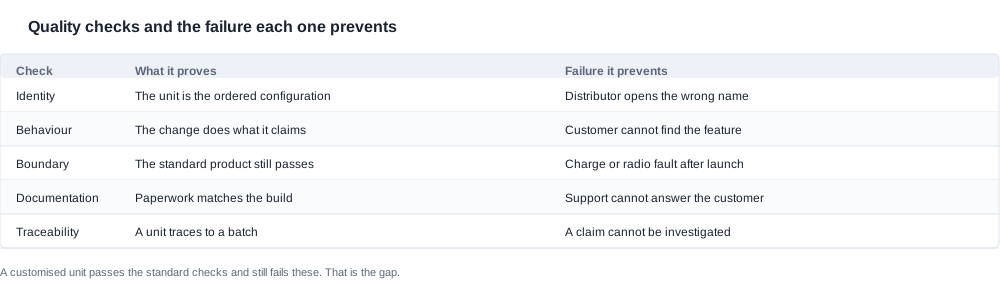

Engineering customization and the purchase order clauses that protect a buyer
Quality arrangements belong in the purchase order rather than in a side email, because that is the document that survives a change of supplier, a change of salesperson or a dispute a year later. The clauses below are the ones that matter most in a customised programme, and each is written in a way that a factory can actually operate.
- The configuration definition. The order references a configuration record by version, not by description, and the record lists every customised element. "As discussed" is not a specification.
- The acceptance criteria. The checks the goods will be assessed against, the reference unit they will be compared to, and who signs off acceptance. Acceptance criteria that name "no defects" are unusable, because every unit has something a picky inspector can point at.
- The evidence pack. What the supplier delivers alongside the shipment: inspection results for the batch, the firmware build identifier, the artwork version, a packing list, a serial number range and photographs of the packed goods. The pack is what turns a dispute into a document review instead of an argument.
- The defect definition and the claim route. What counts as a defect, what the buyer must provide, who pays the freight, how a replacement is credited and within what window a claim must be raised. We publish no warranty terms, so the claim route has to be written by the parties rather than inherited from a template.
- The spare and sample allocation. Whether the shipment includes inspection units, spare units, and how many. On a customised product this is cheap to agree and expensive to add later, because the build has to be reserved.
- The document version binding. The version of the manual, the packaging artwork and the inserts that ship with the goods. Without this, the documentation consistency check has no reference point.
A buyer assembling a shortlist will find that the quotations that carry these six clauses are comparable with one another and the quotations that do not are not. That is useful in a negotiation, because it turns a price discussion into a terms discussion, and terms are usually where the real money is.
One clause deserves expansion because it causes the most argument: acceptance. A shipment is not inspected unit by unit against every criterion, because that is neither possible nor proportionate at volume, so the parties agree a sampling plan in advance. The plan says how many units are drawn from the batch, which checks are applied to every unit and which are applied to a sample, who draws the units, and what the result of the sample means. The last part is the part people forget: a plan that says units will be inspected but not what happens when the sample fails leaves both sides guessing at the moment it matters most. A plan that states the consequence — rework, re-inspection, credit, or replacement of the affected batch — converts a tense conversation into a procedure.
The same logic applies to what the buyer does when a shipment arrives. Inspect against the plan, record the result, and do not open a negotiation with the supplier before the batch has been assessed against the agreed criteria. The great majority of quality disputes in this category are not quality problems at all. They are disagreements about what was agreed, and the way to avoid them is to make the agreement specific enough to be checked.
Two further points close the trail. The first is retention: an evidence pack that is generated and then discarded at the end of the programme has no audit value, because the question it answers almost always arrives later, after the people involved have moved on. Retaining the configuration record, the sample register, the inspection records and the claim log for the life of the product costs very little and is the difference between an answerable question and an unanswerable one. The second is the relationship between the trail and the parts it describes. A batch record that cannot be tied to a build and an artwork version is a record of an event rather than a record of a product, and it will not settle a claim about a specific unit in a specific customer's hand.
Engineering customization and the evidence trail a buyer can audit
The last step is the one that separates a quality process from a quality habit. An auditable trail means that any unit in the field can be traced back to what it was built from, and that the record survives the people who made it. Six artefacts cover it in practice.
- The configuration record, versioned, with the approval history showing who accepted what and when.
- The golden sample, identified and versioned, with the retired versions retained and marked.
- The inspection record for each batch, including the checks that passed and the checks that were not applicable, which is often more informative than the checks that passed.
- The test records for the changed behaviour, naming the build, the method and the result.
- The traceability record, linking serial numbers to a batch, a build and an artwork version.
- The claim log, which is also the best early-warning system a buyer has, because a rising number of claims in one area usually points at a specification problem rather than at bad luck.
None of this is exotic and none of it requires a laboratory. It requires that the factory treats the evidence as part of the product, and that the buyer asks for it as part of the order.
On quality assurance for customised products, our position is straightforward. We would rather a buyer sees the checks, the golden sample and the evidence pack before the first production run than hears about them afterwards, and we would rather a buyer writes acceptance criteria that fit the configuration than accepts a generic quality claim. Ask us for the inspection sheet, the golden sample and the evidence pack for the configuration you are planning, and we will show you what our process produces for that specific build.
Related reading
- The customisation request these checks apply to — engineering customization
- What happens to a returned unit afterwards — after-sales support


