

There is a short window in an outsourcing negotiation where the arrangement is still reversible, and it closes much earlier than most buyers realise. It closes when the first purchase order is raised, and sometimes it closes much earlier — when the supplier's answer to a question reveals that there is a party in the arrangement who is not at the table with you.
That window is the subject of this article. The questions below are the ones worth asking inside it, not because they are difficult, but because each of them maps onto a specific contractual fact: who signs the documents, who holds the model list, who carries the importer obligations, who owns the design files, who authorises a component substitution, and who answers when a shipment fails. A buyer who cannot get a straight answer on those six has already learned the thing they needed to know.
The point of asking early is not suspicion. It is that the answers determine the shape of the contract, and a contract drafted after the structure is fixed cannot fix the structure.
Factory vs trading company: the questions to ask before you outsource
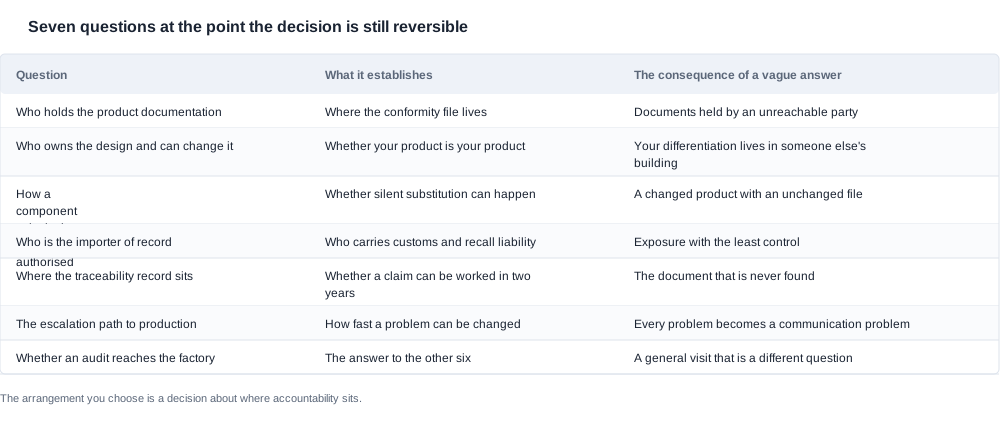
1. Who is the manufacturer of record on the product documentation? The documents that support a product — the conformity documentation, the test reports, the model list — sit with somebody. If that somebody is a party you have never visited, cannot reach and have no contract with, then your market access depends on a relationship you do not control. This is not a hypothetical gap. Our own catalogue publishes no certification row for any individual model, and the export-certification page in our documentation shows ten patent certificates in a single image — eight of them design patents, two of them utility models — with no per-model table behind it. The absence is honest, but it means the question of who holds the documentation has to be answered by the buyer rather than assumed.
2. Who owns the design, and where are the files? If the design belongs to the supplier and they can change it, your product is not your product. Where the ownership sits decides what is worth asking: which system holds the files, what form they arrive in, whether a real repository exists or only email, and what lands in your hands if the work stops, and what you receive if the relationship ends. For a hardware product the files that matter are the mechanical drawings, the firmware source, the bill of materials and the artwork masters, and a request that lists all four by name is a good test of whether the answer will be specific.
3. What is the written process for a component substitution, and who authorises it? A cell substitution changes the runtime, the charge behaviour and the transport documentation. A lens substitution changes the material description. A microphone substitution changes the acoustic behaviour and may change the conformity position. In our published range the charging method alone is split seventeen magnetic and seven Type-C across twenty-eight entries, and is not published for four models — which means a substituted cell or interface is not a cosmetic detail but a change to the specification the customer will receive. If there is no written process, the substitution happens silently and you find out from a return, not from a notice.
4. Who is the importer of record in each destination market? This carries the customs obligations, the product registration where it applies, the recall liability and the obligation to handle a regulator enquiry. A trading structure frequently puts the importer on the factory's side of the transaction, which means the party with the most exposure is the party with the least control over what happens. For a brand selling into several markets this is the question that determines whether you need one importer relationship per country or one that covers them.
5. What happens to the traceability record? The batch or serial record that links a shipped unit back to a production run is the document that makes a warranty claim work two years later. It is also the document most likely to be held by someone who will not know it exists. Ask where it is held, in what form, how long it is kept, and how you obtain a unit's history when you need to make a claim. The shipping damage claims process is a good place to see what happens when this record is missing.
6. What is the escalation path when something goes wrong? Not the account manager's name — the path to the person who can change a production instruction or authorise a substitution. If everything routes through the account manager, then every production problem becomes a communication problem, and communication problems in a hardware programme resolve slowly and expensively.
7. Can you audit, and will the audit reach the factory? This is the question that answers the other six. A supplier who welcomes an audit that includes the production floor has nothing to hide about the arrangement. A supplier who offers a general facility visit has answered a different question. The factory audit preparation material covers what a credible audit request contains, and the production line questions list is written from the operator's side rather than the agent's.


How to read a factory vs trading company answer
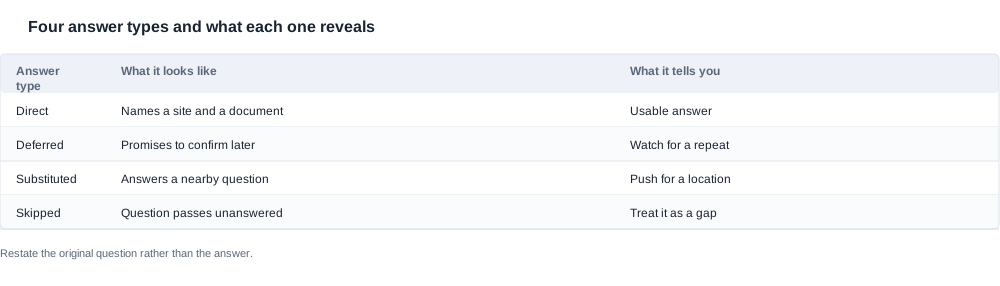
The seven questions above produce answers of three recognisable kinds, and telling them apart is most of the skill.
The direct answer. It names a site, a company and a document, and it is specific enough that you could check it. "The final assembly and test happen at our facility in the industrial park in X, the build sheets are held in the quality system, and the model list on the conformity documentation covers models A through F" is a direct answer. It is not necessarily a good answer, but it is one you can work with.
The deferred answer. It is a promise to find out. "We will confirm the model coverage with the compliance team and come back to you" is not dishonest, and it is not unusual early in a relationship. It becomes a signal when it recurs, particularly when it recurs on the same question across two conversations. Deferred answers on questions six and seven — escalation and audit — are considerably more telling than deferred answers on questions one and two, because those two are about capability and the other two are about willingness.
The substituted answer. It answers a neighbouring question. "We handle all the certification for you" is an answer about work performed, not about who holds the documents. "We have our own factory" is an answer about capability, not about accountability. "We work with certified partners" is an answer about a relationship, not about a name. These answers are not false, and they are the ones most likely to appear in a conversation where the structural question is genuinely ambiguous.
A useful discipline when you receive a substituted answer is to restate the original question rather than the answer. If a supplier says they handle all certification, the follow-up is not "which documents" but "who holds the conformity documentation for the model I am buying, and where is it on the day I ask". Restating forces a location rather than an activity.
A direct answer can also be thin, and thin answers need a different treatment from vague ones. "The documentation is held by our compliance team" is direct and still incomplete, because it names a function rather than a document. The follow-up is not accusatory; it is a request for the artefact to be sighted at the next stage. Ask whether the file can be shown at a sample review, or copied to you for a due diligence pack, and note the answer either way. The trade-off here is that pushing for sighted documents consumes time that a buyer under launch pressure would rather spend on samples, and the sensible sequence is to press for the documentary answers after the physical sample has confirmed that the conversation is worth continuing.
When a factory vs trading company route fits the programme
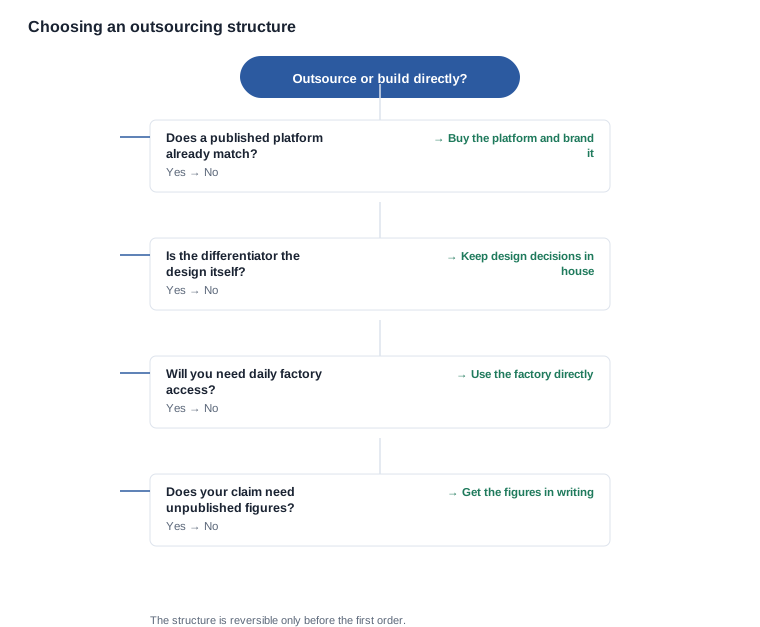
Three situations where an outsourced or intermediated structure is the right call, and in each of them the reason is the same — you are buying a finished configuration rather than a capability.
Your requirement matches an existing platform configuration. This is the clearest case, and the published range is wide enough that many requirements land on a product that already exists. Our catalogue spans eight audio models, three sport models, eleven camera models and three children's models, plus AR, electrochromic and bone conduction entries. Cell configurations run from 40 mAh in the children's range up to 290 mAh in the camera range, charging is magnetic or Type-C, and case capacities are published at 900, 1200 and 1400 mAh for five models. If your requirement already has a home in that space, buying the platform is faster, cheaper and lower risk than commissioning something adjacent to it.
Your volume is small and your variety is high. The fixed costs of a bespoke programme are per programme. Running small quantities across several configurations spreads that cost thinly, and the arithmetic often favours buying in a finished unit even when the unit price is higher than a semi-custom route would eventually produce. The practical test is whether the tooling and setup cost, amortised across your realistic first-year volume, exceeds the gap between the finished unit and a custom route. Neither figure is published in our documentation — minimum order quantity, lead time, tooling cost and non-recurring engineering charges are settled case by case — so the test has to be run with figures the supplier gives you in writing, and it has to be run twice: once at the first order and once at the reorder volume you actually expect.
You have no electronics capability and no intention of acquiring one. In this case the structure is not the problem. The documentation and traceability questions are the problem, and they remain the problem whether the counterparty is a factory or an intermediary. This is the point at which a supplier who answers the six contractual questions directly is worth more than a supplier who offers a better price. The trade-off is that the straightforward answer tends to come from the counterparty who is also the one who will answer it again in two years, when the second order is placed and the first relationship is no longer under competitive pressure.

When a factory vs trading company route leaves you exposed
Three situations where the same structure costs more than it saves, and the common factor is that the buyer needs to change something after the order is placed.
Your product's value is in the design. If the frame, the industrial design or the firmware is the differentiator, outsourcing the whole stack means your differentiation lives in someone else's building. The problem is not that it is outsourced; it is that a design change then becomes a request rather than a decision, and its timeline belongs to somebody else. The cost of a design change is not the engineering hours, it is the calendar.
Your product's claims depend on published performance figures. This is a sharper constraint than it first appears, because a large part of this category's specification is genuinely not published. No model in our range publishes a frame weight except the MT6 at 158 g for the glasses alone. The Bluetooth version appears on none of the eleven camera models, nor on the A05, the A06 or the bone conduction entry. The charging method is published for none of CY05 and the CY03, and L1 Pro or MT6. Nowhere in the catalogue is there a capacitive-touch row, and nowhere is there a translation row either. A brand whose product page needs those numbers is already dependent on the supplier to produce them, and an intermediary arrangement adds a layer between the buyer and whoever holds them.
You need the factory to be reachable during development. The design phase is where the most value is created by direct technical contact, and an intermediary adds a layer precisely where the conversation needs to be fastest. This is the one situation where the structure has to be solved before the programme starts rather than negotiated during it.
There is a fourth case that is not about structure but about timing. If you are outsourcing because a supplier's lead time is shorter than the lead time of the factory you would otherwise use, you are buying schedule, and that is a legitimate reason — but it is a reason with an expiry date. Every year of that arrangement is a year in which the alternative capability gets further away, and the cost of switching later compounds. Some buyers treat the temporary arrangement as the permanent one because it works, and then find that the price advantage was always a function of the structure rather than of the product.
The last case is the one that is hardest to spot because it looks like diligence. Audit access is a condition of the arrangement rather than a feature of it, and there are suppliers who will agree to be audited in a way that never reaches the assembly line — a presentation of a facility, a review of records, a walk of a show floor that is not the one making your units. The audit question is therefore not whether you may audit but what an audit covers. A supplier who names the specific line, the specific building and the specific shift where your configuration is built has answered the question; a supplier who speaks about "the facility" in the singular has not. Where the answer is vague, treat the audit as unperformed and score the supplier as though no audit had taken place, because that is what the evidence supports.

Factory vs trading company: the evidence pack to request in one email
The seven questions are better asked in writing than in a call, and asking them as a single list in a single email is materially more efficient than drip-feeding them across three meetings. The reason is that a supplier who can see the whole set of questions at once has to answer the set, whereas a supplier who receives them one at a time can answer the easy one and leave the rest for the next cycle.
A workable evidence request names the artefacts rather than the topics. Six items cover most of the ground, and they are all reasonable to ask a serious supplier:
- The configuration sheet for the exact unit you intend to buy, with which model it is, which cell it carries, how it charges, which interface it uses and whether a case is fitted written as one line.
- The model list from the conformity documentation, with the designation strings exactly as they appear, so you can check that your model is on it rather than on a family statement.
- A build or traceability sample for one unit, showing the serial or batch reference and how it links back to a production run.
- The written substitution process, naming who authorises a change, who is notified, and what notice the buyer receives.
- The escalation map, showing who can change a production instruction and how a buyer reaches that person.
- The audit terms, stating what an audit covers, who may attend, how far in advance it is requested and how long it takes.
Ask for these in two batches rather than one. The first three establish what the product is; the second three establish how the relationship works. Splitting them means the first answers arrive while you are still deciding whether the second batch is worth asking — which matters, because if the answers to the first three are poor, the second three will not improve them.
The trade-off in requesting documentation at this stage is that it can slow a negotiation that would otherwise close quickly, and a supplier under commercial pressure may treat a document request as a delay tactic. That is a useful signal in itself. A supplier who cannot produce a configuration sheet for the unit being quoted has not priced the unit they quoted, and a unit price for a configuration nobody has described is not a comparable price. The alternative — proceeding on the strength of a specification summary and a price — usually looks faster and reliably costs more, because the specification is then negotiated after the tooling is committed.
A second trade-off runs the other way. Buyers who ask for every document at once, on a first contact, tend to get a partial answer to a large request rather than a complete answer to a small one. The request that works is short, specific and answerable, and it is worth reading each item to check that you could produce the equivalent yourself. If you could not produce it, you probably do not need it.
The factory vs trading company evidence a shortlist needs
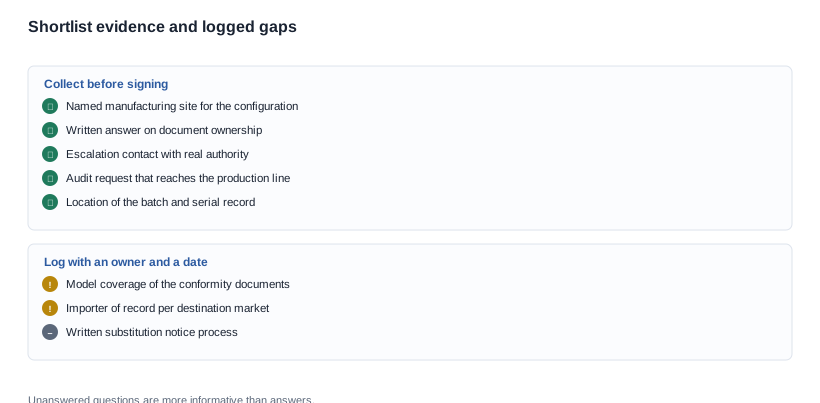
By the time you have the answers to the seven questions, the decision is usually made. The remaining work is to make it defensible, and defensibility in a procurement review comes from a record rather than from a recollection.
A shortlist sheet worth keeping has five columns: the supplier, the answer to each of the six contractual questions, the evidence offered for each, the gap, and who owns closing the gap. The gap column is the important one, because a documented gap with an owner and a date is a manageable item, while an undocumented gap is simply a risk that has not been noticed yet.
Two habits make the difference in practice. The first is to require the answer to a contractual question in writing, in an email, because a verbal answer can be reinterpreted later and an email cannot. The second is to record the questions you did not get answered. The list of unanswered questions is more informative than the list of answers, because it tells the next buyer exactly where the structure is thin.
The factory versus trading company page sets out the distinction in structural terms, and how trading companies operate describes the operating logic from the inside — which is useful reading precisely because it explains why a genuine intermediary answers questions one and two in a different register from questions six and seven.
We will answer all seven questions directly, and where a question depends on a specific programme rather than on our process in general, we will say so rather than produce an answer that sounds complete. We will not publish production capacity figures, line counts or daily output, because those are programme-specific and a number quoted without that context is not a number you can plan against. Unit prices, minimum order quantities and lead times are not published on this site either, and are confirmed per enquiry because each figure is set by the configuration, the quantity we order, the documentation scope and the schedule as it stands.
It is worth being explicit about what we can and cannot evidence on our own side of the question. We publish the configurations we hold, the electrical rows, the charging methods, the case capacities, the Bluetooth versions where they are published, the camera resolution tiers and the colour options — which means that a buyer comparing us against a supplier who publishes less has something concrete to compare. We publish no certification row for any individual model, and the export-certification page in our documentation is an image page of ten certificates, eight of them designs and two of them utility models. We publish one frame weight in the whole catalogue, on the MT6 at 158 g for the glasses alone, and we publish no field of view, no acoustic measurement, no capacitive-touch row and no translation row anywhere. Those are the positions we can state, and stating them plainly is more useful to a buyer than a general assurance.
The arrangement you choose is a decision about where accountability sits, and the seven questions above are how you establish where it will actually land before it is fixed.
Related reading
- Factory versus trading company
- Production line questions that reveal the answer
- How trading companies operate
- Factory audit and what to look for
Ask us the seven questions in any order and we will answer them directly, including the ones we cannot.


