

There is a version of the factory versus intermediary conversation that treats the middle layer as a dilution to be routed around. That version is wrong often enough to be expensive, and it is wrong because it misdescribes what the middle layer is. A trading company in this category is not a reseller pretending to manufacture. It is a service business that owns a set of frictions and sells the removal of them. Some of those frictions are ones you would rather have removed by someone else, and some of them are ones you did not know existed until your first shipment was late for a reason that appeared nowhere on the paperwork.
Understanding the middle layer properly is a commercial skill, because it determines what you can ask for, what you have to accept, and where the accountability sits when something goes wrong. It also determines the negotiation: a buyer who misunderstands the model negotiates the wrong things and then feels betrayed by a supplier who was doing exactly what they agreed to.
The honest description is this. An intermediary in the smart glasses supply chain performs a chain of functions, some of which it performs itself and some of which it arranges for someone else. Its value is real where it removes a friction the buyer genuinely cannot remove. Its cost is real where the removal of a friction is confused with the removal of the buyer's control over it.
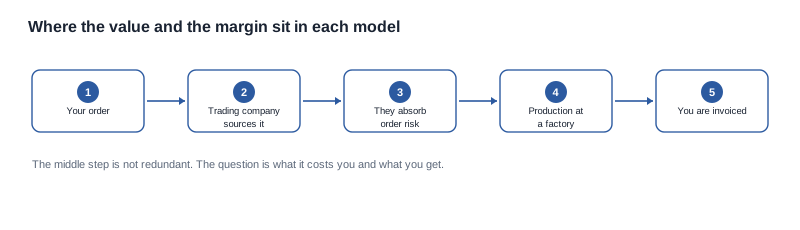
One point of vocabulary before the substance. Throughout this article, "factory" means the party that builds the units, and "trading company" means the party that contracts with you and does not build them. A company can hold both roles, or subcontract part of its own line, and the label describes the commercial relationship rather than the organisation's legal form. Buyers who treat the label as a verdict are the ones who end up surprised.
Three situations produce most of the intermediary relationships in this category, and they need different things. A first-time brand launching one model into two markets wants the search, the regulatory knowledge and the handling of a business that is larger than the order. A distributor buying a proven model in small quantities wants the order consolidated, the documentation handled and the stock risk carried. A company with an existing factory relationship that has hit a capability ceiling wants the intermediary only for the step it lacks. The middle layer is a reasonable answer in all three, but it is a different answer in each, and a buyer who has not decided which situation they are in will negotiate for a package that does not fit any of them.
Factory vs trading company: what the middle layer is actually paid for
Five functions generate essentially all of the margin in an intermediary's quote. It is worth naming them individually, because each one can be bought separately and each one has a failure mode that the buyer should be able to name before signing anything.
Finding the site. Sourcing a manufacturer, assessing it, negotiating with it, and holding the relationship. The buyer pays for the search and for the standing relationship that makes the second order cheaper to place than the first. This is the function most likely to be genuinely valuable to a first-time brand buyer who has never audited a factory in this category and has no way to know whether the site they were introduced to is the site that will build the units.
Absorbing the small order. Carrying the commercial risk of an order that is below a factory's minimum, so that the factory sees a worthwhile production run. This is the function that makes it possible for a distributor to buy fifty units of a model rather than five thousand, and it is the reason the unit price in an intermediary's quotation is higher than the factory's own.
Carrying the paperwork. Customs, shipping documents, freight booking, and the commercial administration around a cross-border movement of goods. Many buyers underestimate this because the first shipment is handled as a one-off by a forwarder and nobody realises it is a recurring obligation.
Carrying the regulatory work. Navigating the documentation required for a product to be sold in a given market, and holding the relationships with the testing and certification bodies who produce it. This is a large part of the value proposition in a regulated category.
Carrying the after-sales. Receiving a claim from a customer in a market the factory has never visited, deciding whether it is a defect, and either crediting it or sending it back for a disposition. The factory would have to do this too, but it would do it in a language and a timezone and with a shipping cost that makes it uneconomic at small volumes. This is the function that most often justifies the margin for a distributor.
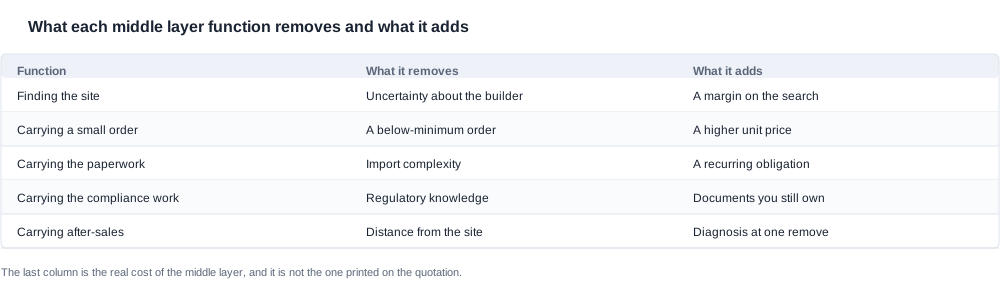
And here is what the buyer pays for that is not on the list: the loss of a single point of accountability. When the contract sits with a party that does not build, a failure has to travel — from the customer, to the intermediary, to the factory, and back with a disposition. Each handover costs days, and the days are not visible in the price.

How a factory vs trading company intermediary earns its margin
Because the margin has to come from somewhere, understanding where it comes from tells you which parts of the offer are structural and which are negotiable. There are four common sources, and they behave differently.
Spread on the unit price. The intermediary buys at the factory's price and sells at a marked-up price. This is the easiest to identify, because it shows up as a gap between the factory's own quotation and the intermediary's. It is also the least interesting, because it tells you nothing about what the intermediary actually does for the money.
A fee for the search and the standing relationship. Usually embedded rather than itemised. It is what pays for the site that builds your units being found, assessed and held, and it is usually worth paying on a first programme.
A fixed charge per order for the administrative work. Sourcing, inspection, documentation and freight handling, quoted per shipment or per order. This is the part that is hardest to compare across suppliers, because one embeds it in the unit price and another itemises it.
Margin inside the freight and the duty. Common in this category, and the reason a comparison of two delivered prices can be misleading. The same declared value can carry different duty outcomes depending on how the transaction is structured and which party is the importer of record. Ask for the landed cost broken into goods, freight, duty and handling, and ask which of them is a fixed charge and which scales with value.
What is not a source of margin is anything that reduces the risk you are carrying. A supplier who tells you the unit price is low because the margin is in engineering, and who then lets you see the engineering scope in detail, is making a different offer from one who tells you the price is low and shows nothing.
The structural point that matters for negotiation: the functions an intermediary performs for you are cheaper for it to perform at scale than for you to perform individually, and that is exactly where its margin is defensible. The functions it performs badly are the ones where it has no leverage and no expertise — engineering scope, tooling decisions, technical disposition of a design problem. If a negotiation is about one of those, the intermediary is negotiating on behalf of a party that has not been in the room.

The factory vs trading company middle layer, stage by stage
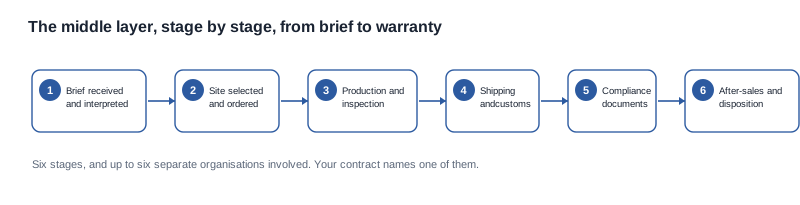
Walk an order through the six stages below and the shape of the middle layer becomes concrete. Notice how many distinct organisations can be involved at each stage, and how few of them are named on your contract.
Stage one — the brief. The buyer describes the requirement. The intermediary interprets it, matches it to a model in a supplier's range, and prepares a quotation. The interpretation is where value is added and where errors are introduced: a requirement that was written to describe your product in your market can arrive at the factory as something subtly different. Ask to see the requirement as it was sent, in the intermediary's own words.
Stage two — the site. The intermediary selects or confirms the site, negotiates the commercial terms, and places the order. The buyer learns the site name, usually late, and usually as information rather than as a right. Whether the site is disclosed at this stage or at the audit stage is a negotiable point, and it should be negotiated rather than assumed.
Stage three — production and inspection. The build happens. Inspection may be done by the factory, by the intermediary, or by a third-party inspection company the intermediary appoints. This is where the acceptance standard actually gets applied, and therefore where the specification of what "acceptable" means has to be written down before production starts rather than after a shipment is rejected.
Stage four — shipping and customs. Documents, freight booking, importer of record, duty. Often the most invisible stage until something goes wrong, and the place where a small inconsistency between the paperwork and the physical goods turns into a week of delay.
Stage five — compliance. The documents required for your markets, obtained and assembled. If the intermediary has done this before for your market, the cost and the risk are both lower. If not, the compliance scope becomes a discovery exercise, and the timeline lengthens accordingly.
Stage six — after-sales. The claim arrives, is triaged, is credited or returned, and — if returned — is finally examined by someone who can diagnose it. The elapsed time on this path is usually the single most consumer-visible number in the whole relationship, and it is the one most often not written down.

Where a factory vs trading company intermediary adds value, and where it does not
This is the part of the relationship where the honest answer is uncomfortable in both directions.
It adds real value when the buyer is small and new. If you are launching one model into two markets and have never placed a manufacturing order in this category, the intermediary's search function, its regulatory relationships and its existing freight arrangements are worth real money. The alternative is to spend three months of your own time learning what would otherwise be a phone call.
It adds real value when the order is small. Below a factory's practical minimum, the intermediary's ability to consolidate and its willingness to accept the risk is what makes the order possible at all.
It adds real value when the market is unfamiliar. Local customs practice, local labelling rules, local distribution norms and a working relationship with a local certification body are not transferable knowledge, and they are cheap to buy and expensive to learn the hard way.
It does not add value where it only forwards. A change request that takes four days to reach the factory because it passes through a project manager is a worse version of sending it directly. A disposition decision that takes a week for the same reason is the same.
It does not add value where it substitutes for a decision you need to make. Product specification, tooling strategy, target cost engineering and market positioning are yours. An intermediary that appears to make them for you is either taking a decision out of your hands or taking a fee for the appearance of doing so.
It does not add value where you need speed of technical response. If the answer has to come from an engineer who understands the product, a routing layer is a cost. If the answer can come from a commercial manager, a routing layer is cheap.
The test to apply to each proposed service is simple and worth keeping: does this remove a friction I could not have removed myself, or does it add a step to something I could have done myself? The first is worth paying for. The second is worth questioning, and often worth declining.
Applied to a distributor's programme, the answer is usually that the middle layer earns its margin on consolidation, compliance and after-sales reach, and does not earn it on relaying technical answers. Applied to a brand's first custom programme, the answer is usually the reverse for the first year, because the engineering judgement cannot be bought at any price from someone who has never seen the product.
Working with a factory vs trading company intermediary: the clauses that matter
If you are going to work through an intermediary — and for many buyers you will, because the alternative is worse — then the agreement has to do a specific job: it has to restore the accountability that the additional layer removed. Five clauses do most of that work.
Identification of the build site. Name the site that will build your model, and require it to be the same site for the reorder unless you agree otherwise in writing. This is the clause that converts a vague relationship into an auditable one.
A document that names your model. Require first-party documents — the test report, the release note, the approval record — that carry your model on the face of them, not a family-level summary that names a different variant. This is the clause that prevents a shipping delay at a customs border three weeks later.
An acceptance standard with a named remedy. The sampling level, the evidence you must supply, who pays the freight on a failure, and whether the remedy is replacement or credit. Written before production, not negotiated after a shipment is rejected.
A deviation process. Any change to the specification, the materials, the sub-suppliers or the site requires written notice and your written agreement, with the cost and the schedule impact stated. A change that arrives as an invoice is a change you did not agree to.
An escalation clock. A stated response time for a technical question and a stated response time for a disposition, with the escalation route named. The clock is what converts a relationship that works when nothing goes wrong into one that works when something does.
Payment and title terms that match the risk. Who pays when, who owns the goods in transit, and what happens to the payment if a shipment is rejected at inspection. An intermediary that takes payment before the goods have passed inspection is carrying your risk, and should be paid for it in the price; one that takes payment only against a passed inspection is asking you to carry it. Either arrangement is legitimate, and the mistake is not knowing which one you have.
A place for the technical relationship to sit. Somewhere in the agreement there must be a named route by which your engineers can reach the people who build the product. This clause is the one most often missing and the one whose absence is felt six months later, when a firmware or mechanical question turns into a chain of forwarded messages. It can be satisfied by a named contact at the site, a scheduled technical review, or a standing requirement that engineering questions are answered by the site rather than relayed through the commercial layer.
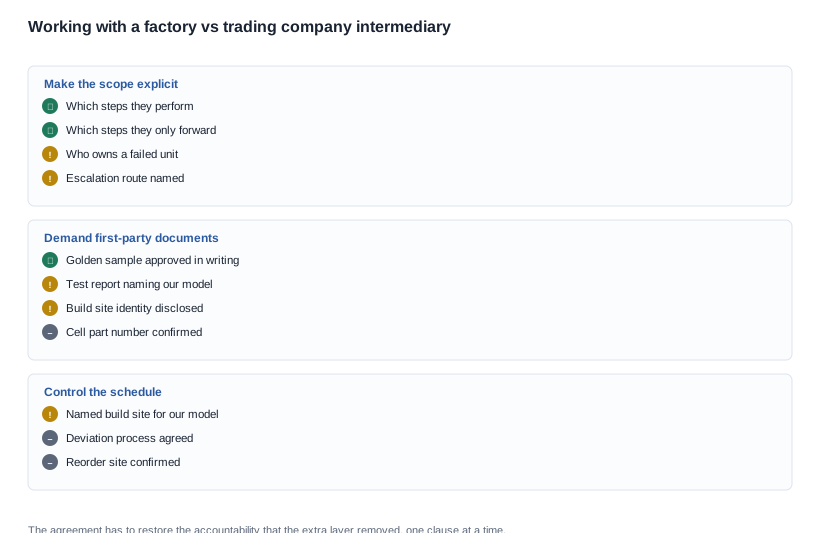
On the negotiation itself: an intermediary's rate card is usually more negotiable than its unit price, because the unit price is anchored to the factory's cost and the services are the part it controls. Negotiating a documented response time, a named site, or an included inspection is frequently easier than negotiating a point on the unit price, and it delivers more than the point would have. The same holds for the clauses above: an intermediary that resists naming a build site has told you something, and the resistance itself is worth more to you than the site name would be.
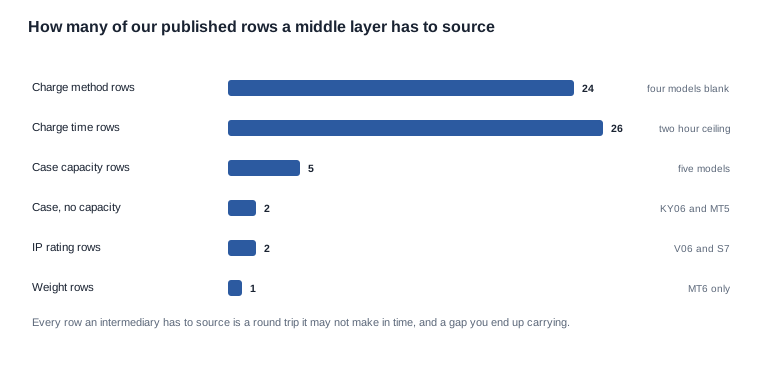
The last point concerns what to expect from our own published material. Our catalogue publishes the product facts and the rows we can stand behind: 28 models across an audio range of eight, a sport range of three, a camera range of eleven and a kids range of three, plus AR glasses, electrochromic and bone conduction entries that carry no model string. It publishes a charging method for 24 models, a charge time for 26, a charging case capacity for five, an ingress protection rating for V06 and S7, and a frame weight for MT6 only. It publishes nothing about price, minimum order quantity, lead time, samples, warranty, capacity, tooling cost, NRE or certification numbers, it mentions CE, FCC, RoHS, RED and EN 18031 nowhere, and its export-certification page is a picture page carrying ten patent certificate images.
A catalogue does not tell you who builds the units behind the model names. That is a question, and it is one we will answer directly. The broader point is the one this article has been making: a published specification sheet and a commercial relationship are two different artefacts, and only one of them tells you which kind of supplier you are dealing with.
The development process article sets out how a custom programme is usually structured, and the customisation risk assessment covers the engineering decisions where the choice of model matters most. The Factory vs Trading Company pillar carries the full comparison.
Related reading
- Factory vs Trading Company — the pillar behind this description
- How factories actually differ — the stage map from the other side
- Common questions — the questions that identify the model
- Cost implications — where the margin in a quotation comes from
Tell us which of the six stages is hardest for you, and we will tell you which of these clauses we can put in writing.


