

Every supplier in this category will tell you they have a production line. Almost all of them do, in some form. The statement is close to meaningless on its own, because a production line is not a room with machines in it — it is a defined sequence of operations, running on a defined cycle, staffed on a defined shift pattern, with a defined owner who signs for the output. A company with a production line and a company with a bench and four people are both, in the loosest sense, people who make things.
The questions below are designed to separate those two. They are ordered into four blocks, and within each block the order is deliberate: the earliest questions are the ones a supplier can answer without preparation and the later ones are the ones they have to look something up to answer. That gradient matters, because it tells you whether the answer is being retrieved or composed, and a composed answer is the one worth trusting.
The reason this sits at the centre of a factory vs trading company evaluation is straightforward. Everything else in the relationship is an agreement: the price, the specification, the delivery date, the remedy. The production line is the only part of the transaction that either exists or does not.
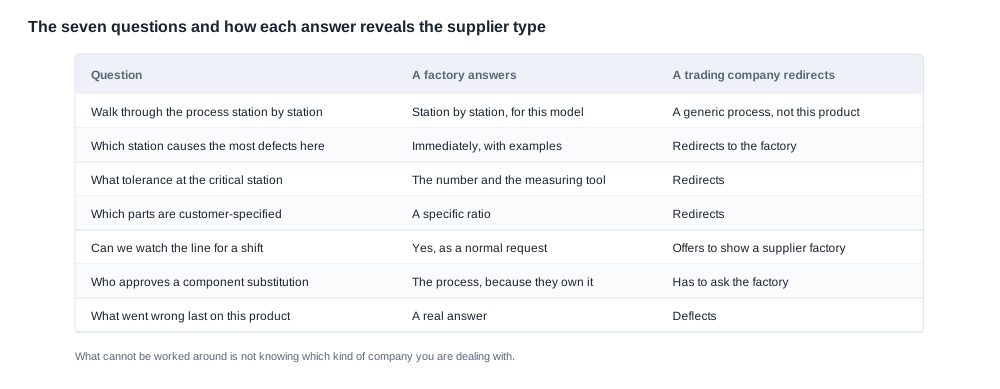
A note on what this article does not do. It does not tell you which supplier to choose, and it does not tell you what our own capacity is, because our production capacity is not published and no production line detail appears anywhere in our catalogue. The catalogue describes the product — 28 models across an audio range of eight, a sport range of three, a camera range of eleven and a kids range of three, plus AR glasses, electrochromic and bone conduction entries with no model string. Whether a production line exists, where it is and what it runs is a question you ask, not a figure you read.
Factory vs trading company: the production line questions, in order
Block one — does the line exist, and does it belong to the party you are contracting with?
- "Do you have a production line, and where is it?" The answer should give a building, a floor and a site. An answer that names a partner's building is not a failure — it is a different commercial model, and you should now ask the next question instead of the first.
- "Is the line operated by your company, or by a partner?" This is the single most consequential question on the list, and it is more precise than asking whether they subcontract. A line operated by a partner with your company's name on the schedule is still an intermediary relationship.
- "Who owns the equipment on that line?" Ownership of the machines is a harder test than ownership of the tooling, because production equipment is a large capital asset that a plant either owns or clearly does not.
- "How many production lines do you operate, and how many are on this site?" The answer tells you whether you are talking to a multi-plant group, a single-plant producer, or a company with one line.
Block two — what actually runs on it?
- "Which models share the same line as ours?" This is the question that separates a real production operation from a claim. A line that runs one model exclusively is a different proposition from a line that runs yours on alternate weeks with three other products.
- "Does our model run on the same line as any other customer's product?" If yes, ask what controls a changeover between them and how long a changeover takes. Both answers belong in your schedule.
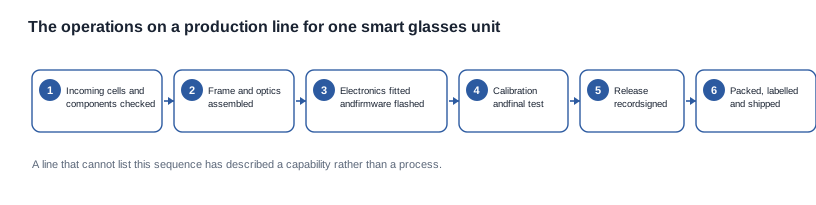
- "What is the sequence of operations on our units, from incoming to final test?" A supplier who can list the operations has a process. A supplier who describes "assembly, testing and packing" has a brochure.
- "Where does the unit go if it fails a test?" A hold area, a rework station and a scrap route are three different answers, and each one implies a different cost for you.
Block three — how is the line measured and changed?
- "What is the cycle time for our model, and at which station?" The answer identifies the bottleneck, which is the only part of the line that sets the schedule.
- "How many units per day does that station complete at the published cycle time, and how many days per month does the line run?" This is the question that turns a capacity claim into arithmetic, and it is the one most often skipped.
- "When the specification changes, what happens on the line — a re-tool, a re-programme, a fixture swap or a new line?" The answer determines whether your next order is a schedule question or a tooling question.
- "Who approves a change to the work instructions, and where are the current instructions for our model?" A controlled work instruction for your model is one of the cheapest and most informative documents you can ask for.
Block four — who signs for it?
- "Who signs the release for a shipment of our units?" A name on a line at the factory means the site owns the output. A company name on a document at a different address means the output has a journey before it reaches you.
- "If the line stops, who tells us, and how quickly?" This is a question about the reporting obligation rather than about the equipment, and the answer tells you whether the supplier monitors its own line.
- "Who is accountable if a unit from that line fails in the field?" The answer closes the loop, and it should be the same party that signed the release.
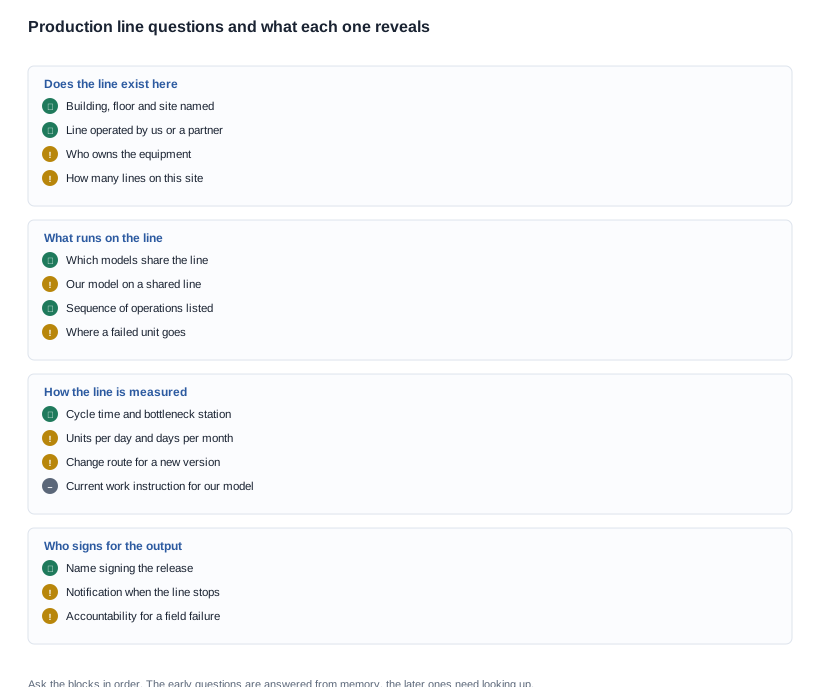
Fifteen questions is a lot to put in one message, and you should not. Ask blocks one and two in the qualification exchange, block three when you are ready to talk about volume, and block four when you are drafting the commercial terms — because the answers to block four are commitments, and a commitment requested too early is a commitment negotiated under pressure.

Why a factory vs trading company production line claim is hard to verify
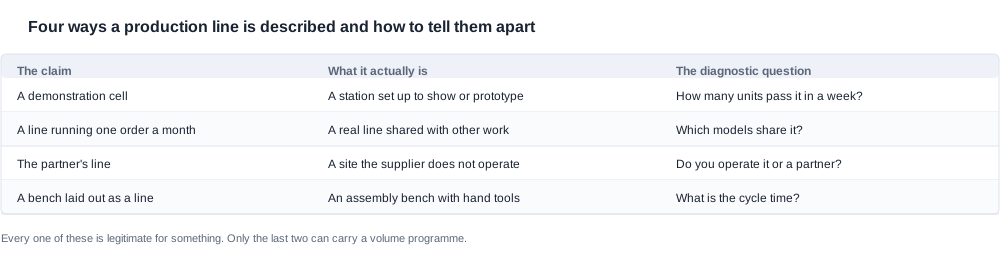
There are four ways a production line can be described in a way that sounds right and means very little, and each has a diagnostic.
The demonstration cell. A single station set up to assemble or repair units, often used to show visitors or to build prototypes. It is a real operation and it is not a production line. The diagnostic: ask how many units pass through it in a week, and ask whether the line's cycle time is set by that station.
The one-order-a-month line. A line that exists and is staffed, but that runs your product rarely because your volume is small. It is a real line and it is shared with other work. The diagnostic: ask which models share it and how often the line switches.
The partner's line. A production line operated by a company the supplier does not own, described as "our production line" in a proposal. The diagnostic: question four above, asked directly, without leading.
The assembly bench dressed as a line. A row of desks with soldering irons and a test laptop. It is how a small operation starts, and it is fine for a prototype and wrong for a volume programme. The diagnostic: question nine. A bench does not have a cycle time.
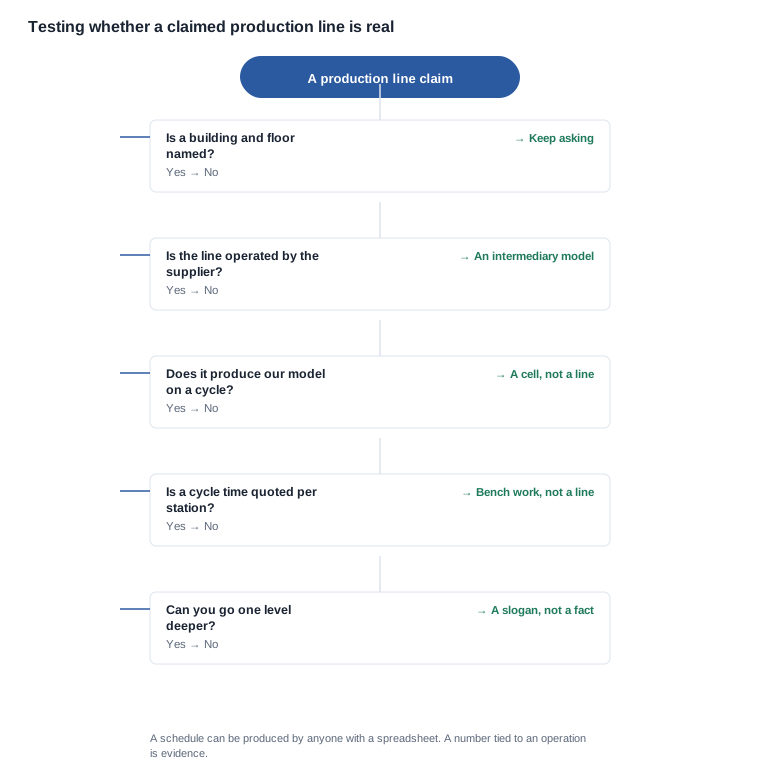
The general rule that covers all four: a description can be copied from any proposal, and a schedule can be produced by anyone with a spreadsheet. What cannot be copied is a number tied to a specific operation on a specific line, on a specific shift pattern, for a specific model. Push every answer towards that form. "We have a professional production line" is a description. "Four operators on the shift, forty units a day at the test station, our model on that line from Tuesday to Thursday each month" is a fact, and facts are comparable between suppliers.
This is also where the trade-off of remote evaluation becomes visible. If you cannot visit, the substitute is a video walkthrough, and a video walkthrough has its own weakness: it can be filmed anywhere, including in a partner's facility. Make the video useful by asking for continuous footage with the date visible on a document in frame, a question about the line answered on camera rather than in voice-over, and a written answer to questions seven and nine afterwards.
The factory vs trading company questions about what runs on the line
Beyond the mechanics, the substantive question about a production line is what else shares it, and what happens when your specification changes.
Dedicated versus shared. A line dedicated to your product is a scheduling advantage, a quality advantage and a cost disadvantage, because a dedicated line carries a fixed cost that a shared line does not. If you are buying a model that already exists and running it in volume, a shared line is usually the commercially sensible answer, and the two suppliers offering it are probably quoting a similar price for similar reasons.
Version mixing. This is the risk that buyers of a mature model underestimate. If the same line runs your model and a variant that differs only in firmware, a colour or a packaging insert, the risk is that the wrong variant reaches the box. The controls that prevent it are a work instruction naming the configuration, a scan or check at the final operation, and a version record that can be read. All three are cheap to ask for and expensive to discover afterwards.
Sub-suppliers on site. Some operations are performed on your line by people who do not belong to the site — a customer's own inspectors, a partner's technicians, or a moulding operation performed by a partner on the same floor. The diagnostic is the operational one: who books the time on that station, and whose work instruction is in use there.
Changeover and the second order. The question that decides whether a reorder is easy: what has to happen between the last unit of one run and the first of the next, and who owns that time. If the answer involves a partner, add it to the schedule.

Production capacity questions a factory vs trading company buyer should expect to skip
Capacity is the number every buyer wants and almost nobody gets. It is skipped because it is hard, because the answer is usually qualified, and because asking well requires asking several smaller questions rather than one large one.
The single large question — "what is your monthly capacity" — has no useful answer, because the answer depends on the model, the line, the shift pattern and the product mix. Five smaller questions get somewhere:
- "How many units per day does the final test station complete for our model?"
- "At what cycle time, and with how many operators on the shift?"
- "How many days per month does the line run for our model?"
- "Which other models share the line, and how many days per month do they take?"
- "What is the planning horizon you hold open for new orders?"
Multiply them and you get a number with its assumptions visible, which is the only form of a capacity claim worth carrying into a schedule. When a supplier resists this sequence, the resistance itself is the finding: either the line is not dedicated enough to produce a stable number, or the supplier does not manage to that level of detail.
For completeness, our own position on this: our production capacity is not published, and no capacity figure appears in our catalogue. It is also not a figure we would want to publish without stating the model, the line, the shift pattern and the product mix alongside it, because a capacity number without those four is not a capacity number. If capacity matters to your programme, ask for the five answers above and we will tell you which of them we can put in writing.
The same reasoning applies to the lead time you are quoted. A lead time is a schedule that depends on the line, and a line description that cannot survive block three of the questions above will not support a schedule you can plan around. The production capacity page covers the commercial framing, and the factory audit page covers what a site visit should add.

Factory vs trading company: how a multi-SKU programme behaves on one line
A production line does not see a product. It sees runs, and every additional colour, lens variant or capacity option is a separate run on the same equipment. The catalogue is generous in exactly this dimension, and the generosity is a customer advantage and a manufacturing cost at the same time.
The published examples are worth holding in view. V06 publishes four colour options. V03 Pro is the only camera model in the range with photochromic lenses, and it publishes three colour options. L2 Utral's charging case capacity can be 900 mAh or 1400 mAh, which is two different case variants for one model. A buyer who wants V06 in four colours, V03 Pro in three and L2 Utral in both case configurations is not ordering three products. They are ordering nine runs, and every one of them has to be scheduled, kitted, built and inspected separately.
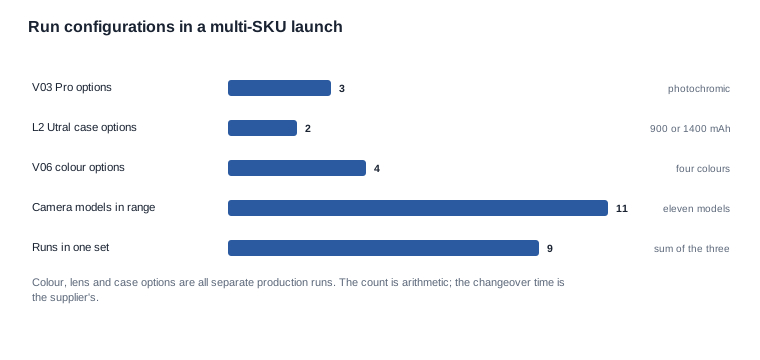
The arithmetic is yours; the changeover time is the supplier's. Multiply the number of runs by the changeover time and by the number of months in which the programme has to land, and you have the schedule cost of your own SKU strategy. A five-colour programme with a six-hour changeover is a different programme from a two-colour programme with a six-hour changeover, and the difference will not appear in a unit price.
This is where the commercial models diverge most sharply on a small order. A factory controls the line and can batch several of its own runs into one production window, or schedule them across consecutive days. An intermediary is negotiating slot allocation on a line it does not control, with a site that has its own priorities, and small scattered runs are exactly the requests that get deferred. The practical consequence is that a multi-SKU launch through an intermediary carries a lead time that is longer than the sum of its parts, and the gap widens as the number of runs rises.
Four questions resolve most of this, and all four belong in the volume conversation rather than the qualification exchange:
- "What is the minimum run per configuration, and who owns the cost below it?"
- "What is the changeover time between two of our configurations?"
- "Can our runs be batched into one production window, and who schedules the window?"
- "Are the shared components common across our variants, or dedicated to one?"
The third question is the one that matters commercially, because batching is what converts a multi-SKU programme from a series of interruptions into a single scheduling event.
The decision that follows is usually to consolidate at launch and expand later. Launch with the configurations that carry the volume, hold the others until the second production window, and treat the release of an additional colour as a separate production event with its own lead time rather than as a variation of the last one. That is a commercial decision rather than a technical one, and it belongs with the buyer who owns the channel plan — not with the factory, and not with the intermediary.
Reading a factory vs trading company production line answer
The last step is judgement, and it is worth being explicit about the criteria, because this is where buyers most often talk themselves into a supplier.
Does the answer name a place? A line without an address is a line without accountability. Every production-line answer should eventually attach to a building.
Does the answer name an operation? "We assemble and test" is two verbs and no process. The number of operations in the sequence, and their order, is the cheapest available proxy for how seriously the operation is run.
Does the answer attach to our model? A factory with an excellent line that has never run your product is a factory with a capability and no evidence. The distinction matters most for a first programme, and it is the strongest argument for paying more for a supplier who has built your exact configuration before.
Does the answer survive a specific follow-up? If the supplier answered "forty units a day at the test station", the follow-up is "on which shift, and what is the test cycle time". A supplier who cannot go one level deeper has produced a slogan.
The due diligence conclusion is usually this: the questions do not disqualify suppliers so much as sort them into three groups. Those who run the line, those who manage a line for someone else, and those who are describing a capability they have yet to use. A shortlist built on that sort is a shortlist you can build a schedule around, because you know which of the two relationships you are in for each candidate. The negotiation position then follows directly from the sort — schedule commitments and remedy terms from the first group, disclosure and escalation terms from the second, and a reference or a sample from the third.
The how to tell the difference article covers the six exchanges that establish the commercial model before any of these questions are asked, and the Factory vs Trading Company pillar carries the full comparison.
Related reading
- Factory vs Trading Company — the pillar behind this question set
- Factory audit questions — the same discipline applied on site
- How factories actually differ — the stage map around the line
- Lead time implications — what the line does to your schedule
Send us your configuration and your annual volume, and we will tell you which of these fifteen questions we can answer directly.


