

Most sample requests begin with a model number and end with a unit that settles nothing. How do i order a sample faq questions are really asking how to avoid spending three weeks and a shipment on an evaluation that could not have answered your question in the first place.
The fix is procedural rather than commercial. You decide what the sample will settle before you order it, and every other decision — which model, which configuration, how many units, which measurements — falls out of that one decision. Get it wrong and the sample is a sample. Get it right and the same unit becomes a piece of evidence you can quote in a purchase order six weeks later.
There is a second reason to be deliberate. A sample is the first time you will handle the actual product, and the gap between what the listing says and what the box contains is usually visible only in the hand. The process below is designed to surface that gap early, cheaply, while the commercial relationship is still new and the conversation is still easy.

How do I order a sample: step one is the use case, not the model
The most useful first message describes what the product will do and where. Continuous capture on a bicycle with both hands on the bars. Hands-free calls in a warehouse where the ambient noise is high. An all-day audio product for a retail counter where the unit is on the head all day and the buyer will notice if it is uncomfortable by the afternoon. An all-day audio product for a retail counter where the unit is on the head all day and the buyer will notice if it is uncomfortable by the afternoon.
A model request gets you a model. A use case gets you a recommendation you can argue with, and an argument at this stage is free — nothing has been ordered, nothing has been shipped, and no one has committed to a configuration. That is the cheapest place in the whole programme to disagree.
The reason this matters is that the model number is the one piece of information the buyer already has, and it is the one piece of information least likely to change the answer. The use case is the piece that determines everything downstream: which class of product fits, which configuration options matter, which measurement settles the question, and what a failed sample actually means.
Ask for the use case in a specific form: the environment, the duration of a typical session, what the wearer is doing with their hands, whether the unit is worn by a customer or by staff, and whether the recording or the audio has to survive an outdoor environment. Those five answers are enough to make a recommendation, and they take a buyer about four minutes to write.

How do you narrow the class once the use case is written down
Workload is the discriminator, not specification. Our own range demonstrates why, and the demonstration is worth walking through because it inverts the usual shortlisting instinct.
The children's platforms publish a 40 mAh cell with a runtime figure of roughly twenty hours. The camera platforms publish cells between 220 and 290 mAh with a rated runtime of about five to eight hours, and no test condition published with either figure. A buyer who shortlists on capacity — the instinct when the first question is "how long will it last" — will conclude that the camera models are the endurance products and the children's models are the weak ones. The published figures say the exact opposite.
The same inversion happens with charging. Twenty-six of our models publish a charge time of two hours or less, which is a ceiling rather than a specification. Only the D17 and the ZH12 publish a charge time of about one hour. If your use case involves a product that is rinsed or wiped and re-worn inside a session, that one published row moves models up the list in a way a capacity comparison never would.
So the narrowing works in this order:
- Continuous capture points to the camera class — the eleven models V06 and S7, L2 Utral and V03 Pro, L1 Pro and MT5, CY03 and V03, CY05 and KY06, and MT6.
- Audio playback and calls points to the audio class — the eight models LC-105-2 and D12, D11 and LC-105-1, and G07 and YK12, and K01 and K02.
- Sport-led sessions point to the sport class — the YKC02, the D17 and the ZH12.
- Very high ambient noise points to the bone conduction entry, with one caveat that matters more than it sounds: that entry carries no model designation in our range, so it cannot be quoted, sampled and specified by name.
- Children's use points to the A05, the A06 and the A07, which are a separate product platform with their own documentation position.
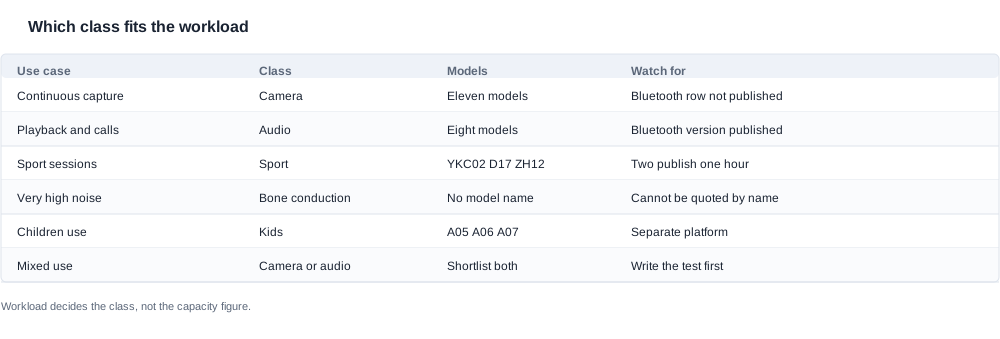
The table above is the version we would send with a first reply. The right-hand column is the one to read twice, because each of those decisions is a place where a buyer's instinct and the published rows point in different directions.
There is also a filter worth applying early that costs nothing. Our catalogue publishes the Bluetooth version for fourteen of the twenty-eight models in the range and does not publish it for the eleven camera models, the A05, the A06, or the bone conduction entry. If your product depends on a phone ecosystem, a multi-point pairing behaviour, or a specific codec, that is a shortlist question before it is a sample question, because a protocol mismatch cannot be evaluated by handling the unit.
How do you write the configuration record that protects you later
This is the step most often skipped, and it is the one that determines whether the sample is worth anything at all. Agree in writing, before the unit ships: the model, the build revision, the colour, the configuration options, the firmware level, and what is included in the box.
Six items, and each of them has bitten somebody.
The model needs the full designation, not a family name, because families in this category carry variants with different charging interfaces and different case configurations. The build revision matters because a sample taken from an early batch and a production unit from a later batch are not the same product, and a disagreement later about whether the unit you received is the unit that was promised is expensive to resolve. The colour matters commercially rather than technically, because a colour that is not available in volume is a listing you have to withdraw. The configuration options matter most for the camera models, where the presence and type of a charging case varies sharply across the range and is part of what you are buying. The firmware level matters because it determines whether a behaviour you observed is a property of the product or a property of the software revision on it. The box contents matter because the accessory set is what the customer judges the product on when they open the box.
If a supplier cannot state a build revision, say so in the record. An acknowledged unknown is usable; a discovered one later is a dispute.
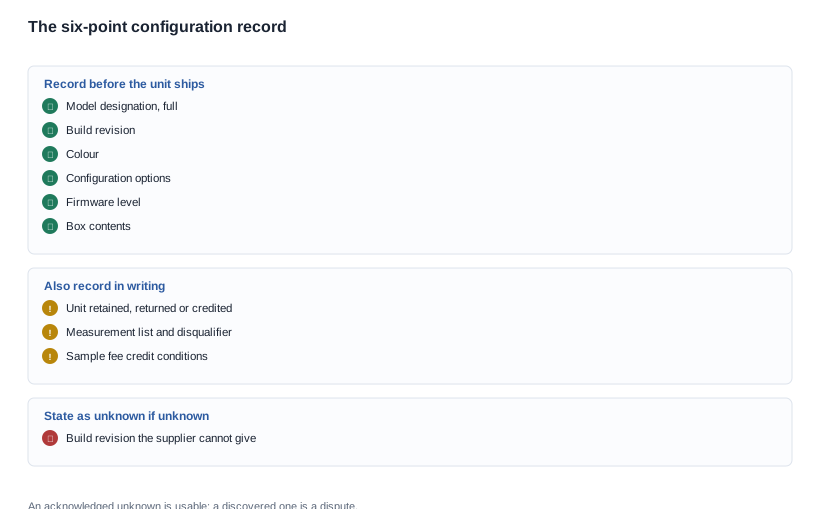
The checklist above is the six-point record, written down before the unit arrives rather than reconstructed afterwards.
There is one more item that belongs in the record and is frequently forgotten: what happens to the unit after the test. Whether it is retained, returned, or credited against a first order. That is a commercial term, but deciding it after the sample has been opened and worn converts a small conversation into a negotiation.
The configuration point deserves one worked example, because the accessory configuration varies more across the camera models than any other published row and is the easiest thing to get wrong. In our range, the CY03, the CY05 and the L1 Pro publish a 1400 mAh charging case. The L2 Utral publishes either a 900 or a 1400 mAh case. The MT6 publishes a 1200 mAh foldable case. The KY06 and the MT5 ship with a case for which the capacity is not published. The V03, the V06 and the S7 have no case row at all. The V03 Pro has no charging-case row.
A sample of the L2 Utral with the 900 mAh case does not settle the question if the order is for the 1400 mAh case, and a sample of the V06 tells you nothing about the case because there is none. That is not a technicality — it is the difference between a product that fits the customer's charging routine and one that does not, and it is a two-minute clarification in a request that avoids a season of returns.

How do you know what a sample can settle and what it cannot
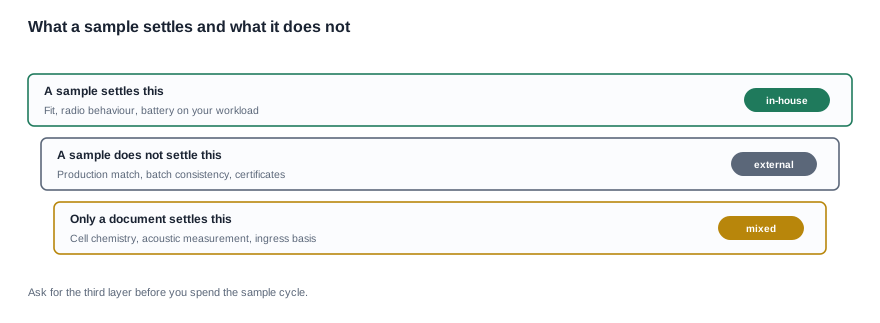
Decide the measurements before the unit is in your hand. Otherwise you will run whatever is convenient and interpret it afterwards, which is the mechanism behind most bad sample evaluations.
A sample can settle these, and it can settle them well:
- Physical fit and comfort over a full working day, including the afternoon.
- Pairing and reconnection behaviour, including what happens when the phone sleeps, the app is closed, or the unit is put down and picked up again.
- Microphone performance in your actual environment. Recording the far end of a call is the only reliable way to convert a microphone impression into evidence.
- Battery behaviour under your workload, at your volume, at your temperature. Not the published figure — your figure, on your duty cycle.
- Whether the physical product matches the listing. Weight, finish, packaging, printed artwork, what is in the box.
- The interaction rows that documentation rarely covers: whether the controls are findable by touch, whether state is confirmed visibly or audibly, and whether anything activates accidentally when it is bumped.
A sample generally cannot settle these:
- Whether the production unit matches the sample. This is the single most common misconception in the category, and it is the reason the written record above exists.
- Batch consistency or anything about the supplier's reliability at volume.
- Whether the documentation you were shown is genuine, current, or covers your exact configuration.
- Cell chemistry, cycle life, or anything that requires a laboratory.
- Acoustic measurement, sensor specification, video specification, ingress test basis, or any certificate. None of these can be produced by handling a unit.
- Frame weights for twenty-seven of our twenty-eight models, because the catalogue publishes a weight for only one.
If one of those rows decides your project, ask whether it can be obtained before you spend the sample cycle. That single question — asked in the first message — routinely removes a sample order entirely, which is the cheapest outcome available.
How do you turn a tested sample into a golden unit
A sample is worth more than its purchase price if it becomes the reference against which production is judged, and worth less than a good lunch if it is thrown in a drawer after the test. The difference is entirely in what you wrote down.
The reference practice in manufacturing is the golden sample: one unit, approved, retained, and used as the comparison point for every incoming batch. The golden sample is not the same thing as the sample you tested, and it should not be. The unit you tested is evidence about a design. The golden sample is evidence about a supply line. Keeping one unit and writing the record properly turns the first into the second, and it is the cheapest quality-control instrument available to a buyer who does not want to staff an incoming inspection function.
What the record has to contain for this to work:
- A photograph set of the unit. Front, back, both temples, the case, the box, the printed artwork, and the accessories laid out. Six or eight angles, taken in the same light, is enough.
- The measurements you took, with the method stated. A weight without the scale used is a feeling.
- The behaviours you observed, described as observations rather than conclusions, so that a later reader can distinguish what you saw from what you concluded.
- The configuration, reproduced from the record, so the unit can be matched to what was ordered.
- A defect list, including the trivial ones. Scratches, print alignment, glue lines, a loose hinge — these are the observations that get lost and the ones that decide whether you open a dispute at all.
The tolerance question follows from the record. When you later receive production units, you are not measuring against a specification sheet, because most rows in this category are not specified tightly enough to measure against. You are measuring against a unit you kept. That is why the golden sample has to be an approved unit and not the sample that happened to arrive first.
This also changes what you say to the supplier. "Unit 3 does not match sample 1" is a different and much more productive sentence than "the quality is not good". It names the reference, it identifies the unit, and it forces the conversation onto a specific item rather than a general complaint. It is also the sentence that survives an audit, because it points at a record rather than at a memory.
Two habits make this work in practice. Agree in advance, in writing, that the approved sample is retained by the buyer rather than returned — and if it is returned, that a second unit is retained on request. And agree which party bears the cost of the golden unit, which for a single unit is not worth arguing about and for a repeat order is worth having on the quotation.

How do the commercial terms on a sample work
We publish no sample price, and the reason is structural rather than evasive. A sample price is a function of the model, whether it is a stock unit or a custom build, the setup involved, the packaging, the destination and the freight method. A standing number would be wrong for most readers, so every sample is quoted per request.
What a sample fee usually reflects is two things: the value of the unit, and the setup that was required to make it a custom unit. A stock unit from the standard range sits at the lower end. A custom build carries the setup, and the setup is the part that matters, because it is the part that is not repeatable — a custom sample tells you what the setup costs, and that number has a way of reappearing in the unit price of the first order.
Freight is quoted to the destination. For a small shipment, compare the air option against the sea option in total cost rather than in transit time, because the absolute difference between two freight quotes on a modest consignment is frequently smaller than the commercial value of having the sample a week earlier.
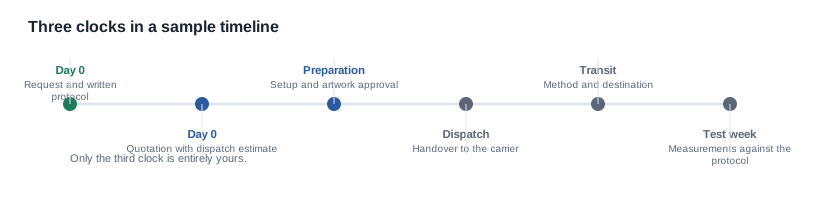
The timeline above separates the three clocks that a single number blends together. Preparation time is internal to the supplier. Dispatch time is the handover to the carrier. Transit is the carrier's, and it is the part you control by choosing the method and the destination. A supplier quoting one blended number has merged a factory performance metric with a logistics variable, and a buyer who plans around the blended number will be surprised by it in a predictable direction.
Two things decide how long the wait actually is. First, batch your requests: a request for three models at once is often faster than three requests for one model each, because the first request of each type carries the setup and the second does not. Second, custom work is where the time goes — a custom colour, a custom lens option or a custom print each introduce a setup a standard sample does not have, and a sample with custom artwork also carries an artwork approval loop that is a buyer-side delay regularly counted as a supplier delay.
Ask about the credit position in writing before the sample is ordered: whether the sample fee is credited against a subsequent bulk order, and under what conditions. That belongs on the quotation rather than in a conversation, and it is one of the few sample terms that transfers directly into the first-order negotiation.
The sample stage is also where the due diligence for the whole relationship actually happens, and it is worth treating it that way. The questions that look like sample questions — which model, which configuration, what is the tolerance for the fit, is the documentation current, what is the fee and is it credited — are the same questions that decide whether you place an order of five thousand units. A shortlist built on those answers is worth more than a shortlist built on catalogue photography, and the sample programme is the cheapest point at which to run them.
The terms worth getting onto the sample quotation, because they carry into the first order without renegotiation: unit price at each volume tier, the minimum order quantity for the model and for the accessory set, the tooling position, the payment nodes, the warranty period and response commitment, the return terms for the channel, and the delivery terms. On delivery terms, FOB and DDP are not cosmetic variants of each other — they place the risk of loss, the cost of insurance and the cost of import clearance in different places, and for a buyer shipping into a market with a seasonal deadline, the question is which of the two leaves you able to react when something goes wrong.
The trade-off worth naming is between the number of samples and the quality of each one. Three samples tested against a written protocol will usually beat one sample tested against a hunch, and one sample tested against a written protocol beats three samples tested against nothing. Buyers who insist on covering every model in the range have usually decided to avoid deciding, and the cost shows up later as a range that no evidence supports.
How do we quote a sample, and what we will not put on a quotation
We will quote a sample with the model, the configuration, the commercial terms and a dispatch estimate stated on it. We will not publish a standing sample price or a standing sample lead time, because both are functions of the request rather than of the product, and a number that is wrong for most readers is worse than no number.
We will also tell you, at the point of the request, which of the variables is actually driving the timeline. That is the useful part of a sample quotation — not the price, but the identification of the constraint. If the answer is artwork approval, the problem is on your side and no freight method will fix it. If the answer is certification work for a destination market the model does not yet cover, that is a laboratory programme measured in weeks and it sits entirely outside the factory's critical path.
One more thing we will say plainly, because it affects what a sample is worth here. A sample can show you our physical product, its fit, its radio behaviour and its battery under your workload. It cannot produce cell chemistry, acoustic measurements, sensor or video specifications, frame weights for twenty-seven of our twenty-eight models, the ingress test basis behind the two sport platforms that carry an IP54 marking, or any certificate. None of that is in our source material, so testing a sample will not produce it.
The narrower questions are covered in the sample evaluation procedure, the model detail for the audio class is on the bluetooth audio glasses range page, and the supplier checks that should precede a sample are in supplier verification steps.
What to do next.
- Write the use case first — environment, session length, what the hands are doing, who wears it.
- Narrow the class from the published rows, then narrow the model within the class.
- Put the six-point configuration record in the request.
- Decide the measurements, and what result would disqualify the model, before the unit ships.
- Quote the commercial terms on the same document as the request, not after the conversation.
Related reading
- What to test and how — the sample acceptance protocol
- Narrowing before you order — smart glasses model comparison
- Checking the supplier first — supplier verification
Tell us the use case and environment, and we will tell you which model to sample and what it will not settle.


