

We are going to answer this one with an honest "not published" and then make the question better, because the version of it that gets asked is usually the wrong version. The number of charges a battery survives is a property of a cell, tested on a cell, under a stated protocol, and quoted for a specific cell model. It is not a property of the product the cell sits in, and it does not transfer from one product to another. The catalogue publishes no cycle life rating for any model in our range, and we will not estimate one from typical industry values, because a cycle life figure is exactly the kind of number that ends up in a tender document and then in a warranty dispute.
There is a second reason we will not guess. The interesting failure mode in this category is not that a buyer quotes a wrong number; it is that a buyer quotes a right number for the wrong cell, and nobody notices until the returns start. That is a procurement problem, not a technical one, and this article is written for the person who has to prevent it.
How many charges before degradation: what is published, and what is not
Let us be precise about the published position, because "not published" is more useful when it is itemised.
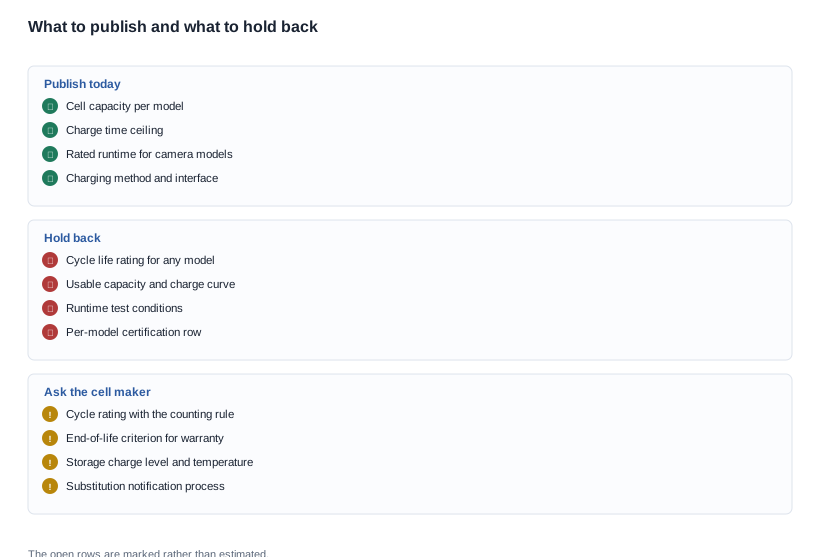
What our catalogue publishes. The cell capacity for every model in the range. The charge time, which twenty-six models publish at two hours or less, with about one hour published only by the D17 and the ZH12. The rated runtime, on all eleven camera models. The charging method and interface. The charging case capacity for the five models where it exists and is published. The current state of charge and the charging behaviour are covered under charging solutions.
What our catalogue does not publish. No cycle life rating for any model. No usable capacity as distinct from nominal capacity. No test condition behind any runtime figure. No charge curve. No end-of-life criterion. No storage temperature guidance. And no per-model certification row of any kind, so there is no certificate number to cross-check a cell against.
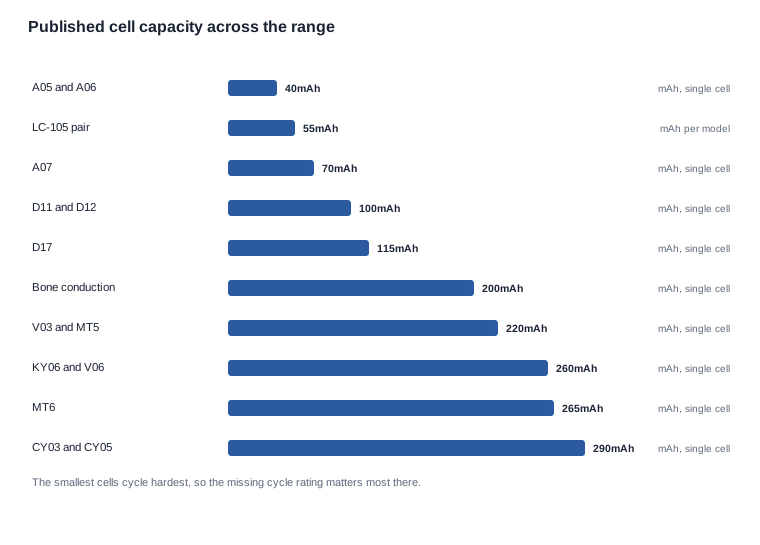
The capacities are published in a range that spans more than seven times, and that spread is why the missing row matters more for some models than for others. The 40 mAh cells in the A05 and the A06, the 55 mAh cells in the LC-105 pair, the G07 and the YK12, the single 70 mAh in the A07, the doubled 70 mAh in the sport YKC02, the doubled 90 mAh in the audio-tier K01 and K02, the single 100 mAh in the D11, the D12, the ZH12 and in the electrochromic and AR entries, the 115 mAh in the D17, the 200 mAh in the bone conduction model, and then the camera family at 220 mAh on the V03 Pro and the MT5, and the V03, 260 mAh on the KY06 and the V06, and the S7, 265 mAh on the MT6, and 290 mAh on the CY05 and the L1 Pro, and the L2 Utral and the CY03.
The smallest cells are where a cycle life figure would matter most, because they cycle harder — a user wears a pair of 40 mAh glasses more often, and charges them more often, than a pair of 290 mAh glasses that are used for a specific task. The row we are least able to supply is the row that matters most for the high-volume, high-turnover models.
The four variables that decide how many charges before degradation
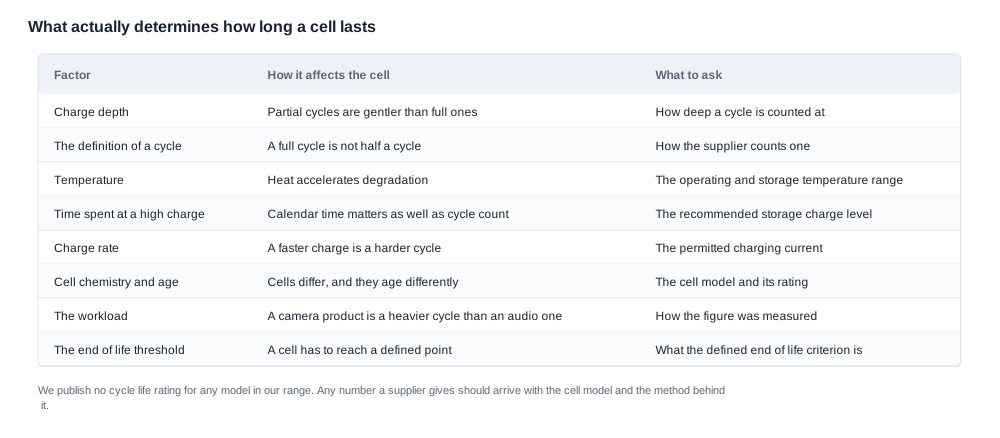
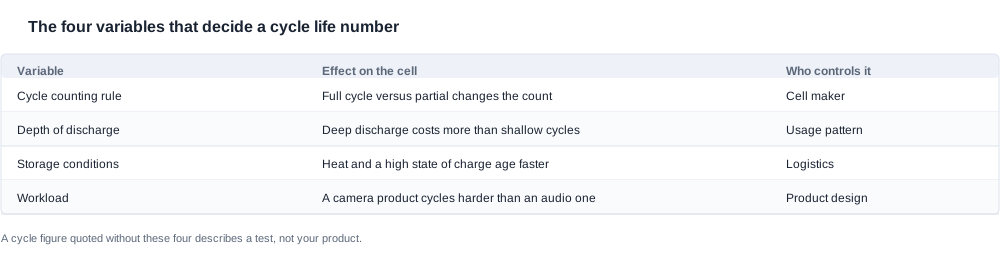
How a cycle is counted. A full discharge followed by a full charge is one cycle. Half of that is usually half a cycle, which is why two products with the same nominal capacity and the same daily use can have very different cycle counts at the end of a year. Ask a supplier how they count it, because the counting convention changes the number by a factor of two, and because the same convention has to be applied by the cell maker and by whoever writes the warranty.
How deep the cycles go. Cells generally tolerate partial cycles better than full ones, and the damage from a deep discharge is worse than the damage from many shallow ones. A product that is charged from a low state every night is working its cell harder than a product that is topped up during the day. This is also where the charging case earns its place: a model that ships with a 1400 mAh case — the CY05 and the L1 Pro, and the CY03, or the L2 Utral in its 900 or 1400 mAh version, or the MT6 with its 1200 mAh foldable case — can be charged in a way that keeps the glasses' own cell off the bottom of its range.
Where the cell spends its time. Temperature accelerates degradation, and so does time spent at a high state of charge. A cell stored at a high charge in a warm warehouse ages faster than one stored cool and partly charged, which makes the storage instruction a real specification rather than a footnote. For a channel that holds inventory before a seasonal peak, this is the variable that determines whether the units you ship in March were already aged in January.
How hard the product works. A camera product draws far more power than an audio-only product, and a cell cycled hard degrades faster than one cycled lightly. This is the point at which the cycle life figure stops being a cell property and becomes a product property — and the point at which a datasheet number carried over from a datasheet becomes misleading.
There is a fifth factor that is not in the cell datasheet at all and that determines the commercial answer: the wearer's usage pattern. A device worn four hours a day and charged every night cycles heavily. A device worn once a week cycles lightly and spends most of its life in storage, which is where the calendar rather than the cycle count becomes the limit. A cycle count on its own is a poor answer to a service life question, and a buyer who writes it into a specification has answered a question nobody asked.
How to ask a supplier about how many charges before degradation
Six questions, sent together, produce an answer that can go in a file. The sixth is the one that catches people.
- Which cell is in this model, and what is the cell maker's cycle life rating for it?
- How is a cycle counted in that rating?
- At what depth of discharge and at what temperature was it measured?
- What is the end-of-life criterion? A capacity percentage, an internal resistance threshold, or a safety event are three different definitions, and they produce three different numbers from the same test.
- What is the recommended storage charge level and storage temperature?
- Is the cell in the product the same cell the rating was measured on?
The sixth question is the one that does the work, because a cell can be substituted for cost or availability, and when it is, the rating quietly stops applying. The cell part number recorded on the transport documentation is the way to check it, which is one more reason the battery transport material belongs in your file rather than in someone else's.

Two questions to add if you are running a shortlist rather than a single purchase.
What does the supplier do when a cell is substituted? If the answer is "we inform you", that is a notice. If the answer describes a review, a decision and a record, that is a control. The first is not enough to protect a warranty position.
Which cell does the supplier quote in its own documentation? A supplier whose warranty and product literature name a cell part number is a supplier who has one. A supplier who answers "it depends on the batch" has a variation problem that will show up in your returns.
How many charges before degradation and what you write in the specification
The practical value of a cycle life figure depends entirely on what the buyer is going to do with it. There are three legitimate uses and one illegitimate one.
A service life commitment to a customer. For this use, the number in the specification must come from the cell maker, for the cell in the product, with the counting convention attached. A figure carried over from a different model in the same family is not a conservative version of the truth; it is a different number, and if it turns out to be optimistic you have a warranty dispute on a technicality.
A charge budget in a high-turnover channel. For a product that will be used daily and charged daily, the cycle figure is the input that tells you what the cell's usable window looks like in months rather than in cycles. Here the counting convention matters more than the number itself, because you will be comparing it with a usage model that counts cycles in its own way.
A storage and inventory policy. For a channel that buys ahead, the calendar limit and the storage conditions matter more than the cycle count, because the inventory is sitting at a high state of charge in a warehouse. The storage instruction is a specification you can act on immediately; the cycle figure is not.
The illegitimate use is quoting the figure on the product listing. A cycle life number on a retail page is a warranty commitment dressed as a specification, and it is the fastest way to convert a technical question into a legal one. The published runtime rows belong on a listing; a cycle rating does not, unless it is the cell maker's figure for the exact cell, with its method, and it has been reviewed by whoever handles the warranty.
What an open row costs commercially
Where a specification row is missing, the risk does not sit still. It moves into the returns process, and it lands there as an argument that neither side can win, because there is no agreed figure to argue from.
Three things reduce the exposure, and all three are commercial rather than technical.
Agree the end-of-life definition in the agreement, even if you do not have the cycle number. If the cell maker's rating is not available, the buyer can still agree with the supplier what constitutes a failed cell in the warranty context — a capacity percentage measured by a stated method, or a voltage behaviour, or a safety event. A definition without a threshold is still useful, because it tells the factory what evidence it needs to see before it can decline a claim.
Tie the warranty to a replacement policy rather than to a cycle count. If the warranty period is expressed in months and the remedy is a replacement unit, the buyer is exposed to the cell's behaviour only indirectly. If the warranty is expressed in cycles, the buyer needs the cycle figure, and does not have it.
And price the risk where it belongs. Where a product is sold into a channel with heavy daily use and the cycle figure is unavailable, the sensible response in the negotiation is to ask for what can be given — a recommended charging discipline, a storage instruction, a replacement policy that is easier on the customer than the cell technically demands, or a lower unit price reflecting the risk. These are all negotiable, and asking for one of them is a better position than accepting an invented number that nobody will honour later.

Comparing candidates when how many charges before degradation is not published
This is the situation a procurement manager actually faces most often, and it is worth a method rather than an opinion, because "not published" from two suppliers tells you nothing about which one to buy.
Rank on the variables you can see, not on the number you cannot. The published rows give you the cell capacity, the charge time, the runtime, the charging interface and the case capacity. Those five rows are enough to build a rough duty-cycle picture for each candidate, and the duty cycle is what determines how hard the cell is worked. A model with a larger cell that is charged every night in a camera application is working its cell harder than a model with a smaller cell that is used occasionally for audio, whatever either supplier says about cycle life.
Ask each supplier for the same six questions in the same order. The value is not only in the answers but in the shape of them. A supplier who answers the sixth question directly — naming the cell, or stating that the cell is selected at production and can vary — has given you something usable. A supplier who answers questions one to five confidently and then goes quiet on six has told you the answer is fragile.
Check whether the two candidates are comparable at all. A camera model with a 290 mAh cell and a 40 mAh children's model are not competing for the same requirement, and a cycle-life comparison between them is meaningless. Before comparing, agree which model fits the use case. Which one is the right model for a daily-use channel is a question about the duty cycle, and it comes before the cycle question.
Then use the sample as the tie-breaker. Where the published rows and the answers both leave you with two plausible options, the deciding evidence is what a unit actually does: run it in the way the channel will use it, through a full day, and compare the runtime against the published figure. The sample evaluation protocol covers what else to check on arrival, and the certification checklist covers the document set that has to arrive with the unit.
And write down the decision basis, including the gap. The most useful sentence in the file is the one that says which model you chose, on which published rows, and that the cycle life figure was unavailable for both. It closes the question for the next person who asks, and it stops the gap from being re-litigated every time a customer raises battery life.
One trade-off worth naming explicitly. The candidate with the larger cell per unit is usually the one with the better runtime and the better cycle behaviour, but it is also the one with the higher cell cost inside the unit price and the heavier product. Where the price gap between two candidates is narrow and the cell capacity gap is wide, the capacity gap is telling you something real about the endurance you are buying. Where the price gap is wide, you may simply be buying a different product tier rather than a better battery.
The two questions a buyer should stop asking
"What is the typical cycle life for a battery of this size?" This is the question that produces a false answer. The typical value describes a different cell in a different product under a different protocol. If you use it in a specification, you have taken on the risk of an unverified number, and there is no way to defend it when a customer asks.
"Will it still hold capacity after a year?" Also unanswerable without the test conditions, and it hides two separate questions — the calendar question and the cycle question — behind one word, "still". A cell can be fine on the calendar and poor on the cycle count, and vice versa.
The better version of the second question is the one that gets a reply: "Which cell part number is fitted, and what is the cell maker's published cycle life rating for it, with the counting convention and the end-of-life criterion?" That question has an answer, and the answer goes in the file.
Where our published boundary sits on how many charges before degradation
We publish the battery rows we hold and mark the rest as open, and in this case the open row is one of the most consequential in the whole catalogue. We publish no cycle life rating, no usable capacity, no runtime test condition and no charge curve for any model, and we will not quote an industry figure for a cell we have not specified, because the figure would describe a different cell in a different product.
What we will do is take a specific model and tell you which cell sits in it, what we can confirm about that cell, and which of the six questions has to be answered by the cell maker before the number belongs in your documentation. The published battery rows and what they omit are on battery life and power, the charging behaviour that affects cycling is under charging solutions, the cell document that identifies the cell is on battery transport, and the protocol for checking a delivered unit is in sample evaluation.
For a buyer running due diligence on a specific model, the checklist that follows from this article is short. Which cell is fitted, and can the cell maker's cycle rating for that cell be obtained. How is a cycle counted, and what is the end-of-life criterion. Who authorises a substitution, and what triggers a document review. What does the warranty say, expressed in months or in cycles. And what does the supplier commit to instead, if the cycle rating is unavailable. Those five answers, in the file, close the question for the programme without a single estimated figure.
One practical note for the sample stage. Because cycle life cannot be tested on a sample — a cycle rating takes months of cycling to establish — what a sample can establish is the cell's identity, the charging behaviour under your usage pattern, and the runtime against the published figure. Those three checks, made on the evaluation unit and recorded, are what turn the open row from a gap in the file into a documented question for the cell maker. A buyer who runs them on a sample has done the part of the work that a sample can actually do.
Related reading
- The published battery rows and what they omit — battery life and power
- The charging behaviour that affects cycling — charging solutions
- The cell document that identifies the cell — battery transport
- The way to check a delivered unit — sample evaluation
Tell us the model, how it will be used and how often, and we will say which cell sits in it and what would have to come from the cell maker.


