
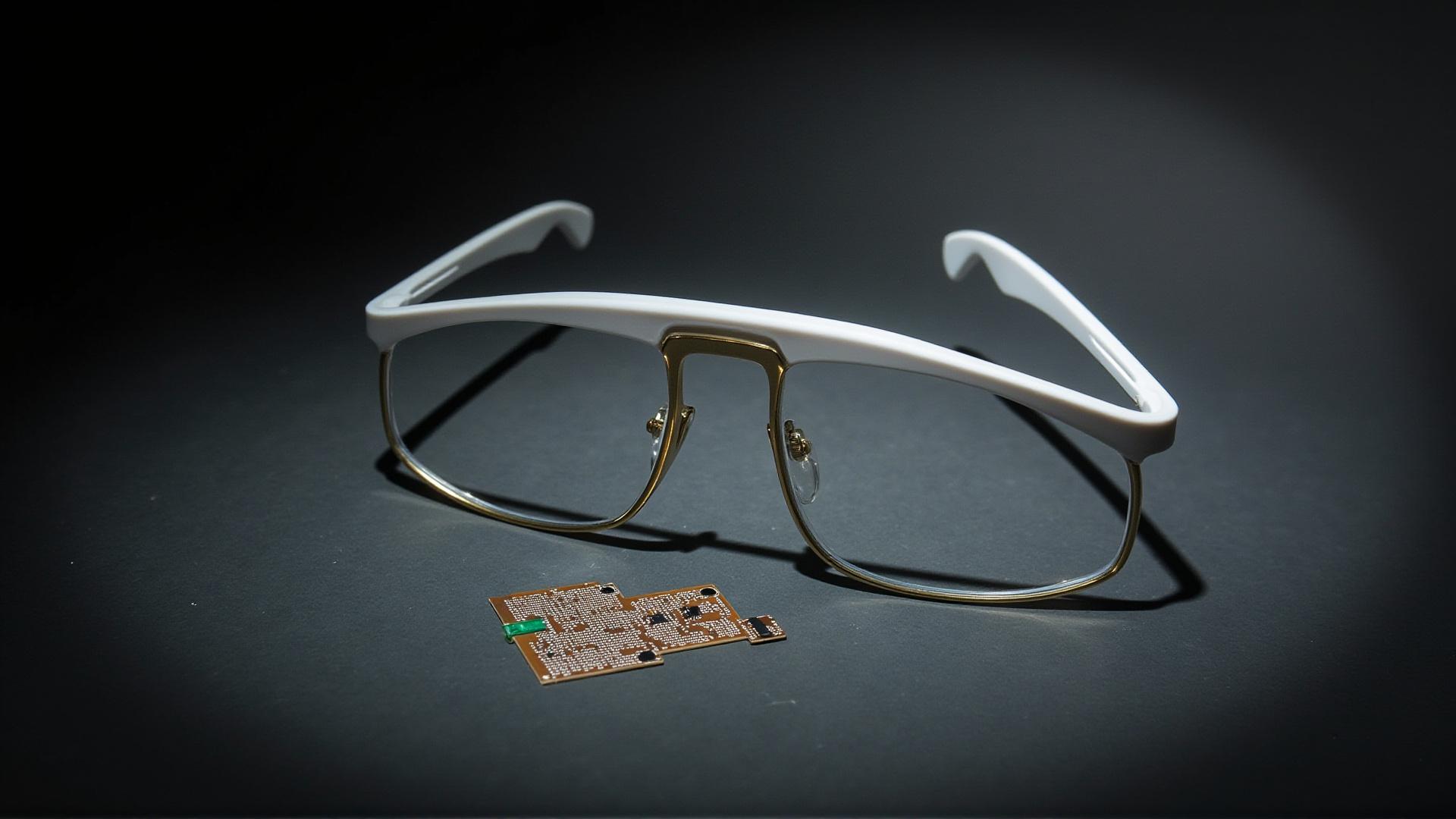
Smart glasses for ecommerce have a charging problem that no other channel has, and it is not a problem about the charger at all. It is a problem about the handover: the unit reaches a customer who has never seen the device, and the state of charge it arrives in decides whether the first ten minutes are a good experience or a return request. The catalogue publishes the charge time for every model in the range and it publishes the state of charge at dispatch for none of them, so the number that governs an ecommerce channel has to be set by the fulfilment operation rather than read off a specification.
This page is written for the brand owner running a marketplace listing, for the procurement manager specifying what ships in the box, and for the ecommerce operator deciding what the packing bench is allowed to do.
Smart glasses for ecommerce: the charge state at the customer's hand
The handover is where the return is decided
An ecommerce customer cannot compare the device against the one they tried at a trade stand, cannot ask a shop assistant, and cannot wait for a second unit to arrive. The first ten minutes after the box is opened are the whole of the evaluation, and in those ten minutes a flat device is not a minor inconvenience — it is a product that appears not to work, because a customer who opens a box expecting a camera and gets a dead battery will not wait for it to charge.
That produces a chain of small decisions with a large commercial tail:
- What state of charge does the unit leave the packing bench in? A unit dispatched flat and a unit dispatched with a partial charge produce two entirely different first impressions from the same product, and the difference is invisible on the spec sheet.
- What does the customer find when the unit is flat? If they find a charging interface they did not expect, or a case that is itself flat, or a magnetic contact they do not recognise, the assumption is that the product is broken.
- What does the customer do about it? A marketplace customer has a returns button. A first-return rate on a category where the device is unfamiliar is a listing-level problem, not a customer-service problem.
Why the catalogue cannot answer the dispatch-state question
The published rows describe the charger. They do not describe the handover, and the difference is worth stating precisely because it is easy to assume the gap is already covered.
- Charge time is published for every model in the catalogue, twenty-six of them at two hours or less and two — the D17 and the ZH12 — at about one hour. What is not published for any model is the state of charge at which that clock starts or the criterion at which charging is judged complete. A fulfilment operation that wants to ship a unit at a known state has nothing in the catalogue to calibrate against.
- The charging interface is published for twenty-four of the twenty-eight models: seventeen on a magnetic contact and seven on a Type-C port. The four that publish no interface row at all are camera models — the CY03 and the MT6, and the CY05 and the L1 Pro — which is a real problem for a fulfilment bench, because a bench that cannot be set up for a model whose connector is not published cannot be standardised across the range.
- The catalogue writes the interface under four different labels across its pages: charging method, charging mode, charging port and charging interface. A listing team that built a product feed by hand from the catalogue is one mis-mapped row away from a customer receiving a product whose charging description does not match its contents.
- The rated runtimes are published without a test condition, so the figure a listing quotes is an upper bound on an unstated workload.
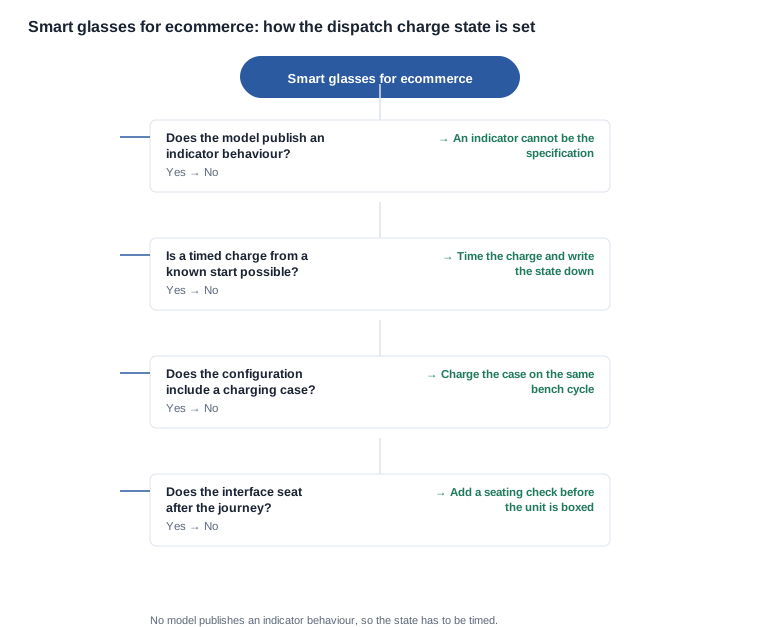
The practical conclusion is that the charge state at dispatch is an operating decision, and the only honest way to make it is to decide it, test it and write it down.
What the packing bench has to be able to do
A fulfilment operation that sells these models ends up with three jobs at the bench, and each one has to be designed rather than assumed.
Charge to a defined state, not to an indicator. If the bench charges until a light turns green, the state of every unit leaving the bench is whatever that light means, and the catalogue publishes no indicator behaviour for any model. A defined state — measured by elapsed time from a known start, against a known input — is repeatable, and it is the only version of this process that survives a shift change.
Verify the interface actually presents. The contact has to be seated and the connector has to be present, because a unit shipped with a mis-seated contact or a missing cap is a dead-on-arrival return with no fault on the customer and no fault visible on the product.
Hold the accessory in the same state. Where the configuration has a charging case, the case has to reach the customer charged as well. A flat case in the box is arguably worse than no case at all, because it tells the customer that the case is the charging solution and then does not perform one.

What a listing may claim, and what it must not
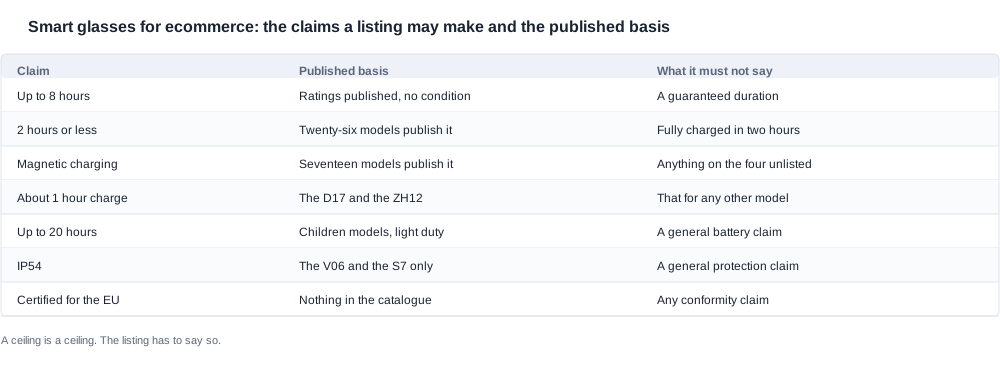
The listing is the point at which a published figure becomes a promise to a customer, and in an ecommerce channel the promise is written in a place where a competitor can screenshot it. This is the table to work from.
| Claim a listing might make | What the catalogue supports | What the listing must not say |
|---|---|---|
| "Up to 8 hours of battery" | Rated runtimes are published, without a test condition | Any figure that presents a rating as a guaranteed duration |
| "Fast charging, 2 hours or less" | Twenty-six models publish two hours or less | "Fully charged in two hours" — that is a ceiling, not a typical value |
| "Magnetic charging" | Seventeen models publish a magnetic contact | That on the four camera models whose interface is not published |
| "About 1 hour charge" | The D17 and the ZH12 publish about one hour | That for any other model in the range |
| "Up to 20 hours" | The three children's models publish about twenty hours on a light duty cycle | A general battery claim that ignores the light duty cycle |
| "IP54 water resistant" | The V06 and the S7 publish an IP54 marking | A general protection claim; no test report is published behind it |
| "Certified for the EU" | Nothing in the catalogue | Any conformity claim at all — there is no per-model certification row |
Two of these deserve more attention because they are the ones that generate correspondence rather than returns.
The runtime claim is the most common source of a complaint that turns into a dispute. The catalogue publishes a rated runtime for every model in the range, and every one of those ratings is a bound under a condition that is not published. A listing that says "up to eight hours" is technically describing the rating; a listing that says "eight hours of continuous use" is making a claim the catalogue cannot support, and a customer who records for three hours on a warm afternoon has grounds to complain.
The charge-time claim is the most common conversion of a ceiling into a promise. "Two hours or less" is the published figure on twenty-six models, and the instinct to render it as "charges fully in two hours" is so natural that it survives review. It is also the exact thing a customer measures, because a customer with a wall clock and an empty battery can check it in an afternoon.
There is a second claim problem that a fulfilment operation inherits rather than creates: the catalogue contains no per-model certification row, and the words CE, FCC and RoHS do not appear anywhere in it. An ecommerce channel that lists into regulated markets is therefore relying on documents it does not hold, and a marketplace compliance enquiry has no catalogue answer to give.
The dead-on-arrival return, and what it costs in the margin
The return itself is the cheap part. The expensive part is that a return rate is a listing-level signal: on a marketplace, a cluster of returns on one listing degrades the listing's performance, and the effect outlives the returns themselves. So the arithmetic that matters is not the cost of a single return, it is the expected cost of a return cluster on one SKU, and the way to move that number is to remove the causes rather than to absorb them.
There are four causes, and they have different owners.
Shipped flat. The unit left the bench with no charge. The fix is a defined dispatch state, measured rather than inferred from an indicator, and the decision belongs to the fulfilment operation.
A contact that will not seat after the journey. A magnetic contact that is not clean and not aligned can appear connected while charging nothing, and the customer discovers this at two in the morning with no way to verify it. The fix is a seating check at the bench, and the owner is the process engineer rather than the customer.
A flat case. The configuration has a case, the case is in the box, and the case is empty. The fix is the case on the same bench cycle as the device, and the cost of that cycle belongs in the fulfilment budget rather than in the returns budget.
A pairing failure mistaken for a fault. The camera series publishes no Bluetooth version, and eleven models is a large part of the range. A customer on an older handset gets a pairing failure and concludes the product is broken. This one is not fixed at the bench; it is fixed in the listing, with a compatibility note, or by requesting the radio version for the models in the range.
A fifth cause is worth naming because it is not a fault at all: the customer's expectation. A listing that quotes a rating without its condition creates an expectation that the unit cannot meet on a warm day, and the return arrives with no fault attached to the product. That is a listing problem, and the fix is a copy problem.
How to judge a fulfilment plan before you order it
A fulfilment plan is rarely visible in a supplier's quotation, which means it has to be interrogated rather than read. The criteria that separate a workable plan from an optimistic one are these, and the questions to ask are the same three in every case.
What state of charge does the unit leave the bench in, and how is it proven? A plan that says "charged" has not answered the question. A plan that names an elapsed time from a known start, against a known input, and shows the measurement on a sample, has answered it.
Which models share a dock, and which need their own? A single cable covers the six models that publish a Type-C port; the seventeen magnetic models each need a positioned fixture; and the four camera models whose interface is not published cannot be bench-designed at all. The number of fixtures is the number of spare parts the operation has to hold, the number of places a unit can be mis-charged, and a line in the supplier's unit price that is easy to forget.
Which claims in the listing rest on a measured figure rather than a published row? Any claim about a duration, a charge time or a protection level has to be traceable to something the operation has verified, and the ones that cannot be traced are the ones that arrive back as a correspondence from a customer rather than as a return.
The three questions work as a checklist, and a shortlist of fulfilment plans is really a shortlist of measurements. The cheapest way to fail that test is to accept a plan with no sample behind it, and the first shipment is where the absence becomes visible — which is a much more expensive place to find out than at a bench.

The fulfilment centre: charging points, refurbishment and the second cell

The refurbishment loop is a second fulfilment operation
Returned units do not go straight back on the shelf in most channels. They are inspected, recharged, sometimes re-boxed, and then listed again. That loop is a charging operation with its own throughput, and the design of the bench determines how many returns per hour the operation can clear.
A magnetic platform needs a dock per model rather than a cable per order, because a magnetic contact has to be positioned and a cable can simply be plugged in. The D12 and the L2 Utral, the D11 and the D17, and the V03 Pro and the ZH12 publish a Type-C port, so a single bench with a mix of cables covers them. The seventeen magnetic models each need their own positioned dock, and the four camera models whose interface is not published cannot be bench-designed at all until that row exists. That is a fixture cost, a spare-parts cost and a training cost, and it belongs in the launch budget.
The second cell changes the storage and the movement rules
Five camera models publish a charging-case capacity — 1400 milliamp-hours on the CY03 and the L1 Pro, and the CY05, 900 or 1400 as a configuration choice on the L2 Utral, and 1200 in the folding case on the MT6. Two more, the KY06 and the MT5, ship with a case whose capacity is not published. Every one of those configurations carries two cells in one package, which changes three things in a fulfilment centre at once: the battery transport documentation for the outbound movement, the storage requirements for the case stock, and the movement of returned units with a case inside them.
The return movement is the one that is routinely forgotten. A returned unit with a case is a returned package with two cells, and a warehouse that treats returns movements as general freight will find this out at a border rather than at a desk.
Colour variants multiply the pick lines
Two models publish a colour count. The V03 Pro publishes three — orange, cream white and black — and the V06 publishes four, adding white ice blue and dark ice blue. Every colour is a separate pick line, a separate bin and a separate chance to ship the wrong unit, and a wrong colour is a return that nobody can defend because the customer received something that genuinely works.

Before a listing goes live: the documents that protect the claims
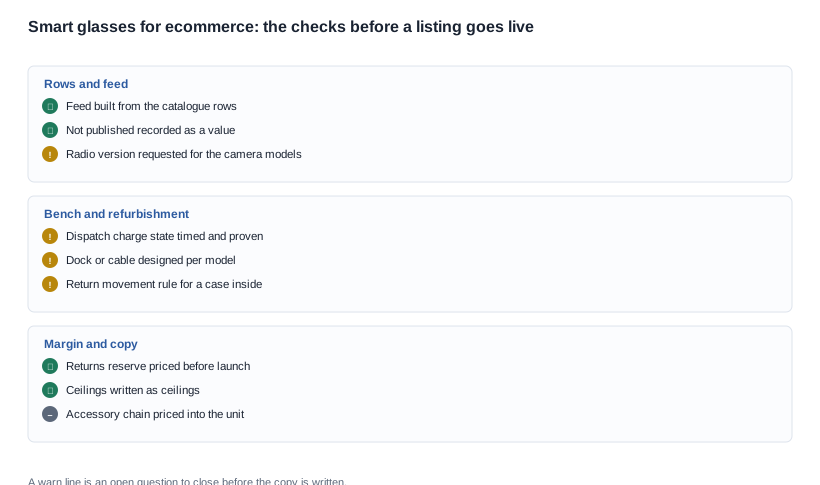
- Write the dispatch charge state into the fulfilment procedure, as an elapsed time from a known start against a known input, and confirm it on a sample rather than trusting an indicator. No indicator behaviour is published for any model, so an indicator cannot be the specification.
- Build the product feed from the catalogue rows rather than from a spreadsheet somebody edited. Twenty-four models publish a charging interface and four do not, and the catalogue labels the same attribute four different ways. The feed has to record "not published" for those four rather than inheriting a value from a neighbouring model.
- Fix the listing copy against the claims table before the copy is written, and mark every figure that is a ceiling as a ceiling. The charge times, the interfaces, the cell configurations, the runtimes and the ingress marking are published rows; the charging inputs, the start points, the indicator behaviours, the case charge times and the per-model conformity positions are not, and a listing cannot rest on the second group.
- Request the radio version for the camera models and publish a compatibility note, so that a pairing failure is not filed as a product fault.
- Price the returns reserve into the margin before the listing goes live, and work out what the dead-on-arrival rate is on the first shipment rather than assuming it. The return rate for an unfamiliar device with a flat arrival is a different number from the return rate for the same device charged.
- Decide the refurbishment path in writing, including the bench cycle for the case, the dock or cable per model, and the movement rule for returned units with a case inside them.
- Decide the accessory set with the product, because the accessories decide the accessory chain, the second cell declaration and the bench cycle, and all three are easier to change before the artwork is locked.
The limit of an ecommerce charging plan, and what we will confirm
The short answer: an ecommerce charging plan is a handover plan, and the handover is governed by the state of charge at dispatch — a figure that has to be set by the operation rather than read from the catalogue. We publish the charging interfaces where they are published, the rated runtimes, the cell configurations, the charge times, the case capacities where they are published and the colour counts, and we will not turn a ceiling into a typical value on a listing, and we will not publish an indicator behaviour, a charging input, a charge-time starting point or a conformity position that we have not been given.
What we will do is take the models, the configurations, the channel and the markets, and tell you which published rows exist for each model, where a listing has to stop at the published figure, and which figures have to be measured or confirmed in writing before the copy is written. The ecommerce application page covers the channel positioning, the charging solutions page carries the published charging rows, and the listing optimisation article covers the wider feed and copy discipline.
What to do next, in order:
- Set the dispatch charge state and prove it on a sample.
- Build the product feed from the catalogue rows, with "not published" recorded as a value.
- Fix the listing copy against the claims table before the copy exists.
- Design the refurbishment bench, including the case and the dock per model.
- Price the returns reserve and the accessory chain into the margin before launch.


