

The strongest listing optimization available to a brand owner is not copy, layout or keyword density. It is a claim discipline that never states more than the supplier's own documentation supports — and this matters more on OEM ready platforms than anywhere else, because the platform is published as a range of specification rows, and the temptation to infer beyond those rows is constant. Every claim a listing makes is either traceable to a published row, traceable to a document the supplier has provided in writing, or traceable to nothing at all. Only the first two categories belong in a listing.
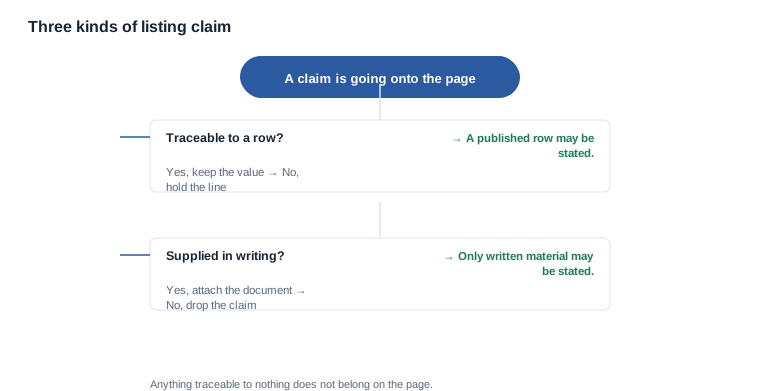
The commercial argument for this discipline is straightforward and it is not primarily about compliance. An overstated claim creates a dispute at the point of return, where you have the least information and the weakest position. A claim you cannot substantiate when a customer challenges it is a liability that sits on the listing permanently, because the listing stays live.
OEM ready platforms and the listing claim you cannot support
The range publishes a great deal, and it publishes it in a specific structure: a cell figure, a runtime figure, a charge-time figure, a charging-method row where one exists, a Bluetooth version where one exists, and a short list of feature descriptors. That structure is exactly enough to build an accurate listing and exactly enough to tempt someone into building an inaccurate one.
The failure mode is rarely a deliberate overstatement. It is inference: a reader sees a runtime figure of about seven hours and concludes the unit runs all day; sees a charge time of two hours or less and concludes it charges in ninety minutes; sees a cell figure and concludes a battery specification that the supplier never published; sees an audio row and assumes a microphone array, a driver size or a codec.
Where inference replaces evidence
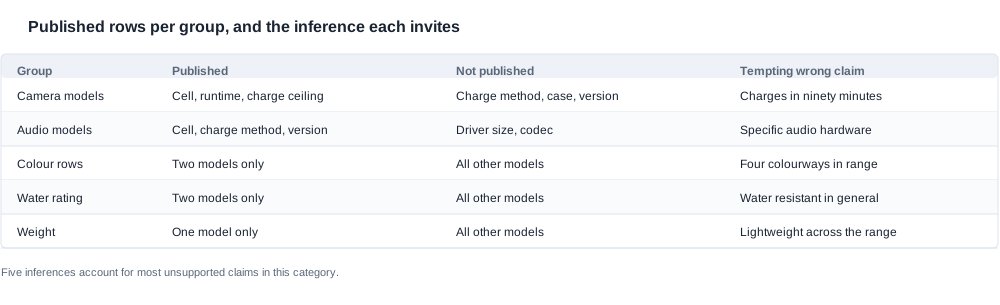
Five inferences account for most of the unsupported claims on listings in this category, and each of them has a specific correct handling:
Charge time. Twenty-six of the twenty-eight catalogue entries publish two hours or less, which is a ceiling and not a measurement. A listing that says "fast charging" is supportable in direction but not in magnitude. A listing that says "charges in under two hours" is not supportable at all, because "two hours or less" permits exactly two hours and "under two hours" does not. Only the D17 and the ZH12 publish roughly one hour, and only those two may be described that way.
Runtime. The runtimes published across the range are about five to eight hours, about six to eight hours, about seven hours, about eight hours, about six hours, about twenty hours for the children's models and about seven to eight hours for several others. A range figure written as "up to eight hours" is a ceiling across a family, not a measurement of one unit, and it should be presented as a range belonging to the specific model rather than as the model's own figure.
Bluetooth and audio. The eight audio models publish Bluetooth versions; the eleven camera models publish none. A listing that states a Bluetooth version for a camera model states something the catalogue does not. The same discipline applies to acoustic descriptors: the D11 publishes a surround-sound row and the D12 does not, which means a listing cannot describe both as sharing that feature.
Water resistance. IP54 appears on exactly two models, the V06 and the S7. It is not a range-wide attribute and it should not appear on any other model's listing, including in comparison tables and category pages.
Weight. One model in the whole catalogue publishes a weight: the MT6 at 158 grams for the glasses body, excluding its folding case. A weight column on a comparison table is therefore 28 blanks and one figure, which is a strong signal that the column should be removed rather than populated with estimates.
The rule for a range page
If a specification cannot be stated for every model on a comparison table, it does not belong on the comparison table. This rule resolves most category-page problems, and it has the useful property of being checkable: pick any cell, trace it to a published row, and if the trace fails, the cell comes out.
Writing to the published row and nothing beyond it
A disciplined listing has a specific construction. Each specification line states the value, the unit, and the condition under which the value holds. If a condition is unknown, the line says so rather than omitting it silently, because a silent omission on a comparison table reads as a zero and a zero is a claim.
The pattern is straightforward. Take the D12: it publishes a 100 mAh cell, a charge time of two hours or less, about seven hours of runtime, Type-C charging and Bluetooth 5.4. Its page carries no acoustic descriptor at all. A correct listing line therefore reads: cell 100 mAh, charge time two hours or less, runtime about seven hours, charging Type-C, Bluetooth 5.4 — and makes no statement about sound beyond the fact that it is an audio model. The absence is part of the accurate description, not a gap in it.
Handling a range where rows differ model by model
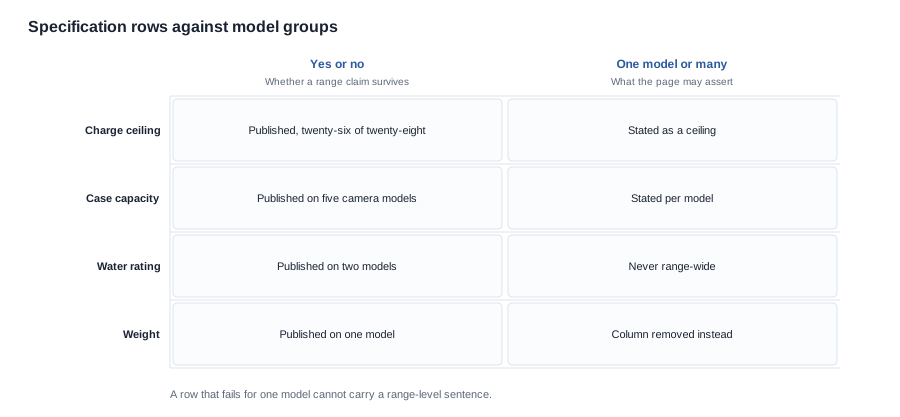
The camera group shows why range-level claims are dangerous. Of the eleven camera models, four publish about seven hours of runtime, four publish a five-to-eight-hour range and two publish six-to-eight hours. Five publish a case capacity, two publish a case with no capacity, and four publish no case row at all — the S7 and the V03, and the V03 Pro and the V06. Four publish no charging method. Two publish colour rows and nine publish none.
A range-level sentence such as "all camera models ship with a charging case" would be wrong on four models, and wrong in a way a customer can verify by opening the box. The accurate range-level sentence describes the structure rather than asserting uniformity: camera models in this range fall into four different charging-case states, and the case configuration is stated per model.
Turning an unpublished row into a customer question, and who answers it
The most useful transformation in listing optimization is turning an unpublished fact into a question the page answers by pointing to the supplier. Instead of writing "lightweight" for a model whose weight is not published, the page states that a weight figure is not published for this model and names what the buyer should ask for before ordering. That is not a weakness in the copy. For a channel seller it is a differentiator, because a competitor who has invented a number is now carrying a claim that can be challenged.
This approach also keeps the listing honest under update. If a supplier later publishes a figure, the question can be replaced with the figure and the page improves. If a competitor has written the number into their listing permanently, it does not.
Turning an unpublished row into a customer question
The discipline extends beyond specifications into the commercial layer, and it should, because the commercial layer is where this category's listings are least disciplined. Price, minimum order quantity, lead time, production capacity, warranty period and certification scope are not published on this platform. None of them should appear as a claim.
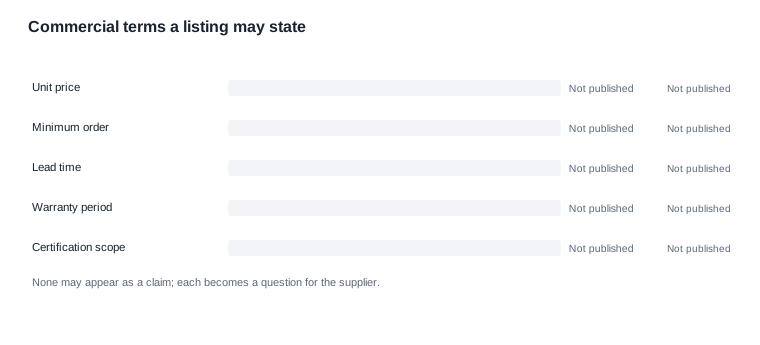
A listing that says "factory-direct pricing" is not a price claim and is acceptable; a listing that says "best price in the category" is an unverifiable comparative claim that will be challenged and should be removed. A listing that says "fast lead time" without a number invites a dispute the seller cannot win. A listing that implies a certification it cannot evidence is the most serious category of all, and on this platform the distinction is unusually clear: the catalogue text names none of CE, FCC or RoHS, and no per-model certification row appears anywhere in it.
Handling the certification question honestly
Because our catalogue carries one export certification sheet at company level, and what sits on it is pictures rather than typed text — ten patent certificates, of which eight are appearance-design filings and two utility-model filings — a buyer cannot derive a per-model conformity claim from the range documentation in either direction. The accurate listing position is neither "certified" nor "not certified". It is: the certification scope for a specific model is material that has to be requested in writing from the supplier before an order is placed.
That is a defensible, specific and commercially useful statement, and it is what a serious channel partner needs to hear. The failure pattern to avoid is writing a certification mark on a listing because every competitor listing has one.
Making the compliance-safe claim about the children's category
Where a model belongs to the children's category, the discipline is stricter still. The A05 and the A06 pages list a fogging unit, correct and incorrect posture-and-distance prompts, and lens clarity and lens fogging lines; those lines describe what the catalogue publishes, and they must be stated as descriptions of the page rather than as a benefit claim about eyesight, posture or clinical effect. A listing that turns those rows into a vision-protection claim is making a claim that no document supports, and it is the kind of claim that attracts regulatory attention.

A criteria set for choosing what to state and what to hold back
Where information is unpublished, the listing decision is not a writing problem but a selection problem: which of the available framings will survive scrutiny, and which will not. A workable criteria set makes that selection repeatable, which matters because the same choice recurs for every model a brand owner adds.
Four criteria decide it, applied in order.
Traceability. Can the claim be traced to a published row or to a written document from the supplier? If it cannot, it does not go on the page regardless of how obviously true it seems. "Obviously true" is exactly how the five common inferences arrive, and each of them fails on this criterion.
Specificity. If the claim is traceable, is it stated at the same level of specificity as the source? A source that publishes a resolution class supports naming that class and nothing finer. A source that publishes a weight for one component supports that component's weight and not the assembled product. Claims lose their defensibility when they are more specific than their source.
Transferability. Does the source support the claim for this model, or for a model in the same family? Family transfer is the most common silent error in this category, because sibling models genuinely do share rows. Where the catalogue shows a row shared by more than one model, that sharing supports a statement about the set — not a statement about a member.
Stability. Will this claim still be true in six months, after the supplier updates a colourway, adds a variant or changes a configuration? A claim tied to a configuration that may change is a claim you will have to withdraw, and withdrawing a published claim costs more than omitting it.
Red flags that a listing has already drifted
When auditing an existing page, these patterns indicate claims that were written rather than sourced. They are worth scanning for directly, because they are fast to detect and each one has a known correct replacement.
A specification presented without a unit suggests it was written from memory rather than copied from a row. A value that appears on a category page but not on the model page suggests the category page was written first and never checked. A superlative or comparative without a stated basis is unverifiable by construction. A certification mark or standard reference with no document reference behind it cannot be traced at all. A feature described in outcome terms rather than as a published descriptor usually represents an inference from a descriptor — for example turning a fogging-unit row into a vision-protection benefit, which is both an inference and a claim the row does not support.
The questions to ask the supplier to close a gap
Listing accuracy is downstream of supplier documentation, so the fastest way to improve a page is to improve the file it is written from. These are the questions to ask, and each one closes a specific class of gap:
- For the named model, which certification documents exist, which body issued them and what are their expiry dates.
- Which of those documents name the model designation explicitly rather than a family or platform.
- What is the physical weight of the assembled unit, and of the case separately, if it ships with one.
- Which colourways are available, and is that list stable or still growing.
- What is the charge time measured from, and to what termination state.
- What is the Bluetooth version, for models whose page does not publish one.
- What is the input rating and the supported charging protocol.
- Which accessories are included in the box, per configuration.
- What is the warranty period, expressed as a term, and what it excludes.
- What is the minimum order quantity and lead time for this configuration, in writing.
None of these ten is published on this platform, and all ten are ordinary questions that a supplier can answer in a single message. The point of asking them in writing rather than by conversation is that the answer becomes part of the file the listing is written from — which is the only thing that makes a claim defensible when it is eventually challenged.
What a buyer should check before committing to a seller's page
The same discipline applies in reverse, and a channel buyer or a sourcing manager will need it. Before committing to a supplier's catalogue, evaluate each claim on the page for traceability: does a specification appear with a unit, does it state a condition, and is there a document behind it. If a page has no unit on its specifications, that is a signal about the rest of the page. If a category page asserts uniformity across models whose published rows differ, treat the uniformity claim as absent.
This is a shortlist criterion rather than a disqualifying one. Plenty of suppliers will have a good product and a loose page. The question a buyer is answering is not whether the seller is competent in every respect, but whether the evidence behind the claims can be produced on request. A seller who answers the ten questions above is materially lower risk than a seller whose listing is more confident than its documentation.

Structuring a range page that does not need a rebuild
Most category pages are rebuilt repeatedly because they are organised around claims rather than around rows. A page organised around published rows can absorb new information, new models and new supplier documentation without a redesign, because adding a row adds a line rather than a section.
Four structural choices do most of the work.
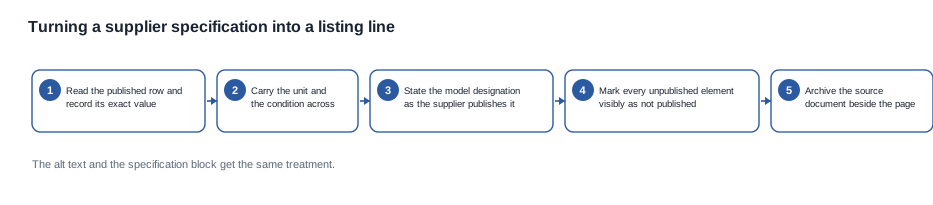
Organise by published row, not by marketing category. If the navigation follows what the catalogue publishes — cell configuration, runtime, charging method, resolution class, feature descriptors — then every page can be sourced, and a source gap becomes visible as an empty column rather than an unwritten paragraph.
Keep one value per line, with its unit and its condition. "Two hours or less" and "about seven hours" and "100 mAh" and "Bluetooth 5.4" are four separate claims. Combining them into a marketing phrase loses the conditions and makes the claim harder to verify.
Mark every unpublished cell visibly. An empty cell on a comparison table is ambiguous: it can mean zero, unknown, or not applicable. Writing "not published" costs a few characters and removes the ambiguity permanently.
State the model designation exactly as the supplier publishes it. This is not a copy point; it is a link-integrity point. Where a model page carries more than one name, the listing needs to carry the same one, or a customer who searches the second name finds nothing.
The review that catches an overstated claim before a customer does
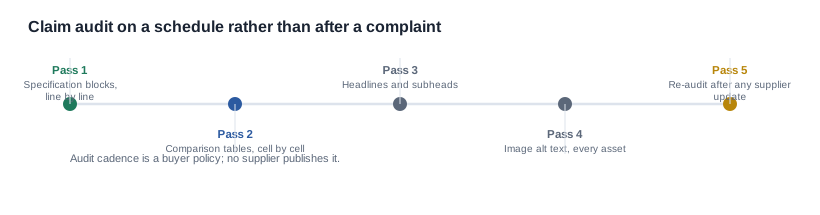
A claim audit is a finite task with a repeatable procedure, and it is worth doing on a schedule rather than after a complaint. The procedure takes one specification at a time and asks four questions.
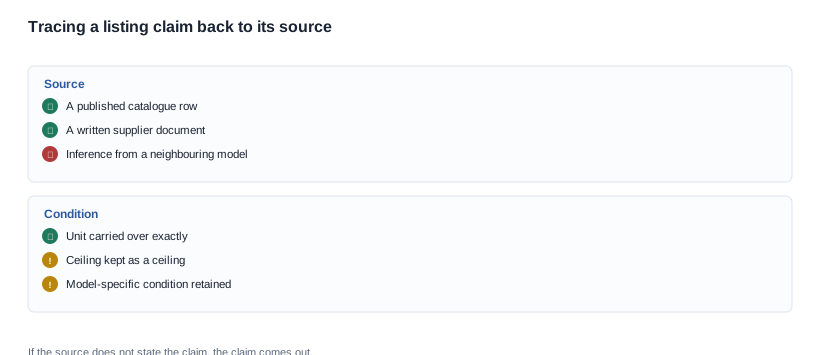
Question one: which document states this? The acceptable answers are a published catalogue row or a written document the supplier has provided against the named model. Anything else is inference, and inference is the thing to remove.
Question two: does the source state the same thing? Not the same topic — the same claim. A source that publishes "two hours or less" does not support a listing that says "under two hours", and a source that publishes "158 grams for the glasses body" does not support a weight for the case.
Question three: is the condition carried over? If the source attaches a condition, the listing must carry it. Runtime figures that belong to a particular model do not transfer to its sibling; case capacities that belong to one variant do not transfer to another.
Question four: could a competitor disprove it from the same public source? If yes, the claim is a liability rather than an advantage, and it will be disproved at the worst moment — in a review, in a dispute or in a marketplace complaint.
Run the audit across the specification blocks, then the comparison tables, then the headline and subhead lines, then the images and their alt text. The alt text matters more often than people expect: it is indexed, it is read aloud by assistive technology, and it is frequently the only place a claim survives after a copy edit elsewhere.
What optimization actually means here
Listing optimization on a range with this much unpublished information is not about adding more words. It is about removing the claims that cannot be defended, replacing them with the structure that can be, and using the resulting accuracy as the differentiator against sellers who wrote the inference into their copy. A page whose every line traces to a published row or to a supplier document is rarer than it should be, and it is the kind of page that survives a compliance review, a marketplace audit and a customer dispute.
We will not state a certification status for a model our documentation does not support, and we will not publish a certificate number we have not seen. Where the documentation is incomplete, we say so, and we will tell you what to ask for so that the gap can be closed in writing before you commit.
Send us the models and the markets you intend to list in, and we will mark which of your existing claim lines are already traceable and which are inferences that will not survive a question.
Related reading
- The documents that make a claim defensible — the export documentation set to ship
- The terms a listing may not state — minimum order quantity for private label
- Why a claim is a liability at the point of return — market positioning without specs
- What is published per model — inventory planning that survives


