

Smart glasses for education are charged by somebody else, on a timetable, in a room with a fixed number of sockets. That single fact produces a planning problem that has nothing to do with the cell inside the unit and everything to do with the rotation: how many devices a class set contains, how many periods they move between, how many charging points the site can hold, and who is standing at the bench when the bell rings. The catalogue publishes the cell capacity and the charge time for every model in the range and publishes none of those four numbers, because they are site facts rather than product facts.
This page is written for the buyer specifying a class set, for the procurement manager comparing a school-wide deployment with a department pilot, and for the person who will write the routine that a teacher actually follows.
Smart glasses for education: the rotation between periods, not the school day
Why the school day is the wrong unit of planning
The instinct is to compare the published runtime against the length of the school day. That comparison is wrong for a classroom deployment, and it is wrong in a way that produces an over-specified and over-priced answer.
The unit is not in use for most of the day. In a typical timetable a device is in a student's or a teacher's hands for one or two periods out of five or six. The published runtime figures assume a duty cycle that no catalogue model publishes, so a runtime number compared against a school day measures a case that never arises.
The real unit of consumption is the period. A forty-five-minute period with a ten-minute changeover is the operational block, and the number that matters is whether the device can serve a full day of rotations while sitting on a dock, not whether it can serve a day of continuous use.
The binding constraint is at the site. A classroom has a fixed number of sockets, a store cupboard that is locked at night, and a timetable that does not flex for a charging plan. The number of devices and the number of charging points in the room are the two numbers that decide whether a class set works at all.
Somebody else does the charging. In a school, the person who seats the connector is a teacher between two bells, or a technician who comes in the morning, or a student under a routine the school has written. Each of those three produces a different interface requirement, and the difference is not cosmetic.
What the buyer is actually deciding in a school
The decision on the table for an education buyer is not "does this model work in a classroom". It is a set of four linked questions, and they are worth separating because they have different owners.
- How many devices does a class set contain, and how many charging points does the site hold? This is a site survey. It is also the number that decides the configuration, because it decides whether the deployment needs a dedicated cabinet, a second pool of devices, or a model with a longer interval between charges.
- Who seats the connector, and how often? A teacher, a technician or a student. The answer determines the interface, and it determines how much the routine can assume.
- What does the school publish about what the device does? The catalogue publishes rows; the school's parent-facing material has to describe something, and the boundary between the two is where a school buyer needs a position.
- What is the asset plan? A class set is a capital purchase with a replacement cycle, and the charging hardware is part of that asset rather than part of the consumables.

The three children's models and what their published rows settle
The catalogue contains three entries for children's products, and they are the models an education deployment is most likely to start with.
| Model | Cell | Charge time | Published use time | Charging interface | Bluetooth version |
|---|---|---|---|---|---|
| A05 | 40 mAh | Two hours or less | About 20 h | Magnetic | Not published |
| A06 | 40 mAh | Two hours or less | About 20 h | Magnetic | Not published |
| A07 | 70 mAh | Two hours or less | About 20 h | Magnetic | V5.4 |
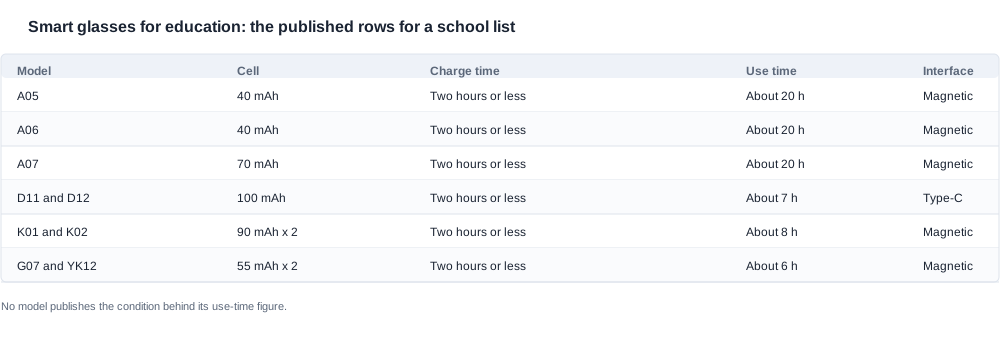
Two things are worth pulling out of that table, because they pull in opposite directions.
The published use time is long, and that is the good news. About twenty hours on the three children's entries is comfortably more than a full school day of rotations for a device that is used in bursts. The practical consequence is that an education deployment on these models does not need a device that survives continuous use; it needs a device that survives being charged once and then sat on a dock through the rest of the day, which is a much easier proposition.
The published use time is not comparable with the audio and camera figures. The catalogue publishes the figure but not the condition behind it, so it cannot be set against the about seven to eight hours the audio models publish or the about seven hours on the camera models and treated as a like-for-like comparison. The right reading for an education buyer is that the three children's entries publish a materially longer use time, and that the condition behind it has to come from a measurement rather than from the page.
The rest of the range is available for education deployments that are not aimed at younger users. The audio models are the usual choice for language and communication work: the D11 and the D12 publish a Type-C port and about seven hours, the K01 and the K02 publish 90 milliamp-hours across two cells with a magnetic contact and about eight hours, the LC-105 pair publish 55 milliamp-hours across two cells with a magnetic contact and about eight hours, and the G07 and the YK12 publish the same cell configuration with about six hours. The camera models are the usual choice for technical and practical work, and the catalogue publishes a rated runtime for all eleven of them.
One published fact applies to every model on a school list. The catalogue carries a company-level export-certification page, has no per-model certification row for any of the twenty-eight models, and contains no CE, FCC or RoHS wording anywhere. For an education buyer that is not a formality, and it is treated in its own section below.
Site planning: outlets, docks and the number that actually binds
The arithmetic that settles the configuration
Before any model is discussed, the site has to be counted, and the count is short.
- Devices in the class set. Multiply by the number of devices a student or a group shares, and by the number of class sets the school wants running at once.
- Charging points available in the rooms where the sets live. Count sockets that are actually usable — a socket behind a fixed desk is not a charging point — and count them separately for rooms that are locked when the devices are not in use.
- The turnover ratio. Devices divided by charging points gives the number of times a device must be recharged across a school day, and that number is the one that determines whether the configuration works.
- Storage. Where the devices spend the periods they are not in use, and whether that place has power. A store cupboard with no power means the devices live in the classroom on a dock, which has consequences for security and for wear.
The outcome is one of three designs, and the site survey tells you which one before a model is discussed:
- Charging point ratio at or above one to one. Every device returns to a dock after each rotation. The charging hardware is a capital item at classroom scale, and the interface choice can follow whatever the routine already uses.
- A ratio between roughly one to two and one to one. Devices are shared across a period boundary, and the number of devices per student has to be raised, or the deployment has to be split across two rooms with their own hardware.
- A ratio worse than one to two. The device count is not supportable at the period length the school wants. At that point the answer is a second pool of devices or a longer interval between uses, and not a faster charger.
That last point is worth making plainly, because it is where a buyer can spend money in the wrong place. A shorter charge time does not help when the constraint is the number of sockets, and the catalogue's fastest published figures — about one hour on the D17 and the ZH12, against two hours or less on the rest of the range — matter only in the first two designs.
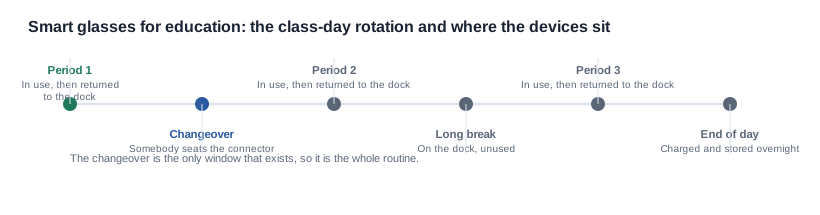
The rotation, shown as a timetable rather than as a total
The timetable above is the reason the plan is built per period rather than per day. The device is on a dock for most of the timetable, it is in use for one or two slots, and the only moment that matters operationally is the changeover, when somebody has to seat the connector in the time available. That last clause is where an interface decision is really made.
The procurement shape of a school deployment
Education buying has a calendar that product buying does not, and the charging hardware sits on a different part of it from the devices. A school or a district places this kind of purchase against a budget year and, often, against a tender timetable, and the date the money is committed is set months before the term the devices are needed in.
That has two consequences a buyer should price in early. First, the minimum order quantity for docks, cabinets and fixtures is usually larger than the minimum order quantity for the devices, so the larger of the two numbers effectively sets the deployment size and the cash requirement — and the two are rarely quoted together. Second, the lead time on the charging hardware can exceed the lead time on the devices, which means a deployment can be held up by a box of fixtures rather than by a box of glasses.
The shortlist criterion that follows is a total-cost criterion rather than a unit-price one: the cost of a class set per student per year, including the charging hardware, the storage solution and the replacement cycle. A device price quoted on its own does not answer that question, and comparing two suppliers on device price alone compares the least informative part of the quotation. The questions to ask before you order are short — what the minimum order quantity is for the hardware, what its lead time is, what the warranty covers across the replacement cycle, and whether the shipping hardware can be ordered separately from the devices — and the answers decide whether the deployment is sized by the budget or by the hardware.

Who plugs it in: the classroom routine and the interface decision
Three routines, three different interface requirements
A technician charges the pool in the morning. The connector is handled by one person with a routine and a bench, and the interface that suits this is the one that is fastest to seat repeatedly and hardest to seat wrongly. A magnetic contact that has to be positioned exactly is a poor choice here, because a misaligned contact often appears seated and a technician will not notice until the device is flat.
A teacher charges the class set between bells. This is the harshest routine in education: it happens in a few minutes, in front of students, with an audience, and it happens every day. The interface that suits this is the one that cannot be seated wrongly — a Type-C port, which either goes in or does not, rather than a magnetic contact that can look connected while charging nothing. The D17 and the D12, the L2 Utral and the D11, and the ZH12 and the V03 Pro publish a Type-C port; the seventeen magnetic models, including all three children's entries, do not.
A student charges their own device. The routine assumes a level of care and a level of judgement that a school has to assume rather than expect, and the published rows do not help here: the charging interface for the three children's entries is published, and the charging input, the state of charge at which the charging clock starts and the criterion at which charging is judged complete are not published for any model in the range. A student-facing routine therefore cannot say "charge until the light turns green", because no light behaviour is published.
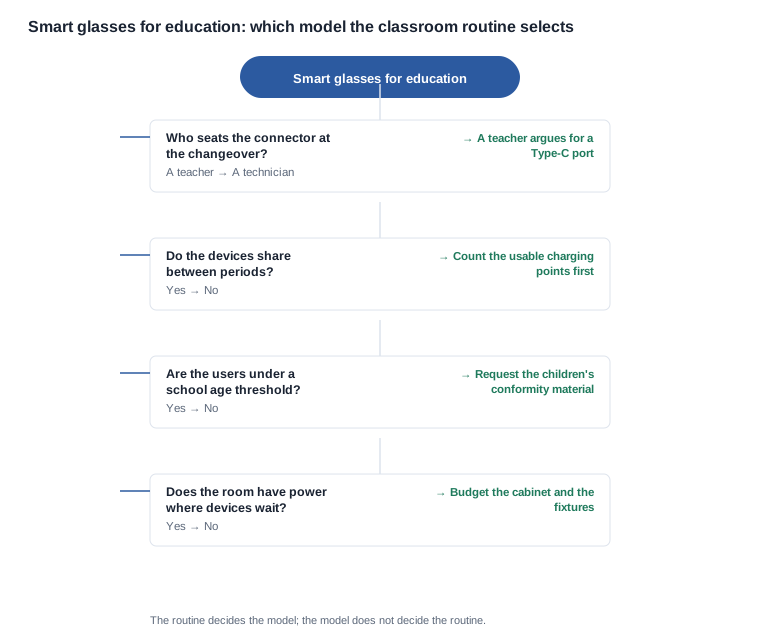
The recommendation that follows is specific rather than general: for a student-facing routine, choose a model with a Type-C port and write the charge duration into the routine as a fixed number of minutes; for a technician-facing routine, choose whatever the technician's bench already supports, and give them a docking fixture per model so that seating is not a judgement call.
What the routine must contain, whatever the interface
- A fixed charge duration measured from a known start, because neither a start state nor an end criterion is published for any model.
- A named moment and a named person for each charge, because the changeover is the only window that exists.
- A seating check that a non-specialist can perform, which for a magnetic contact means a visual confirmation and for a Type-C port means simply that it is in.
- A storage and security rule for the hours the devices are not in use, since a school set left in an unlocked classroom is an asset-control problem before it is a charging problem.
- A return-to-charge rule for the end of the day, so that the morning pool starts the day charged rather than starting it flat.

The compliance boundary an education buyer has to hold
This is the part of an education deployment where the catalogue is silent, and silence has to be handled as a position rather than as an absence.
No model in the catalogue carries a per-model certification row. The catalogue has one company-level export-certification page, the words CE, FCC and RoHS do not appear anywhere in it, and the three children's entries are in the same position as every other model. For a buyer placing a class set, the conformity position for each model and each destination market is a document to request in writing, and it is the compliance lead's document to obtain — not something a catalogue page can settle.
Children's products sit under additional regimes. A school buyer will be asked about the children's models specifically, and the answer the catalogue supports is that the conformity material for them is the same material every other model requires plus the material that the destination market demands for children's products. We do not publish a position on that, and we will not guess at one on a page.
No therapeutic, protective or clinical claim attaches to any of these models. The catalogue publishes electrical rows and structural features, and nothing in it supports a claim about eyesight, vision correction, hearing protection, concentration or clinical benefit. An education channel that writes one of those claims is writing a claim the catalogue cannot substantiate, and in a school setting the consequences of that are not a returns figure.
The ingress marking is narrow and it belongs to two models. IP54 appears on the V06 and the S7 and on no other model, with no published test report behind it, and it says nothing about a charging contact that has been handled by a student. A school buyer should describe the marking as a catalogue attribute and not extend it into a protection claim.
The certification checklist article is the field version of the request, and the samples route is where the units come from that a school set is specified against.
Before a class set is ordered: what to put in writing
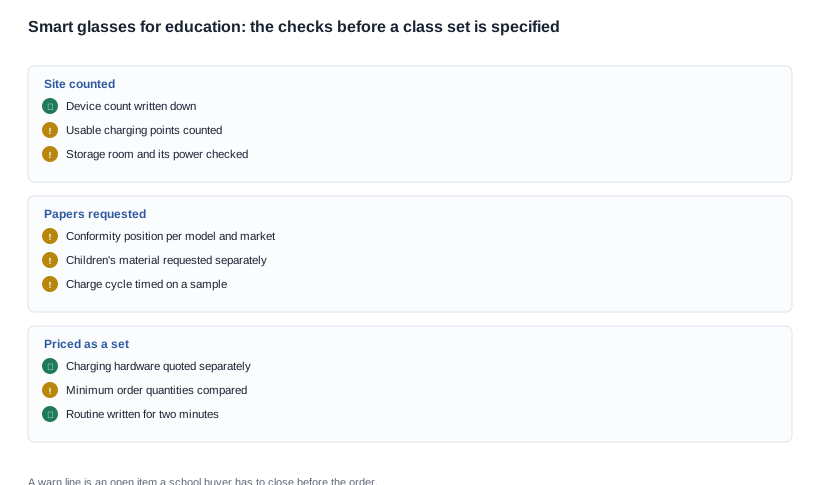
- Run the site survey first and write down the device count, the usable charging point count, the storage location and the charging routine owner. Every configuration decision downstream depends on those four numbers and on nothing else.
- Choose the interface from the routine, not from the shelf. Teacher-facing and student-facing routines both point at a Type-C port; a technician-facing routine can use a magnetic platform with a fixture per model.
- Request the conformity position in writing for each model and each destination market, and treat the three children's entries as a separate request rather than a subset of the others.
- Measure a charge cycle on a sample from a stated start, and write the duration into the classroom routine as a fixed number of minutes.
- Price the charging hardware as part of the class set — docks or cabinets, fixtures per model, the storage solution and the power — because a device price quoted without them is not a class-set price. Ask for the unit price at each volume tier, and ask what the minimum order quantity is for the charging hardware separately from the minimum order quantity for the devices, because the two rarely match and the larger of the two sets the deployment size.
- Confirm the warranty period and the returns path for a school set, including what happens to a device returned mid-year and how a device swap is handled inside a term.
- Write the routine into a card the teacher can follow in two minutes, with the charge duration, the moment, and the seating check in it, and nothing else.
Here, an education deployment is a site plan with devices in it, and the charging hardware, the routine and the conformity documents are part of the specification rather than consequences of it. We publish the cell capacities, the charging interfaces where they are published, the charge times, the rated runtimes and the structural features, and we will not publish a charging input, a start state, an end criterion, an indicator behaviour or a conformity position for a model where we have not been given one. What we will do is take the device count, the charging point count, the routine owner, the age range and the destination markets, and tell you which published rows apply to that configuration, which four numbers are site facts you have to count, and which documents have to be obtained before a class set is ordered.


