

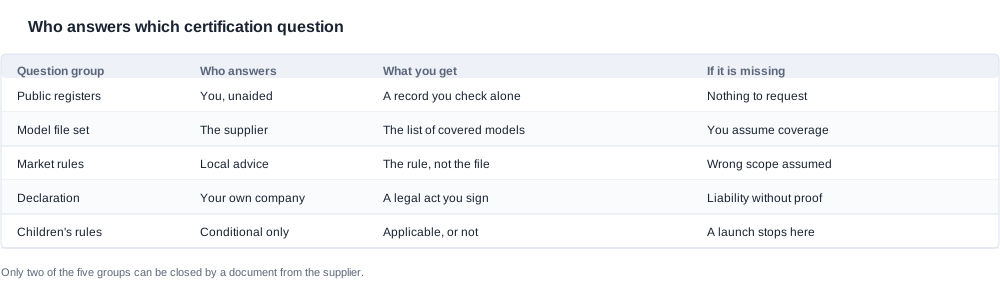
A smart glasses certification checklist is not a list of certificates, and treating it as one is the reason buyers end up with a folder of documents that does not support the order they signed. The list that actually decides a programme is a list of questions, sorted by who is able to answer them: the public register answers some without anyone's help, the supplier answers a smaller number than buyers expect, the destination market answers a set the supplier cannot, the brand answers the only question that carries legal weight, and one conditional group can stop a launch outright. Sort the questions that way and the work shrinks to something a procurement manager can finish in an afternoon.
Smart glasses certification checklist: five question groups, and who can answer each
Public information versus internal decisions
Most of what a buyer needs in this category is either public information they can check without permission, or an internal decision they have to make themselves. The supplier's contribution sits in the middle, and it is narrower than most enquiries assume: a list of which models sit inside the supplier's file, and the model-level documents behind that list. If the buyer arrives with a request for "the certification", they will receive a company-level statement about the range. If they arrive with a request for the file set, named by model, they will receive something they can act on.
Who is reading this and what they are actually protecting
The reader is a brand-side procurement manager, a channel buyer, an importer or an e-commerce buyer who already holds quotations and has to choose between them, or who is opening a new programme and has to decide what goes into the specification before anyone is allowed to quote it. The question underneath the enquiry is never the general one. It is whether the configuration in front of them can be built, documented, shipped and defended after it has left the factory, and whether the supplier can show the evidence for that rather than assert it.
What is being managed is not a price gap. It is a schedule that a missing document can stop, a launch window that a border can close, and a channel that a defective file can cost twice — once in the units that come back, and once in the trust that does not. That is why the checklist below is organised by answerer rather than by document type. A document list tells you what to ask for; an answerer list tells you who has to move for the programme to move at all.
Why the supplier's share is smaller than buyers expect
Three of the five groups are largely outside the factory's control. Public registers are checked by the buyer against the identifier printed on the device or in the file. The rules that apply in a destination market are public texts, and what varies is how they are applied locally. The declaration of conformity is a legal act by the party placing the product on the market, which in most cases is the brand, not the factory. A supplier that produces a file and a brand that signs a declaration are two different acts, and conflating them creates a liability that nobody priced.
The factory's real contribution is narrower but heavier than the buyer sometimes assumes. It is the technical file behind the covered models, the material declarations for the build, the battery transport documentation where the shipping mode requires it, and the knowledge of which configuration was actually assessed. That last one is where the work usually is, and it is the item most often returned as a family-level answer because it requires someone to go and look.
The one group that can stop a launch outright
Products intended for children carry their own category rules, and those rules are conditional on the product and on the intended use rather than on the factory's file. In our catalogue the certification position for the child range is recorded as not provided, and the applicable rules have to be confirmed as applying or not, with local advice where the market has its own application. This is the only group in the whole list that can stop a launch rather than delay it, and it is also the one most often assumed to be in hand because nobody asks.
The check is not expensive. The question is whether the product is intended for children, whether the rules apply to that product in that market, and if they do, whether anyone has confirmed the position in writing. Ask it at the specification stage, when changing the packaging is still cheap, rather than at the point where the artwork is printed and the launch date is fixed.

What our published catalogue settles, and what it deliberately leaves open
The catalogue's own certification position
Our catalogue carries one certification page at company level, and what that page holds is images rather than text; the catalogue wording offers no CE, FCC or RoHS to read, and nothing is certified row by row in the catalogue. The applicable scope for a model and a market is written material to be requested and filed before the order — not a mark a buyer can read off a catalogue page. We publish no certificate number we cannot quote, no issuing body we cannot name, and no validity date we cannot show.
That position is narrower than a marketing page, and deliberately so. A certificate number copied from a general data sheet is a liability for the buyer who relies on it and for the factory whose name is on it. A list of covered models is useful, checkable and can be reconciled against a purchase order in minutes. Where the model-level identifiers are still open in our own records, saying so is more valuable than a plausible-looking number, because it tells the buyer exactly which request to make next.
The model-level rows a buyer can pin a claim to
The catalogue does publish the configuration rows that decide whether two models are comparable: camera resolution tiers across the eleven camera models, cell capacities, rated runtimes with their caveats, charging interfaces, charging case configurations, Bluetooth versions for the audio range, and the ingress marking on the two models that carry it. The IP54 marking appears on the V06 and the S7, and on those two only — no third-party report number sits behind it, so it travels into a retailer specification as a catalogue marking rather than as a test result.
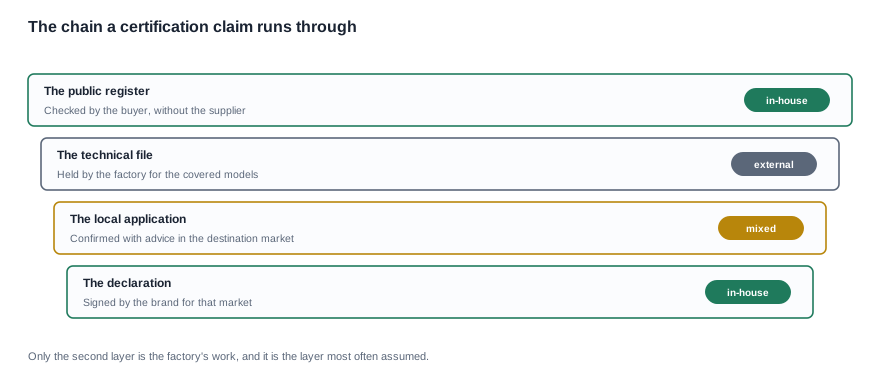
This matters for the checklist because it tells you what to compare. When two quotations differ, the question is rarely "which certification is better" — it is "are these two quotes describing the same model at all". The resolution tier, the cell capacity, the charging interface and the case configuration are the rows that decide whether two model designations refer to the same physical product. A certificate against a different configuration is not a certificate against yours.
The four configuration changes that reopen the file
A radio module substitution, a change to the antenna path, a different cell or a revised housing will each reopen work that has already been paid for, and none of them feels like a certification change at the moment it is made. This is why a status form needs a change column and not just an expiry date: the file can be entirely current and still not cover the unit on the pallet.
The practical control is a controlled item on the purchase order. Any substitution that touches the radio, the antenna, the cell or the housing gets a written approval before it happens, and the approval states whether the file is affected. Where a supplier cannot say whether a change affects the file, that is a finding in itself — it usually means nobody in the factory knows which configuration was assessed.
The three gating questions that decide a smart glasses certification order
Question one: is the model on the purchase order inside the file
Not the family, not the sibling, not the model with a similar name in the same row of the catalogue. This is the question that stops an order, and it is answered by a list: the model designations the file set actually names, with the configuration each one covers. A file set covering three models and an order for five is a partial answer, and it is much better known before the order than after the first carton is sealed.
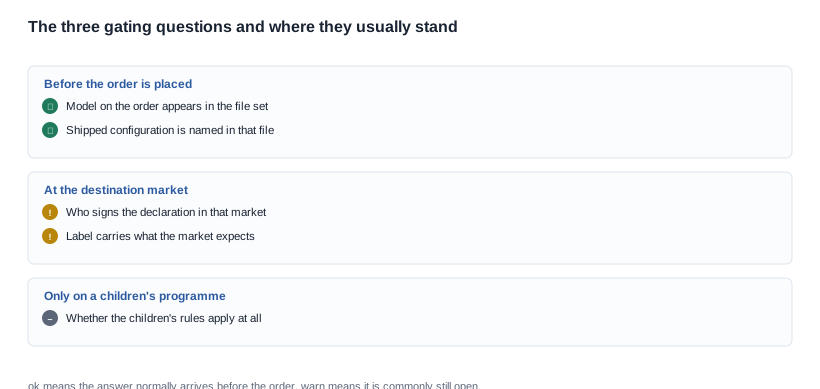
The list is cheap to request and cheap to compare between suppliers. Ask each factory to return the same list format — model designation, configuration, market, document reference — and the comparison becomes a one-page exercise rather than an exchange of paragraphs. A supplier who answers in prose about the range has given you a different thing from the one you asked for, and it is reasonable to ask again in a form that leaves no room for a family-level answer.
Question two: does the file cover the configuration that will ship
This is where most of the real risk sits. A model can be inside the file and the shipped configuration still fall outside it, because the file was written for one build and the order is for another: a different colour, a lens option, a charging case in the box rather than sold separately, a firmware build under the buyer's own application, packaging artwork with a private label.
Each of these is a small decision that is made for commercial reasons and does not feel like it touches the file. The question to put to the supplier is not "is this model certified" but "which of these configuration differences change what the file covers, and which do not". A supplier who can answer that has a maintained configuration record. A supplier who cannot has a file and a separate, informal understanding of what was built.
Question three: who signs the declaration in the destination market
This is a question with a short answer and a long consequence, and it is the one that decides whether certification is a cost or a liability transfer. The declaration of conformity is a legal act by the party placing the product on the market. A brand that has delegated the technical file without taking the declaration has delegated the liability along with it.
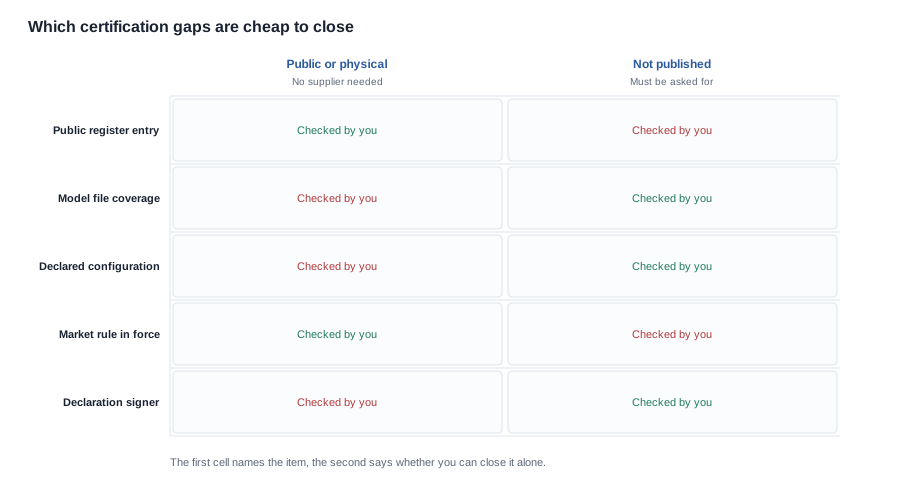
This is also where market-specific obligations sit that have no obvious document to request. A brand distributing consumer products under its own name into the European Union takes on obligations that attach to the online listing itself, including the presence of a responsible economic operator and manufacturer information. Nothing arrives by post from a factory, and the item most often missed is the one with no obvious document behind it.

How a certification claim is verified, in the order that finds problems fastest
The verification sequence
Verification in this category is a document exercise with a physical check at the end, and it works best in a fixed order. The order below is arranged so that the cheapest checks run first, because the checks that find a mismatch early are the ones that cost nothing to run.

- Ask which model designations the supplier's file set names, and for each one, which configuration and which market it covers. A list is enough to start.
- Pull the public register entry for each identifier the supplier has given you. Check the grantee, the model and the frequency band against the unit you intend to buy. This takes minutes and it needs no cooperation.
- Compare the configuration rows on the catalogue page against the configuration in the purchase order: resolution tier, cell capacity, charging interface, case, Bluetooth version where it is published.
- Ask for the model-level document behind anything you could not check alone, as a document, naming the model designation in the request.
- Establish who signs the declaration in the destination market and what obligations attach to the listing rather than to the product.
- Write the open items and their owners into the order file, so the gaps travel with the programme instead of sitting in an inbox.
Run the sequence before the deposit rather than after the first shipment. A file that cannot be produced within hours of a request is itself the finding, and the cost of finding it late is measured in weeks.
What to ask for as a document rather than as a statement
The distinction is between a document that names a model and a statement about a range. Statements are cheap to make and impossible to check. Documents are expensive to produce and can be reconciled against a purchase order line. A request that says "please confirm the product is certified for the European Union" will be answered with a sentence; a request that says "please provide the model-level declaration and test references for model X in configuration Y for the European Union" will be answered with paperwork or with a refusal, and both are useful answers.
The refusal case deserves attention. A supplier who says that model-level documentation is not releasable is telling you something real about the file, and it may still be a workable supplier — the file may exist and be held under a confidentiality or contractual restriction. What it is not is a supplier whose claims you can rely on for a new market without seeing the paper. The certification step by step sequence sets out this request list in the order that produces the fastest answers.
The questions that only make sense with a market attached
Certification questions without a destination attached are not really questions, because most of them have two different answers. The radio framework that applies in the European Union is the Radio Equipment Directive (EU) 2014/53/EU, and its number is worth getting right, because the EMC Directive (EU) 2014/32/EU is a different instrument with a different scope and the two are routinely confused. The cybersecurity requirements published as EN 18031 became part of the CE marking obligation from the first of August 2025, and the General Product Safety Regulation has applied since the thirteenth of December 2024.
In the United States the radio element is verifiable against a public register without the supplier's involvement at all, which makes it the cheapest confidence a buyer can obtain in this category. In other markets the answer may be that the requirement has to be confirmed locally before the order, and that confirmation is worth more than any document the supplier can send you. The documents to request are covered in what documents to request, and the deeper scope questions sit in the certification advanced guide.

Where certification programmes go wrong between the quotation and the first shipment
The file that covers a sibling model
The most common finding in this category is not a missing document. It is a document that exists, is genuine, and was written for a build that is not the one on the order — an earlier version of the same product, before the antenna path or the cell changed, or a related model with a similar designation. It is not detectable by reading the document, because the document is correct about what it covers.
The prevention is a comparison against the purchase order rather than against the brochure. Match the model designation printed in the file against the model designation in the order, then match the configuration rows against the configuration. Where a supplier cannot produce the comparison themselves, that is the single most useful thing you can ask for.
The claim that was read one level too high
A supplier's catalogue states certifications at company level across the range, and a buyer reads a set of marks such as CE, FCC or RoHS as a per-model statement. The two are different propositions. The company-level claim tells you the manufacturer holds the capability and the paperwork somewhere. The model-level claim tells you the paperwork covers the unit you are buying. Only the second one is what a retailer or a market authority will ask about.
This failure is quiet, because nothing appears wrong until someone inspects the file against the model. It is also completely preventable, and it is prevented by writing the request in a form that cannot be answered at family level.
The configuration change nobody logged
A battery supplier improves availability and substitutes the cell. A module vendor revises the radio. A designer trims the housing to save material. Each is a reasonable commercial decision, and each can invalidate a document that was current on the day it was issued. The programme then discovers the mismatch at the point where the file is needed, which is the worst possible moment.
The control is a change notification clause naming the four items that reopen the file, attached to the purchase order rather than left to a general undertaking to notify changes. If the supplier will not accept a change-notification obligation, that tells you the substitution is treated as a routine internal decision, which may be entirely reasonable and is still something a buyer with a fixed launch window needs to know before committing.
The children's rule that was never checked
A programme that includes a model aimed at children inherits a category of requirements that do not apply to the rest of the range, and the applicability question is asked late or not at all. It cannot be closed by a factory document, because it is a question about the product, its intended use, the market and the local application of the rules.
The handling is simple and should happen early: confirm the intended use, confirm with local advice whether the category rules apply in the destination market, and if they do, get the position in writing before the artwork is locked. A programme that changes the intended use halfway through should treat that as a configuration change in the full sense, including the certification scope.
The charge document requested after the goods were sealed
A lithium-powered product needs transport documentation, and for air freight the test summary is a model-specific document that has to exist before the consignment is offered, not after it is offered. The failure mode is timing rather than content: the buyer raises the request when the shipment is ready, the supplier produces the summary in a few days, and the forwarder has already booked against a date that now moves.
The prevention is to treat the battery document as part of the specification rather than as part of the logistics. Ask for it with the model-level list in the same request, so the whole evidence set is in hand before the production slot is booked.
What we can evidence, what we will not claim, and the next step
Our position on the certification file
Two things are true about our own documentation, and they are worth separating because they point in opposite directions. What we publish is a company-level export certification page whose content is images rather than text, and the catalogue text names no CE, FCC or RoHS at all. What we leave open is published just as plainly: there is no per-model certification row, no certificate number, no issuing body and no validity date for a buyer to read.
What we can do is take a supplier's document set and mark each item against the five groups above, and tell you which questions remain open and who has to close them. We will complete the model-level request for a configuration and a destination market, including the rows where the position is not held, because a form with honest negatives is worth more than one with optimistic positives. We will not fill an open row with a typical figure from another supplier's general data.
Designation, configuration, market and channel
Send the model designation, the configuration as you intend to order it, the destination market and the channel, and we will tell you which of the questions in this article can be closed from what we already hold, which require a document from us, and which have to be settled with local advice before the order. The certification checklist pillar page sets out the wider framework, and we would rather hand you a short list that holds up than a long one that does not.
Related reading
- The verification sequence — certification step by step
- The documents to request — what documents to request
- The common questions — what buyers most often ask
Send us a document set and we will mark it against the five groups.


