
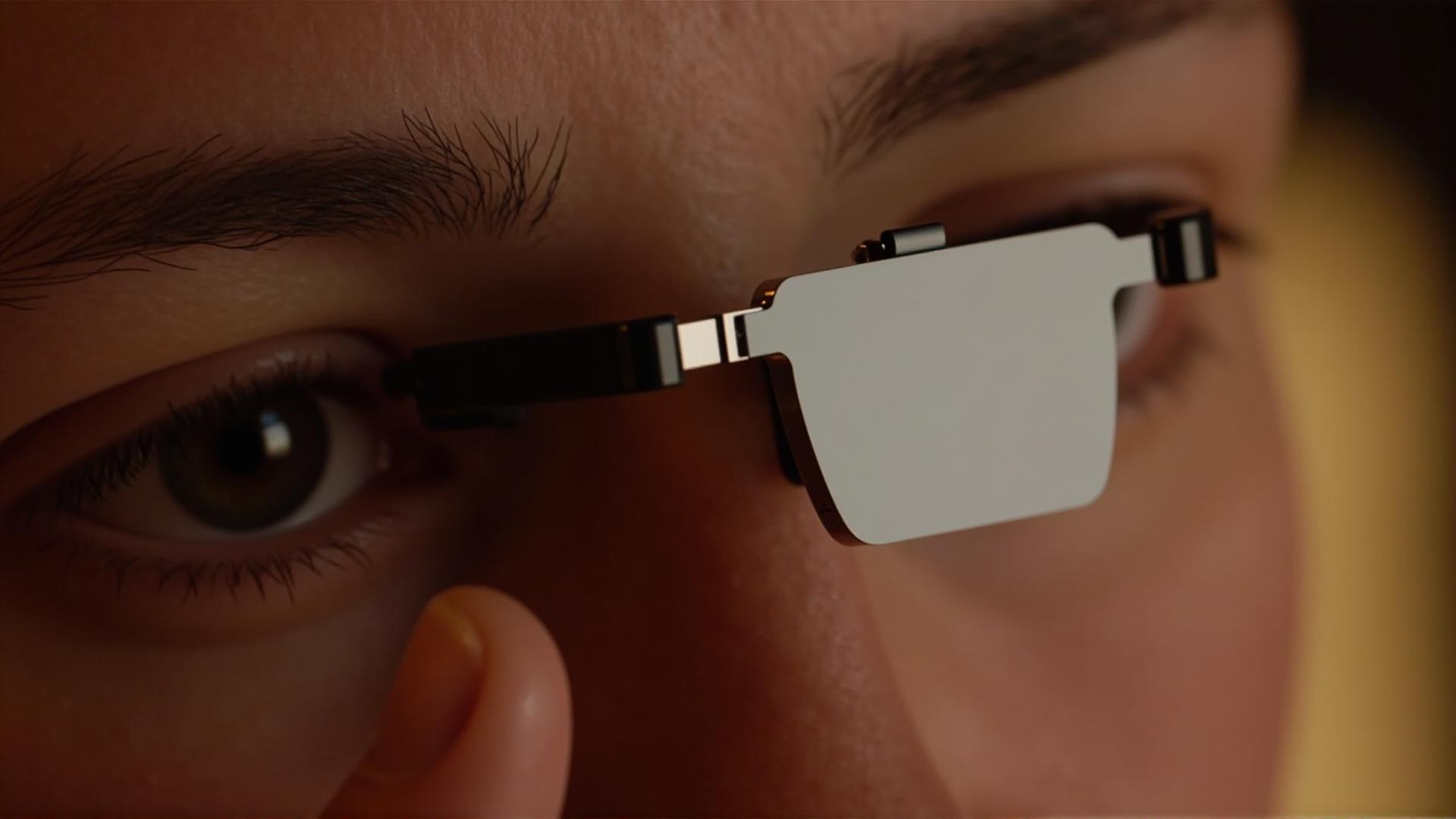
Smart glasses for kids parenting have a charging problem that no other scenario in this catalogue has, and it is not a capacity problem. The published use time on the three children's entries is about twenty hours, which is more than enough to cover a child's day, so the cell is not the constraint and never will be. The constraint is that the charging routine has to survive being carried out by a seven-year-old, badly, at the end of a long day, with no published indicator behaviour to tell anyone that it went wrong.
That single constraint decides the model, the charging spot, the accessory set and what a parent-facing listing is allowed to say. It is also the reason a parent's routine is written for an adult even when the child is the one who uses the device.
This page is written for the brand owner building a parenting channel, for the buyer specifying the accessory set, and for the parent-facing copy writer who needs to know which words are true.
Smart glasses for kids parenting: who actually performs the charge
The question that has to be answered before the model is chosen
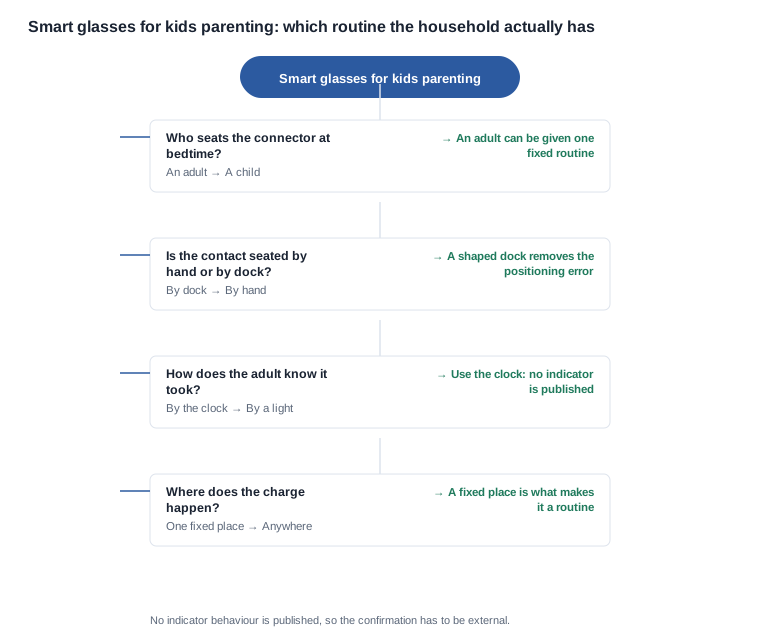
Ask who seats the connector, and the answer determines everything downstream. There are three answers and each produces a different product.
A parent charges the device, every night, in one fixed place. This is the routine that the published rows actually support, because an adult can be told to do the same thing correctly every time, and an adult can be told how to check that it worked.
A child charges the device, unaided. This is the routine that the published rows do not support, and the reason is specific rather than general. All three children's entries publish a magnetic charging contact, and a magnetic contact has to be seated in the right position. The catalogue publishes no indicator behaviour for any model in the range, so there is nothing in the specification that tells a child — or a parent glancing over their shoulder — that a misaligned contact is charging nothing. A misaligned magnetic contact is the failure mode that appears to be a success.
An older child charges the device with an adult checking afterwards. This is the middle case and it is the one most households will actually land on, and it needs two things the catalogue does not publish: a positive confirmation that the charge has taken, and a defined duration so that "checked afterwards" has something to check against.
The difference between those three answers is not a detail of the manual. It is the difference between a product whose charging routine is a nightly five minutes and a product that generates a weekly support conversation.
What the parent is actually buying
The buyer's decision is not only the model. It is the combination of four things, and the catalogue is helpful on some of them and silent on others.
- Which model the child gets. The three children's entries differ in cell capacity and in whether a radio version is published, and they do not differ in the way that matters most for this scenario, which is the interface: all three are magnetic.
- Where the charge happens. A fixed spot with a fixed routine, reachable by an adult and not by the child alone.
- What is in the box. A cable for a magnetic contact is not a universal object; the contact itself, the dock and the cable are separate items with separate replacement cycles.
- What the listing is allowed to claim. Which brings the compliance boundary, and it is a real one for a product aimed at children.
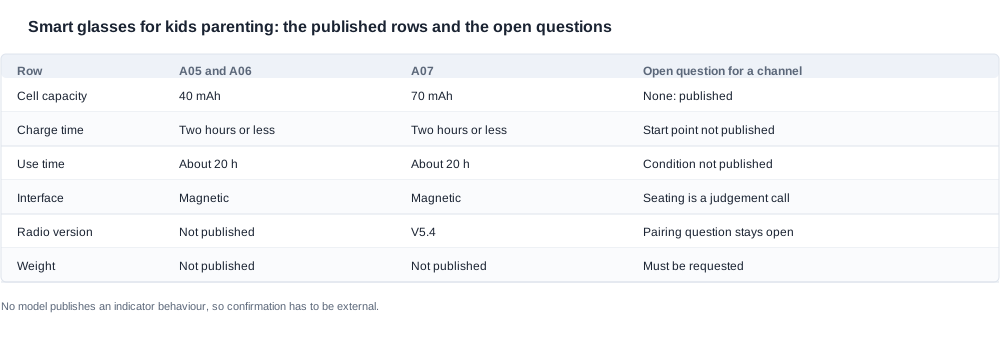
The three children's models and what their rows settle
| Row | A05 | A06 | A07 | What it means for a parenting channel |
|---|---|---|---|---|
| Cell capacity | 40 mAh | 40 mAh | 70 mAh | The daily charge is a ritual, not a capacity problem |
| Charge time | Two hours or less | Two hours or less | Two hours or less | An overnight charge is the intended pattern |
| Published use time | About 20 h | About 20 h | About 20 h | More than a child's day, on an unpublished condition |
| Charging interface | Magnetic | Magnetic | Magnetic | The connector has to be seated in position |
| Radio version | Not published | Not published | V5.4 | Two of the three leave the radio question open |
| Weight | Not published | Not published | Not published | No weight may be printed for these models |
| Per-model conformity row | None | None | None | The material has to be requested in writing |
Four of those rows deserve a comment, because each one is a place where a well-intentioned listing will overreach.
The published use time is long, and the condition behind it is not published. About twenty hours on all three entries is well over a child's day of use in bursts. But the catalogue publishes the figure and not the workload that produced it, so a listing that says "twenty hours of use" is describing a rating rather than a guarantee, and the two are not the same thing on a page that a parent reads carefully.
The charge time is a ceiling. Two hours or less is what the catalogue publishes, with no state of charge at which the clock starts and no criterion at which charging is judged complete. For a routine that says "leave it overnight", the ceiling is harmless. For a routine that says "it will be ready in two hours", it is a promise the catalogue does not support.
The radio version is published for the A07 and for neither of the other two. For a parent's device, the practical question is whether the child needs a phone at all and whether the household's handset can pair with it. A model that publishes no radio version cannot answer that, and a parent channel that lists it next to the A07 has to say so rather than assume parity.
No weight is published for any of the three. The only weight published anywhere in the catalogue is 158 grams, and it belongs to the MT6 — a camera model with a folding charging case, which is not a children's model and must not be quoted as one. A parenting channel therefore has to request the weight for the specific models it sells, because a parent's first question about a device for a child is often about how it stays on.
A magnetic contact, a child, and no indicator light: the seating problem
Why the seating problem is the whole scenario
A magnetic charging contact is a deliberate industrial choice, and it has two properties that matter here. It is convenient, because a device can be dropped onto a dock without aiming. And it is unforgiving, because a contact that is a millimetre out of position can appear seated while conducting nothing.
For an adult at a kitchen table with the device in both hands, that is a non-event. For a child at the end of a day, in a hurry, with the device in one hand, it is the single most likely thing to go wrong in the entire ownership experience. And the catalogue publishes no indicator behaviour for any model in the range, so the routine has no in-product way to say "this did not charge".
That produces the central design conclusion for a parenting product: the routine needs a positive confirmation step, and the confirmation cannot be an indicator light because none is published. It has to be external — a time, a check at a known moment, or a physical check that the contact is seated.
The three ways to build that confirmation
- Charge by the clock. A parent charges the device at a fixed time — bedtime — and knows the charge is complete the next morning because the routine is the routine, not because the device said so. This requires a published charge duration, and the honest way to write it is "two hours or less from a full discharge, then leave it overnight", which matches what the catalogue actually supports.
- Dock the device instead of seating it. A dock with a shaped recess removes the positioning judgement entirely, and it moves the failure from the child's hands to the parent's. This is the accessory that has the largest effect on the routine of any item in the range, and it is the item most often left out of a parenting channel's bill of materials.
- Charge it, then check it. The parent seats the contact, waits a fixed interval, and confirms the contact is properly seated before leaving it. This is the routine for a household where an older child charges their own device.
The accessory set a parenting channel should ship
| Item | What it prevents | Cost treatment | Why it belongs in the box |
|---|---|---|---|
| A dock with a shaped recess | A child seating a contact in the wrong position | Per-unit accessory line | It removes the failure mode the interface creates |
| A spare cable | A cable that fails at the wrong moment | Consumable | Cables are the most common failure in the chain |
| A spare contact or dock insert | A worn contact that charges intermittently | Spare-parts line | It is the part most likely to be replaced |
| A fixed-place card | A charge that happens somewhere different each night | Print cost | A fixed place is what makes the routine a routine |
The dock is the line that deserves the most attention in a quotation, because it is the one item that changes the routine rather than supporting it, and because it is frequently left out of a bill of materials that was assembled from the device's own rows. It also carries a minimum order quantity of its own, which is usually the number that sizes the order.

The charging spot: a routine that is safe, fixed and adult-checked
Where the charge happens is a design decision
A parenting product's charging spot has three requirements, and none of them is about the device.
It has to be a fixed place. The value of the routine comes from the charge happening at the same point every night, in the same order, by the same person. A charging spot that moves around produces a charging routine that is skipped.
It has to be reachable by an adult and safe for a household. A cable across a floor is a trip hazard for a child who is walking around in the dark looking for the device at the wrong time, and a charging dock on a low surface is a small part at a child's height rather than an adult's. An elevated, fixed position that an adult reaches comfortably solves both.
It has to be dry and out of the way. A contact in a bathroom or a kitchen corner collects moisture and grit, and both of those are exactly the conditions in which a magnetic contact seats unreliably and gives no indication that it has not.

The ritual is the product experience for the parent
For a parent, the nightly charge is the most frequent contact they have with the product, and it is the moment they decide whether the device was worth the money. That is why the routine is worth designing rather than describing.
A good routine is one line, it takes under a minute, and it has a visible end state: the device goes into the dock, the parent checks that it is seated, and the parent walks away. A bad routine is one with a second step — "make sure it is charging" — because a step that requires judgement is a step that a tired parent skips.
The published rows support the short routine and not the long one. There is no published indicator behaviour to check, so the confirmation has to be the physical act of seating it in a shaped recess, and that is an accessory decision rather than a copy decision.

The boundary a parenting channel has to hold
A product aimed at children carries a claim boundary that a product aimed at adults does not, and the catalogue is unambiguous about where the boundary sits.
Nothing in the catalogue supports a therapeutic, clinical or protective claim. The catalogue publishes electrical rows and structural features. It contains nothing about eyesight, vision correction, hearing protection, attention, focus, posture correction or any clinical benefit, and none of those can appear in a parent-facing listing, a packaging panel or a product page. The children's eye guidance page explains the boundary in detail, and the rule for a listing is simple: describe what the device does, never what it does for the child.
Children's products sit under additional regimes, and the catalogue has no per-model conformity row. The catalogue carries one company-level export-certification page, the words CE, FCC and RoHS do not appear anywhere in it, and no model in the range — including all three children's entries — carries a per-model certification line. A buyer placing a parenting product into a market therefore has to obtain the conformity material in writing for that model and that market, and the children's material has to be requested as its own item rather than assumed to be covered by the general file.
The ingress marking is narrow and belongs to two models. IP54 appears on the V06 and the S7 and on no other model, with no published test report behind it, and it says nothing about a charging contact that has been handled by a child. It should be described as a catalogue attribute and kept out of general protection language.
No medical or preventive claim may be attached to the published figures either. The cell capacity, the charge time and the published use time are electrical rows. They are not evidence about a child's eyes, and a listing that uses them that way is misusing a figure that the catalogue did publish accurately.
How to judge a parenting routine before you order
A parenting routine is easy to describe and hard to verify, so it is worth judging on the basis of what has been measured rather than what has been proposed. The criteria that matter are these.
The seating failure rate of the supplied dock, on a sample. A dock with a recess that a child can seat reliably is a different product from a contact that has to be aimed at. A supplier who will report the seating rate of a specific dock under a specific routine is answering the question that decides the return rate.
The routine, written as a number of minutes. A routine that takes one minute and ends in a visible state survives a bad week. A routine that requires a judgement — "check that it is charging" — does not, and the catalogue cannot support it, because no indicator behaviour is published for any model in the range.
The weight of the model, in the packaging it actually ships in. A parenting channel has to publish it eventually, and the only weight published anywhere in this catalogue belongs to a different model.
The accessory terms. The dock, the spare contact and the spare cable carry their own minimum order quantities. The questions to ask are whether they can be ordered separately from the devices, what the restock interval is, and whether the bulk order tier on the accessory is higher than the one on the device — because the interval is what the channel actually carries, and the unit price is the smaller half of the cost.
The red flags worth naming: a routine that depends on an indicator, a bill of materials with no dock in it, and a listing that quotes a use time without its condition. All three are common, all three are avoidable, and all three are cheaper to fix before the purchase order than after the first shipment.
What a parenting channel costs, and what to settle before a listing goes live
The dock is the cost that carries the routine. If the routine is to survive a child, the dock has to ship, and it has to be priced at each volume tier rather than treated as a goodwill item. The same question applies to the spare contact and the spare cable, which are consumables over a multi-year ownership period and are ordered on their own terms.
The accessory minimum order quantity sizes the order. A parenting channel that is assembled from the device's own rows will produce a bill of materials with a device minimum order quantity and a dock minimum order quantity, and the larger of the two sets the size of the order and the cash requirement.
The returns profile is different from an adult product. A parent's most common return reason for a product aimed at a child is that the routine proved difficult, and the return arrives without a fault. A dock in the box is the single most effective lever on that ratio, and it is worth measuring on the first shipment rather than assuming.
The terms worth settling before the listing goes live. Unit price and volume tiers; the dock and accessory set with its minimum order quantities; the packaging specification and whether the insert artwork is ours to supply; the warranty period with a stated response time; the returns path and who pays the return freight; the conformity material for the children's products in each destination market; the delivery split against a staged payment; and the terms of a pilot order with a small group of households before a wider listing.
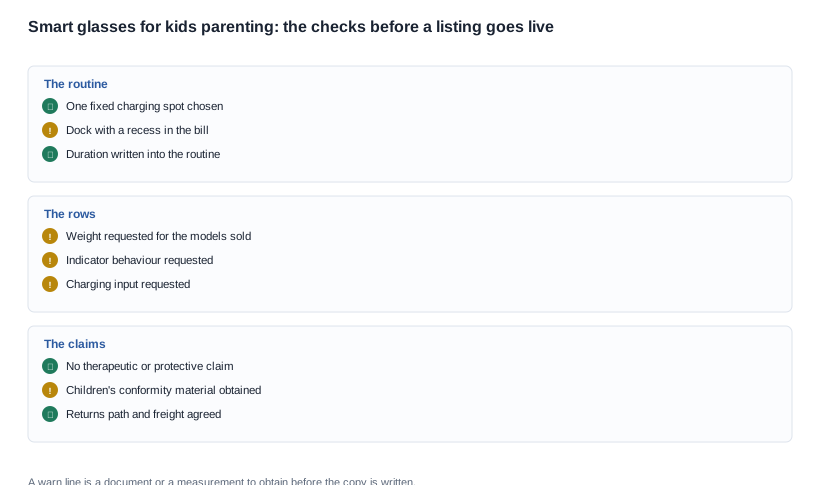
The questions to ask before you order. What is the weight of the specific model, since none of the three children's entries publishes one; what is the indicator behaviour, since none of the three has a published one; what is the charging input; and what is the conformity material for this model in this market. Four questions, and they are the same four a school buyer would ask, which is a fair sign that the two channels are the same problem at different scales.
The boundary we hold: a parenting charging routine is an adult routine that has to tolerate a child, and the way to build one is a fixed spot, a shaped dock and a duration rather than an indicator. We publish the radio versions, the charging interfaces, the charge times, the cell capacities and the published use times where they are published, and we will not publish a weight, an indicator behaviour, a charging input, a start state or an end criterion for a model where we have not been given one. The kids smart glasses range is where the published baseline sits, the battery life page covers what a published rating includes, and the samples route is where the units come from that a parenting routine is written against.


