

Photochromic: the two decisions that come first
If your channel sells into open-air conditions where the light changes several times a day, a light-responsive lens is a defensible proposition — but you should specify it as a mechanism and a measurement set rather than as a feature, because the retail word covers two different products. If your customer's day is mostly indoors, a light-responsive lens is a cost with no customer-visible benefit, and a standard model from our range serves the channel better at a fraction of the engineering.
Two decisions come before any specification: whether the lens is passive (ultraviolet-driven) or active (voltage-driven), and whether the channel can demonstrate the effect at all. Get those two wrong and everything downstream — the sample approval, the claim wording, the return rate — is being built on the wrong product. Get them right and the rest of this article is the work.
Photochromic: a configuration change, not a new product
The buyer in this category is usually a brand-side product manager or a channel buyer, and they are typically approving a configuration change rather than a new product. That distinction matters more here than in most categories, because a lens option creates a new combination on the production schedule, and a new combination creates new minimums, new artwork, and a new document question.
Three situations show up. The first is a brand adding a lens option to an existing camera platform, which is the cheapest route and the one where the configuration burden is most often underestimated: a four-colour range with a lens option is four new combinations, not one. The second is a brand opening a dedicated light-responsive line, where the product is its own bill of materials and the entire conformity file is new. The third is a distributor adding the feature to a range they already stock, where the accessory and documentation questions outnumber the technical ones.
What the buyer is afraid of is not the wrong lens. It is the combination: a lens that arrives behaving differently from the demonstration, a claim on the listing that cannot be defended, and a configuration whose paperwork does not cover it. All three are cheap to prevent at the quotation stage and expensive to prevent after the artwork is approved.
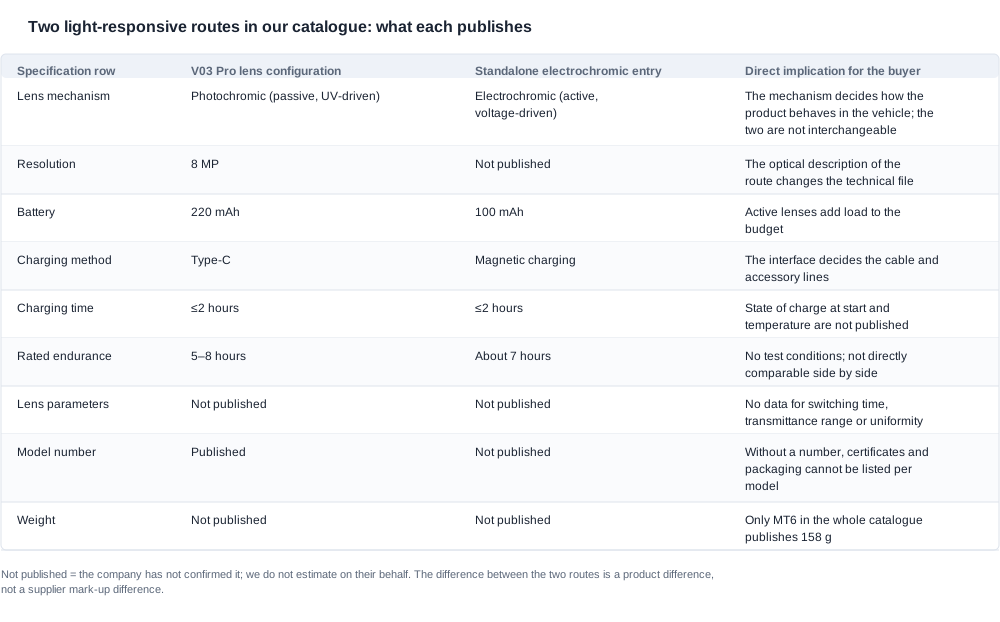
The commercial question underneath is the same in all three cases. Our catalogue offers two routes, and they are different products rather than two configurations of one product. The V03 Pro is an 8 MP camera platform with a 220 mAh cell, charging in two hours or less, a rated runtime of five to eight hours, Type-C charging, flexible temples, three published colour options and a photochromic lens listed as a configuration. The dedicated entry is described as electrochromic, with Bluetooth V5.4, a 100 mAh cell, charging in two hours or less, roughly seven hours of rated runtime, magnetic charging, and no model designation at all. That last fact is the one that decides schedules, and it is covered in the section on what the model designation blocks.
Where the money sits when a lens programme is quoted
Cost discussions in this category go wrong in a predictable way: the quotation is compared line by line, the lens is compared as a component, and the two comparisons ignore the fact that a lens option is mostly fixed cost rather than variable cost.
The visible part is the lens itself. Its price depends on the technology, the size, the coating, the tint depth and the volume, and it scales with units, so it falls as volume rises. The less visible part is everything the lens drags into the product. An active lens brings a cell, a driver circuit, a control path and a firmware function; it brings a charging interface, which in our range is magnetic; and it may bring a case, which changes packaging, shipping weight and the battery transport paperwork. A passive lens brings none of those, which is the single largest reason it costs less.
The part that is not in the quotation at all is the specification. If the lens is a named feature rather than a commodity, the lens maker has to commit to a specification, and that commitment carries a minimum volume attached to it. At a pilot quantity the tooling and the specification commitment, not the unit price, is what dominates the difference between two quotes. Two quotations that look like a 15% gap on unit price can be a 2x gap on the whole programme once the setup and the re-validation are counted.
The buyer's negotiating space therefore sits in the setup lines, the per-configuration minimums and the market list, not in the unit price. The unit price of a passive lens in a volume order is a small number and the supplier knows it. The number of configurations, the per-colour minimum for each, the artwork round count, and the number of markets you enter are all negotiated numbers and all of them are larger.
One more structural point is worth putting in the model before the quotation arrives, because it changes what you ask for. A configuration change is a product change. Whether you like it or not, the lens alters the optical description of the product, and where the product also has a camera, it alters the imaging description. A change to the bill of materials, a change to the frame material and a change to the charging interface all carry the same consequence: the material documentation and the conformity position have to be reviewed rather than assumed to carry over.

The eight rows that decide the purchase, and the thresholds to hold
The published position in this range is thin in a way that is easy to mistake for a data problem. It is not — it is what a category with no published performance baseline looks like. Here is what exists, what it settles, and what it does not.
| Published row | What it is | What it settles | What it does not settle |
|---|---|---|---|
| Bluetooth V5.4 | A protocol generation | That the radio is a current generation | Nothing about the lens, and no other product difference in our data |
| 100 mAh cell | A quantity of charge | The power budget available | The runtime, because runtime depends on load |
| Charging in two hours or less | A laboratory result | An upper bound | The starting state, the temperature, the charger |
| Roughly seven hours of runtime | A rated figure | A ceiling under favourable conditions | The workload, and therefore any comparison |
| Magnetic charging | An interface | The cable, the cradle and the case geometry | The contact condition, the charger, the thermal behaviour |
| Electrochromic lenses | A technology name | That the lens is actively driven | Depth, speed, uniformity, temperature range, cycle life |
| No model designation | A gap | Nothing | Traceability, documentation coverage, customs description |
| No weight published for this entry | A gap | Nothing | Comfort claims, which usually lead the listing |
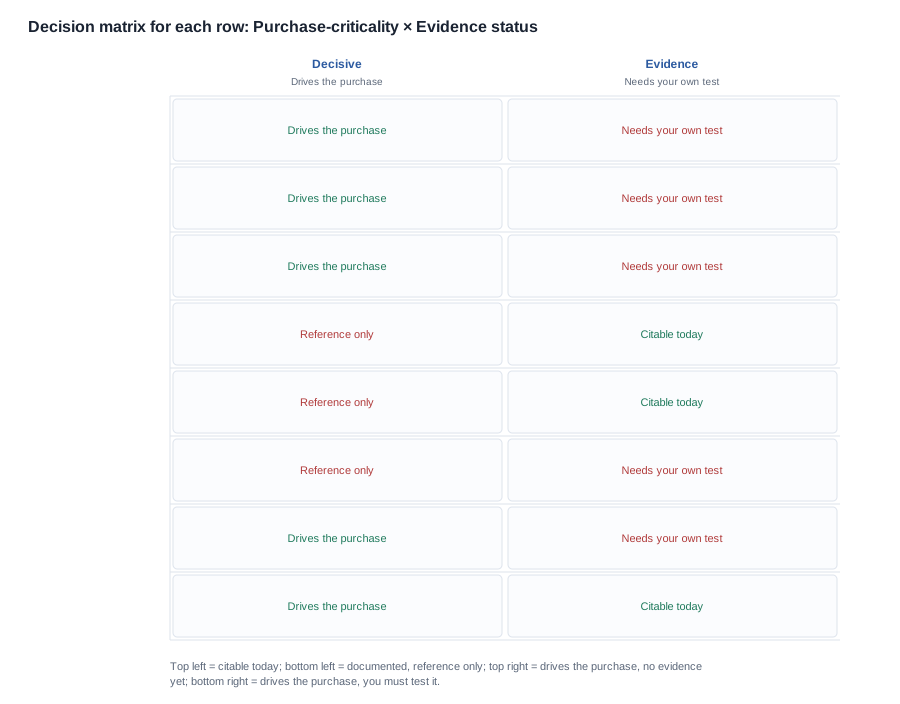
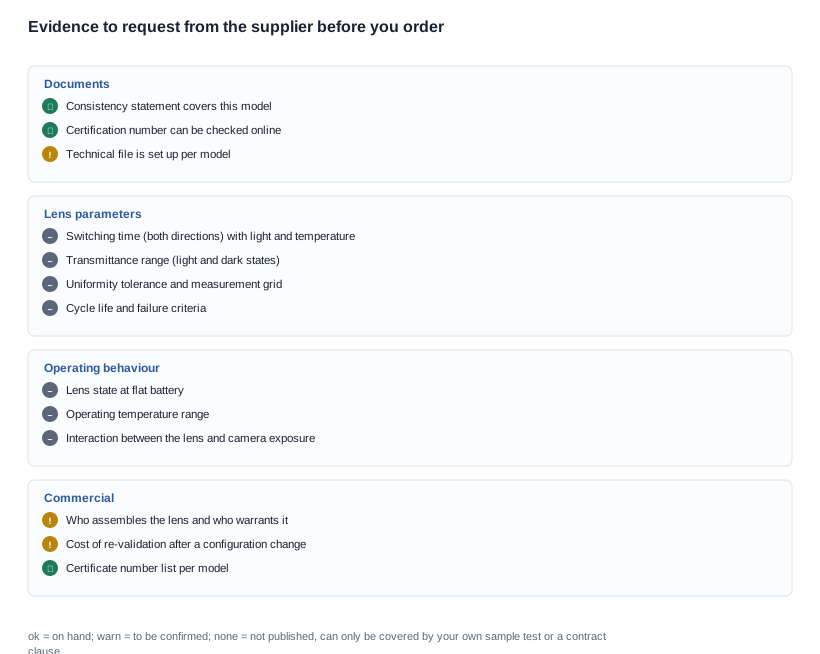
The absent rows are the ones that decide the purchase, and the matrix above is how we would sort them. The switching time in both directions, the transmission range in the clear and dark states, the uniformity tolerance, the temperature range and the cycle life with a failure criterion are all absent for this entry, and each of them decides something specific.
Switching time decides whether the product works in the customer's day. It is only usable with its conditions: the direction of travel, the initiating light level, the ending light level and the temperature. A figure without those is positioning language. There is a specific trap here — a lens that takes ninety seconds to reach a moderate darkness under strong sun may take several minutes to reach full darkness under weak winter sun, and the second scenario is the one a customer in February is standing in. The threshold to hold is: two figures, one per direction, each with a light level and a temperature, and the vendor's willingness to state whether the figure is typical or best case.
Transmission range in the two states decides whether a sunglasses positioning was ever available. The clear-state figure is the indoor experience and the dark-state figure is the outdoor one, and the pair together describe the range the lens actually works across. A lens that moves from ninety per cent transmission to twenty per cent, and one that moves from ninety per cent to forty-five per cent, are different products with the same story. The threshold to hold is a range with the units and the method stated, and it must include the clear state — a seller quoting only the darkened figure has quoted only the part that looks good on a beach.
Uniformity tolerance decides whether a good lens is rejected at first article. A centre reading is easy and nearly useless, because users notice edge-to-centre variation before they notice an average. The threshold to hold is a maximum difference between zones, measured on a stated grid, agreed before the first article rather than discovered at it. A tolerance set afterwards is a tolerance that has already been missed.
Temperature range decides whether the product works in the customer's climate. It is almost always quoted wider than it is useful, and the honest question is how slow the lens is at the cold end.
Cycle life with a failure criterion decides whether a durability warranty has a measurable end. A cycle count without a criterion is a quantity. The threshold to hold is a transmission level at which the lens is considered failed, written by you and applied by both parties.
The flat-battery lens state decides what the customer sees when they forget to charge. For a powered lens this is a product behaviour and a support-script line, and it has to be specified rather than discovered.
The model designation decides whether the paperwork can name the product at all. A product without a formal SKU cannot be correctly listed on a certificate, correctly packaged, or correctly described at customs.
One warning that applies to every row above: these figures are not directly comparable across suppliers, and the reason is usually the measurement, not the product. A switching time measured from bright sunlight to indoor light is not comparable with one measured from indoor to sunlight, and neither is comparable with a figure measured at 35 degrees against one measured at 5. Until the conditions are stated, two numbers in the same row are two different measurements.

Photochromic verification: a supplier claim is not a record
Verification in this category is mostly documentary, and it is fast once you know which four documents to ask for. The order below is deliberate: each step assumes the previous one passed, and a failure at any step tells you what the next step would have told you.
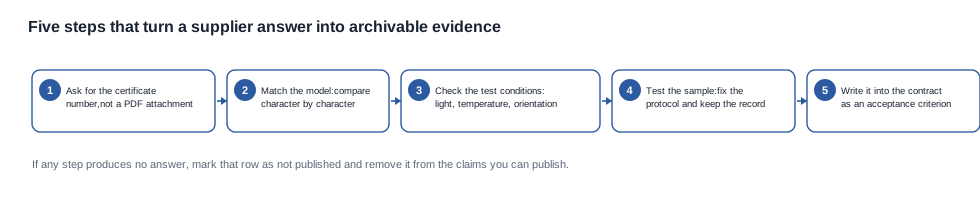
Step one: ask for the certificate numbers rather than the certificates. A number is the only part of a compliance document that a broker, a marketplace or your own compliance team can check later. A PDF attachment is a claim; a number is a record. Ask for the list in the body of the email, with the issuing body and the validity dates, before the first sample ships. Cost: one email. Value: it converts an unverifiable claim into a checkable one.
Step two: look the numbers up and check the model string. In the issuing body's register, confirm three things: that the model designation on the document matches the model you are ordering, that the document covers the functions and the radio band you are shipping, and that the validity date has not passed. Do the model comparison character by character. In a family where several models share their electrical rows, this is the check that catches a substitution, and a mismatch here is a stop condition rather than a query.
Step three: ask for the test conditions behind every quoted figure, and treat a figure without conditions as absent. The three conditions to insist on for any lens figure are direction of travel, light level and temperature. If the supplier cannot state them, the figure is not usable in a specification, and it should be removed from the comparison table rather than propagated into it.
Step four: run your own measurement on a sample, on a fixed protocol, and record it as your measurement. The protocol that closes the rows is short: a comparison photograph against a lens you already know, in the same light, at the same moment; a stopwatch timing in one direction and then the other; a run in a cold environment; and a run with the network and the power state varied so the flat-battery behaviour is observed. Write the protocol down before you take the first reading, because a protocol designed afterwards is a description.
Step five: put the criteria and the measurement into the purchase order. In a category with no published standard, the contract is the standard. If the criteria are only in an email, they are not binding; if they are in the purchase order, they are the acceptance standard and a lot that fails them is a lot you can refuse.
How lens programmes break, and the early warning for each
The claim outruns the evidence, and the return arrives with a photograph. The symptom is a customer reporting that the lens does not work. The root cause is usually a copy line written from the retail word rather than from the mechanism — "photochromic" written where the product is electrochromic, or "adapts to the light" written where the product never reaches a meaningful depth. The prevention is the cheapest one in this article: fix the claim wording before the product page is written, and let the copy say what the mechanism does rather than what the customer hopes for.
The product performs correctly and is still returned, because the expectation was set by a different technology. The symptom is a cluster of returns from one channel with a description that does not match the product. The root cause is that a buyer who has handled mineral photochromic lenses carries that expectation into the listing for a powered lens. The prevention is to state the mechanism in the copy and to set the expectation in the listing, in the packaging and in the support script, consistently.
The certificate arrives and names a different model. In practice the symptom is a customs query, a warranty claim, or a marketplace rejection nobody can resolve. The root cause is that a family-level document was treated as coverage for a branded configuration. The prevention is to make the exact model designation a condition of the purchase order and to check the string on the units on receipt.
A variant ships outside the covered configurations. The symptom is a consistency problem in the field that appears after the programme has launched. The root cause is that the per-variant configuration check was never established, because the lens was treated as a colour rather than as a combination. The prevention is to put lens, coating, tint range and frame material on the change-control list, with a notice obligation attached.
The programme is a month late and the cause is a document, not a factory. The symptom is a launch date that slips and a factory that says the units are ready. The root cause is that the model identifier was requested last, so the artwork, the technical file and the customs description all waited on it. The prevention is to ask for the identifier in the first email and to treat the date as derived from it rather than from the production schedule.
A warranty is set from a cycle count and the first claim is unanswerable. The symptom is a claim that cannot be settled because nobody can say what a failed lens looks like. The root cause is a cycle count used as a service life. The prevention is to write the failure criterion at the sample stage and to set the warranty against it.
What a lens programme can and cannot negotiate
Some of this cost is negotiable and some of it is fixed, and knowing which is which saves an argument that cannot be won.
Negotiable, and worth spending the negotiating capital on. The setup costs are the factory's fixed cost rather than a market rate, and they are the line where a per-configuration minimum actually moves. The per-colour and per-configuration minimums move when you commit to a combination count rather than a unit count. The artwork round count is negotiable and each round is a week. The market list is a negotiation as much as a decision, because a channel served from markets where approvals already exist is worth a better price than one that requires new testing. The lens specification itself is negotiable as a document, and agreeing it before the quotation is worth more than negotiating the unit price afterwards. The retention held against the documentation package protects you on the failure that costs most, which in this category is a product that arrives with paperwork that does not cover it.
Not negotiable, and worth saying so early. Certification cost and certification time are a fixed cost per product family and a queue at the test laboratory; pressing on either produces a longer schedule rather than a shorter one. The one-off tooling cost is usually amortised across the first order, so the questions worth asking are over what volume it is amortised and what happens to it if the programme is discontinued. The re-validation cost of a configuration change is per configuration, and it is the line that compounds. And the mechanism is not a commercial variable at all: a passive lens is a different product, and if your requirement needs a wearer-controlled tint, no negotiation turns an active lens into a passive one.
The documents to request before the deposit. The certificate numbers with the issuing body and the validity dates, per model designation. The written statement of the lens mechanism. The switching times with their conditions. The transmission range in both states, or a written statement that it is not published. The flat-battery behaviour. The material documentation for the lens module, per material. The battery transport summary for the fitted cell. And the model designation written on the quotation.
The clauses to write into the purchase order. The lens specification and the exact model designation, attached to the order. The acceptance criteria from the measurement protocol, with the conditions and the sample size. A clause requiring notice before any change of lens, coating, tint range or frame material, because each of those invalidates the configuration. A clause requiring the documentation pack to be reissued for a configuration change. A clause setting the warranty against an agreed failure criterion rather than a cycle count.
A worked example: an outdoor brand evaluating a light-responsive lens
This is a hypothetical case rather than a real engagement, and it exists to make the order of decisions visible rather than to report a result.
Assume a European outdoor brand with four colourways and an existing camera platform, currently shipping into three markets, considering a light-responsive lens option for a spring line. The constraint that matters is not the lens. It is that the brand's own listing reviewer rejected a claim in the previous cycle because the supplier's datasheet had no measurement behind it, and the brand does not want to repeat that.
Step one: the mechanism. The brand's channel is cyclists and trail runners who spend hours outdoors and whose complaints are about swapping glasses. The exposure is direct sun, so a passive ultraviolet-driven lens is mechanically sufficient, and it removes a cell, a driver, a firmware function and a charging routine from the design. The brand's engineering lead notes that the passive route also removes the flat-battery question entirely, which removes one of the acceptance criteria they would otherwise have to write.
Step two: the demonstration. Rather than accepting the supplier's figure, the brand buys one unit, places it next to a mineral lens the team already owns, and photographs both in the same light at the same moment. The result shows the tint is visible in a photograph, which is the test that matters, because the brand's product photography will show the lens. The brand records the protocol and the observation in a single page, and that page becomes the source of the copy.
Step three: the paperwork. The brand asks for the certificate numbers per configuration and finds that the family-level document names the platform rather than the lens configuration. That is a real gap, and it converts the model designation into a precondition rather than an administrative detail. The brand makes the designation a condition of the first order and puts a re-issue obligation into the contract.
Step four: the commercial structure. Four colours with a lens option is four new combinations, and the brand negotiates the per-configuration minimum on the basis of a committed combination count rather than a unit count. The brand also moves the artwork approval earlier than it normally would, because the lens configuration has to appear on the box, and it adds one artwork round for the feature demonstration to the schedule.
Step five: the claim. The brand's copy says only that the lens adapts to light conditions, and it makes no claim at all about sunglass depth, because no transmission range was available. The listing reviewer accepts it, because the wording is now narrower than the evidence behind it rather than wider.
The result is a cheaper programme, a narrower claim, and a schedule that has one identified precondition rather than four unowned risks. The point of the walk-through is that the decisive decisions were made before the sample order, and that the lens specification was never the thing that decided the outcome.
What we can and cannot tell you about our own lens product
It is worth being precise: we publish the rows we hold and mark the rest as open, and we would rather show you eight empty fields than eight plausible values.
For the dedicated electrochromic entry, what we publish is the Bluetooth version, the charge time of two hours or less, the 100 mAh cell, the roughly seven-hour rated runtime, magnetic charging, and the fact that the lenses are electrochromic. What we do not publish, and will not estimate: the switching time in either direction, the transmission range in either state, the tint depth, the uniformity tolerance, the temperature range, the cycle life, the coating description, the frame weight, and the model designation. For the V03 Pro configuration we publish the camera resolution, the cell, the charge time, the runtime, the charging interface, the temple type and the colour options, and we publish no lens performance figure for that configuration either.
Across our whole catalogue, one weight is published — 158 g for the MT6 glasses unit, excluding its foldable charging case — and no model in the range publishes a weight with a light-responsive lens fitted. For a product whose listing leads on comfort and on all-day wear, that is a gap we would rather name than fill.
We also make no claim on vision, health or eye-protection efficacy for any of our products, in any market. A device whose function is to detect a position or a distance and to remind is not a clinical intervention, and a listing that implies otherwise is a regulatory exposure rather than a marketing decision. If your channel is built on a eyesight concern, this is the wrong category, and we would rather tell you that before the sample order than after the copy is written.
The lens mechanism, the five-question list, and the use case
Send the mechanism question first, in writing. Whether the lens is passive or active, and what it does with no power, decides the product and the whole test programme. Everything else is downstream of it.
Send the five supplier questions as a list. The certificate numbers, the switching times with their conditions, the transmission range, the flat-battery behaviour, and the model designation. A supplier who answers all five has a documentation habit; one who answers two is telling you something you need to know before the deposit.
Send us the two candidates and the use case. Tell us the channel, the environment, the target market and the price band, and we will tell you which of our two routes the requirement actually needs, which rows our documentation answers today, and which ones you have to establish on your own units. The range is at photochromic smart glasses, and the technology background is under photochromic lens technology.
Where the decisions come from
- Photochromic lens technology
- How to compare photochromic smart glasses
- Photochromic smart glasses range
Send us the environment, the target market and the price band, and we will say which route the requirement needs.


