
Photochromic smart glasses: find the mechanism before anything else
The comparison of two photochromic products has to start somewhere other than the lens, because the word photochromic in a listing does not tell you what mechanism is in the frame. Photochromic smart glasses smart glasses how to compare therefore runs in two stages: establish the mechanism on each side first, and only then decide what the comparison is for.
The reason the mechanism comes first is that it determines the entire shape of the product. A powered lens is an active component with a power path, a control connection, a state and a failure mode. A passive lens is a coated material that reacts to light. A hybrid does both. The claims, the documentation, the failure modes, the power budget, the conformity file and the customer's expectation all follow from which of the three is in the frame, and a performance comparison between a powered product and a passive one is not a comparison at all — it is two different products being scored against each other.
The second stage is the channel. A dark lens is a selling point in an outdoor channel and a liability in an indoor one, and a powered lens that clears slowly is a good morning product and a bad evening one. So the second question is not "which lens is better" but "which environment dominates in the channel this product is sold into".
Our catalogue entry for the electrochromic product in this range publishes Bluetooth 5.4, a 100 mAh battery, charging in two hours or less, roughly seven hours of runtime, magnetic charging, and the fact that the lenses are electrochromic. There is no model designation, no switching time, no transmission range, no temperature behaviour and no coating description.

The buyer with two lens products and one channel to place them in
How to compare two photochromic products, in two stages
Photochromic smart glasses smart glasses how to compare is decided in two stages. Stage one establishes the mechanism on each product — powered, passive, or hybrid — and if the two mechanisms differ the comparison ends there. Stage two asks what the comparison is for: an outdoor channel where a dark lens is a selling point, an indoor channel where it is a liability, or a transition channel where a powered lens is the only product that works.
What the buyer already holds before the mechanism question
A buyer comparing lenses is usually holding two or three supplier samples, a product page draft, and a channel decision. What they are missing is the mechanism, and the mechanism is missing because the word in the listing is used for at least two unrelated technologies. That ambiguity is not a supplier trick; it is what happens when a category name outlives the technical distinction.
The other thing a buyer is usually missing is a sense of who the customer is in the comparison. A customer who expects a mineral lens — darkening in sun, clearing indoors, no power involved — will read a powered lens's behaviour as a fault. That is not a misunderstanding the buyer can fix with better copy; it is a product-expectation mismatch, and the only fixes are a different product or a different channel.
The four failures this category is set up to produce
Comparing two products that are not comparable. A passive lens and a powered lens have different failure modes, different documentation and different claims, and a performance comparison between them is meaningless.
A lens that is described but not documented. A powered lens with a cell is a different conformity file from a passive lens, and the listing has to reflect whichever it is. This is the failure with the longest tail, because the file is what a customs inspection, a marketplace reviewer or a retailer's technical team asks for.
A lens that does the wrong thing in the customer's environment. A powered lens that clears slowly is a good morning product and a bad evening one, and the customer's channel decides which of those two situations dominates. For a commuter product, the evening is the problem; for a delivery product, the morning is.
Buying a differentiator the channel cannot demonstrate. In an indoor or office channel the lens is a cost and a compliance burden with no product benefit. The buyer who adds a powered lens to an office line has added a component, a battery draw and a set of claims, and the only thing the channel will notice is the tint.
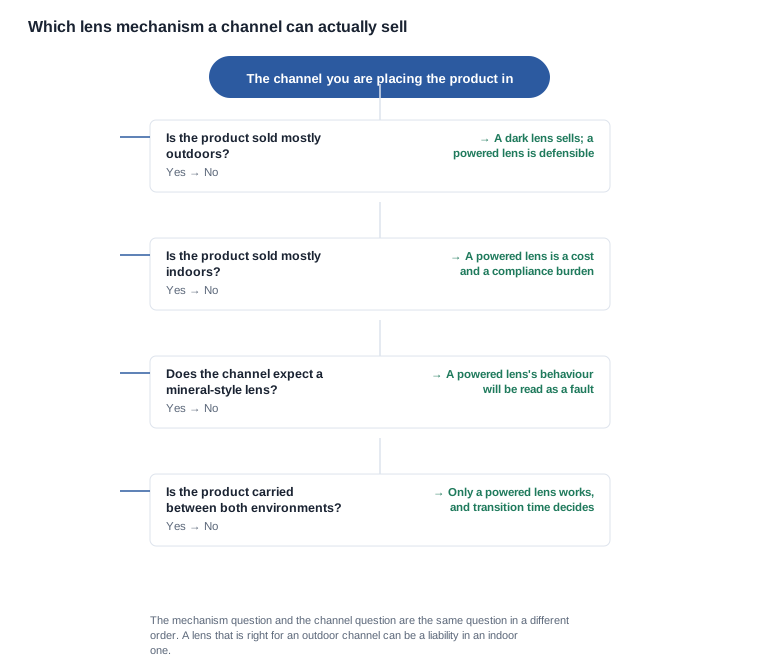
The rows a lens product is actually judged on
Powered, passive, hybrid: the first question
Ask the question in writing, first, before anything else: is the lens powered, passive, or hybrid, and does it need power to change state? The answer is a sentence, and the answer may end the comparison.
The pass line is the mechanism named plus the power path described. A soft answer is the word photochromic with no mechanism, and it is the standard answer because the category name does the work the mechanism should be doing.
Why it matters commercially, rather than technically: a powered lens draws current in a product that already has a battery, so the lens changes the runtime, the thermal behaviour and the charge profile of the whole product. That means the lens decision is also a battery decision and a certification decision, and both of them cost money and time before a single unit is compared.
Transmission range, switching time and the conditions behind them
Transmission range decides whether a sun-protection positioning is possible at all. The minimum governs how dark the lens goes and therefore whether the copy can describe sun protection. The maximum governs whether the product is usable indoors without the customer wanting to take it off. A supplier who publishes only a tint percentage has given you one half of the range and left the half that decides your positioning unstated.
Switching time has to be given in both directions, each with a stated light level and a stated temperature. One number with no condition is not a figure. Darkening and clearing are different events with different physical drivers, and the number that matters commercially is usually the clearing time, because that is the one the customer experiences at the end of the day.
The warning that belongs on both rows: the figures must be measured on the product. A component datasheet from the lens supplier describes a lens, and a lens in a frame with a coating, a curvature and a temperature is a different object.
Uniformity, cycle durability and temperature behaviour
Uniformity tolerance is the row nobody writes, and its absence produces an argument. A lens that darkens evenly at the centre and unevenly at the edge is described by the supplier as within tolerance, and without a written tolerance that phrase means the supplier's internal default. Set the tolerance in the request and put it in the acceptance criteria for the sample, and the argument disappears because both sides are reading the same number.
Cycle durability without an end point is not a test. Ask what the sample looked like at the end of the cycles and what constitutes a failure. A cycle count is a quantity; a test needs a criterion. A warranty built on a cycle count with no failure definition has no measurable end, and the warranty term has to be set against something else.
The temperature question is the one that gets skipped, and it is a field question. A parked car in summer and a winter morning are different conditions, and the electrochromic entry publishes nothing about either. A lens that behaves differently in a hot parked car than on a cold winter morning is a different product in summer and in winter, and the channel that sells it may only ever see one of those. If the season is a summer season, the winter behaviour is still the one that produces the returns in month one of next year.
The flat battery question and the camera exposure question
What happens when the battery is flat? It belongs in the instructions, in the manual and in the customer service script, and a supplier who has not thought about it will not have a written answer. The absence of an answer is itself the finding, and it is a finding a buyer can act on: it goes into the agreement as an obligation on the supplier to specify the behaviour.
The camera exposure question is specific to smart glasses rather than to sunglasses. A tinted lens changes the exposure the camera sees, and an electrochromic lens that changes state changes it during a recording. Whether the camera compensates is a question worth asking, and it is a different question from whether the microphone's noise processing assumes a fixed input level. It is worth asking because the camera is what the product is sold for on most of the platforms in this category, and a recording that clips every time the lens darkens is a defect the lens introduced.

How to test a lens that changes state
Each step has a written completion condition, because a lens observation without a record is a memory.
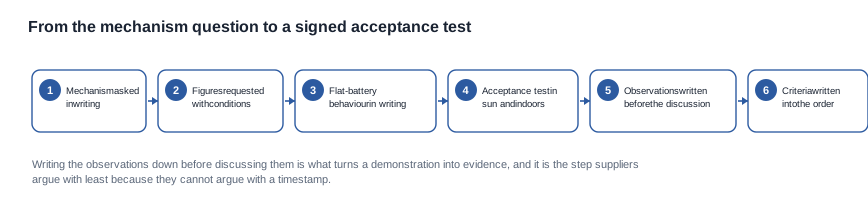
- Ask the mechanism question in writing, first, before anything else. "Is the lens powered, passive, or hybrid, and does it need power to change state?" The answer is a sentence, and the answer may end the comparison.
- Ask for the published lens figures with their conditions, and accept "not published" as a finding. Switching time in both directions, transmission range, uniformity, and a cycle count with a failure criterion. If the answer is that they are not published, the comparison ends at the sample stage rather than continuing on platform rows that do not distinguish the products.
- Ask what happens when the battery is flat, and get the answer in writing. It goes in the instructions, in the manual, and in the customer service script.
- Run one acceptance test on the sample, in sunlight and indoors. Set the lens in direct sun, record video while it darkens, then let it clear indoors, and write down what you observed before you discuss it. A supplier disputing a written observation is arguing with evidence; a supplier who has never seen the test is arguing from theory.
- Check the platform rows only after the lens rows are settled. For our electrochromic entry, the platform rows are Bluetooth 5.4, a 100 mAh battery, two hours or less to charge, roughly seven hours of runtime, and magnetic charging. None of them distinguishes it from another electrochromic product, because there is no other electrochromic product in the catalogue to distinguish it from. Comparing them is work without a result.

The breakdowns that turn a lens comparison into a return rate
Four breakdowns that turn a mechanism into a returns problem
A powered lens is compared against a passive one and the passive one wins. Root cause: the mechanism was never established, so the difference was read as a performance difference. Prevention: make the mechanism question the first line of the request, in the same words to every supplier.
The customer reports that the glasses do not work and no defect is found. Root cause: the customer expected a mineral lens and read the powered lens's behaviour as a fault. Prevention: fix the claim wording before the product page is written, keep the description to the mechanism the product actually has, and put the behaviour in the insert and the training material rather than leaving it to be discovered.
The lens darkens evenly at the centre and unevenly at the edge, and the supplier says it is within tolerance. Root cause: no uniformity tolerance was written into the specification, so within tolerance means within the supplier's internal default. Prevention: set the tolerance in the request and put it in the acceptance criteria for the sample.
Two candidates are ranked on a warm day, and the one that clears the threshold in summer is the one that fails in winter. Root cause: the temperature range was never asked of either supplier, because the comparison was run in the season the buyer happened to be shopping in. Prevention: put the temperature range in the request sent to both candidates, and where neither publishes one, run the sample test at both ends of the range the product will actually meet.
A fifth failure is commercial and is worth naming separately: the lens is treated as a free feature of a camera product. A powered lens inside a camera platform adds a power path, a state, a failure mode and a set of claims to a product whose proposition is the camera. That is a deliberate commercial choice, and it is a defensible one, but it has to be made deliberately rather than inherited from a platform decision made for a different product.
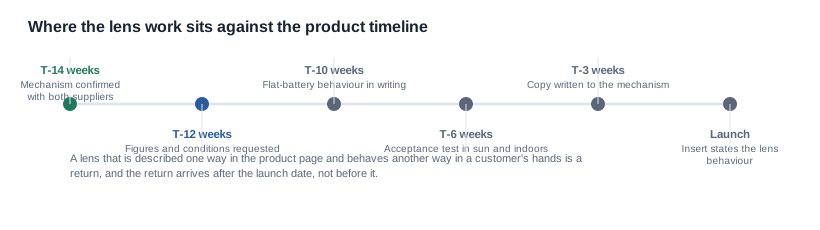
The schedule and the cost of a powered lens
Open terms, settled terms, and the lens documentation
In a photochromic programme the commercial levers sit in the merchandising layer, because the lens itself is the part that does not move. The terms worth negotiating time on:
- Minimum order quantity.
- Packaging and insert design, including the market labels, the language of the documentation pack and the wording that describes the lens behaviour to the customer.
- Delivery splitting against a sample-approval milestone, which is often granted more easily than a price concession because it moves the risk onto the schedule where it belongs.
- The payment schedule: a deposit against the order, a balance against the inspection pass, and a retention tied to the documentation pack.
The lens side of a photochromic programme is not a commercial lever. Certification cost and certification time are fixed per product family, and the elapsed time is set by the test laboratory and the review queue. Raised once and written down against the opening order, the tooling charge leaves a buyer with two things to settle: how much volume absorbs it, and whether the tool is still needed when the programme ends. In this category there is a third item: the lens itself. A supplier who will not change the lens, the coating or the tint range is telling you the product is fixed, and no commercial term changes that.
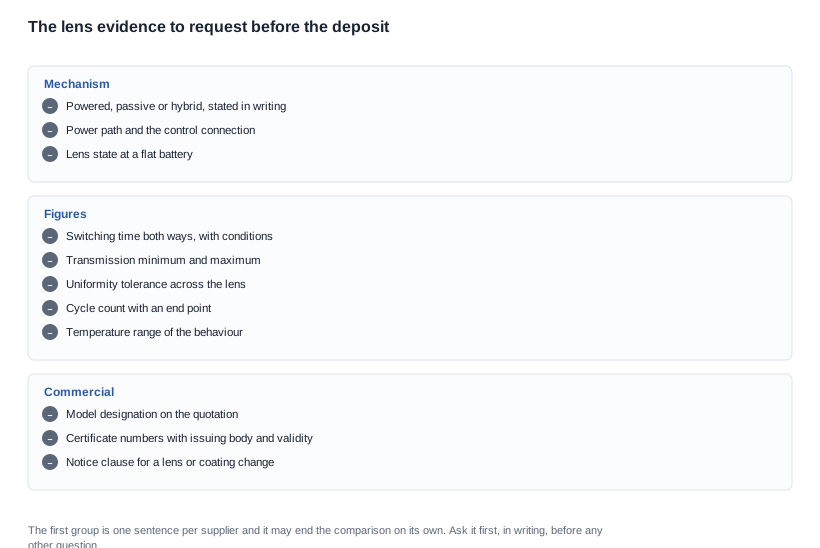
The file to request before the deposit in a photochromic programme is: the certificate numbers with the issuing body and the validity dates, the declaration of conformity for the exact model designation, a written statement of the lens mechanism and of the behaviour at a flat battery, the measurement conditions behind the runtime figure, the lens figures with their conditions or a written statement that they are not published, and the uniformity tolerance and the cycle durability criterion, in writing, if they exist.
The clauses for a photochromic programme are: the model designation as a line item, with the certificate numbers attached; the acceptance criteria for the sample, referencing the lens acceptance test and the observed timings; a clause requiring notice before any change of lens, coating or tint range, because a lens substitution changes the conformity file; a clause requiring the flat-battery behaviour to be documented in the insert as supplied; and a clause on who bears the cost when the sample does not meet the acceptance criteria.
A worked example: a brand placing one lens SKU into two channels
For clarity, the passage that follows is a worked example built for this article. It demonstrates the order of comparison rather than a result.
Assume a mid-size European brand that already sells a general audio product, and that wants to add one powered-lens SKU to the range and place it in two channels: an outdoor retailer and a business-software marketplace for a field-service customer.
Step one, the mechanism. The brand asks the supplier for the lens mechanism in writing before asking anything else. The answer is powered, and the brand now knows the lens draws current, has a control path, has a state and changes the conformity file relative to a passive product. That single sentence has already told the brand that the two channels cannot be treated as one launch.
Step two, the exposure. The brand writes down what each channel actually does. The outdoor retailer's customers are outside for long periods in changing light. The business marketplace's customer wears the product in a vehicle, in a plant room and at a desk, and the desk day is the dominant case. For that customer, a dark lens in an office is not a feature, it is a reason to take the product off.
Step three, the request. The brand asks for switching time in both directions with a stated light level and temperature, the transmission minimum and maximum, the uniformity tolerance, the cycle count with an end point, the temperature range of the behaviour, and the flat-battery state. The supplier publishes some of these, states that others are not published, and confirms the flat-battery behaviour in writing. The brand puts the flat-battery answer into its own insert wording immediately, because it is the one item the brand will have to answer for the customer.
Step four, the acceptance test. On the sample, the brand runs one test: direct sun to darken, video recorded throughout, then indoor clearing, with the observations written down before the discussion. The observed clearing time is slower than the brand would like for a product that moves between a vehicle and a desk. That observation is now the brand's own, and it is the basis for the next decision rather than a supplier's number.
Step five, the channel decision. The brand concludes that one SKU cannot serve both channels: the outdoor retailer's customer is outside, and the field-service customer is at a desk for most of the day. It splits the placement — the powered lens goes to the outdoor channel where the tint is the proposition, and the field-service customer is served by a passive-lens or no-lens product instead. That decision is a cost decision, and it was made because the exposure was written down at step two rather than assumed at step one.
Step six, the commercial structure. The brand negotiates the insert design and the documentation pack language, because the lens behaviour description is now a required part of the product. It splits the first run against the sample-approval milestone. It takes a smaller first quantity in the outdoor channel, on the basis that the channel is seasonal, and books the rest against a second delivery once the first season's behaviour data exists.
The result is one SKU placed deliberately in one channel and a decision not to force it into a second. The expensive mistake avoided was not buying a poor lens; it was buying a good lens into a channel that could not use it.
What we publish for the electrochromic model, and what we do not
The working rule we apply: we publish the row that tells you the mechanism, and we mark the rest of the lens data as open rather than filling it with a typical value. The electrochromic entry's published rows are Bluetooth 5.4, a 100 mAh battery, charging in two hours or less, roughly seven hours of runtime, magnetic charging, and electrochromic lenses. We publish no model designation, no switching time, no transmission range, no temperature behaviour, no uniformity tolerance, no cycle durability figure and no coating description for this product, and we will not estimate any of them.
The reason is specific. A plausible-looking switching time on a product page becomes a claim the customer will test on a windowsill, and a claim that fails is a return rather than a specification. We would rather tell you that a comparison on the published rows alone produces a tie, because in this tier it does.
We will also tell you plainly that in this category the deciding variables are the regulatory position and the channel rather than the lens specification, because the specification does not exist yet. A separate entry in our range, the V03 Pro, publishes a photochromic lens as a feature of a camera platform, and the same discipline applies there: a published feature is not a published lens specification.
The category background is at photochromic lens technology, the selection argument is at how to choose photochromic smart glasses, the published rows are at photochromic key specifications, and the limits are at photochromic limitations and drawbacks. The range is at photochromic smart glasses.
The questions to send us
Send us the two products, the channel, the destination markets and the claims you intend to make, and we will say which stage of the comparison each product is in, and which rows our documentation answers and which have to come from a supplier or a test on your own units. If the two candidates turn out to use different mechanisms, we will tell you that first, because it is the answer that changes everything after it.


