

Every runtime figure in this category is a ceiling until somebody states the condition behind it, and nobody states it. That is the finding that shapes everything else: a buyer who shortlists on the published number is shortlisting on a rating, and a rating is a result of a test whose method is unknown. It tells you what a device achieved under conditions the catalogue does not describe. It does not tell you what it will do in your customer's day.
So the conclusion first.
Name the workload before you name the requirement. The device that draws power from a radio in bursts while a person talks, the device that records video continuously while a camera moves, and the device that draws almost nothing for hours and briefly for a prompt are three different products with three different budgets. The published figures cluster so tightly across the range that quoting them does not constitute a selection method at all.
Treat every published runtime as a screening value until a sample confirms it under your own load. This is a one-day test and it is the only measurement you will ever own on this row.
Ask for the condition, not the number. If a supplier cannot state what the device was doing during the measurement, the figure cannot go in a specification and should be removed from the comparison table rather than carried forward with a question mark.
Do not treat the charging case as packaging. A case is a second lithium cell. It has to be declared for transport, it has its own minimum order quantity, it adds weight to every unit shipped, and it is a second thing the customer can lose. The recharge count measured on a sample is what turns it from an accessory into a proposition.
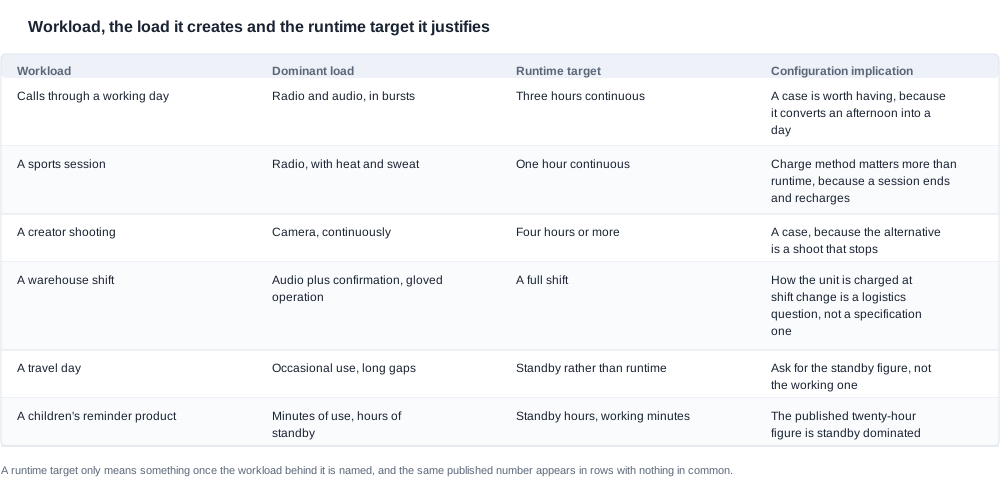
Smart glasses battery life: converting a workload into a runtime target
The first question is not how long the session is. It is what the device is doing during it, because the load determines the runtime and the session length only determines how many times the load has to be sustained.
A device used for calls draws from the radio and the audio path in bursts, with the person mostly still. A device recording video draws from the camera continuously, and a camera on a moving head also makes the radio work harder, so the two loads compound. A device worn as a reminder draws almost nothing for most of the day and then draws a little when it prompts. A device with a magnification or an active lens has a fourth profile, where the load depends on the user's own settings.
Those workloads are not interchangeable, and that is why two products with identical cell capacities can behave completely differently. The table at the top of this article is the working form: one row per workload, the dominant load, the runtime target it justifies, and the configuration consequence that follows.
Two rows in that table are routinely skipped, and both change the outcome.
The end-of-runtime behaviour. A device that warns before it shuts down turns a support call into an inconvenience. A device that dies silently in the middle of a call turns it into a return. The fix is almost never a bigger cell; it is a warning, a priority order for which functions stop first, and a decision about which function the customer is actually paying for. That decision belongs in the acceptance criteria, because it is a behaviour of the shipped firmware and it costs nothing to specify.
The cycle life rating. A cell that is fine for a year and poor after two is a product line decision, not a component decision, and it changes the warranty economics completely. If the supplier cannot give a figure, ask for the test plan and for a sample of the cells actually being fitted. Either way, write the acceptance criteria for a specified cycle count into the contract, because a cell that has been cycled two hundred times is a different component from a new one and the difference is invisible until somebody measures it.
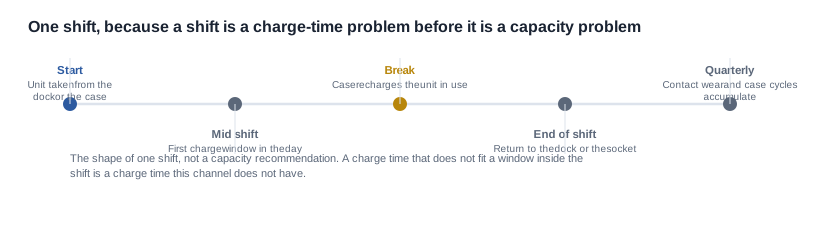
There is a third row that is not a specification question at all, and it is the one that decides whether a battery programme is a hardware programme or a logistics programme: how the device gets charged during the day. A warehouse shift, a clinic round, a school day and a retail shift all have a moment when the device goes back on charge, and if that moment is not compatible with the charge time then the charge time does not matter. A buyer who specifies a two-hour charge for a shift with a thirty-minute break has specified a device that will not be charged on that shift. This is why the charge time and the runtime are decided together and never separately.

What the published cells and runtimes settle, and the comparisons they cannot support
Our catalogue publishes four rows per model: cell capacity, charge time, rated runtime and charging interface. Case capacity is published for part of the camera range. That is the whole of the published data, and reading it carefully produces two conclusions that are worth more than any individual number.
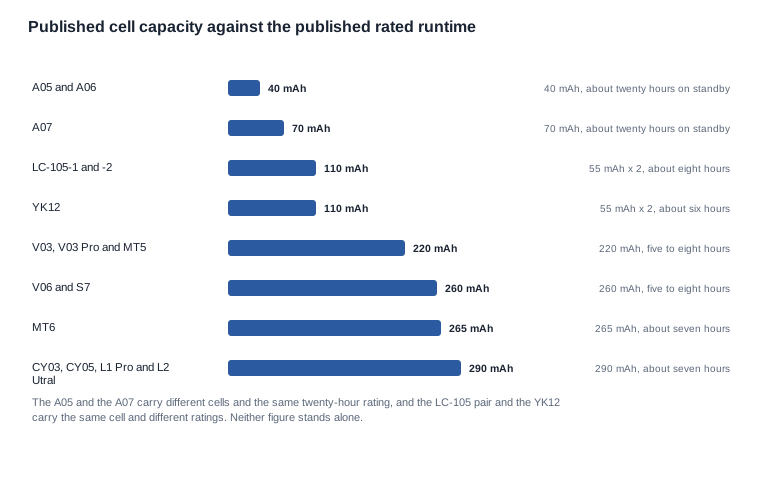
Conclusion one: the published runtime is a workload rating, not a capacity rating. The evidence is inside the catalogue and it is unusually clean. The K01 and the K02 publish 90 mAh on each side and rate about eight hours. The LC-105 pair publishes 55 mAh on each side and also rates about eight hours. That is nearly double the cell producing the same headline number, which means the number is describing something the cell size does not determine. The same cell, at 55 mAh on each side, also produces two different ratings in the same class: the LC-105 pair at about eight hours and the G07 and the YK12 at about six. Same cell, same generation, two different published runtimes.
The commercial reading is direct. A buyer who treats the published runtime as a function of capacity will systematically over-buy on the models with big cells and under-buy on the models with small ones, and will be wrong in both directions. Capacity is a screening filter and a cost driver. It is not a performance figure.
Conclusion two: a range in the published figure is a warning, not a range of products. The 220 mAh camera models publish five to eight hours. The 290 mAh camera models publish about seven hours. A point estimate is a rating under a stated condition that the catalogue has chosen to summarise. A range means the figure depends on a variable the catalogue has not named — a configuration, a workload, a build — and a buyer who writes "5 to 8 hours" onto a product page has published a nine-hour spread of customer expectation and called it a specification.
There is a third reading worth carrying into the meeting. The A05 and the A06 publish 40 mAh and the A07 publishes 70 mAh, and all three are rated at about twenty hours. Two very different cell sizes and one identical rating, which is only coherent if the twenty hours is dominated by standby rather than by work. That figure is a reminder product's standby number, and taking it as continuous-use runtime is the most expensive misreading available in this category.
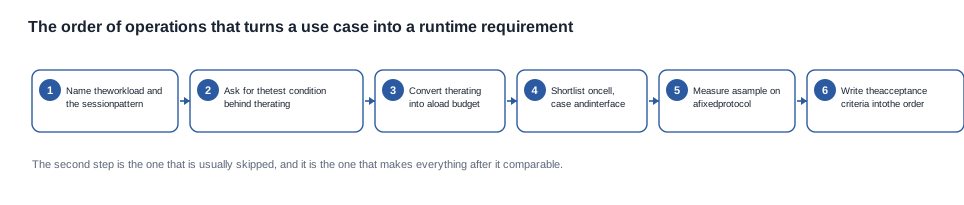
Asking for the condition behind every number
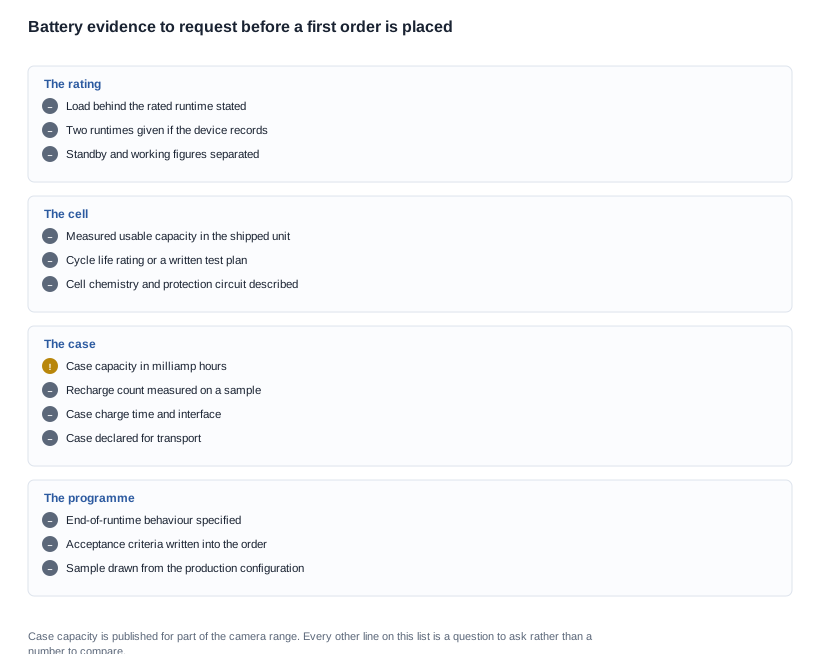
The request list for this category is short, and each line is a standard answer for a supplier to give. The value of the exercise is not that the answers are difficult to obtain. It is that a supplier who answers all of them has told you something about how they run their business, before the deposit.
- What was the device doing during the measurement? Specifically, was the camera active. A runtime measured with the camera off and a runtime measured while recording are two different numbers, and a supplier who cannot separate them has not measured them comparably.
- The full test condition. Signal strength, ambient temperature, volume level, and whether the device was connected to a phone. A figure measured against a weak radio signal is a floor rather than a typical case, and a supplier who quotes it as a typical case is telling you about their test chamber, not about your customer.
- Two runtimes, not one, if the device records. One with the camera active and one without. This is the single most useful question in the category, because it is the question that exposes an incomparable figure, and most supplier documentation carries exactly one.
- The standby figure, stated separately from the working figure. For any product sold on "long battery life" to a customer who will use it intermittently, the standby number is the number the customer will experience and the working number is the number nobody will.
- What happens at the end of the runtime. Which function stops first, whether there is a warning, and whether a charging unit that has run flat will accept a charge without a manual reset.
- The measured usable capacity in the shipped unit, not the nominal figure. Published capacities are nominal, and the usable capacity in a product with a protection circuit is lower. The gap is small in a good design and large in a rushed one, and it is a free question to ask.
- The cycle life rating, or the test plan. With the cycle count, the discharge rate and the capacity retention threshold, and an agreement on which of those the acceptance test will use.
- The case's contribution, stated separately. What the case adds to the day, and how many times a unit can be recharged from it before the case is empty.
The documents to request before a deposit, per model: the battery specification sheet with the test condition written on it, the battery transport file for the fitted cell, the case specification with the capacity and the case's own charge time and interface, the packaging artwork proof showing what is in the box, the agreed incoming inspection criteria, and the cycle life figure or the test plan. The transport documentation is not a preference — the requirements are at battery transport — and it is a document that cannot be assembled after the first shipment.
A worked shortlist: one warehouse shift, written out
The following is a hypothetical sourcing exercise. It is written to show the sequence rather than to report an outcome.
Assume a distribution operator running a single shift, issuing a hands-free scanning headset to a hundred and twenty people, with a thirty-minute break at midday and a dock-side charging point at the start and end of the shift. The binding constraint is not the battery — it is the charging window, because a device that cannot be topped up in thirty minutes is a device that comes off the floor at the two o'clock pick wave.
Step one: name the workload. Audio output at a low working level for most of the shift, short bursts of voice confirmation over a warehouse radio, and no camera in the requirement. That is a light, radio-heavy duty cycle, and it sets the target at something close to a full shift of intermittent work rather than a continuous-runtime figure.
Step two: convert it into a target and a configuration consequence. The target becomes the whole shift without a mid-shift charge, and the configuration consequence is a case or a dock rather than a bigger cell. A case is unusable here — a hundred and twenty people cannot be asked to carry a second object — so the configuration answer is a shared dock at the break point.
Step three: check the published rows against the target. The published runtimes across the audio platforms are six to eight hours of rated runtime, and the 220 mAh camera models publish five to eight. On the face of it that covers the shift. The buyer notes the range in the camera figures and the workload rating in the audio figures, and treats the published numbers as screening values only.
Step four: request the conditions. The supplier answers with a single runtime per model and no camera-active figure for the camera platforms. That single answer is itself the finding: the supplier is not measuring the two workloads separately, which means the published number describes a condition nobody can state. The buyer keeps the platform but writes the condition into the acceptance criteria, and asks for the dock rather than a case.
Step five: measure the sample. The measured run time on a unit running the operator's actual protocol, on the actual radio, at the actual volume, is lower than the published figure. The gap is expected, because the published figure was measured under conditions nobody would recognise. What matters is that the gap is now a number with a protocol attached to it, and that the dock schedule is designed around the measured number rather than the published one.
The result is a programme whose runtime requirement is a measurement instead of a catalogue row, and whose mid-shift charging is a dock rather than twenty individual cases. The decisive decision was made in step one, and nothing about it involved a battery.

Smart glasses battery life: the five patterns where a programme loses money
Five patterns, each with the symptom, the root cause and the prevention, because in this category the failures show up in the margin rather than in the lab.
A rating is quoted as a continuous-use figure when the duty cycle is intermittent. The symptom is a product page that says eight hours and a customer who expected eight working hours. The root cause is that the condition was never published or requested. The prevention is to write the condition into the listing rather than the number.
A camera model is compared with an audio model on runtime. The symptom is a shortlist that gets rebuilt when somebody notices the two rows are not measuring the same thing. The root cause is that the workloads behind the figures were never established. The prevention is to keep them in separate columns and to compare each model against the target its workload justifies.
A charging case is treated as a free accessory. The symptom is a freight cost per unit that nobody modelled and a returns rate with a second object in it. The root cause is that the accessory chain was inherited from a competitor's bill of materials. The prevention is to price the case with the product, and to measure the recharge count before committing to the proposition.
The charge time is assumed to be the same for every model. The symptom is a shift-charging routine that does not fit. The root cause is that two hours or less is true for most of the range while approximately one hour is published for the D17 and the ZH12, and the buyer designed the routine against the average. The prevention is to take the charge time from the model you are actually ordering.
Cycle life is never asked, and then it becomes a warranty problem. The symptom is a warranty file that gets expensive in year two. The root cause is that a component characteristic was never converted into a commercial number. The prevention is to ask for the figure or the test plan, and to write the acceptance criteria for a specified cycle count into the contract.
On commercial terms, the structure is unusually clear. Negotiable: whether the charging case is included and at which capacity, the minimum order quantity tiers, and whether models can be combined in a single purchase order; the case specification differing between markets, which the L2 Utral's published 900 and 1400 mAh options already make possible; splitting a first run into two deliveries against a staged payment; and the share of units taken at the pilot tier rather than the run tier, which is usually where the real room is. Not negotiable: the cell and charging architecture, and therefore the runtime ceiling; certification cost and lead time; and the battery transport documentation, which is a compliance requirement rather than a preference.
The rows we publish, the rows we hold back and the rows to demand
Here, we publish the runtime figures as the catalogue states them, and we will not convert a rated figure into a usable one by guessing at the test setup. For every model in our range the catalogue publishes the cell capacity, the rated runtime and the charge time, and it publishes the charging interface for twenty-four of the twenty-eight and the case capacity for part of the camera range. It publishes no test condition behind any runtime, no usable capacity, no cycle life and no end-of-runtime behaviour for any model, and we will not estimate them from typical values.
That is a deliberate position rather than an absence of data on our side, and it is the reason we can tell you which rows will hold and which will not. It also has a commercial consequence worth naming. In this category, a supplier who quotes a runtime with a condition is worth more than one who quotes a higher runtime without one, even if the second number looks better on the page. The first answer can be written into a specification and into an acceptance test. The second can only be written into a listing, and a listing is the one document in the chain that a customer will hold you to.
Three things to do this week.
- Write the workload row for your use case, with the load named and the target derived from it. The table at the top of this article is the format. If the target is not derivable, the requirement is not yet a requirement.
- Send the eight requests as a list. The two-runtime question and the cycle life question are the two that expose whether a supplier measures comparably.
- Send us the use case, the session pattern and the models you are comparing. We will say which published rows apply, which of the eight we can answer from our documentation today, and which need a sample or a written confirmation from the company. The full set of published battery rows is at battery life, the interface decisions that follow from a runtime target are at charging solutions, and the way to check a delivered unit is at sample evaluation.
Related reading
- The published rows and what they omit — battery life specifications
- The charging decisions behind a longer day — charging solutions
- The case capacities across the range — AI camera glasses range
- The way to check a delivered unit — sample evaluation
Tell us the use case, the session pattern and the model, and we will say which published figure applies and what has to be confirmed.


