
The outdoor decision is a claim decision first. Smart glasses for outdoor procurement is unusual in one specific way: the environment is the specification, and the specification is what the listing is allowed to say. The published position across our range is a resolution class, a cell capacity, a charge time, a rated runtime, a charging interface, a colour count, an ingress marking on two sport camera models, and case capacities that vary by model. The published position is thin on exactly the points that a customer tests in the rain: no ingress test report is published behind the marking, no per-model unit weight is published except for one camera model, no operating temperature range is published, and no runtime test condition is published. So the outdoor buy is a two-channel job. A professional channel buys the documentation and the routine; a consumer channel buys the claim and the configuration that supports it, and a consumer channel that skips the documentation step inherits the risk in the returns column.
Smart glasses for outdoor: the claim the listing is allowed to make
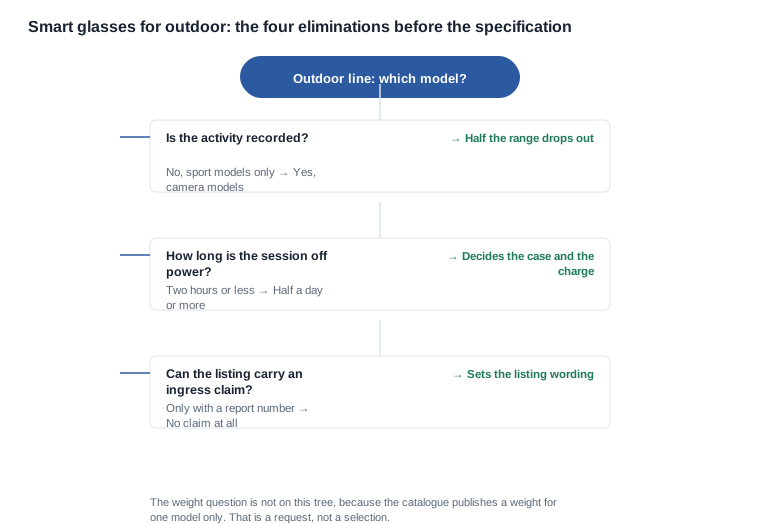
The four eliminations, in the order that saves the most work. Is the activity recorded at all? How long is the session away from a power socket? What does the environment do to the device? And how much does the device weigh? The first two are cheap to answer and each removes a group of candidates. The third determines what the listing may claim. The fourth cannot be answered from our catalogue for almost every model, and that is a sourcing task rather than a selection task.
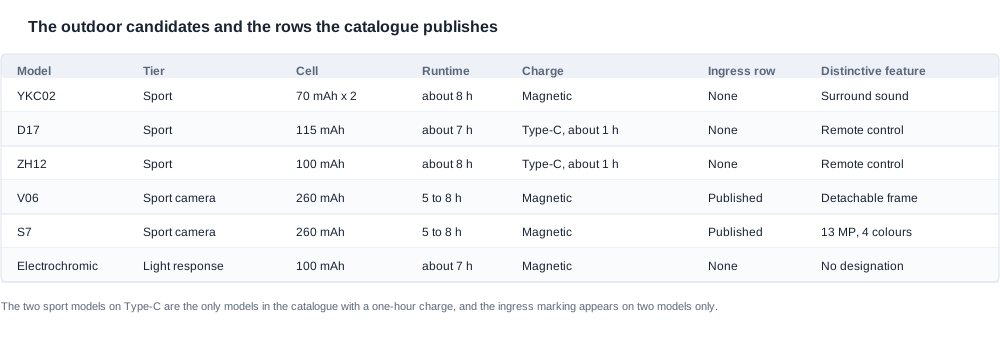
Elimination one: is the activity recorded? If it is not, the camera models are irrelevant and the field narrows to the three sport models. The YKC02 publishes Bluetooth V5.4, two 70 mAh cells, magnetic charging, a rated use of around eight hours, and surround sound with a long-battery-life feature row. The D17 publishes Bluetooth V5.4, a 115 mAh cell, charging over Type-C in roughly an hour, a rated use of around seven hours, and a remote capture control with surround sound. The ZH12 publishes Bluetooth V5.4, a 100 mAh cell, charging over Type-C in roughly an hour, a rated use of around eight hours, and a remote capture control with surround sound. If it is recorded, the field narrows to the two sport camera models: the V06 at 8 megapixels on a 260 mAh cell and the S7 at 13 megapixels on the same cell, both magnetic-charged, both rated five to eight hours, both with a detachable inner frame and both carrying the ingress marking. The sport models are at sport smart glasses and the camera range at AI camera glasses.
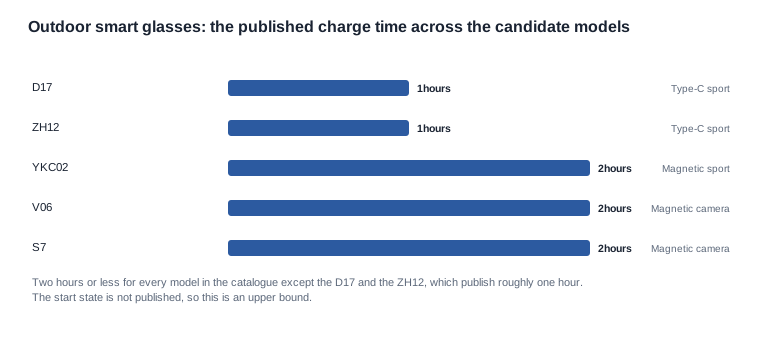
Elimination two: how long is the session away from a socket? This is where the outdoor range differs from the rest of the catalogue in a way that is easy to miss. Every model in our catalogue publishes a charge time, and all of them publish two hours or less — except the D17 and the ZH12, which publish roughly one hour. Those two are the only models in the catalogue with a sub-two-hour charge time, and they are also the only two sport models on a Type-C interface. For an outdoor session measured in hours rather than minutes, a one-hour recharge against a two-hour recharge is the difference between a device that is usable at a midday stop and one that is not.
Elimination three: what does the environment do? The ingress marking appears in our catalogue on the V06 and the S7 only. It covers splashing water and a dust protection level, not immersion and not a sustained downpour, and no test report is published behind it. The reading of the second digit is at IP ratings. Note carefully where the marking does not appear: the three sport models carry no ingress marking at all, so a listing for the YKC02, the D17 or the ZH12 cannot make any ingress claim whatsoever.
Elimination four: how much does it weigh? The published data answers this for one model only. The MT6 is published at 158 g, and that figure is the glasses body including its 265 mAh cell and its camera, excluding the folding charging case, whose own weight is not published. No bare frame weight is published anywhere in the range, and no other camera model publishes a weight. That is not a reason to guess. It is a reason to request a per-model measurement before the packaging artwork is designed, because an outdoor product page without a weight is a weaker page and an outdoor product page with an estimated weight is a liability that shows up in the first review.
The published rows across the sport and camera tiers
| Criterion | How to read the published row | Pass line for an outdoor line | A weak answer in practice |
|---|---|---|---|
| Camera or audio | Whether the activity is recorded | A decision with a stated reason | "Both would work" |
| Cell and rated runtime | Published capacity and rating per model | A figure that covers the session, condition stated | A rating quoted as a working day |
| Charge interface and time | Magnetic across most; Type-C on the D17 and the ZH12 at about one hour | An interface the routine supports | One interface claimed for the whole tier |
| Ingress marking | Published on the V06 and the S7 only | A report number, or a written statement that none exists | "Waterproof" on a product page |
| Colour availability | Four colours on the V06, three on the V03 Pro | A count per configuration | A colour named without a count |
| Frame structure | Detachable inner frame on the V06 and the S7, flexible temples on the V03 Pro | A sizing system for a wide customer range | A feature name with no use case |
| Weight | Published for the MT6 only, at 158 g | A per-model measurement before packaging is frozen | A category average |
| Light response | An electrochromic entry with no model designation | A named model and a documented mechanism | A tint feature with no SKU behind it |
The two sport camera models carry the same four published colours. The V06 publishes four colours, and the S7 publishes the same detachable inner frame and the same ingress marking on the same 260 mAh cell. A brand building an outdoor line from one platform can therefore build a colour ladder from a single platform, which is the cheapest way to make a consumer price ladder. What it cannot do is treat the colour as a free option: each colour is a distinct production combination, with its own minimum quantity, its own artwork and its own listing, and a four-colour launch is four combinations rather than one.
The one-hour charge models are the only two in the catalogue. The D17 and the ZH12 publish roughly one hour of charging over Type-C. Both also publish a remote capture control, which is a procedure answer rather than a convenience feature: it lets a capture be triggered without touching the temple, which matters on a wet or gloved hand. For a professional outdoor deployment, the D17 at 115 mAh and roughly seven hours and the ZH12 at 100 mAh and roughly eight hours are the two candidates where the charging arithmetic works, and they are also the only sport models on a Type-C interface, so the charging hardware can be shared with the rest of the kit.
The electrochromic entry has no model designation at all. Our catalogue carries an AI electrochromic smart glasses entry with Bluetooth V5.4, a 100 mAh cell, magnetic charging, a charge time of two hours or less and a rated use of around seven hours — and no model number. For an outdoor line this is the most interesting and the most awkward entry: it is the obvious answer to a light-response requirement, and it is the hardest to put on a purchase order, because paperwork, packaging and customs description all need a designation that the catalogue does not supply. That designation has to be requested, and it should be requested before the concept is approved, because a product without a formal code cannot be correctly listed on a certificate, correctly packaged or correctly described at the border.
The camera tier's published spread is wider than the sport tier's. Across the eleven camera models the catalogue publishes four cell sizes — 220 mAh, 260 mAh, 265 mAh and 290 mAh — and three case positions: published capacities of 1400 mAh on the L1 Pro and the CY05, and the CY03, 900 or 1400 mAh as a configuration choice on the L2 Utral, and 1200 mAh in the MT6's folding case; a case row with no published capacity on the KY06 and the MT5; no charging-case row listed for the S7 and the V03, and the V06; and the V03 Pro has no charging-case row. A buyer who treats "the camera range" as one product family will build the wrong accessory list.
Three outdoor thresholds: light, session length and weight
Threshold one: the light condition, and what the answer is allowed to be. Outdoor use has three light states and they need three different answers. Direct sun needs a tinted lens. Variable light needs an adaptive lens. Low light needs a clear lens and a good sensor. Only one of those three is solved by a product we publish: the electrochromic entry, whose mechanism is active rather than passive and whose model designation is missing. The alternative route is a lens option on an existing platform — the V03 Pro is published with a photochromic lens configuration and flexible temples — and a lens option is a change to the bill of materials, the optical description and the artwork. Whichever route a buyer takes, the threshold is the same: a written statement of the mechanism, the switching behaviour with its conditions, and the model designation that the paperwork will use.
Threshold two: the session arithmetic, written out rather than estimated. The session length is not the runtime band; it is the runtime band multiplied by the number of sessions and minus the charging windows. The threshold to hold is a written plan for the deployment: how long a session runs, how many sessions a day, where the charging point is, how long the charge takes, and what happens when the charge does not finish. The published rows support that calculation — the runtime bands and the charge times are published for every model — but they do not support it on their own, because the runtime condition is not published and the charge time has no start state and no termination criterion.
Threshold three: the weight, as a precondition rather than a specification. For an outdoor product the weight decides whether the device is carried at all. The threshold is a measured figure per model, on a production unit, with the measurement scope stated, before the packaging and the listing copy are finalised. The one published figure in the whole catalogue is the MT6 at 158 g, and the scope statement matters: it is the glasses body including the cell and the camera, and it excludes the folding charging case. A listing that says "158 g" for a different model, or that says "158 g including the case", is stating something our catalogue does not say.
The threshold that protects both channels. Any claim the listing makes has to be narrower than the documentation behind it. That is not a conservatism; it is a cost decision, because a claim that is challenged costs more in one consumer channel than the entire margin on the affected units. In a professional channel the same rule protects the buyer from a claim dispute in a contract negotiation, and it protects the supplier from a deployment being blamed for a failure that was never covered.
The consumer channel and the professional channel specify different things
The tolerance for a documentation gap is the difference between the two channels. A professional outdoor deployment can absorb a missing ingress report: the buyer writes a claim position, issues a routine, and the acceptance criteria are contractual. A consumer listing cannot absorb it, because the customer has no contract and no inspection criteria — only the listing and the product. The same gap is a documentation task in one channel and a returns problem in the other, which is why the order of effort differs: the professional buyer buys the file and the routine, and the consumer buyer buys the claim and the configuration that supports it.
The word on the supplier's own product page is a warning, not a licence. Our catalogue presents the V06 and the S7 with an ingress marking and a waterproof description on the product page. No test report is published behind that marking, and no report number exists in the catalogue for anyone to check. A brand that copies that language into a retail listing inherits a claim it cannot evidence, in a category where the customer will test the claim in the rain. The safe construction is a statement of the marking and its scope — for example, a rating against splashing water and a dust protection level — with the source and the report number attached, or with the claim omitted.
The case decision is different in the two channels. A professional crew usually does not want a case: it is a second lithium cell to declare for transport, a second object to issue and track, and a second thing that can be lost in a vehicle. A consumer listing usually wants one, because it changes the price point and the perceived endurance, and the published capacities make two price points buildable from one platform. The shipping requirement for the second lithium cell is at battery transport, and the sampling procedure that confirms the configuration is at samples.
The colour ladder belongs to the consumer channel. Four published colours on the V06 is a commercial asset for a retail line and an inventory cost for a professional one, because a professional deployment usually wants one colour. A brand that builds the ladder for the retail channel and the flat configuration for the institutional channel is running two production combinations from one platform, and that has to be priced into the minimum quantities rather than discovered at the second purchase order.
The professional outdoor line has an extra row that the consumer one does not need. The remote capture control published on the D17 and the ZH12 answers an operability problem that a retail customer will never raise and a field crew will raise on the first wet morning. That is the general pattern of the outdoor range: several published features exist to solve a procedural problem, and the buyer has to decide whether the procedure is one they have.
What a supplier has to put in writing for an outdoor line
- Test the sample in the environment — dust, rain, vibration and temperature — rather than in a room, and record the conditions alongside the result. A test result without the conditions is unusable.
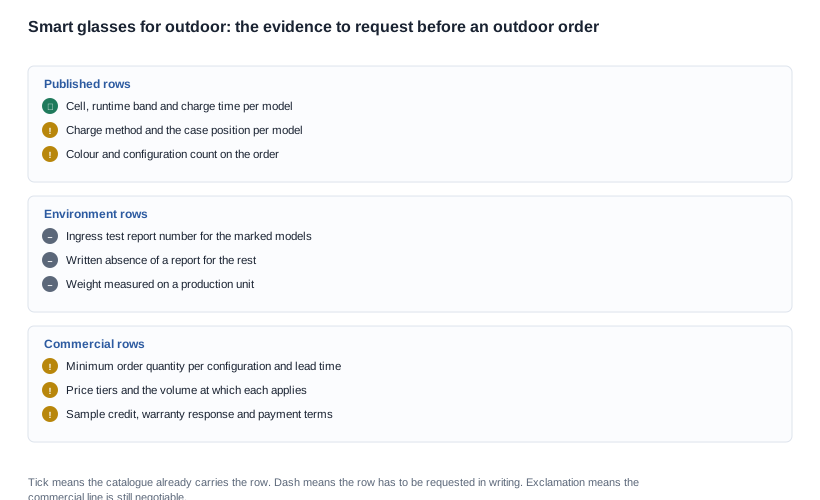
- Ask for the ingress test report — institution, report number and standard — or a written statement that none exists, and then write the listing claim to match whichever answer arrives.
- Ask for a per-model weight, and treat the answer as a precondition for the packaging artwork rather than as a line to be filled in later.
- Ask for the runtime with the condition stated, and for the case specification, its capacity and its input where a case is included in the configuration.
- Ask for the model designation for any entry the catalogue publishes without one, and for the light-response mechanism with its switching behaviour and conditions.
- Confirm the model designation on the unit against the paperwork, check every certificate number in the issuing body's public register through the procedure at certification checklist, and request the battery transport documentation for the exact configuration.
The documents to request before a deposit. The ingress test report or the explicit absence, per model. The per-model weight with its measurement scope. The runtime figure with its condition. The case specification with capacity and input. The model designation table, including the entry that currently has none. The certificate register. The packaging artwork proof with the colour and configuration count on it. The agreed incoming inspection criteria. The clause language is at contract terms, the commercial structure of a first order is at pricing, and the charging decisions are at charging solutions.

Where an outdoor programme breaks after the launch. The first pattern is a listing that claims waterproof on the strength of an ingress marking with no report behind it, and a customer who tests it in the rain and says so publicly. The second is a colour ladder built without counting the combinations, and a second production run that cannot be repeated because the minimum was set per SKU rather than per platform. The third is a professional deployment that discovers the charging window is longer than the session it has to cover, because the one-hour charge models were not considered for a kit that shares its charging hardware with other Type-C equipment.
The commercial structure of an outdoor order, and what we publish
The lines that decide the order. The unit price is the line the supplier controls most and moves least. The lines that decide an outdoor order are the minimum order quantity per configuration, the lead time from purchase order to shipment, the production capacity behind the quoted date, the price tiers and the volume at which each one applies, the colour and configuration count on the order, the artwork and packaging setup cost, the sample cost and whether it is credited, the warranty period with a stated response time, the battery transport documentation for the shipped configuration, and the payment terms including the deposit structure.
What is fixed and what is negotiable. The camera or audio architecture, the cell, the interface and the ingress architecture are fixed. Certification cost and certification lead time are fixed, because they are a per-model cost and a laboratory queue, and pressing on either produces a longer schedule rather than a shorter one. Tooling is a one-off cost usually amortised across the first order. What is negotiable is whether a case is included and at which capacity, the minimum order quantity tiers, whether the camera and sport models share a purchase order, the colour count, the logo, the lens tint and the packaging, whether the supplier funds a second sample round for the environmental testing, whether a first run is split into two deliveries against a staged payment, and the share of units taken at the pilot tier rather than the run tier.
Where the negotiating capital sits. On the setup lines, the per-configuration minimums, the artwork round count, the sample credit, the spare-unit ratio and the payment terms. Not on the unit price of a single model in a single market.
What goes into the agreement. The exact model designations attached to the order, including the designation for the entry that currently has none. The published row values the quotation was priced against, including the colour and configuration list. The ingress position as a written statement. The runtime with its measurement condition. The documentation package with an obligation to re-issue it after any configuration change and to notify the buyer before one. Three parts belong in the warranty terms: how many months of cover, the response that is committed, and the definition of a defective unit. The battery transport file for the shipped configuration.
What we publish and what we will not claim. We publish the structural features, the colour availability, the charging interfaces, the case capacities, the charge times, the rated runtimes, the resolution tiers and the cell capacities exactly as the catalogue states them, and we publish the absence of an ingress test report, a runtime test condition, a per-model frame weight, an operating temperature range and a video specification with the same prominence. We will not state that any product is tested to IP54, and we will not present a rating as an endurance guarantee. Our product catalogue contains a company-level export certification page and no per-model certification row, and it contains no CE, FCC or RoHS marking for any model, so the certification scope for a specific model is material to be requested in writing with the quotation.
What to send us. Tell us the environment, the session length, the channel, the price band and the markets, and we will narrow the range to the two or three models that fit, tell you what your configuration is allowed to claim, and list the documents to settle before the order. The scenario entry point is outdoor, and the sampling procedure is at samples.
Related reading
- The entry point for this scenario — outdoor
- The ingress standard — IP ratings
- The charging decisions — charging solutions
- The sampling procedure — samples


