
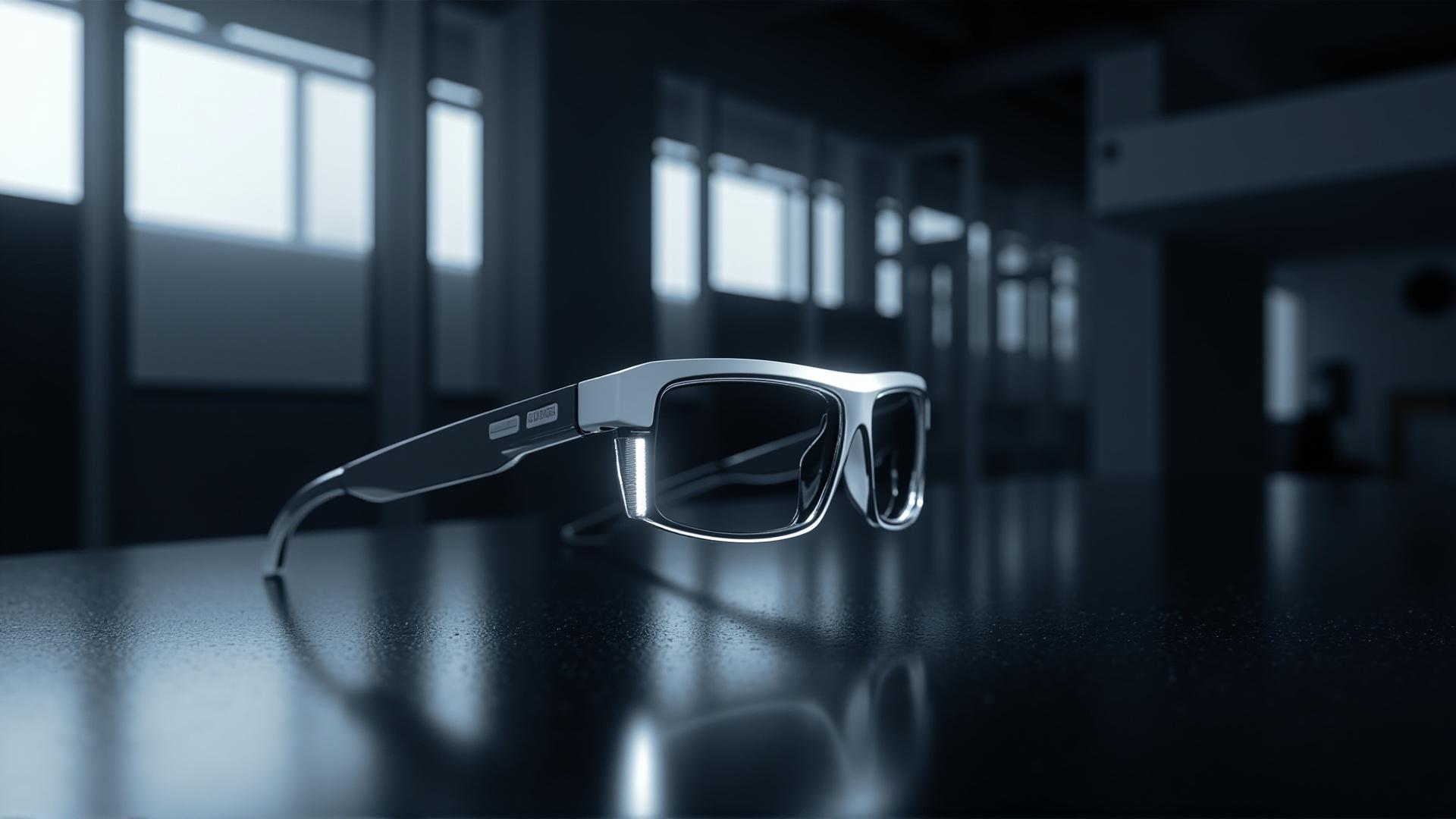
Smart glasses for livestreaming are judged in front of an audience, which makes the lens a production specification rather than a warranty specification. A smudge on a retail unit becomes a returns-desk argument; a smudge on a live unit becomes a bloom that follows the presenter's face for forty minutes, and no returns desk is going to settle it. The buyer of a streaming device is therefore not asking what to tell the customer; they are asking what has to be true before the go-live cue, and the answer is a short, repeatable check backed by a written reference. The catalogue publishes the lens material, the coating and the surface treatment for no model, and it publishes no field of view, no video specification and no frame rate, which means the surface position and the output position have to be settled from documentation rather than from a demonstration. That constraint shapes everything below: the thresholds a production kit should set, the controlled capture that settles a disagreement, and the clauses that let a channel hold a supplier to a procedure rather than to an intention.
Smart glasses for livestreaming: the source that judges a smudge on air
The buyer, the channel, and the cost of a bad take
The reader is a brand owner selling a creator product, an agency that runs content for clients, a platform-affiliated channel buying hardware at volume, or a procurement manager equipping a studio. The task is to specify the device, specify the kit that goes with it, and write the pre-show procedure that the operator will actually follow at the top of a session. The commercial risk being managed is asymmetric in a way that is unusual in this category: the unit cost is small, the unit is rarely returned, and the reputational cost of a bad session is borne by a channel with an audience rather than by a procurement desk with a budget.
That asymmetry changes which decision matters. In most channels the lens decision is about a returns rate. Here it is about repeatability, because a channel that runs four sessions a week experiences a lens problem four times a week and will stop trusting the device for production within a month. The practical question a buyer asks is therefore not "how do I reduce returns on this product" but "what has to be in the kit, and what has to be on the pre-show sheet, so that the same result comes out every time".
There is a second consideration specific to this channel: the device is often used by people who were not trained on it. A presenter, a host or a guest may handle the unit for the first time during a rehearsal, and the rehearsal is usually the only chance to catch a problem before an audience is present. A procedure that assumes the operator has done this before will fail on the day, which is why the pre-show check has to be short, printable and impossible to misread.
Why a live audience makes the lens a production-grade specification
Three things about a live image make a lens contamination more expensive than the same contamination in a returned unit.
The first is that the audience sees it in real time and reacts to it. A retail customer who sees a soft image closes the tab; a viewer does not close the tab, they simply form an impression of the production, and the impression is formed in the first few seconds. There is no review process in which the problem can be diagnosed and fixed, and there is no customer service team between the fault and the brand.
The second is that the contamination interacts with the camera rather than with the eye. A fingerprint is a thin oil film that scatters light; to an eye it is a faint smudge at the edge of the field, and to a camera it is a bright, stable bloom that sits over whatever is behind it. A lens that a presenter can barely notice can be the most visible object in the frame. This is the reason the pre-show check has to be done with the actual lighting rig in place rather than in a room, because the same contamination produces a very different result under a soft key light and under a hard ring light.
The third is that a live stream is compressed. A video codec spends its bits on the differences between frames, and a broad, low-contrast veil across the frame is expensive to encode because it changes the entire picture rather than one edge of it. The practical consequence is that the contamination that a presenter tolerates on the monitor may be materially worse in the delivered stream than it is in the preview.
All three of these push the same way, and the push is decisive: a published resolution tier cannot rescue a dirty lens. Our catalogue publishes an 8 MP class across eight camera models — the V03 and the KY06, the V06 and the V03 Pro, and the MT6 and the MT5, and the CY05 and the CY03 — and a 13 MP class across three — the S7 and the L2 Utral, and the L1 Pro. The extra detail in the higher tier is detail in the scene; a veil that covers the frame is not a detail problem and is not recovered by more pixels. That is why the tier is not the right comparison for a streaming buyer and the surface position is.
What a camera lens does to a broadcast image
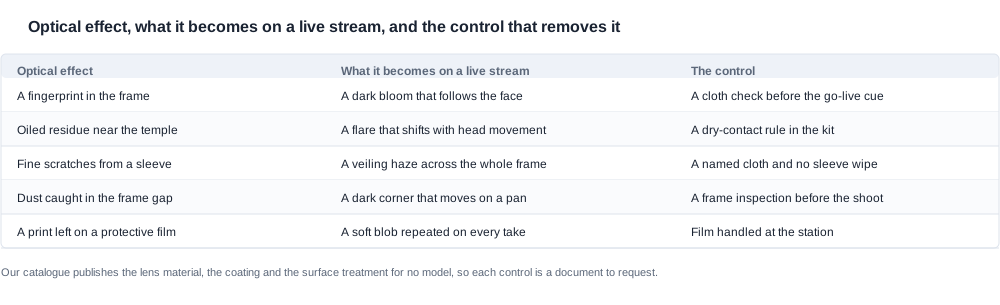
Three optical effects a fingerprint produces on a stream
The first effect is a localised bloom. A fingerprint sits in one place, and light from the key light scatters from the oil film, so the bright spot moves with the presenter's head and stays attached to the face. On a stream this reads as a soft blob that tracks the subject, and it is the most common single complaint in this category because it is unmistakable and it is on screen for the whole session.
The second effect is a veiling haze. Fine scratches distributed across a surface scatter light in every direction, so the whole image gets a low-contrast film over it rather than a local spot. This is the effect that people describe as "the picture looks flat" and that is almost always blamed on the camera rather than on the surface, because there is no visible mark to point at. The path that produces it is a sleeve or a cuff, and it is the path with the least documentation behind it.
The third effect is a moving artefact from the frame gap. Dust caught between the lens and the frame does not sit on the optical path in a stable way, so it produces a dark region that shifts as the camera pans. Operators describe this as a shadow that will not settle, and because it appears on movement rather than on a static shot, it is often attributed to the camera's stabilisation or to the compression rather than to contamination.
There is a fourth, quieter effect worth naming because it is a cost rather than a fault: a lens that has been wiped with the wrong material often looks acceptable at low brightness and fails once the key light comes up on the second run of the session. A channel that changes its lighting between sessions will meet the same kit as good in the afternoon and bad in the evening, and will conclude that the kit is unreliable rather than that the method is wrong.
The thresholds a production kit should set
Six thresholds decide whether a streaming kit can produce the same result on a Tuesday in a rented studio and on a Friday in a room with a window. Each one is written so that an operator can apply it without training.
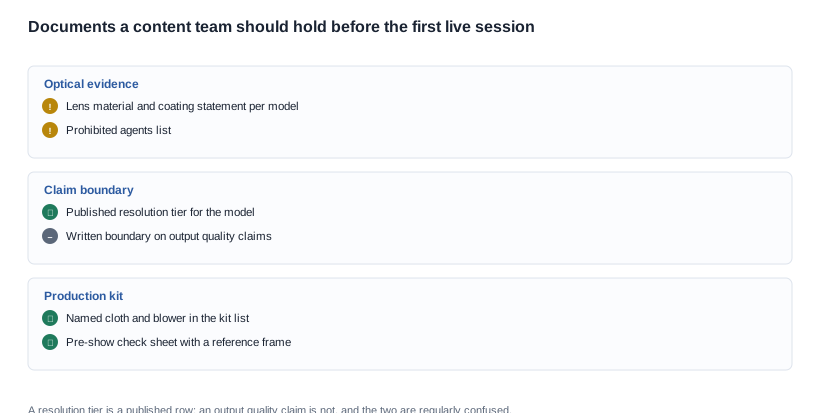
Threshold one: the surface statement for the exact model. How it is measured: a written statement of the lens substrate and the coating treatment, with the model designation on it. Pass line: the statement covers the model in the operator's hand, which for a camera model means one of the eleven camera models rather than the range. What a soft answer looks like: a statement about "our camera glasses" with no model list. For the material behind the lens and the frame, go to materials and ergonomics and the fit questions are answered there.
Threshold two: the prohibited-agents list, with the studio's own products on it. How it is measured: the supplier's list compared against the makeup-grade cleaners, the sanitiser and the screen cleaners that a production kit actually contains. Pass line: the studio's products have been checked against the list. What a soft answer looks like: a generic warning, which an operator cannot apply to a bottle on the desk.
Threshold three: the named cloth and the named method. How it is measured: the kit list states the item, and the method states the order — wipe, then dry, then confirm dry before charging. Pass line: an operator can perform it in under a minute, standing up, without looking anything up. What a soft answer looks like: a kit list that says "cleaning cloth" and an insert that says "wipe the lens", because "wipe" is where most of the damage happens.
Threshold four: the pre-show reference frame. How it is measured: a stored frame captured on the same set with the same rig, with the lens in its known state. Pass line: an operator can compare the live preview against it and call the difference. What a soft answer looks like: a verbal standard, which turns into an argument with the presenter.
Threshold five: the claim boundary on output quality. How it is measured: the published rows against the marketing claims. Pass line: the listing states the published resolution tier and makes no claim about the output of a stream, because our catalogue publishes no field of view, no video specification and no frame rate for any model. What a soft answer looks like: "broadcast-ready", "studio quality" or a stated frame rate, none of which a published row supports.
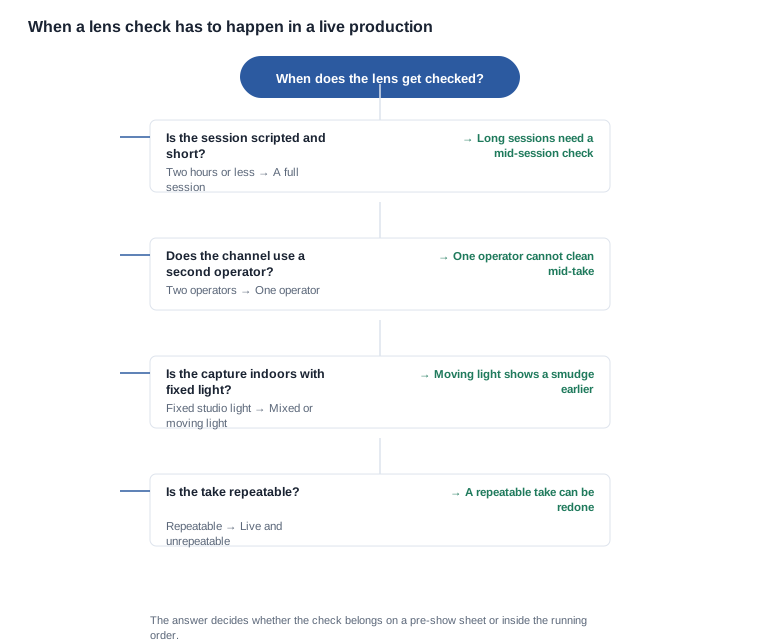
Threshold six: the mid-session rule for long sessions. How it is measured: the session length against the check interval. Pass line: a rule that says when a check happens, and the published rated runtimes — five to eight hours across the camera models — are stated as published rows with no test condition attached. What a soft answer looks like: an assumption that the device will run a whole day and therefore that nobody will look at it.
Verifying a livestreaming lens position with a controlled capture
The A-B capture that settles the argument
The verification method for this channel is different from every other one in the category, and it is available because the failure is visual. Two captures of the same set, one before and one after, settle a question that an inspection sheet cannot.
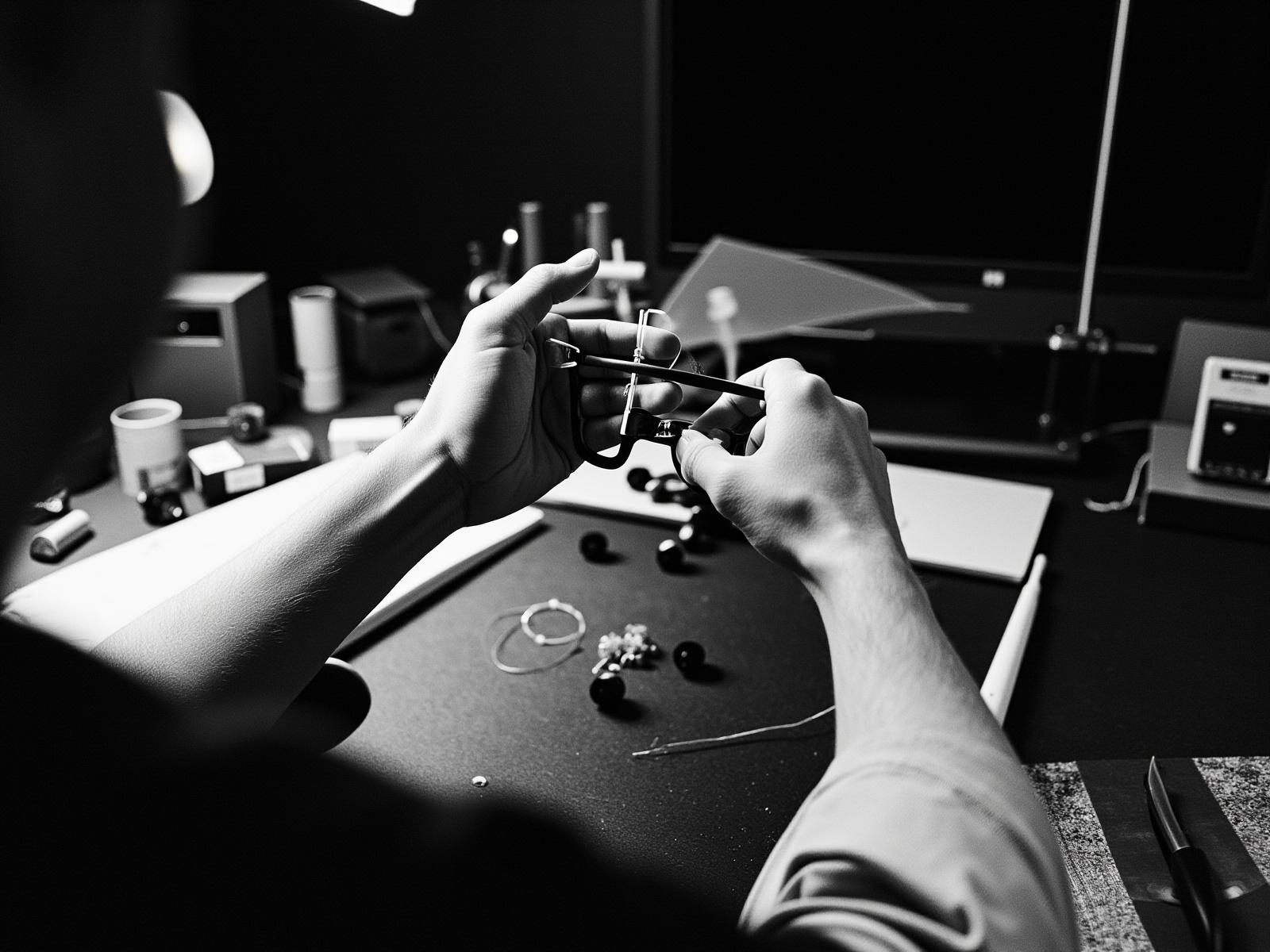
- Capture the set with the sample in its as-received state, under the rig that will be used in production, at full size rather than as a thumbnail. Completion test: a stored frame, and a note of what the lens was touched with beforehand.
- Repeat the identical capture with the named cloth and the stated method applied. Completion test: a second frame from the same position, the same rig and the same exposure.
- Compare the two frames at full size, and record the difference in words rather than in a verdict. Completion test: a written note naming the effect — a bloom that has gone, a haze that has lifted, a dark corner that has cleared.
- Repeat with a deliberately poor method, using a tissue, to establish how much damage the household path produces. Completion test: a third frame and a written note, so the brand can quantify the risk in its own insert.
- Store the approved frame as the pre-show reference and write the comparison step into the pre-show sheet. Completion test: a stored reference frame and a check sheet that names it.

The supporting documents are the surface statement, the prohibited-agents list, the kit list with the named item, the pre-show check sheet with the reference frame, the model designation table, the certificate register and the claim sheet for the listing. The certification register procedure is at certification checklist, the clause language is at contract terms, the commercial structure of a first order is at pricing, and the transport file a configuration with a case requires is at battery transport. The product family is at AI camera glasses and the imaging background is at camera imaging.
The questions to ask a supplier before you order a streaming kit are specific to a production, because most of them are about repeatability rather than about the device:
- What is the lens substrate and the coating treatment for the exact camera model?
- Which agents must not touch the surface, and can the list be reconciled against a studio kit?
- Can a named cloth and blower be supplied as standard, or as a separate line?
- Will you review the pre-show sheet and the claim sheet before either is printed?
- Which published rows can we state in the listing, and which output claims cannot we make?
- What is the published runtime for the model, and is a test condition attached to it?
- Can the same configuration be repeated across orders, with the surface statement unchanged?
- What is the consumable quantity per unit and the restock interval against a session count?
The last question is the one most often left open, and it is the one that determines whether a channel running four sessions a week runs out of cloth in the middle of a month. When to ask the questions is as important as asking them: every one of them is cheap before the purchase order and awkward after the first session that went out with a lens nobody had wiped.
Where a livestreaming lens position fails commercially
Six failure signatures in a live production
The presenter wipes the lens with a sleeve. Symptom: an unexplained flatness in the picture that appears after the first half hour and is blamed on the camera. Root cause: the insert names a cloth but the sleeve is faster. Prevention: a named cloth at the desk and a pre-show check that includes the presenter, not only the operator.
The kit is shared and nobody owns it. Symptom: the cloth is missing on the day of the session. Root cause: the consumable was specified per operator rather than per device. Prevention: one cloth per device, issued with the device.
A film left on for the shoot. Symptom: a soft blob that repeats on every take, which looks like a sensor fault and gets escalated to the supplier. Root cause: the film removal step was not written into the pre-show sheet. Prevention: the film step as an explicit line on the sheet.
A chemical in the studio kit. Symptom: haze that appears after a cleaning round and never quite clears. Root cause: a screen cleaner or a sanitiser used near the lens. Prevention: the reconciliation of the studio's own products against the prohibited-agents list, done once and redone when the products change.
A resolution claim on the listing. Symptom: a channel that bought on a tier and evaluates on an image, and finds the difference is not where they expected. Root cause: the published tier was read as an output guarantee. Prevention: the claim sheet, with the published tier and its limits written side by side.
A check that happens only before the session. Symptom: a long session that degrades visibly in the second half. Root cause: the check interval was never set against the session length. Prevention: the mid-session rule, set against the published runtime rows.
The clauses a content brand should write
A worked scenario for a creator brand going live weekly
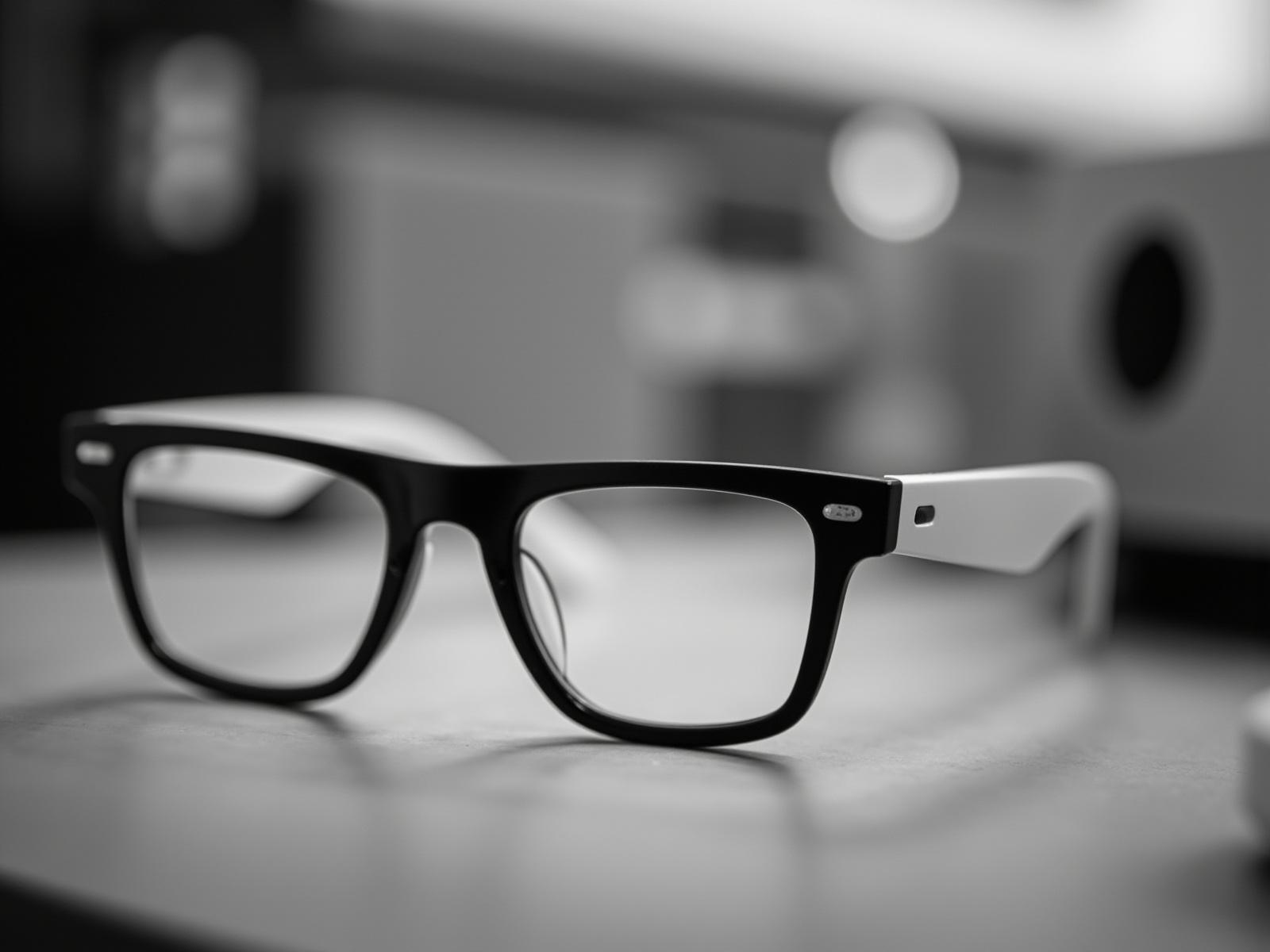
Take a creator brand that runs four live sessions a week from a rented studio, sells a camera model as part of a kit, and has one operator who is not present for the final rehearsal of each session. The first decision is the kit, and it is settled on the operator's absence: a cloth per device issued with the device, a named blower in the station list, and a print of the pre-show sheet inside the case lid, because an instruction that is on the case is the only one that will be read when the presenter picks the device up. The second decision is the reference frame, and it is settled by capturing it on the actual studio rig and storing it with the channel's graphics, so that the check is a comparison rather than an opinion. The third decision is the session-length rule, and it is settled against the published runtime rows for the model rather than against a guess: the check is scheduled part-way through a long session and at the start of any session after a lighting change.
The fourth decision is the claim sheet, and it is settled before the listing is written: the published resolution tier is stated, and no output-quality claim appears, because the catalogue publishes no field of view, no video specification and no frame rate for the model. The fifth decision is the consumable replenishment, and it is settled on the session count rather than on the unit count, since a four-session week consumes cloth faster than a four-unit order would suggest. The sixth decision is the supplier relationship, and it is settled by asking for the surface statement and the prohibited-agents list before the first order and by keeping the A-B frames in the documentation pack, so that a later question about a unit's surface can be answered with a comparison rather than with an opinion. The outcome is a production that repeats the same result across sessions and a channel that stops treating the device as a variable.
Where the commercial room sits in a content kit
The lens material, the coating and the surface treatment are fixed for a model revision, and the certification cost and lead time behind them are a cost of market access rather than a price item; tooling belongs on its own line so that the one-off charge stays visible. What a content brand can move is the consumable and its format, the case or dock that holds the kit, the artwork of the pre-show sheet, whether the supplier will review that artwork, the quantity of consumables per unit and the restock interval against the session count, the split of a first delivery into batches against a staged payment, and the share of units taken at the pilot tier. On a channel that runs weekly, the consumable restock interval is worth more attention than the unit price, because the failure mode of running out is a session that goes out with a lens nobody has wiped.
What we publish for content teams, and what we will not claim
Stated plainly: we publish the rows a buyer can order from and the absence of the other rows with the same prominence, because a channel that discovers a missing row during a session cannot act on it. For this range that means the resolution tier — the 8 MP class across the MT6 and the MT5, the CY03 and the V03 Pro, and the CY05 and the V06, and the KY06 and the V03, with the 13 MP class covering the L2 Utral and the S7, and the L1 Pro — the cell capacities from 40 mAh to 290 mAh, the charge times, the rated runtimes between five and eight hours, the charging interface per model, the case capacities where they are published, the colour counts, and the structural features the catalogue states.
What we do not publish, and will not estimate: the lens material, the coating, the surface treatment, the field of view, the video specification, the frame rate, the runtime test condition, the standby draw, the cycle-life rating, the operating temperature range and the per-model unit weight. We publish one weight figure in the whole catalogue — 158 g for the MT6, a camera model, which is the whole unit including its 265 mAh cell and its camera and excluding the folding charging case — and we will not present it as a frame weight. We will not state that any product is tested to IP54, because the marking appears on the V06 and the S7 with no test report published behind it and no marking is published for the other models. We publish no output-quality claim and no broadcast-readiness claim, because the catalogue supports neither.
What we will do: take the session profile, the rig, the studio and the volume, and tell you which published rows apply to each model, what the kit list should carry, what the pre-show sheet should reference, and which claims the available evidence supports. The product family is at AI camera glasses, the scenario entry point is smart glasses for livestreaming, and the selection logic upstream of the lens position is at how to choose smart glasses for livestreaming.
What to send us next. Send the session length, the number of sessions a week, the rig, the studio conditions and the volume, and we will return the published rows for each model, the kit list and pre-show sheet structure, and the claim boundary in writing.
Related reading
- The scenario's starting point — smart glasses for livestreaming
- The family this product sits in — AI camera glasses
- The imaging background — camera imaging
- The obvious question to ask — materials and ergonomics
Send us the session profile and the rig, and we will return the kit list and the pre-show sheet structure.


