
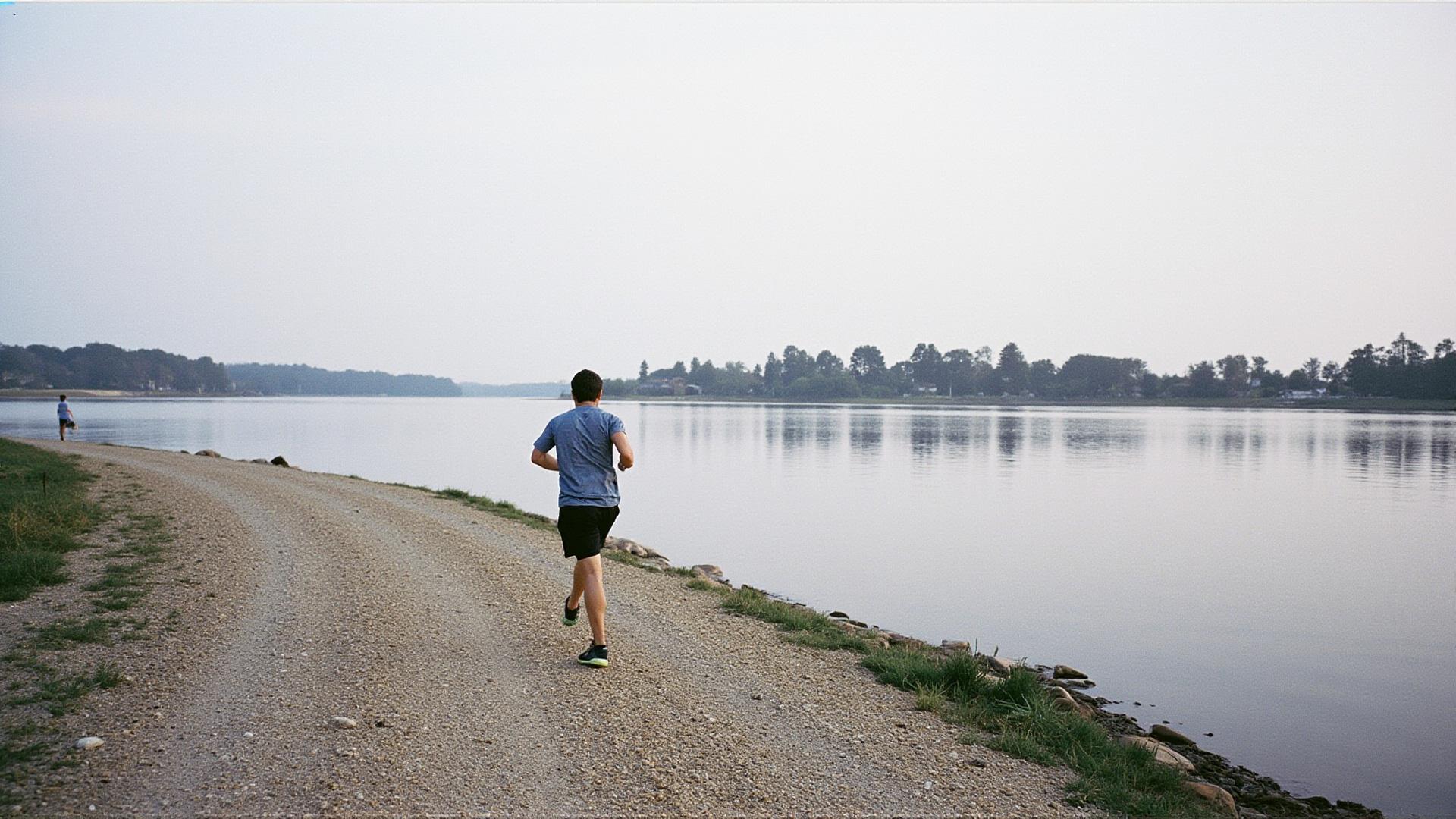
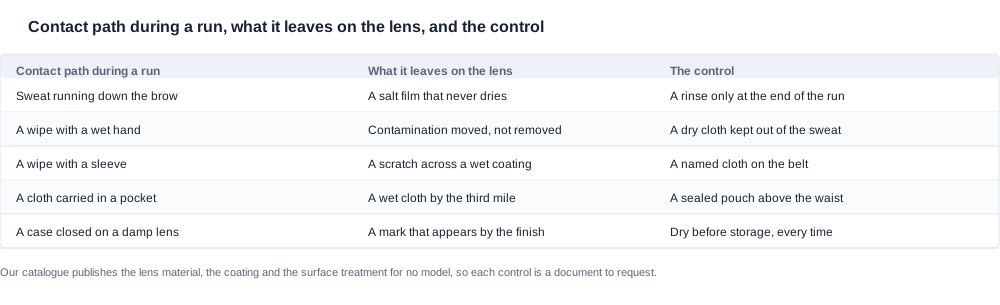
Smart glasses for running are wiped mid-stride, with one hand, with whatever that hand is holding, while the body is moving. That single fact is what separates this channel from every other one in the category, and it is the reason the ordinary answer — "wipe it with a cloth" — fails here in a way it does not fail anywhere else. A cloth in a running pocket is a wet cloth by the third mile. A wet cloth moved across a lens that has salt on it does not remove the contamination; it redistributes it. And if there is any grit on the surface at that moment, the wet pass is what turns it into a scratch. The control for a running range is therefore not the instruction and not the packaging; it is the consumable design, because the consumable has to be dry, reachable one-handed, and separate from the sweat. The catalogue publishes the lens material, the coating and the surface treatment for no model in the range, which means that decision has to be made from documents rather than from a specification row — and the documents have to be requested before the accessory bundle is designed.
Smart glasses for running: the desk wipe versus the running wipe
The buyer, the channel, and the moment the wipe happens
The reader is a sports brand, a running-channel buyer, or a product manager deciding whether a running line is worth adding at all. The task is to select the model, decide the accessory bundle, decide what the listing claims about sweat and weather, and decide what the runner is told to do at the point where the lens stops being usable. The commercial risk being managed is a peculiar one: a running product is reviewed by people who are sympathetic and honest at the same time, so the review that damages a running line is rarely about a defect. It is a sentence like "the lens was smeared the whole way", and that sentence is written about a control the brand could have specified.
The second commercial characteristic of this channel is the audience. A running brand sells to a community rather than to a segment, and the community publishes. A run club, a review channel or a creator running with the device produces content that other runners read, and the lens appears in that content whether or not the run was meant to be filmed. That means the lens state is not a private matter between one runner and one cloth; it is visible to an audience, in motion, at the exact moment the runner cannot stop to fix it.
The third characteristic is that the wipe is involuntary. Nobody plans to wipe a lens mid-run; the lens marks, the runner notices, and the hand goes up. Whatever is in that hand becomes the cleaning implement. So the question a running brand has to answer is not "how do we tell runners to clean the lens" but "what will be in their hand at mile ten when they do it", and that is a question about the accessory bundle and the insert, not about a warning.
Why a running wipe is not a desk wipe
At a desk the wipe is deliberate, the surface is dry, and the implement is under the user's control. On a run, all three of those conditions fail at once. The surface is wet with sweat, the implement is whatever the hand has, and the action is a reflex rather than a decision. That combination is what makes the running case worth specifying separately.
The chemistry matters first. Sweat is salty, and salt in contact with a surface under a warm skin will leave a film as it dries. A lens that has been running with salt on it has a layer that a dry cloth will smear into a haze rather than lift, because the film has bonded to the surface rather than sitting loosely on it. The correct sequence for a running product is therefore a rinse at the end of the run, not a wipe during it — and the insert has to say so, because the alternative is what every runner does.
The mechanics matter second. A wet cloth moved across a surface with any particulate on it is a grinding pass, and a grinding pass on a coating whose specification is unpublished is how a scratch becomes permanent. Dry, the same motion is less damaging because the particles move with the cloth rather than staying under it.
The access matters third. A consumable that lives in a running pocket shares the pocket with a phone, a key and a card, and it will be wet within a short distance of the start. A consumable that lives in a sealed pouch above the waist stays dry. That single design decision — pouch, position, separation — is worth more than any instruction the brand can print, because it is the only one the runner does not have to remember.
What a run does to a lens between the start line and the finish
Three contact paths that never involve a cloth
The first path is the brow line. Sweat runs down the forehead and onto the top edge of the lens, and on a running device that contact is continuous rather than occasional. Where the frame meets the brow there is also the removable inner frame on the V06 and the S7, which is the part of the product that actually meets the skin, and therefore the part along which the salt path runs. That makes the inner frame a serviceable component rather than a cosmetic one, and it is worth asking whether spare inner frames exist and what they cost, because a running range that replaces the whole device for a worn inner frame is paying for the wrong part.
The second path is the reflexive wipe. It happens with a wet hand, it uses the back of the hand or a sleeve, and it happens in motion. The consequence is that contamination is moved rather than removed, and that any particulate present becomes the abrasive in a grinding pass.
The third path is the storage path after the run. A device put into a case while the lens is damp closes a wet surface against the case interior, and it does so for the whole trip home. A device put into a pocket goes into a pocket with a warm body and a wet lining. Both are the same failure in different packaging, and both are solved by one line in the insert: dry before storage, every time.
The thresholds a running range should set
Six thresholds decide whether a running range can be specified defensibly, and they are tighter than they look because the runner has no time.
Threshold one: the surface statement, per model. How it is measured: a written statement of the lens substrate and the coating treatment with the model designation on it. Pass line: the statement covers the model the runner will carry, and it can be attached to the insert artwork. What a soft answer looks like: a general statement about "our sport glasses" with no model list. How the lens and the frame are made is covered at materials and ergonomics, where the fit questions sit alongside it.
Threshold two: the consumable specification, not just the consumable. How it is measured: a written specification of the item and of how it is carried. Pass line: a named cloth, a sealed pouch, and a stated position — above the waist, out of the sweat path. What a soft answer looks like: "a cleaning cloth included", which says nothing about where it lives between mile one and mile forty.
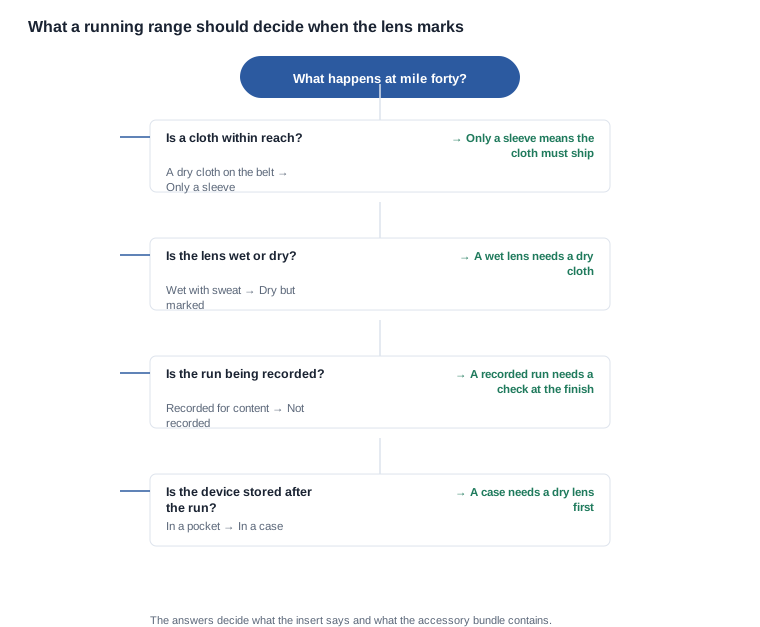
Threshold three: the wipe-during-run rule. How it is measured: an instruction that says what to do when the lens marks mid-run. Pass line: the instruction says that a dry cloth is used on a dry lens, that a wet lens is left until the run ends, and that a sleeve is not used. What a soft answer looks like: "wipe the lens if needed", which under load produces the wet grinding pass.
Threshold four: the rinse-and-dry rule at the end of the run. How it is measured: the stated sequence, in order. Pass line: rinse with clean water, dry thoroughly, then wipe, with the dry step written as a step. What a soft answer looks like: "clean after use", which is where most of the salt stays.
Threshold five: the storage rule. How it is measured: the condition the device must be in before it goes into a case or a pocket. Pass line: dry, stated as a precondition rather than as an assumption. What a soft answer looks like: a case instruction that does not mention moisture at all.
Threshold six: the runtime expectation against the event. How it is measured: the published rated runtime against the length of the event the product is sold for. Pass line: no expectation beyond the published rows. The catalogue publishes rated runtimes between five and eight hours across the range — the sport models publish about seven hours on the D17, about eight on the ZH12 and about eight on the YKC02, and the camera models publish between five and eight hours — and none of them carries a test condition, so a claim about a long-distance event has to be a claim the supplier supports, not one our rows support. What a soft answer looks like: "up to 20 hours", which belongs to a different family entirely and does not apply to a running model.
Verifying a running lens position on a real route
A field test that counts wipes rather than opinions
The verification for this channel has to be done on a route, with a real runner, because the failure is behavioural and a desk demonstration cannot reproduce it.
- Issue the intended configuration to a runner who has not been briefed, with the accessory bundle as it would ship. Completion test: a written record of what was in the bundle and what the runner did with each item.
- Count every wipe on the run, and record the state of the lens at each one. Completion test: a count, with a photograph at the first, the middle and the last wipe.
- Repeat the run with the shipped cloth carried in the sealed pouch, so the pouch is tested rather than assumed. Completion test: a second count, and a note of whether the cloth was still dry at the finish.
- Photograph the lens at the finish under one fixed light, and compare against a pre-run reference frame. Completion test: a paired photograph set showing the accumulation rate over the distance.
- Write the insert rule from what actually happened, not from what was intended. Completion test: an insert draft in which every instruction matches a recorded behaviour.

The supporting documents are the surface statement, the prohibited-agents list, the consumable specification and pouch artwork, the wipe-during-run and rinse-and-dry instructions, the storage rule, the model designation table, the certificate register and the spare-parts position for any removable frame. The certification register procedure is at certification checklist, the clause language is at contract terms, the commercial structure of a first order is at pricing, and the transport file a configuration with a case requires is at battery transport. The product families are at sport smart glasses and AI camera glasses.
The questions to ask a supplier before you order a running range are about the route rather than about the product:
- What is the lens substrate and the coating treatment for the exact model?
- Which agents must not touch the surface, and can the list be reconciled against what a runner carries?
- Can a named cloth and a sealed pouch ship as standard, and can we specify the pouch artwork?
- Is there a published test condition behind the rated runtime, and what does it cover?
- Do spare removable inner frames exist for the models that publish one, and at what price?
- Can the supplier review the wipe rule and the rinse-and-dry sequence before they are printed?
- What ingress position can we publish for this model, and is a report behind it?
- Can the same configuration and the same surface statement be repeated across seasons?
The fifth question is the one that changes a running range's cost structure. A model with a removable inner frame that cannot be replaced separately turns every damaged frame into a device replacement, and no supplier will raise that with you unless you ask.
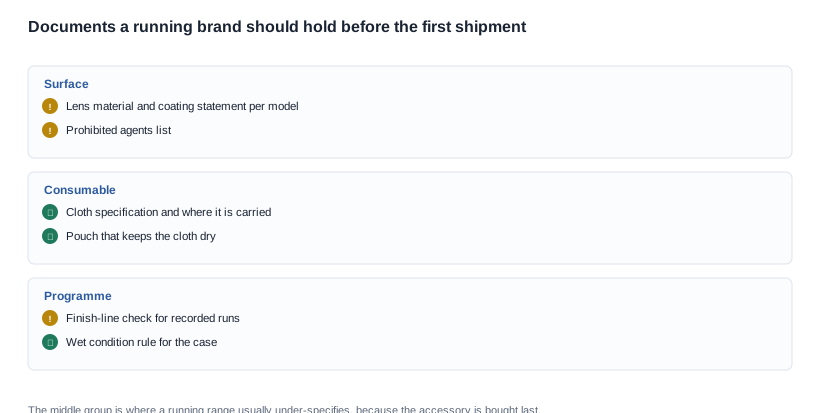

Where a running lens position fails commercially
Six failure signatures in a running range
The sleeve wipe. Symptom: a scratch that appears after a first long run and is reported as "the coating is poor quality". Root cause: the insert did not forbid the only implement the runner had. Prevention: the wipe rule, printed where the runner will see it before the run rather than after it.
The pocket cloth. Symptom: a lens that gets worse rather than better when it is wiped. Root cause: a wet cloth moved over a salted surface. Prevention: the sealed pouch, above the waist, specified as part of the bundle rather than as an afterthought.
A case closed on a damp lens. Symptom: a mark visible at the start of the next run, with no explanation. Root cause: no dry-before-storage precondition. Prevention: the storage rule and a dry cloth in the bundle.
A sweat-resistance claim with no row behind it. Symptom: a customer in a downpour, and a brand explaining that no rating is published. Root cause: an outdoor adjective used in place of the digit reading. Prevention: the ingress position quoted from the catalogue — the V06 and the S7 publish an IP54 marking with no test report behind it, and no other model publishes a rating — and no claim beyond it.
A runtime promise for a long event. Symptom: a device that stops recording before the end of the run, and a review that says the battery is poor. Root cause: an expectation set above the published rows. Prevention: the expectation written against the published runtime, with the absence of a test condition stated.
A worn inner frame replaced as a whole device. Symptom: a running range that quietly becomes a replacement programme. Root cause: no spare-parts position for the removable inner frame. Prevention: ask for spare inner frames and their availability, and price them into the bundle.
The clauses a running brand should write
A worked scenario for a run club partnership
Take a running brand supplying a club of two hundred members with a camera model for club runs and a content partnership with two run channels. The first decision is the bundle, and it is settled on the wipe behaviour rather than on price: a named cloth in a sealed pouch, positioned above the waist, issued with the device and replaced with it, plus a second cloth in the pouch for the rinse-and-dry step at the finish. The second decision is the wipe rule, and it is settled on what the runner will actually do: the insert says that a wet lens is left until the run ends, that a sleeve is never used, and that a dry cloth is used on a dry lens only — which is a shorter instruction than a generic cleaning paragraph and far more likely to be followed.
The third decision is the storage rule, and it is settled on the two places a runner puts the device: a case is closed only on a dry lens, and a pocket is used only on a dry lens. The fourth decision is the runtime expectation, and it is settled against the published rows, with the club's longest event in mind and a recharge point built into the club's own logistics rather than assumed away. The fifth decision is the spare-parts question, and it is settled by asking what a spare removable inner frame costs and how it is ordered, so that the club's damaged frames do not become device replacements. The sixth decision is the channel partnership, and it is settled by giving the two run channels a documented protocol — a check at the finish before filming — so that the content a club produces shows a clean lens rather than the state it was in at the start of a long run.
Where the commercial room sits in a running range
The lens material, the coating and the surface treatment are fixed for a model revision, and the certification cost and lead time behind them are a cost of market access rather than a price item; tooling belongs on its own line so that a one-off charge stays visible. What a running brand can move is the consumable and the pouch that keeps it dry, whether the pouch is supplied by the brand or sourced separately, the artwork of the wipe rule and the rinse-and-dry sequence, the wording of the storage rule, spare inner frames for the models that publish a removable frame, the consumable quantity per unit and the replacement interval against the run calendar, the split of a first order into batches against a staged payment, and the share of units taken at the pilot tier. For a brand selling into a club or a channel the consumable specification is the most commercially important line in the agreement, because it is the only line that changes what the runner does.
What we publish for running ranges, and what we will not claim
It is worth being precise: we publish the rows a buyer can order from and the absence of the other rows with the same prominence, because a runner meets the consequence of a missing row at the worst possible moment. For this range that means the resolution class, the cell capacities from 40 mAh to 290 mAh, the charge times, the rated runtimes between five and eight hours, the charging interface per model, the published Bluetooth versions, the colour counts, the case capacities where they are published, and the structural features the catalogue states — the removable inner frame on the V06 and the S7, and the detachable temples published on the sport models.
What we do not publish, and will not estimate: the lens material, the coating, the surface treatment, the hinge specification, the field of view, the video specification, the runtime test condition, the standby draw, the cycle-life rating, the operating temperature range and the per-model unit weight. We publish one weight figure in the whole catalogue — 158 g for the MT6, a camera model, which is the whole unit including its 265 mAh cell and its camera and excluding the folding charging case — and we will not present it as a frame weight or carry it across to a running model. We will not state that any product is tested to IP54, because the marking appears on the V06 and the S7 with no test report published behind it. We publish no sweat-resistance claim, no waterproof claim and no endurance claim beyond the published rated runtimes.
What we will do: take the models, the events, the distance, the climate, the channel and the volume, and tell you which published rows apply to each model, what the accessory bundle should carry, what the insert should say, and which claims the available evidence supports. The product family is at sport smart glasses, the scenario entry point is smart glasses for running, and the selection logic upstream of the lens position is at how to choose smart glasses for running.
What to send us next. Send the models, the events and their distances, the climate, the channel and the volume, and we will return the published rows for each model, the bundle and insert structure, and the claim boundary in writing.
Related reading
- The scenario entry point — smart glasses for running
- The product family — sport smart glasses
- The surface question — materials and ergonomics
- The published rows — battery life
Send us the models, the events and the climate, and we will return the bundle and insert structure.


