

Smart glasses bluetooth version: the weakest of the four methods
Comparing smart glasses bluetooth version smart glasses how to compare is a question with an uncomfortable answer: the strongest comparison method is one that most suppliers cannot supply, because it requires a module part number, and the next best requires a sample that most buyers skip. The version number itself ranks near the bottom of the available methods despite being the one everybody uses.
There is a reason it ranks there, and it is worth stating plainly because it changes what a buyer should ask for. A Bluetooth version identifies a generation of the specification, not a part. Two products both marked with the same version may use entirely different silicon, with different radio characteristics, different antenna designs, different power behaviour in idle, and different coexistence behaviour. The version is a statement about the specification the product claims to implement; the module is a statement about the hardware that will actually be in the customer's hand.
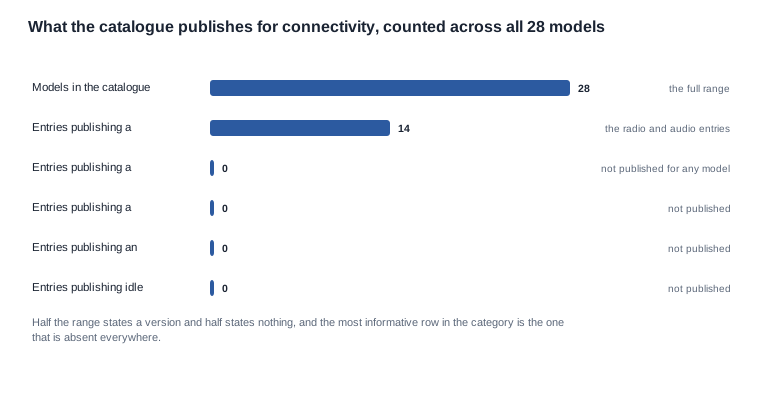
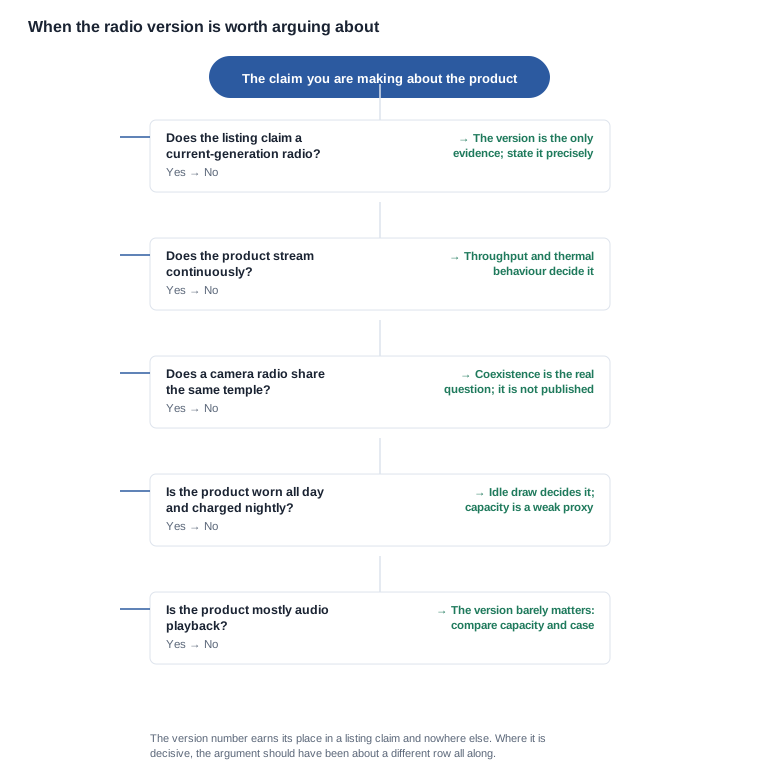
So the version earns its place in exactly one place: a listing claim about what generation the product implements, where it is the only evidence available and it has to be stated precisely. Everywhere else, the deciding rows are workload-specific, and in most of them the version number does not appear at all.
The buyer who needs the radio to hold up, and the failure it causes
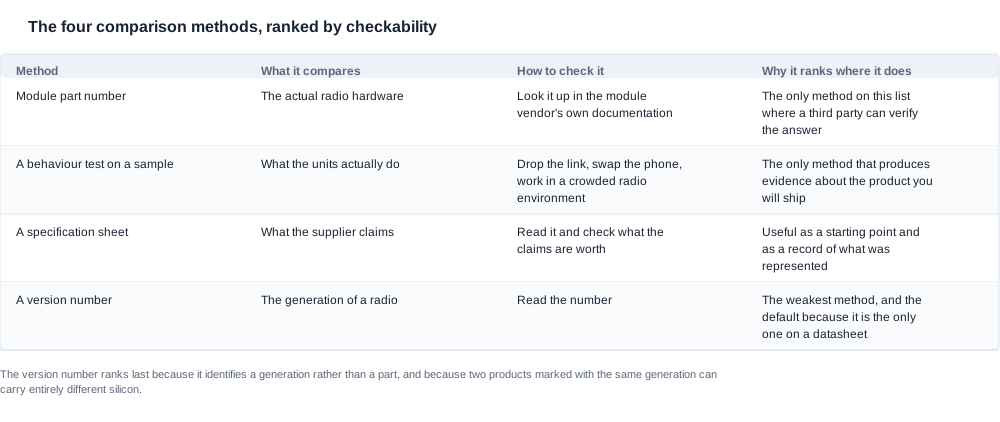
The four methods, ranked by checkability
Method one, the module part number, compares the actual hardware. It can be looked up against the module vendor's own documentation, which tells you the radio generation, the supported profiles and the expected power behaviour. It is checkable, which is the property that makes it useful — nothing else on this list has it.
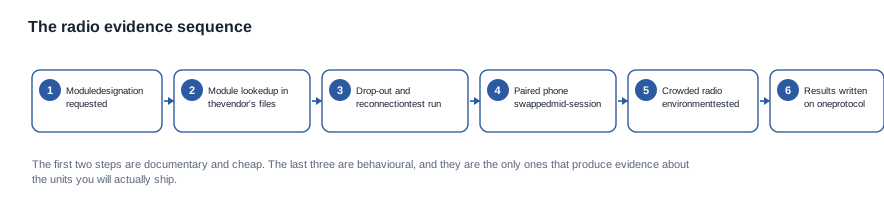
Method two, a behaviour test on a sample, compares what the units do. Reconnect after a deliberate drop-out, swap the paired phone, work in a crowded radio environment. This is the only method that produces evidence about the product you will actually ship, and it is the only method a buyer can run without any cooperation from the supplier.
Method three, a specification sheet, compares what the supplier claims. It is useful as a starting point and as a record of what was represented to you, which matters more than buyers expect when a dispute arrives later.
Method four, a version number, compares the generation of a radio. It is the weakest of the four, and it is the default because it is the only one available on a datasheet.
The ordering is not a matter of taste. Methods one and two produce a fact about your product. Method three produces a fact about a conversation. Method four produces a fact about a specification family, and a specification family is the level at which a comparison cannot end.
Where our own range falls on that ranking
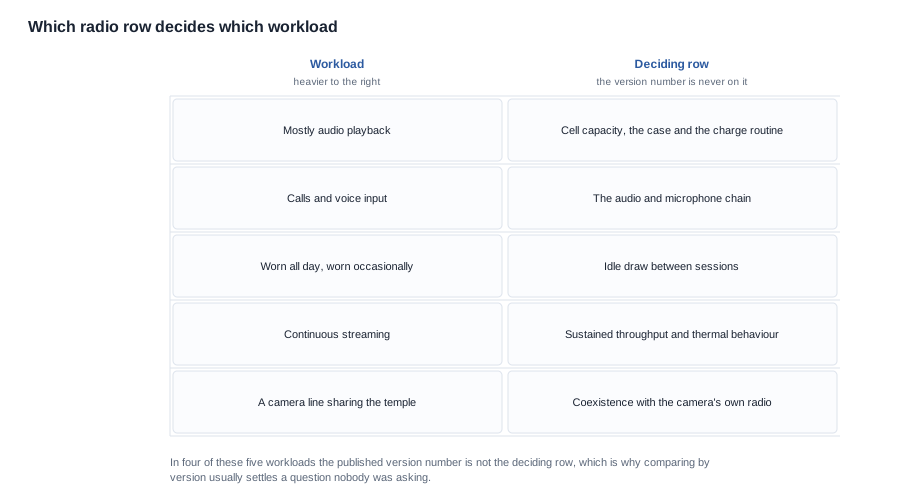
We publish a Bluetooth version for 14 of our 28 models: 5.3 on the K01 and the K02, and 5.4 across the D11, the D12, the LC-105-1, the LC-105-2, the G07, the YK12, the YKC02, the D17, the ZH12, the A07, the AR entry and the electrochromic entry. The remaining fourteen entries publish no version, and they are almost entirely the camera platforms and the two children's protective models.
We publish no module part number for any model. So the strongest method on this list cannot be used against our range from published data alone.
That is worth stating as a practical matter rather than a confession. If radio comparison is a selection criterion for your project, you will need to obtain module detail from us directly, and you should establish whether that is possible before you shortlist. We cannot answer it from the catalogue, and pointing you at the version number as a substitute would be a poor answer dressed as a helpful one.
The radio rows that decide a comparison, and the workloads that make them decisive
The coexistence question inside a shared temple
This is the question that the version number answers least well, and it is specific to this category rather than to Bluetooth in general.
A smart glasses temple carries a radio and, on camera platforms, a camera module, a speaker, a battery and, in some configurations, a charging connector. A radio that shares a physical structure with a camera, a speaker and a charger is a radio operating in a crowded electromagnetic environment, and its behaviour there is a property of the design rather than of the specification generation. The keep-out around the antenna, the location of the radio relative to the camera's own emissions, and the behaviour of the connector are all design decisions.
The practical form of the question is narrow and answerable. Ask the supplier whether the antenna keep-out around the charging interface was reviewed as part of the design, and whether the radio has been characterised with the camera active rather than with the radio alone. A supplier who answers with a certification reference is one thing; a supplier who answers with a design review is another, and the second answer tells you the product was engineered rather than assembled.
Where the configuration uses a physical charging connector in the temple rather than a magnetic contact — and several of our published entries do, including the ZH12 and the D12, the D17 and the V03 Pro, and the D11 — this question is sharper, not softer, because a connector is a larger metal structure in the same temple as the antenna.
The pairing, reconnection and idle rows
The pairing and reconnection row. How many devices does the product hold in its paired list, does it connect to two at once, and what happens after a drop-out — does it reconnect to the device it was on, or to the first available one? For a product used with a phone and a laptop, or a phone and a work handset, this is the difference between a product that works and a product that becomes a support call. None of it is stated for any model in our range.
The idle draw row. For a product worn all day and charged nightly, the energy consumed between uses is the number that determines whether a customer charges it or stops wearing it. The published capacity figures are a weak proxy for it, because a radio's idle behaviour depends on the implementation and the module rather than on the cell.
The sustained throughput row. For a product streaming continuously, throughput and thermal behaviour decide whether the connection holds. A radio that throttles after twenty minutes is a different product from one that does not, and the specification generation does not describe either.
The remote and accessory row. Where a product ships with a remote control, there is a second pairing relationship whose behaviour is not published, and a buyer who has not asked about it will discover it in the field. The same applies to a charging case with its own radio.
The six questions worth asking, in the order to ask them, are these. Written in full, they cost one message and they will tell you within a week whether the radio is a selection criterion for this project or a detail you can leave alone.
- What module is fitted, and who is the module vendor?
- What is the Bluetooth qualification reference for the shipped configuration, and which model does it name?
- How many devices are held in the paired list, and does the product connect to two at once?
- After a drop-out, does it reconnect to the last device or the first available one?
- Was the radio characterised with the camera active, and with the charging interface in place?
- What is the idle current, and under what conditions was it measured?
A supplier who answers all six has a radio programme. One who answers two has a datasheet, and a datasheet is what you would have got anyway.

How to test radio behaviour on a sample
Each step has a written completion condition, because a radio observation without a protocol is an anecdote.
- Obtain the module designation for each candidate, with the module vendor named. If the supplier will not give it, record that as a finding and move to step two.
- Look the module up in the vendor's own documentation. Note the radio generation, the supported profiles, the expected power behaviour and any stated coexistence information. This step costs nothing and it is the only documentary check available.
- Run a deliberate drop-out and reconnection test. Interrupt the connection in a defined way — walk out of range and back, or power-cycle the paired device — and record what the product reconnects to and how long it takes.
- Swap the paired phone mid-session. The failure this exposes is the one that generates returns, because the customer's expectation is that a product will return to the device it was last on.
- Test in a crowded radio environment. A depot, a trade show floor, an office with a dense wireless network, a hospital. If the product is sold into any of those, the quiet room result does not predict the field.
- Record the results on the same protocol for both candidates, with the environment, the distance, the device and the date for every observation.
Two units of each candidate, as with every other measurement in this category. A radio characteristic that differs between two units of the same model is a manufacturing variance finding, and it is worth knowing about before the volume arrives.
The breakdowns that make a radio comparison a false conclusion
Four breakdowns and the conclusions they produce
A version is treated as a part number. Symptom: two candidates are shortlisted as radio-equivalent and one of them reconnects differently in the field. Root cause: the version was used as if it identified the module. Prevention: ask for the module, and treat the version as a listing claim only.
A published version is compared against an unpublished one. Symptom: a comparison table has a blank cell for a camera model, and the conclusion drawn is that one supplier documented a number and the other did not. Root cause: fourteen of our entries publish a version and fourteen do not, and the blanks were treated as a difference in the products rather than a difference in the documentation. Prevention: keep the blanks labelled as blanks, and plan the comparison around the rows both sides published.
A version difference is read as a quality difference. Symptom: a product is chosen for a marginal radio generation reason, and a more important row — the audio chain, the cell, the case, the case for the product's actual use — is left unexamined. Root cause: a visible specification was allowed to stand in for a decision. Prevention: rank the selection criteria by workload, not by specification.
Coexistence is never asked about. Symptom: a camera product drops its connection or degrades its capture when the two functions are used together. Root cause: the radio and the camera were treated as independent subsystems. Prevention: ask whether the radio was characterised with the camera active, and test the combination rather than the parts.
There is a fifth pattern that is documentary rather than technical and is the one that catches out careful buyers. The certification document is accepted without resolving the number. A declaration that a product complies with the Bluetooth specification is not the same thing as a resolvable reference, and a buyer who never asks for the number cannot check the model designation against it. The register approach is set out in the certification checklist.
The value of radio evidence, and the file it produces
Where the room to move sits, where it does not, and the radio file
The radio line is where a buyer is most often handed a specification rather than a choice, so the commercial terms that restore a choice are worth the negotiation time. Those terms are:
- Unit price and volume tiers.
- Whether the module can be quoted as a specified option or a specified alternative, which is a different conversation from accepting whatever the factory has fitted that month.
- The accessory set with its own minimum order quantities.
- Packaging specification.
- Delivery splitting against a sample-approval milestone.
- Payment node structure, with a balance on inspection before shipment.
- The warranty period with a stated response, and specifically the treatment of connectivity complaints, which in a smart glasses line are a disproportionate share of the first three months of field data.
The radio platform of a given model, and therefore its coexistence and idle behaviour, does not move. Certification cost and lead time follow the testing body rather than your order size, and the qualification route for the shipped configuration is settled by the module that goes into the box. The tooling charge is shown separately and spread over the first order.
The file to request before the deposit is: the module designation, with the module vendor and the version of the module's own documentation; the Bluetooth qualification reference for the shipped configuration, with the model designation it names; the pairing limit and the concurrent-device behaviour; the antenna arrangement, or at least the design review position on the keep-out around the charging interface; the idle current, and the sustained-throughput test condition if one exists; and the model designation on the quotation, so that every one of the above can be tied to a unit.
A worked example: a brand with a camera line and an audio line
A worked example appears below, built to show how the version check sits within the wider sequence. It does not describe a real purchase.
Assume a brand with two product lines: a camera product for a consumer channel and an audio product for a business channel. The brand has been asked by a retailer whether the two are on the same radio platform, and it cannot answer, because the audio entry publishes a Bluetooth version and the camera entry publishes none.
Step one, the question that matters. The brand asks which of its two lines is radio-critical, and the answer is not symmetric. The audio product is worn continuously, used for calls, and sits in a shared office; the camera product is used in short sessions and mostly offline. The retailer's question was therefore aimed at the wrong line, and the brand says so rather than answering it.
Step two, the module request. The brand asks the factory for the module designation for one model on each line, with the module vendor named. One is provided. For the camera line, the factory states that the module is not fixed across production and will be confirmed at the order, and the brand records that as a finding rather than a yes.
Step three, the coexistence question. Because the camera line is the one with a crowded temple, the brand asks whether the radio was characterised with the camera active. The answer describes a separate characterisation of the radio and the camera independently, which is a real gap. The brand writes the combination into its own sample test rather than accepting the two separate results.
Step four, the behaviour test. Two units of each line. A deliberate drop-out and reconnection, a paired-phone swap, and a crowded radio environment — a depot for the audio line and a trade show floor for the camera line. The audio product reconnects to the last device in one case and to the first available in the other, on two units of the same model. That is a manufacturing variance finding, and the brand takes it to the factory before the order rather than after the first field complaint.
Step five, the decision. The brand now has two different answers to the retailer's question: the audio line is a documented radio platform with a qualification reference, and the camera line has a module that is confirmed at the order and a coexistence position that the brand has tested itself. Both answers are defensible, and both were produced by asking rather than by reading a datasheet.
Step six, the commercial structure. For the camera line, the brand asks for the module to be fixed for the duration of the programme with a notice obligation before a change, because an unfixed module is a documentation problem for the retailer's own file. For the audio line, it negotiates the warranty treatment of connectivity complaints explicitly, since that is where the first quarter of field data will concentrate.
The result is a brand that can answer the retailer's question, knows which of its two lines is radio-critical, and has a written position on the line that is not.
What our catalogue publishes for connectivity, and what it does not
We publish the versions our documentation states, and we do not fill the gaps for the fourteen entries where none is given.
What we publish: the Bluetooth version for 14 of 28 models — 5.3 on the K01 and the K02, 5.4 on the D11, the D12, the LC-105-1, the LC-105-2, the G07, the YK12, the YKC02, the D17, the ZH12, the A07, the AR entry and the electrochromic entry. What we do not publish for any model: a module part number, a pairing limit, a concurrent-device behaviour, an antenna specification, an idle current figure, a coexistence test result, or a sustained-throughput condition.
The technical background is under bluetooth connectivity, the terms are defined in the bluetooth version glossary, and the workload-based framing is in bluetooth version by use case. Testing behaviour rather than specifications is covered at sample evaluation.
How to open a radio question with us
Ask us for the module on a specific model, not for a comparison against another supplier, and we will tell you whether we can evidence it. If we hold it, we will say so and name the model it applies to; if we do not, we will say that rather than pointing you at the version number as a substitute. And tell us the workload — continuous streaming, all-day intermittent use, calls, or mostly playback — because that is what determines which radio row is the one worth arguing about, and in several of those workloads it is not the version at all.


