

Most of the terminology in a smart glasses bluetooth version smart glasses glossary matters for one reason: it lets you tell the difference between a term that identifies the hardware and a term that only describes a generation. Version numbers describe a generation. Part numbers identify hardware. Quoting in this category is easy when the distinction is kept, and expensive when it is not.
The glossary below is built around that distinction rather than around alphabetical order, because a buyer does not need to know what a word means in the abstract — a buyer needs to know what to ask next when a supplier uses it. Every entry therefore carries a second line: the question it implies. A glossary that only supplies definitions leaves a buyer with vocabulary and no leverage.
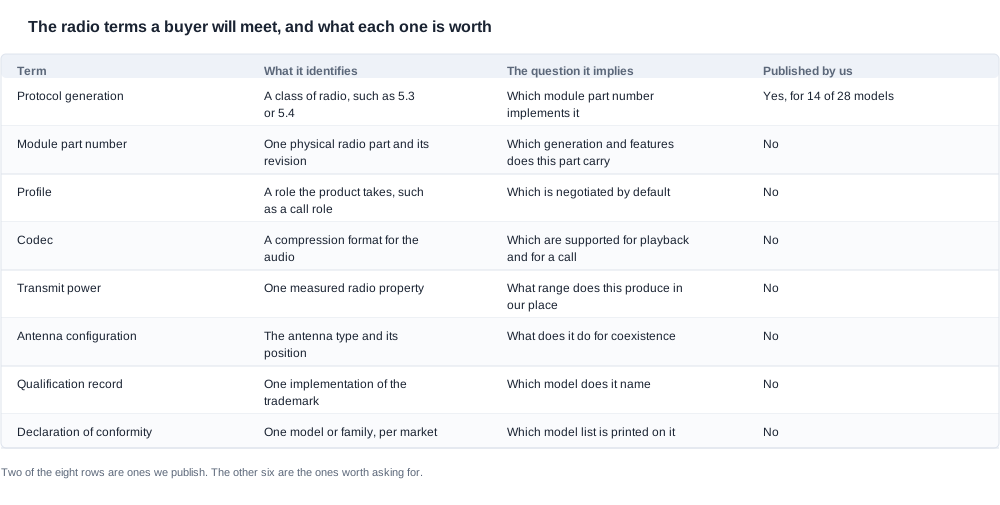
Smart glasses Bluetooth version: hardware terms versus generation terms
Module part number. The single most useful term on this list and the one most often absent. A module part number can be looked up against the module vendor's own documentation, which tells you the radio generation, the supported profiles and the expected power draw. It is checkable, which makes it worth insisting on, and it answers four other questions at once — which is why a supplier who cannot give it is short several answers without realising it.
Our catalogue publishes no module part numbers for any of the twenty-eight models. If a buyer needs one, they have to ask, and the answer is a request to engineering rather than a catalogue lookup.
SIG listing reference. The Bluetooth qualification record for a radio. Like the part number, it is verifiable independently, which is the point. It names an implementation rather than a model, and a buyer reading it can establish which module it covers and therefore whether it covers the product in front of them. Not published for any model in our range.
Declaration of conformity. The document that states a product conforms to a market's requirements. It is unit-level in the sense that matters commercially, because it carries a model list, and the model list is what decides coverage. A buyer who holds a declaration has to read the list and compare it against the model on the carton, and the comparison is the entire value of the document.
Model designation. The string on the unit, the carton, the listing and the artwork. It sounds too obvious to be in a glossary, and it is here because the category contains genuine inconsistencies: our own catalogue publishes one entry as "L2 Utral", with a note that "Utral" appears to be a typographical rendering of "Ultra", and a further designation of "Utral Pro Max" whose meaning is not published to us. The light-responsive and bone conduction entries have no model designation at all. Where the designation on the unit and the designation on a document differ, neither covers the other.
Against those four, the class-level terms.
Three phrases a supplier uses when it is avoiding a unit-level answer
Three patterns come up so often in this category that a buyer who recognises them can move the conversation forward without a confrontation.
"It is the latest version." This is a class-level statement with a superlative attached, and it is the one most likely to appear in a quotation or a listing. The question behind it is which module part number implements the version, because the part number converts the superlative into a fact. If the supplier answers the part number, the superlative is no longer needed.
"It supports the full feature set." This is a class-level statement with no class attached, and it is close to unanswerable as it stands. The way to make it answerable is to name the features: which profiles, which codecs, how many devices held at once, and what the update path is. A supplier who answers those four has given a feature list that can be tested; a supplier who does not has not made a claim, they have made a mood.
"Fully certified for the target market." This one is more dangerous than the other two, because it sounds like the unit-level answer. It is not: it describes a relationship rather than a document, and a relationship cannot be filed. The question behind it is which model designations are named on which approval, for which market, and the answer to that question is either a document reference or an admission that the work has not been done.
None of these three is a sign of a bad supplier. A supplier working from a catalogue that does not carry the underlying data will use them, because they are what the catalogue supports. The buyer's job is not to catch the supplier out but to move the conversation one level down, from the class to the unit, and to write down what comes back.
Protocol generation. 5.3 and 5.4 in our range. These identify a class of radio, not a module. Two products both marked 5.4 may use entirely different silicon. The generation tells you what era of capability to expect; it does not tell you the behaviour of any particular unit.
BLE. Bluetooth Low Energy. Every model in our range uses it. It is worth naming because Classic Bluetooth is a different profile with different connection behaviour, and some supplier language blurs the two. A buyer who has been told a product is "Bluetooth" has been told nothing at all, because the word on its own does not distinguish the two.
Our catalogue states a version for fourteen of the twenty-eight models — 5.3 on the K01 and the K02, and 5.4 across the A07, the D11, the LC-105-1, the D12, the YK12, the LC-105-2, the G07, the YKC02, the D17, the ZH12, the AR entry and the light-responsive entry. The remaining fourteen, which are almost entirely the camera platforms together with the A05, the A06 and the bone conduction entry, state no version at all.

Class-level terms against unit-level terms, and why the distinction decides the quote
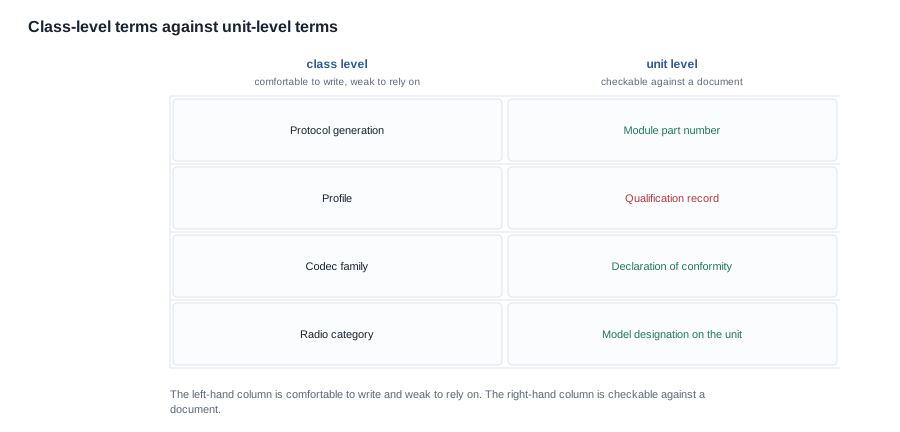
The practical test for any term a supplier uses is short: does it identify the specific unit you are buying, or does it describe a class of product? Version, codec, profile and generation describe a class. Part number, listing reference, declaration and model designation identify the unit.
That test is worth more than it looks, because it changes what a buyer does with the answer. A class-level answer is something you note and then convert into a question, because the class is not what you are buying. A unit-level answer is something you file, because it can be checked against a document and can be quoted back at a supplier who later changes the position.
Class-level answers convert into questions. "Bluetooth 5.4" becomes "which module part number implements it, and what does that part support". "HD audio supported" becomes "which codec list, and does the call path use it". "It pairs with any phone" becomes "which profile does it take by default, and how many devices are held at once". The conversion is mechanical and takes a few seconds, and it is the difference between a supplier call that produces information and one that produces adjectives.
Unit-level answers get filed and then reused. The module part number goes into the technical file, the declaration goes into the market folder, and the model designation goes into the artwork pack. On the next order for the same model, these are the first three things anybody asks for, and a programme that has them ready is a programme that negotiates from a position.
There is a third category, and it is the one that quietly causes trouble. A supplier-specific term — a house name for a module, a marketing name for a feature set, a tier label like "Pro" or "Max" — is neither a class nor a unit. It looks like a unit because it is a specific string, and it behaves like a class because it means whatever the supplier decided it means. The handling is the same as for any class-level term: note it, and ask what it maps to on a document.
Audio terms: the profile and the codec are separate rows
Codec. The compression format used for the audio. It is relevant because a codec affects both quality and power draw, and because a product can support a radio generation without supporting wideband speech. A buyer who has only a version has a category and no format.
A2DP. The profile governing audio playback. It tells you the product can stream audio. It says nothing about the microphone, and a buyer who assumes otherwise will be disappointed by a call in a noisy place.
HFP. The profile governing hands-free calling. This is the one that matters for a product whose main function is a call, and it is where wideband speech, if supported, is implemented. It is also the profile a product is most likely to fall back to when the host offers something else, which is why the default is a question worth asking.
HD voice / wideband. A speech bandwidth mode, wider than the narrowband default. It is a separate capability from the radio version — a 5.4 radio does not guarantee it — and it is one of the clearest examples in the category of a feature that a buyer will assume and cannot obtain. Not published for any model in our range.
Multipoint. Simultaneous connection to two devices. Useful for a buyer whose customers carry a phone and a watch, and not stated for any model in our range. It is worth asking about specifically because it is one of the features most often assumed from a newer generation, and the assumption is that the radio can do it rather than the firmware.
Latency. The delay between an input and an output. In this category it matters for the camera shutter and for the audio path, and it is a property of the firmware stack and the application rather than of the generation. Not published for any model in our range.
Transmit power and antenna configuration. The two numbers that determine range, which is the question buyers most often believe the version has already answered. The power is a measured value with a unit; the antenna configuration is a description of what is fitted and where. Neither is published for any model in our range, and a buyer who has both has the only route to a range answer that does not involve a bench test.
A worked example of translating class terms into questions
Take a single line in a supplier's response and follow it all the way through, because the sequence is the same on every programme and it is worth doing once properly.
The line is "Bluetooth 5.4, supports HD audio, multipoint, and pairs with all phones." Four class-level claims, no unit-level answer, and a buyer who accepts it has a file with nothing in it.
The first move is the generation. "Which module part number implements 5.4, and what revision is fitted on the units you are quoting?" The answer is either a part number — in which case the generation claim is now anchored to a part that can be looked up — or a deflection, which tells the buyer that the radio details sit somewhere they have to be requested separately.
The second move is the audio claim. "Which codec list is supported for playback, and which for a call?" A supplier that answers this has narrowed the claim to something testable, because a codec list can be checked on a sample with a fixed clip. A supplier that answers "HD audio" again has not narrowed anything, and the buyer now knows the claim is a marketing label rather than a specification.
The third move is the multi-device claim. "How many devices are held at once, and what happens to the first connection when the second arrives?" The second half is the part that matters, because a count without a behaviour is another class-level statement. A description of the takeover is a behaviour, and a behaviour can be written into an acceptance criterion.
The fourth move is the phone claim. "Which profile is negotiated by default, and which phones are in the test set?" The answer replaces "all phones" with a set, and a set can be tested and can expire — which is exactly the form a compatibility statement should take in a product listing and in a channel document.
What the buyer ends up with after four questions is a small, specific, testable set of statements, and a supplier who answered all four has a documentation habit that is worth more than any individual row in the answer.

Regulatory terms: qualification, declaration, and what each one is not
The qualification. The Bluetooth SIG's approval of one implementation for trademark use. It is not a regulatory approval, it does not open a market, and it is tied to an implementation rather than to a product or a version. A radio module change is a new implementation and therefore a new qualification. The Bluetooth SIG compliance material covers the distinction in full.
The declaration. A manufacturer's statement that a product conforms to the requirements of a market, and it carries the model list that defines its scope. It is a market access document and it is the one a buyer should read first when they are asking which markets a product may be sold into.
The technical file. The evidence behind the declaration, and in a wearable product with a microphone and an application, this is where the substantive work sits rather than in the radio. Not published for any model in our range.
EN 18031 category. The cybersecurity classification that follows from what the product does rather than from what radio it carries. Where a product carries a microphone and an application, the personal-data category is the one that applies. The category is set by the product's function, and the EN 18031 material describes the evidence behind it. Not published for any model in our range.
The market route. The regulatory framework a destination applies. The Radio Equipment Directive (EU) 2014/53/EU in the European Union, with the EN 18031 harmonised standards cited into it, and the General Product Safety Regulation (EU) 2023/988 applying from 13 December 2024. UKCA in the United Kingdom, on a framework that has diverged from the European one. FCC equipment authorisation in the United States, which is a separate framework rather than a derivative.
The model list. The clause that appears at the end of most of the documents above and the one that decides what any of them covers. A family-level document does not cover a specific variant, and the certification checklist covers how to read the list rather than assuming it.
Two terms deserve a note because buyers use them incorrectly. A family approval is not coverage of a variant, and a platform reference is not a document at all. Both are commonly offered in place of a model list, and both leave the buyer unable to establish what is covered.

Using the glossary as a question list in a supplier call
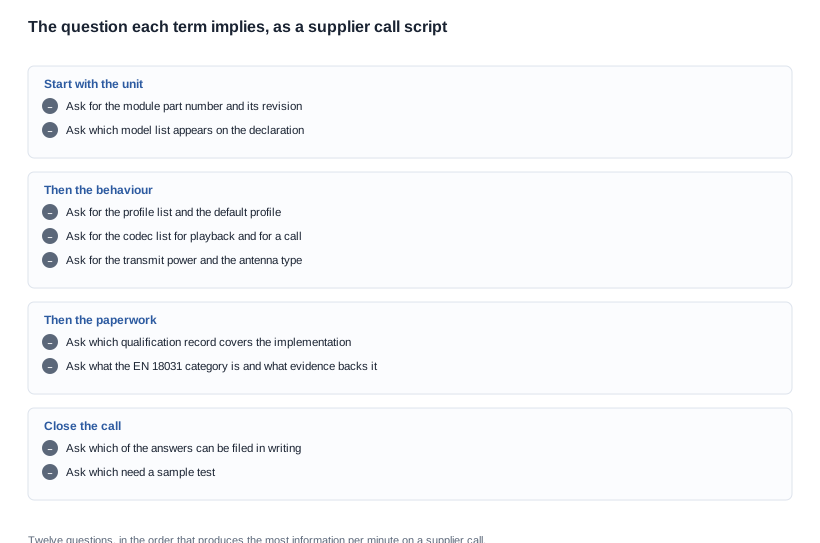
The practical test for each term is whether it names the specific unit you are buying or describes a class of product. When a supplier uses only class-level terms, that is normal and not suspicious — most do. The point of the glossary is to know which question to ask next.
Start with the unit. Ask for the module part number and its revision, and ask which model list appears on the declaration. These two answers identify the hardware and the coverage, and they are the two that turn the rest of the conversation into something specific.
Then the behaviour. Ask for the profile list and the default profile, the codec list for playback and for a call separately, and the transmit power with the antenna configuration. These are the rows that decide what a customer experiences, and none of them is on a datasheet.
Then the paperwork. Ask which qualification record covers the implementation, and what the EN 18031 category is together with the evidence behind it. The category question is worth asking in that order because the answer determines how much work the second question is.
Close the call. Ask which of the answers can be filed in writing and which need a sample test. That question converts a supplier conversation into a plan, because it sorts the answers into the two categories the procurement file needs — the ones that become acceptance criteria and the ones that become a test protocol.

A few practical notes on the call itself. Write down the supplier's own words rather than a paraphrase, because a paraphrase is where a class-level term quietly becomes a unit-level one. Ask the same question twice if the first answer was a class, using the unit-level term the second time. And do not close the call while any answer is still an adjective, because an adjective cannot be written into a purchase order and cannot be checked at goods-in.
What this glossary cannot tell you, and what we publish
Nothing in this glossary establishes quality. Every term on it describes capability rather than performance. Two products with identical radio terms can behave very differently, and the only way to find out is a sample — a connection, a transfer, a call, in the environment your customer will use. The sample evaluation material covers how to turn those terms into evidence.
We also cannot fill in the version for the fourteen models where our documentation states none. We would rather leave that gap visible in a glossary than invent a value to complete a table, and the same rule applies to every other row on this list: no module part number, no transmit power, no antenna configuration, no profile list, no codec list, no qualification reference, no certificate number.
On radio terminology, that we publish the terms our documentation supports and mark the ones it does not. In practice that means we can tell you a generation for half our range and nothing at all for the other half, and we cannot name a module, a chipset or a qualification reference for any model.
Buyers frequently tell us the radio version is their top selection criterion. We would gently push back on that: for an audio platform the version rarely decides the outcome, and for a camera platform it is the class where the version matters most and is least published. Ask for the part number instead — it answers the version question and four others at once.
The technical treatment is under bluetooth connectivity. For the camera platforms where radio detail is thinnest, how to choose a camera platform sets out what is and is not published, and comparing camera platforms works through the comparison itself. A working list of the questions this glossary generates is on the bluetooth version buying checklist, and the electrical rows are on the Bluetooth audio glasses range.
Related reading
- How to interrogate a radio specification — bluetooth version buying checklist
- Where radio behaviour meets charging constraints — bluetooth audio range
- Camera platform detail gaps — comparing camera platforms
Ask us for the module detail on a specific model and we will tell you plainly whether we can supply it.


