
How to compare smart glasses camera technology: seven rows, and one published number
Comparing two camera platforms in this category is awkward because the specification sheets describe the products rather than their cameras. The published camera rows across the range are a resolution figure and a platform feature line: 8 megapixels on the MT6 and the MT5, the V03 Pro and the CY03, and the KY06 and the V06, and the V03 and the CY05, and 13 megapixels on the L2 Utral and the L1 Pro, and the S7. No sensor model, no field of view, no video resolution, no frame rate, no aperture, no pixel size and no stabilisation figure is published for any of them.
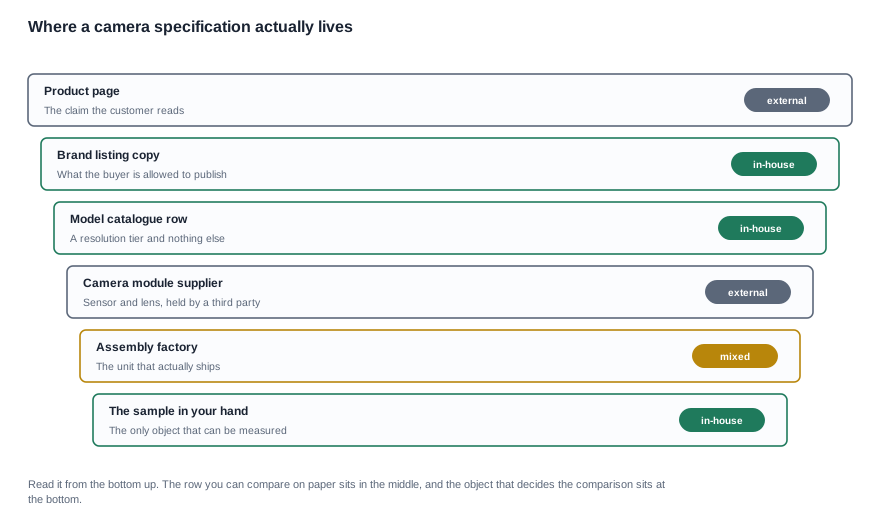
Which means the comparison has to be built from the parts that do exist, and the method is the same for every pair. If you are choosing between two camera platforms, compare the four unpublished rows — sensor model, field of view, video resolution and frame rate — and treat the megapixel figure as a label rather than a result. Ask all four questions of every candidate in the same format, before the samples ship, because a supplier who will not name a field of view has already told you something worth more than a second opinion on the pixel count. If the deployment is indoor or happens at dusk, the pixel-size question outranks all three of the others.
The buying task behind the comparison, and what it is really costing
A procurement manager is usually choosing between two camera platforms with one comparable row between them, the resolution tier, and a schedule that will not stretch. A product manager is deciding what the camera is for, and the field of view decides that before anything else does. A channel buyer is writing the listing and needs to know which claims the documentation supports and which have to be earned with a sample.
Each of them is afraid of a specific thing. The first is a product that photographs well on a sunny street and badly in a shop, which is the failure a customer notices within a week of purchase. The second is a supplier who quotes a component datasheet and calls it a product figure, which is not deception so much as a different question being answered. The third is a claim on a product page that cannot be defended when a competitor's review unit is held up beside yours.
The cost of getting this wrong is not the unit price difference. It is the rework: a listing rewritten after artwork approval, a batch held in customs over a document that names a different model, a channel return rate that nobody can explain because no one ever agreed what the camera was for. All three are cheap to prevent at the RFQ stage and expensive to prevent afterwards, and the reason they are expensive afterwards is a scheduling fact rather than a technical one. The documentary work runs on your timeline, not the factory's, and the artwork sits at the end of it.

Where the camera cost actually sits, and why the same tier prices differently
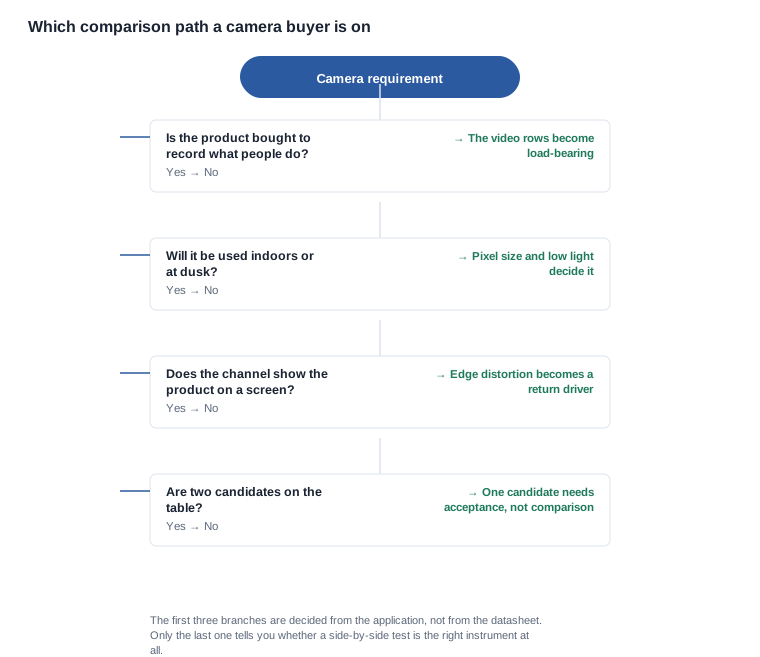
The camera is not a line item on a quotation. It is a module, a firmware image, a calibration step, a tooling decision and a set of files that have to travel with the goods. Two products with the same printed resolution tier can sit at different price points because the sensor is different, because the lens is different, because the module supplier changed and nobody wrote it down, or because the two suppliers are quoting different volumes of the same platform.
The commercial consequence is that a unit price comparison between two camera platforms is a comparison of two bundles, and the bundles are rarely described with the same completeness. A supplier who tells you the sensor model, the field of view, the video resolution and the frame rate is describing a bundle you can price. A supplier who quotes a megapixel number is describing a label, and the label is the part of the bundle that is cheapest to copy. Price the bundle, not the label, and ask what is inside it before you ask what it costs.
The same reasoning applies to the parts of the programme that never appear on an invoice. The capture application on the phone, the storage path, the file format, the microphone capture that runs alongside the video, the power draw while the camera is live, and the firmware version that ties the two together all sit between the sensor and the customer's finished clip. A buyer who compares only the sensor will end up with a product whose output pipeline is the real difference, and will find out from the reviews.
The thresholds: the rows to request, and how to read the one that is published
The table below is the request you send to every candidate, in the same format, before any sample is opened. The third column is the one that does the work, because it tells you which of two answers a supplier has given you.
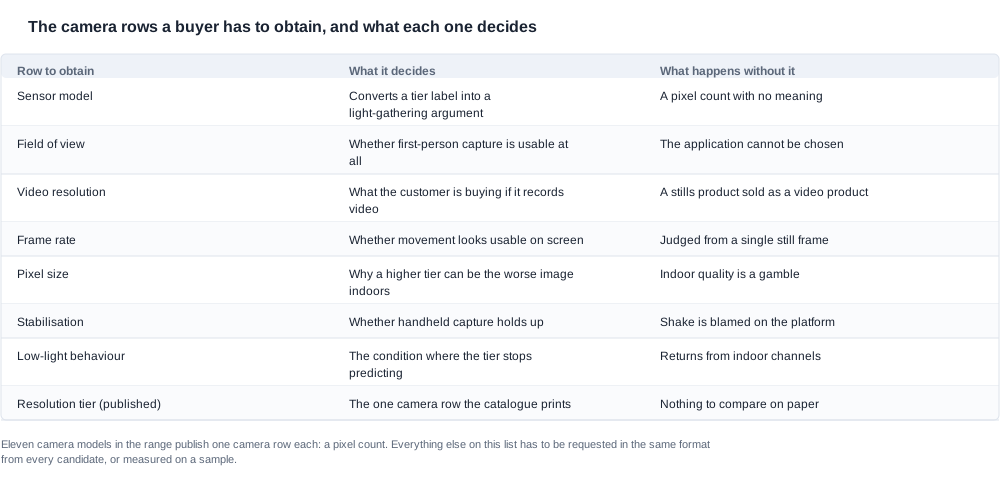
Measured on the product or on the component is the first question, because the two answers are not comparable. A component datasheet describes a sensor in a test fixture. A finished product adds the frame geometry, the sealing, the port design, the position of the lens relative to the wearer's line of sight, and whatever processing the firmware applies to the frame. A supplier who quotes the component figure as though it were a product figure has not made an error; they have answered a different question, and the question they answered is one you did not ask.
A field of view is a number with a unit and a reference point. The horizontal angle in degrees, the diagonal angle, or the full frame diagonal are three different numbers for the same lens, and a comparison written across them is a comparison of incompatible figures. Ask which one is being given and at what distance it was measured. A narrow field of view is unusable for first-person video and perfectly adequate for stills; a wide one distorts at the edges, and the edge is what a customer photographs. If no field of view is published for a model, it can be measured without any specification at all: put the frame on a head, point it at a grid at a fixed distance, and photograph what it sees. That is a twenty-minute test and it produces the row that decides the application.
Video resolution and frame rate are two rows, not one, and a product sold on stills can fail badly on video. A product described as a camera that records 4K at 30 frames per second and a product described as a camera that records 1080p at 60 are selling different products, and the second one is not a downgrade if the application is slow motion or a moving subject. Neither row is published for any model in the range. The camera imaging page sets out the full published position.
The sensor model and the pixel size are what turn a tier label into an argument. This is the row most buyers skip and the one that decides indoor performance. A 13-megapixel sensor with small pixels gathers less light per pixel than an 8-megapixel sensor with large ones, which means a worse image indoors or at dusk. The customer comparing two products in a shop is comparing exactly the image they will see on a screen, which is usually an indoor image, and the higher tier can lose. This is also the reason a resolution figure is a tier label rather than a quality claim, and it is worth asking both candidates for the pixel size even when neither will name the sensor.
Stabilisation and low-light behaviour decide whether the image holds up in the deployment the product is sold into. A camera platform sold into a creator channel, a warehouse, a site inspection or a field service channel has a different failure mode in each. Handheld capture without stabilisation produces a clip that the customer will not post, and a clip the customer will not post is a return with a reason attached. Neither row is published for any model, so both belong in the request.
One warning applies to every row in the table: these numbers are not directly comparable across suppliers. Two suppliers measuring the same quantity will use different sample counts, different light sources, different distances and different definitions of the test. A field of view quoted by a lens distributor and a field of view measured on the assembled frame are not the same figure. Before you build a table, decide which column is your own measurement and which is a supplier's number, and never mix the two in a single row without a note.

Running the comparison: the request format, and the one test that produces an output
The comparison runs in a short sequence, and every step in it assumes the one before it held. A step that fails tells you what the next step would have told you, so the order is the method rather than a convenience.
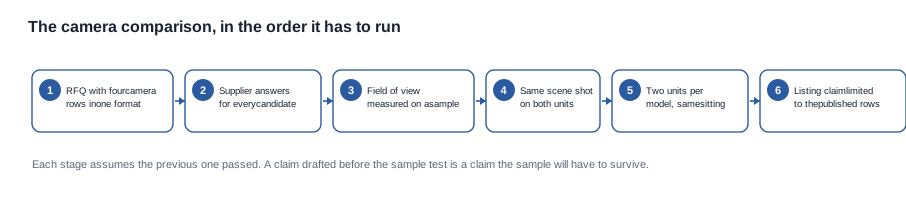
Step one: request the four rows for every candidate in one message, in one format. Sensor model, field of view, video resolution, frame rate. Send it to all candidates on the same day, with the same wording, and ask for the answers in writing rather than in a call. A comparison built on a consistent request format is the only one that stays fair, because a supplier who answers a question asked in a hurry will give you a catalogue line rather than a measured figure.
Step two: establish the model designation for each candidate before anything else. Two platforms with the same printed resolution and the same commercial tier may or may not be the same hardware with different branding. If the designations cannot be separated, the comparison is between one platform and itself, and the real decision is commercial rather than technical. This is a cheap question with a large effect on the rest of the programme.
Step three: measure the field of view yourself if the row is not supplied. Grid, fixed distance, fixed head position, and a photograph of the grid through the lens. Repeat it on two units of the same model, because a tolerance on the assembly is a real thing and it is the difference between a specification and an average.
Step four: shoot the same scene on both, in the same light, at the same distance, with the same content. Keep the footage. The scene should be chosen to stress the product rather than flatter it, which usually means an indoor mixed-lighting situation and an outdoor backlit one, because those are where the resolution tier stops being predictive. A comparison in prose is not a comparison, and a demo is not a comparison.
Step five: test two units of each candidate, in the same sitting. A single unit can be atypical. Two units also tell you whether the platform is consistent, which is a production question rather than a product question, and consistency is what determines whether the returns rate you will see in month three matches the returns rate in the sample.
Step six: put the rows in the agreement. The established sensor model, field of view, video resolution and frame rate for the exact configuration ordered, with a notice obligation before any change to the camera module or the capture firmware, and a clause on who bears the cost when a lot fails the acceptance criteria you have set.
Step seven: decide the listing boundary before the copy exists. The resolution tier, the cell, the charge time, the rated runtime, the charging method and the platform feature line are published rows. The sensor, the field of view, the video specification, the frame rate, the pixel size, the stabilisation, the aperture and the low-light behaviour are not. A buyer-run measurement belongs in the copy only as a buyer-run measurement, with the conditions attached, and never as a specification of the product.
Where camera programmes lose money, and the terms that actually move
The resolution tier was treated as a quality claim. Symptom: the chosen product disappoints indoors or at dusk, and the channel describes the product as not working. Root cause: a pixel count was read as an image. Prevention: ask the pixel-size question before the sample order, and run the low-light scene in step four.
The field of view was assumed. Symptom: the product does not capture what the use case needs, and the customer concludes the camera is faulty. Root cause: the row was never requested and never measured. Prevention: request it for every candidate, and measure it yourself where it is missing.
The video rows were never asked. Symptom: a product sold on stills turns out to be a poor video camera, and the return reason is the same as the one that generated the first batch of positive reviews. Root cause: the tier label was carried across from the stills figure. Prevention: treat the video rows as a separate request with a separate answer.
The comparison was made in different conditions. Symptom: the two candidates rank differently from the review, and the review is right. Root cause: one was shot indoors and the other outdoors, or the light differed, or the distance differed. Prevention: the same scene, the same light, the same distance, written into the protocol before the samples arrive.
The sample comparison was run once. Symptom: the result is not reproducible, and the supplier disputes it after the order. Root cause: a single unit, a single scene, a single run. Prevention: two units per candidate, two environments, and the footage kept with the paperwork.
The specification was invented to fill the gap. Symptom: a listing carries a sensor or a field of view that nobody verified, and a technical reviewer finds it. Root cause: an unpublished row was filled with a plausible value. Prevention: mark it unpublished, and put the sample result in the copy instead, with its conditions.
The commercial lines worth negotiating time on in a camera programme are the ones that shape the box and the schedule, because that is where camera claims usually get written and where camera returns usually get generated:
- Unit price and volume tiers.
- The accessory and charging set with its own minimum order quantities.
- Packaging specification and the artwork round count, which matters more than usual in this category because the box is where the camera claim is usually written.
- Delivery splitting against a sample-approval milestone, which is granted more easily than a price concession because it moves the risk onto the schedule where it belongs.
- Payment nodes: a deposit as part of the order, a balance on the inspection before shipment, and a holdback on the document set.
- The warranty period with a stated response, and the return terms for a content channel, where the camera is the product and the return rate is the only number that matters.
Two costs in a camera programme can be quoted but not negotiated. Certification cost and certification lead time follow the process and the testing body rather than your order size. Tooling is often amortised across the first order, so the useful questions are over what volume it is amortised and what happens to the tooling if the programme is discontinued. Below both sits the camera module itself, because a supplier who will not change the sensor or the lens is telling you the image is fixed.
The agreement should carry the rows the sample programme produced rather than the rows the category wishes existed: the published rows for the configuration ordered, the sensor model, field of view, video resolution and frame rate once they are established, the low-light and stabilisation behaviour, the measured weight, the warranty period with a stated response, and the acceptance criteria your sample protocol produced.
The agreement should equally bound the copy: any image quality claim that was not checked on a sample, and any camera row the supplier did not supply. A placeholder in a specification table is a liability that ships with the product.
A camera comparison walked through, and the limit of what we can evidence
Consider a constructed case rather than a client project. Assume a mid-size European brand launching a first-person video line, with one model in two colourways, a target market of three countries, and a channel that is mostly creator marketplaces and one retail partner who has already asked for a field of view.
Step one: the requirement. The product records what the person is doing, indoors and outdoors, in daylight and at dusk, and the listing will show a captured frame on a screen. That single sentence settles the field of view as the decisive row, the low-light scene as a mandatory part of the test, and the edge of the frame as a visible feature rather than a detail. Without that sentence, the buyer would have compared pixel counts and chosen the 13-megapixel model, which is exactly the wrong answer for an indoor creator channel.
Step two: the request. Both candidate suppliers are asked the same four questions on the same day. One replies with a field of view in degrees, a video resolution and a frame rate, and names the sensor model. The other replies with a resolution tier and an offer to check the rest. The asymmetry is itself the finding, and the brand writes it into the evaluation rather than treating it as a slow response.
Step three: the test. On samples, the brand measures the field of view on a grid, shoots the same two scenes on two units of each candidate, and records the results with the light, the distance and the content stated. The measurement produces a table the brand can use internally, and it also produces a claim the brand can defend in a listing, which is a narrower sentence than the one it originally wanted.
Step four: the commercial structure. The brand negotiates the accessory and charging set minimums against a committed configuration count rather than a unit count, moves artwork approval earlier than usual because the box carries the camera sentence, and splits the first delivery against the sample-approval milestone. The result is a programme with one published row, four established rows and a claim the brand can stand behind, instead of a programme with a megapixel number nobody can interrogate.
Our own position is deliberately narrow. We publish the resolution tier for the camera models in the range and we publish the platform feature line, and we do not publish a sensor model, a field of view, a video resolution, a frame rate, an aperture, a pixel size or a stabilisation figure for any model, because the company has not confirmed those to us. We will not present a megapixel tier as an image quality claim, and we will not supply a typical figure to fill a cell in a comparison table. An empty cell prompts a question, and a plausible-looking cell does not.
That leaves the four rows to request and the one test to run, and we will walk a buyer through both on their own samples. The models and their published rows are listed on the AI camera glasses page, the full published position is under camera imaging, and the questions to put to a supplier are in the CY03 common questions piece.
What to do next, in order.
- Write the deployment in one sentence, and read the decisive row off it.
- Request the four camera rows for every candidate, on the same day, in the same format.
- Measure the field of view yourself where it is not supplied, on two units per model.
- Shoot the same two scenes on both candidates and keep the footage.
- Put the established rows, the notice obligation and the acceptance criteria into the purchase order, and quote no camera number you have not measured.
Related reading
- The full published position on the camera rows — camera imaging
- The models and what they publish — AI camera glasses
- The questions to put — CY03 common questions
Tell us the use case, the deployment and the models you are comparing, and we will tell you which rows are documented and which have to be measured.


