
Buyers ask about the CY03 in a fairly predictable set of ways, and almost every one of those questions comes back to the same two things: what the published rows actually say, and what the charging case changes. The answers below are given in three parts every time — what is published, what is not published, and the question that closes the gap — because a partial answer to a specification question is the thing that causes the dispute later.
What does the CY03 specification actually say?
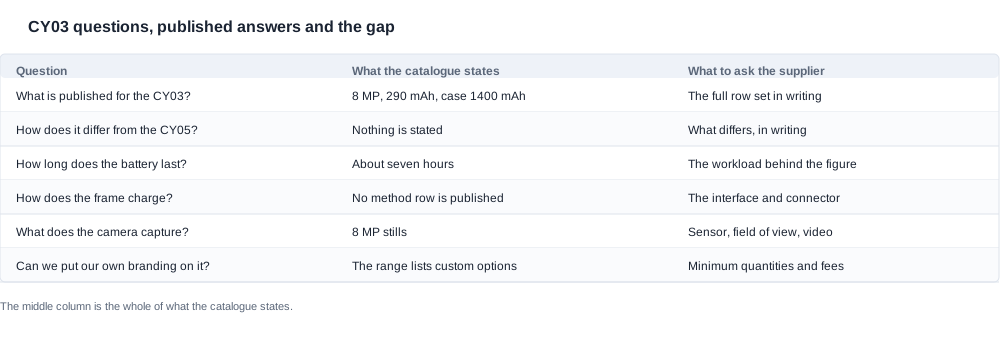
Published. The catalogue page for the CY03 carries five rows: an 8 MP camera, a 290 mAh frame cell, a charge time of two hours or less, a rated endurance of about seven hours, and a 1400 mAh charging case. That is the complete published set. Read it as a list rather than as a sales line, because every one of those five numbers is a fact a brand can put in front of a customer, and the things that are not on that list are things that cannot be.
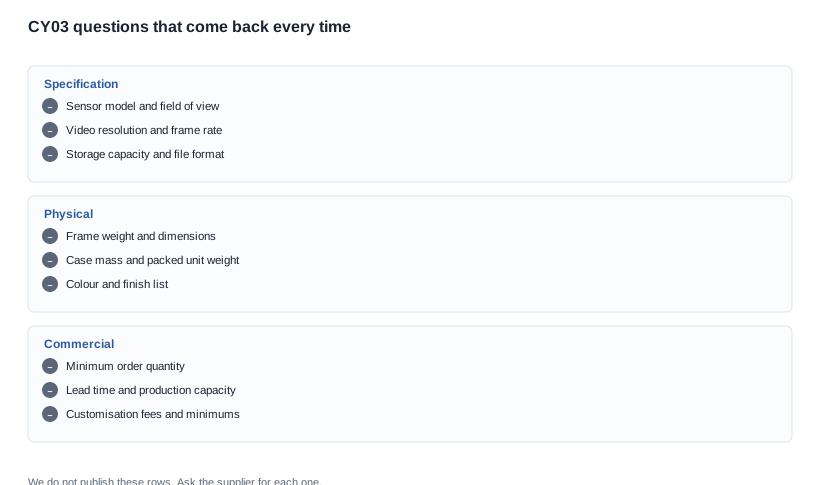
Not published. The sensor model, the field of view, the video resolution and frame rate, the frame weight and dimensions, the ingress protection rating, the storage capacity and file format, the Bluetooth version, the colour and finish list, the charging method, the certificate numbers and covered model schedules, the minimum order quantity, the lead time and the price.
What to ask. Ask for the camera specification closed once for the platform, and ask for the physical rows from a sample rather than in writing. A frame weight measured on three units is more useful than a stated frame weight, and it is the only version you can put an acceptance criterion against.
One detail worth pausing on is the Bluetooth version. The catalogue publishes a Bluetooth version row for the audio and sport models, and it publishes none for any of the eleven camera models — including the CY03. So a buyer cannot treat the radio version as known for this configuration, and should ask rather than assume it from the audio models.
Why a five-row sheet is more useful than a long one
There is a habit in this category of treating a sparse specification sheet as a sign of weak engineering. For a buyer, the opposite is true. A short sheet has a short list of things to verify; a long sheet has a long list of things to interpret. Five rows on this model means five claims to evidence, and everything else is explicitly a request rather than an ambiguity.
That is worth stating plainly to a customer who finds the sheet thin: the published figures are the ones we can stand behind, and the gaps are the ones we will go and get. The risk in this category is not a missing row, it is a published row that does not survive a sample. A five-row sheet that passes inspection tells you the product matches its documentation; a twenty-row sheet that includes a sensor model with no specification behind it tells you considerably less.
The second reason the sparse sheet helps a buyer is that it makes the comparison work. When you put the CY03 next to the other ten camera models, you are comparing eleven small sets of published rows rather than eleven sets of prose. That is what makes it practical to work out which configuration a channel actually needs, and it is why the range questions in this article are asked against rows rather than against impressions.

What is the difference between the CY03 and the CY05?
Published. The specification for the CY05 is identical to the CY03's in every row: 8 megapixels, 290 mAh, a charge time of two hours or less, about seven hours, and a 1400 mAh charging case. Neither model publishes a charging method row, and neither publishes a feature row. The catalogue genuinely does not state what separates them.
Not published. Whether the difference is a colourway, a temple, a lens, a firmware revision, an enclosure change, a supply arrangement, or nothing at all.
What to ask. Ask what differs, in writing, naming the CY03 and the CY05 separately. Get the answer before you build a range, and get it before you build the product page, because two SKUs that a customer cannot tell apart invite a question you cannot answer.
We will not invent a difference to fill the gap, and we will not quietly drop one of the models from a range either. If you tell us you are planning to list both, we will tell you what we can confirm about the distinction. The CY03 versus CY05 price positioning analysis works through what each possible answer means commercially.
How to test the answer once you have it
The answer will be one of four, and each one has a different commercial consequence, so it is worth deciding in advance which answer you are prepared to act on.
A visible difference — a colourway, a lens, a temple treatment — is the best outcome for a range. It means two SKUs are a legitimate merchandising structure, the customer can tell them apart on a shelf, and the case, the firmware and the accessory programme are shared between them. The only work it creates is the artwork, and the only risk is that a certificate naming one model does not automatically cover the other.
A technical difference — a sensor revision, a firmware branch, a changed enclosure — is workable but carries documentation with it. The specification sheet for each model becomes incomplete in a way that surfaces later, and the compliance scope has to cover both configurations. If this is the answer, ask for the revision identifier and the firmware baseline, because those are the strings that will appear on the purchase orders, the labels and the test reports.
A commercial difference — different minimum quantities, different lead times, different packing configurations — is the difference that is easiest to miss and easiest to regret. Two models with identical published rows but different packing rules mean two packing lists, two carton specifications and two sets of freight assumptions, none of which the product page shows.
No difference at all is the answer that saves the most money, provided you act on it. One model in the tier, one set of artwork, one certificate scope, one line in the catalogue, and the capital that would have gone into a second slow-moving line goes into a configuration that differs on something published.
Whatever the answer, write it down with a date and attach it to the range decision. A verbal answer to this question ages badly, because the people who give it are not always the people who hold the configuration six months later.
How long does the battery last, and what does the charging case add?
Published. Two separate numbers, and they need to be kept apart. The frame is rated at about seven hours. The case is 1400 mAh, which is more than four times the 290 mAh frame cell. The charge time is two hours or less — a ceiling, not a typical figure.
Not published. The test condition behind the seven-hour rating, the starting state behind the two-hour ceiling, the completion criterion for a charge, and the case's own input port and charge time.
What to ask. Ask whether the camera was running during the endurance measurement, and at what frame rate and resolution if it was. Ask what state the frame starts from when the charge time is measured, and at what point charging is considered finished. Ask how the case itself is charged. The battery specification guidance covers the questions to ask about how a runtime figure was produced.
Two practical points follow from the published numbers. First, the frame's rating is a rating under favourable conditions, and on a camera product the camera is the dominant load, so treat it as an upper reference rather than as a working day. Second, the case changes the routine rather than the rating: it is what removes the need to charge on a schedule, and what turns a single unit into a two-cell consignment with its own freight and transport paperwork. A listing that presents the case as multiplying the runtime is making a claim the published rows do not support.
There is a third consequence that belongs in the commercial conversation rather than the technical one, and it is the one that most often surprises a buyer planning a first order. The 1400 mAh case is a second lithium cell in every unit, and a second cell changes the freight class, the transport documentation and the warehouse volume per unit. Buyers who build a cost model around the frame cell and add the case afterwards find that the accessory they positioned as a feature is the line that moves the delivered cost. The order of operations is the whole difference here: measure the packed unit on a sample before you set the price, not after the first consignment lands. The shipping weight breakdown covers the arithmetic, and the charging case options piece covers how the case decision is made across the camera family.
One further point on the ceiling wording, because it is a genuine trap rather than a pedantic one. The catalogue publishes "two hours or less" for this model and for twenty-five of the other models in the range; only two models publish a shorter figure. "Two hours or less" permits exactly two hours. Writing "under two hours" on a product page tightens a published bound into a claim the source does not support, and it is the kind of tightening that a competitor's listing can be checked against. Where a buyer needs an operational figure rather than a published bound, the way to get one is to measure a charge from a stated start state to a stated completion point, and to publish that figure as your own.

What can the camera do, and what is not published about it?
Published. The camera figure is 8 megapixels, and that is the whole of the published camera information for this model.
Not published. Sensor model, field of view, video resolution, frame rate, aperture, stabilisation, low-light behaviour, storage capacity, file format and overwrite behaviour.
What to ask. Ask for the sensor and the optical specification, and for the video and storage behaviour in one request, since they come from the same engineering answer. If your decision depends on image quality rather than on specification, ask for a physical comparison instead: shoot the same scene on the two candidate units, in the same light, and compare the output. That is the only comparison that settles it, and it is the approach our camera imaging guidance takes.
On storage specifically, a buyer who fills the storage and loses a session's footage has a predictable support ticket, and today the storage behaviour cannot be sized from the documentation. Ask for the capacity, the format and the overwrite rule as three separate items.
It is also worth being clear about how the 8 MP figure relates to the rest of the camera range, because it is frequently read as a quality ranking rather than as a resolution class. The catalogue carries eleven camera models across two published pixel tiers: eight models at 8 MP — the KY06 and the CY05, the V06 and the V03, and the V03 Pro and the MT5, and the CY03 and the MT6 — and three at 13 MP — the S7 and the L2 Utral, and the L1 Pro. So 8 MP is the wider tier, and a buyer who wants the higher tier is looking at a different and much smaller set of models. Two of the three 13 MP models are on the same 290 mAh platform as the CY03, with the same case capacity, which means the resolution question can be settled without also reopening the power and accessory questions.
The right way to use the pixel figure in a buying decision is therefore as a routing input rather than as a quality claim. It tells you which tier a channel is competing in. It does not tell you what the picture looks like, and it is not a differentiator against another 8 MP model, because eight of the eleven share it.

Can the CY03 be ordered with our own branding?
Published. Our company profile in the catalogue describes design, production and customisation services, and positions the business as an OEM and ODM solution provider. The catalogue does not publish a per-model customisation list for the CY03 — there is no published row naming logo, colour, packaging, temple, interface or firmware options for this model or for any other camera model.
Not published. Which customisation options exist for this configuration, the minimum quantity for each, whether a version or tooling fee applies, and how long each takes.
What to ask. Ask what can be customised on this model, at what minimum quantity, at what fee, and with what lead time. Ask the same questions for each item separately, because a logo, a colour and a packaging change have different costs and different minimums, and a supplier who quotes one figure for "customisation" has quoted you a number you cannot use in a cost model.
Two caveats belong in the same breath as the list, because they are the ones most often underestimated in a private-label launch.
A change that touches the radio module, the battery or the enclosure moves the compliance position. A logo does not; a different radio module does. The certification checklist sets out how that review normally runs.
The companion application is part of the product. Where the application comes from, who publishes it, where the footage it handles is stored, what the retention policy is and how updates are delivered are all unpublished for this range. That is a legitimate question before you commit, and in some markets it is a required one.
How should a question like this be closed? Route it before you ask it, and ask it in a form that can be answered in writing against a named configuration.
The questions that arrive after the first order, and why they are the expensive ones
Some questions are asked by procurement before the order, and some are asked by your own operations team after the goods are in the warehouse. The second group is more expensive, because by then the answer is a cost rather than a decision.
The one about the interface is the clearest example. If the charging method was never confirmed in writing, the first consignment arrives and the operations team discovers how the frame charges by trying it. If the answer is a magnetic contact, the customer instruction has to explain seating and the metal-surface warning, and the carton artwork has to be reprinted. If it is a wired connector, the accessory list in the box changes and the packaging has to change with it. Either way the rework happens after the goods have arrived rather than before.
The one about the packed weight is the second. A freight class estimate built on an assumed case weight is an estimate, and estimates get inherited. By the time the real measurement exists, the delivered cost model has usually been used to set a price, and a price set on an estimate is very hard to move later — the customer has already seen it.
The one about the camera is the third, and it is the one that surfaces as returns rather than as rework. A customer whose expectations were set by a listing that implied more from an 8 MP figure than the resolution class can carry will send the unit back, and the reason will be described as quality. The remedy for that is not a discount; it is a listing that does not overstate.
The pattern is simple enough to act on: the questions that cost most are the ones nobody asked in a form that could be answered in writing, before the order. That is the entire argument for the three-part structure above — published, not published, and the specific question to ask.
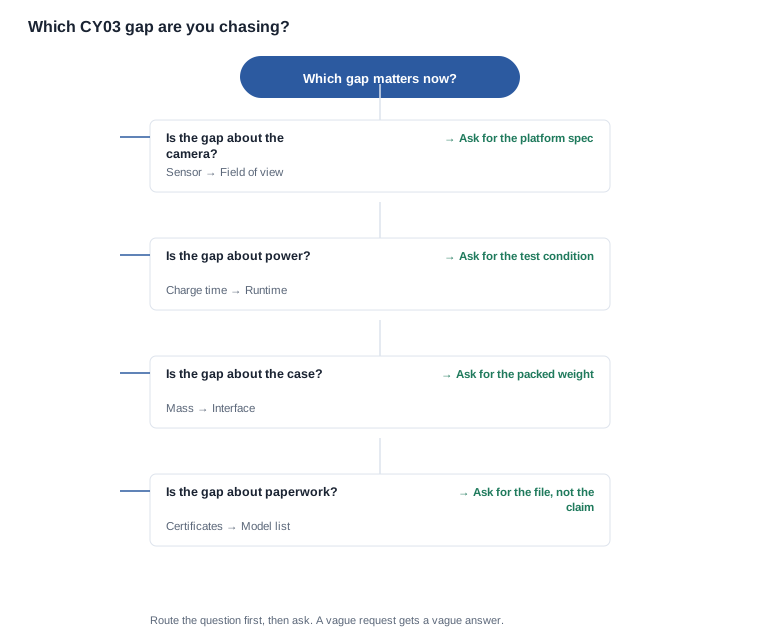

The sequence is short: write the question as a single specification request, separate what the catalogue publishes from what it omits, send it with the model named, ask for the answer in writing against the exact configuration, check the answer against the sample unit you received, and record it in the purchase order file. A reply without a model name does not close the question, however complete it sounds.
The CY03 boundary and how to get an answer we can rely on
The CY03 is a straightforward, well-specified camera platform with a case that changes the economics of it, and the most useful thing we can tell a buyer is where the published row stops. We will not fill a gap with a typical value, and we will not tell you that two models differ when our own documentation does not say they do. We will not describe the charging method for this model, because the catalogue carries no such row, and we will not quote a frame weight, a sensor, a field of view, a certificate number or a minimum order quantity that our documentation does not contain.
The three-part structure above is the format we would ask for in return, because it is the only format that survives a customer question. "We will confirm" is not an answer. "The catalogue publishes no frame weight for this model, and here is what we measured on the sample you sent" is an answer, and it is one you can put in a technical file and defend.
If you tell us the target market, the quantity and the configuration you need, we will come back with what is available and what is not. The camera family is on our AI camera glasses range page, and the platform options are on our OEM and ODM options page.
Related reading
- The model-level detail behind this platform — CY03 compared
- How to read a runtime figure before you rely on it — battery life
- What a private-label launch of this platform involves — OEM and ODM options
Tell us the market, the volume and the required configuration, and we will come back with what is available and what is not.


