

Smart glasses microphone quality: four variables, and the step everyone skips
Comparing two microphones is easy to do badly, because the conditions that determine the result are numerous and every one of them is easier to change than to control. Change the distance by twenty centimetres, change the phrase, or compare a product in a quiet room against a product in a café, and the ranking changes without either product changing. Smart glasses microphone quality smart glasses how to compare is therefore a procedure: eight steps, each one removing a variable, ending in a result you can defend. It matters because a microphone comparison is usually made once, before a large order, and the loser of that comparison is frequently the better product.
The short answer: hold four variables constant — the script, the output level, the environment and the handset — and score the result before forming a preference. The most commonly skipped step is the level match, and it invalidates more comparisons than any other, because a louder product sounds clearer whether or not it is. The second rule is that a comparison is only worth running on units drawn from the production configuration, because a result on a demonstration unit is a result about a different product. The third is that a microphone claim is a two-sided claim, and the speaker side of the conversation is part of the same experience.
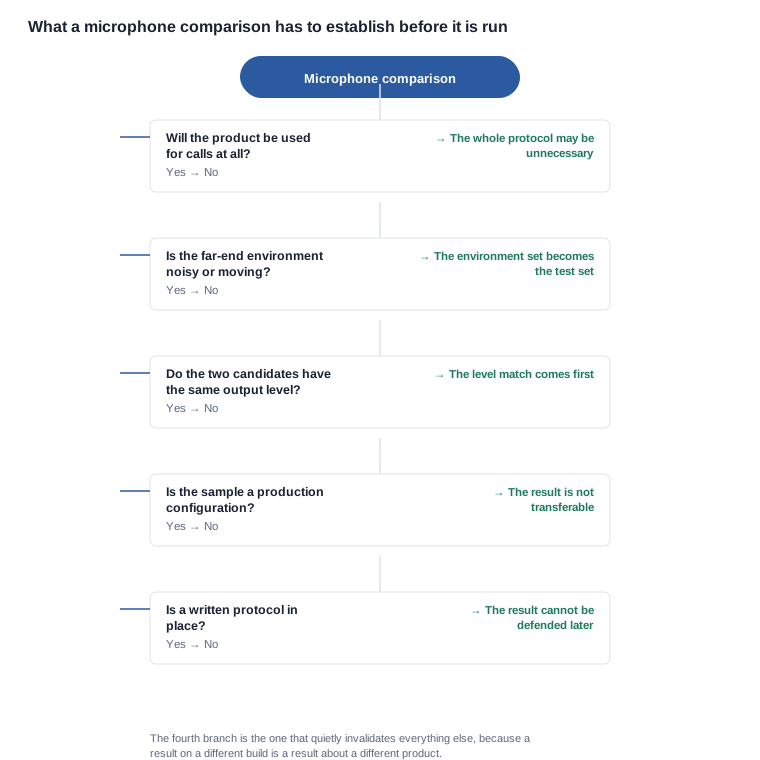
The buyer who has to make the call, and the prior it has to discard
A buyer comparing microphones is usually choosing between two candidate models for a product that will be used for calls: a camera product sold to creators who will make first-person video with audio, an audio product sold for open-ear listening, or an open-ear model sold to people who work while wearing it. They will hold two samples, a customer profile, and a strong prior about which one sounds better from a demo.
That prior is the main risk in the process. A demonstration is run in good conditions, by whoever built the product, from a favourable distance, and with a familiar phrase. Every one of those is a variable, and the combination almost always flatters one product. The prior is not wrong in general; it is wrong in a specific way, because a demo is run under conditions that the customer's channel will never reproduce.
The buyer is also usually working to a schedule that compresses the testing window. A microphone comparison that is properly run takes half a day: a script to prepare, three environments to set up, two units per product, two scorers, and two repeat runs. Compressed into an hour, it becomes a demonstration, and a demonstration is what the prior came from. The decision worth making early is not which microphone to buy but how much time the comparison is allowed to take, because the two candidates cannot be separated reliably in less.
The other thing the buyer needs to be explicit about is what the comparison is for. Ranking two candidates before an order is one job. Detecting drift between production lots months later is a different job, and it is the one that needs the recordings kept rather than the scores. A programme that only wants the ranking can stop after the scores; a programme that wants the drift detection has to retain a reference and the audio from the day it was approved.
What a microphone row is worth, and where two quotations for the same product diverge
The acoustic performance of a finished product is not a property of any single component. Between a microphone element and what the far end hears sits the port design, the position of the port relative to the mouth, the frame geometry, the sealing, the wind handling, the firmware processing, the speaker, and the room. That is why a component datasheet and a product measurement can both be correct and still be two different numbers, and why a supplier who quotes the component figure as a product figure has not made an error — they have answered a different question.
The cost of an acoustic design is concentrated in the parts that do not appear on the quotation. A multi-microphone arrangement, a port and grille treatment, a seal line, a mount with a defined acoustic gap, a firmware processing stage and a tuning pass are the components of an acoustic result. A supplier who has all six has a design; a supplier who has a microphone and a filter has a part. The price difference between the two is usually visible in the unit price and invisible in the paperwork, which is why a unit price comparison alone will not tell a buyer where the two platforms actually differ.
Two quotations for the same product can differ because the acoustic design is not the same on each line. The same electronics on the same board will produce different results in two different frames. That means a quotation is not only a price and a configuration; it is a statement about a specific enclosure, a specific processing chain and a specific firmware, and it should be quoted with all three named. A buyer who compares two quotations without that is comparing two products, not two prices for one.
The real commercial consequence of the acoustic result is the return rate, not the review score. A microphone failure does not arrive as a fault report. It arrives as "people cannot hear me", which is a description a customer gives about a working product, and it arrives in the channel where the calls actually happen rather than where the product was demonstrated. So the measurement that matters commercially is the one taken in the customer's environment, which is exactly the measurement the demo does not take.
The thresholds: what to ask each supplier for, and what a soft answer sounds like
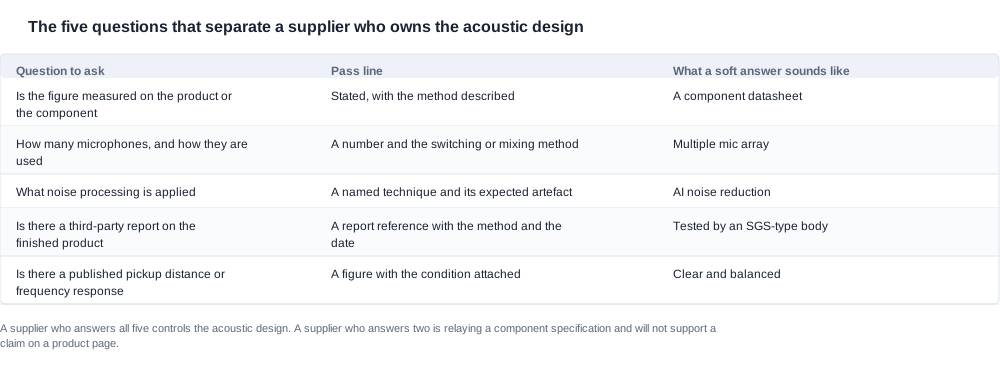
Send the table to both suppliers before any test. The answers narrow what needs testing, and they are the difference between a comparison and a guess.
Measured on the product or on the component is the first question, because the two answers are not comparable. A component datasheet describes a microphone in a test fixture. A finished product adds the frame geometry, the sealing, the wind handling, the position of the port relative to the mouth, and whatever processing the firmware applies. A supplier who quotes the component figure as though it were a product figure has not made an error; they have answered a different question.
The processing claim needs its cost stated. A named technique is not a result, and every processing stage has an artefact: gating, pumping, a sense of removed material, or a voice that sounds compressed and lifeless. A supplier who names the technique and describes the artefact is more useful than one who claims the technology removes noise: the first can be tested, the second can only be repeated in a listing without any evidence behind it.
Third-party evidence is about the evidence, not the product. A report on the finished product, with the method and the date, tells you what was measured and when. If one supplier has a report and the other does not, that is a fact about the documentation rather than about the two products, and the comparison should proceed on a test rather than on the paperwork. If neither does, the test is the only route. The noise control page sets out the claims we publish for the Bluetooth audio family and where the line is drawn.
The speaker side is half the conversation. A product with an excellent microphone and a quiet speaker works in a quiet room, whatever the microphone on its own can do. The far end has to hear, and the volume and clarity of what the product plays back are part of the same experience. A comparison that scores only the near end produces a result that is right and useless.
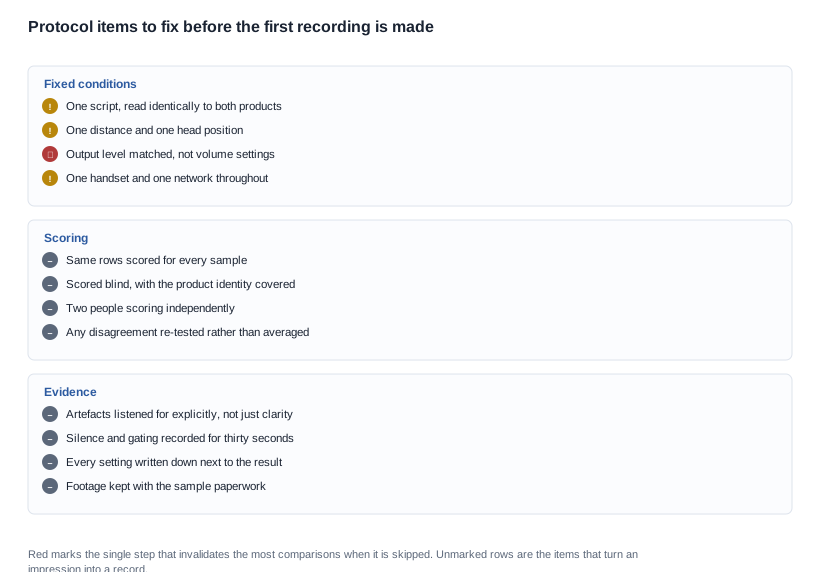
The level match is the row that decides whether the comparison is valid. Match the output level, not the volume setting, because a volume setting means nothing across two different products. If a sound level meter is unavailable, recording both products at the same volume setting and listening for the level difference is a workable substitute, because a clear level imbalance is audible to most people even when they cannot name it.
One warning applies to every row: these figures are not directly comparable between suppliers. Two suppliers measuring the same quantity will use different distances, different noise types, different levels and different definitions of intelligibility. A microphone pickup distance quoted by a component distributor and a pickup distance measured on an assembled frame are not the same figure. Before building a table, decide which column is your own measurement and which is a supplier's number, and never mix them in one row without a note.

The eight-step protocol, and the step that invalidates the most comparisons
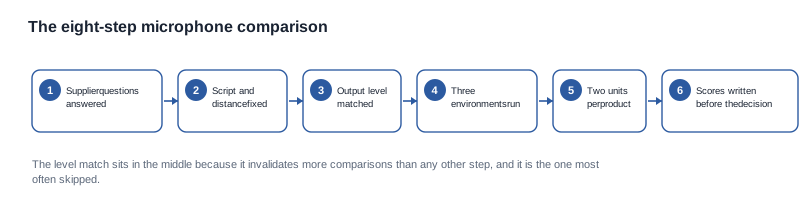
1. Ask the five supplier questions before you touch a sample. Measured on the product or the component; how many microphones and how they are used; what noise processing is applied and what it costs; whether there is a third-party report on the finished product with method and date; whether there is a published pickup distance or frequency response with the condition attached. The answers decide what you have to test and what you can accept, and asking them first is what stops you from spending half a day testing something the supplier has already documented.
2. Fix the script, the distance and the position. Read the same phrase to both products, at the same distance, in the same position, in a normal speaking voice. A different phrase in each test is a different test, and the difficulty of a phrase varies more than most people expect — a phrase with an unfamiliar word or a consonant cluster can dominate the result of the whole comparison.
3. Match the output level, not the volume setting. This is the step most often skipped, and it invalidates more comparisons than any other. If one product is louder, it sounds clearer, and the comparison then measures the volume control rather than the microphone.
4. Run three environments, not one. A quiet room, an ordinary office, and a noisy street. Watch whether the ranking is stable rather than who won, because a product that wins in two environments and loses in the third is telling you where it belongs. The stable ranking is the finding; the single-environment winner is an accident.
5. Test two units of each, in the same sitting. A single unit can be atypical, and a comparison decided by one atypical unit is one you will revisit. Two units also tell you whether the products are consistent, which is a production question rather than a product question, and a difference between the two units of the same product is a finding about the supplier rather than about the product.
6. Keep the handset and the network identical. If the AI or the call routing is involved, the phone and the network are variables. A different handset with a different noise suppression profile can change the result more than the microphone does, and a buyer who runs the two candidates on two phones has measured two systems.
7. Score it before you decide. Write the scores down before you form a preference, and decide afterwards. Choosing first and measuring second is not a comparison, it is a confirmation. Two scorers working independently, with the product identity covered, is the cheapest way to stop a confident listener from steering the result.
8. Keep the recordings and keep a reference unit. The audio from the approved sample, with the firmware version recorded against it, is what later deliveries are compared against. Without it, drift between production lots is invisible, and drift is a much larger commercial exposure than the difference between two candidates.
Five ways a microphone comparison is invalidated
The product that is louder wins, and the louder product is not the better one. Root cause: the level match was skipped and the default volume settings differed. Prevention: match the output level before the first recording, and record which setting produced it.
A comparison is won in a quiet room and lost in an office. Root cause: only one environment was tested, and the quiet one is the easiest to win. Prevention: build the three environments into the protocol before the samples arrive, and repeat the test in the third.
Noise processing removes part of the speech and nobody notices. Root cause: the test scored clarity only, and clarity scores do not capture a lifeless signal. Prevention: listen for artefacts explicitly — gating, pumping, and the sense that something has been removed — and treat a gating artefact as a failure regardless of the clarity score.
A single unit decides the order and the second unit behaves differently. Root cause: one sample per product. Prevention: two units of each, recorded in the same sitting, and treat a difference between the two units of the same product as a data point about the supplier's consistency.
The result cannot be reproduced when a customer complains. Root cause: the protocol was never written down, only improvised. Prevention: record the script, the distance, the level setting, the environment and the scores, and keep them with the sample paperwork. A measurement that cannot be repeated is not evidence.
The comparison was run on the wrong build. Root cause: the sample carried a different firmware or a different enclosure from the units that were about to be ordered. Prevention: record the model designation and the firmware version on every unit tested, and require the production units to match the approved sample.
What an acoustic programme costs to keep, and which parts of it are fixed
An acoustic programme carries a sampling cost that a hardware category does not, because a single unit cannot support a golden sample. The terms worth negotiating time on:
- Minimum order quantity, particularly where the programme needs a second unit of each model for the two-unit consistency check, which is a sampling cost rather than a per-unit one.
- Packaging and insert design, including the market labels and the language of the documentation pack, which is a low-cost negotiation that carries no tooling implication for an electronic product.
- Delivery splitting against a sample-approval milestone, which is often granted more easily than a price concession because it moves the risk onto the schedule where it belongs.
- Payment stages: a first deposit, a balance due after inspection and ahead of shipment, and a retention against the document set.
- The warranty period with a stated response, which matters more than usual in this category because a microphone complaint is a description rather than a fault.
Two costs in an acoustic programme are quoted but not negotiated. Certification cost and certification lead time follow the process and the testing body rather than your order size. Tooling is often amortised across the first order, so the questions worth pressing on are the volume it is spread over and where the tool goes if the programme is discontinued. Below both sits the signal chain itself — the microphone arrangement, the port and grille design, the frame geometry and the firmware processing. A supplier who will not change any of them is telling you the acoustic behaviour is fixed, and a programme should be built around that fact rather than against it.
The file to request before the deposit is: the third-party report reference with the method and the date, if one exists; the microphone configuration, in writing, with the number and the mixing method; a written description of the processing and its expected artefacts; the certificate numbers with the issuing body and validity dates; and the model designation written on the quotation.
The clauses for an acoustic programme are: the model designation as a line item, with the certificate numbers attached; the acceptance criteria for the sample, referencing the eight steps and the level match; a clause requiring notice before any change of microphone, DSP tuning or firmware, because a firmware change alters the acoustic result without altering the hardware and is the most common way an approved acoustic design changes without anybody deciding to change it; and a clause on who bears the cost when the sample does not meet the acceptance criteria.
A field-service call line evaluated, and where our documentation stops
This is a worked case rather than a live order. What it is for is the sequence. Assume a brand-side buyer building a call-capable product line for a field-service channel, where the end user works outdoors, speaks through a phone, and cannot take the product off to move to a quiet place.
Step one: the prior. The demonstration unit was clear indoors and the buyer believes it. The protocol is written before the samples are opened, with the script, the distance, the level match and the three environments fixed in advance, and the scoring done by two people independently with the product identity covered.
Step two: the level match. In the first session the two products are clearly not level-matched, and the louder one wins every scoring round. The buyer stops, matches the output, and repeats. The result inverts, which is the single most common outcome in this category and the reason the level match is the step that decides whether anything else is worth doing.
Step three: the three environments. In the quiet room the ranking holds. In the office the ranking holds. On the street the two products separate, and the separation is in the near end, not the far end — one product's processing keeps the caller's voice and takes the environment with it, the other keeps both. The buyer records the artefact explicitly rather than scoring clarity alone, because the losing product scores well on clarity and fails on the pumping that a customer experiences as the call cutting in and out.
Step four: the consistency check. Two units of each product, same sitting. One product's two units differ noticeably on the street, and the buyer treats that difference as a finding about the supplier's consistency rather than as noise, which changes the question from "which product is better" to "which supplier can hold a tolerance".
Step five: the commercial outcome. The programme is not decided by a unit price comparison between the two platforms. It is decided by the street result, the consistency result, and the fact that one supplier can name a processing technique and describe its artefact while the other cannot. The acceptance criteria from the protocol, including the level match and the three environments, go into the purchase order along with a notice obligation on any firmware change.
Our own position is that a microphone comparison is worth doing only once, only with a script, and only with the variables held constant, and that the result should be recorded so that it can be revisited when a customer complains. The Bluetooth audio family publishes its technique — open-ear acoustic structure, directional audio and smart noise reduction — and we publish no microphone specification for any model in it either: no pickup distance, no noise figure, no frequency response, no microphone count and no third-party report to go with them. We will not quote a microphone figure from the industry for a product we have not measured, and we will not present a technique name as a result.
We will also be plain about the limit of any comparison. It establishes a ranking under the conditions you tested. It does not establish a ranking in the environment your customer will use, and it does not establish one across the population of units the supplier will ship. Both of those need a production-side control: a reference unit, a defined frequency of testing and a third-party report on the finished product. The claims and how to read them are under noise control, and the sample-side protocol is covered in sample evaluation.
What to do next. Send the two products, the target environment and the load the customer will actually run, and we will write the comparison script with you, including the script text, the distance, the level-match method and the three environments. If you send samples we will run the same protocol alongside you and report what we measure, including where the result is worse than expected.
Related reading
- The claims and how to read them — noise control
- The protocol for a sample test — sample evaluation
- The production-side control — microphone quality control
Tell us the two products and the environment, and we will write the comparison script for you.


