

A microphone specification, a microphone measurement and a microphone process are three different things, and in this product category they are routinely confused with one another. The specification is a number on a datasheet. The measurement is a number produced in one environment, on one unit, on one day. The process is the set of controls that keeps production units close to that measurement. A factory that holds the first two and not the third was lucky on the day, and a sourcing team that asks about the specification alone will never find this out. That is the whole subject of smart glasses microphone quality control: the question is not what figure the factory quotes but what the factory does when the figure moves.
The practical consequence for a buyer is a procurement rule that costs nothing to apply and saves a returns cycle: treat every microphone claim as a claim about a process until a document says otherwise, and make the document a condition of the purchase order rather than a courtesy of the supplier.

Smart glasses microphone quality: what a control point must survive
The buyer behind this question is usually a sourcing manager who has received two quotation requests, both for an audio platform, both from a factory, both quoting a voice-first product for a call-driven channel. The decision to make is not which microphone is better. It is which factory can hold a microphone characteristic steady across a production run, and how the buyer will know if it does not.
The fear that governs this decision is specific rather than general. It is not that the goods will be late or the paperwork will be wrong. It is that the first customer review says the other person cannot hear them, that the defect is intermittent, that it cannot be reproduced on the buyer's bench, and that the factory's response is that the sample unit was not representative. An intermittent voice fault in a shipped lot is expensive in a way that a dimensional out-of-tolerance is not, because it is invisible in incoming inspection, it clusters in the returns data with no obvious pattern, and the buyer has no measurement to point at.
That is why control points matter commercially rather than technically. Each control point below exists because a specific failure, if not caught at that point, arrives as a customer complaint that nobody can close.
The published rows settle nothing about the process
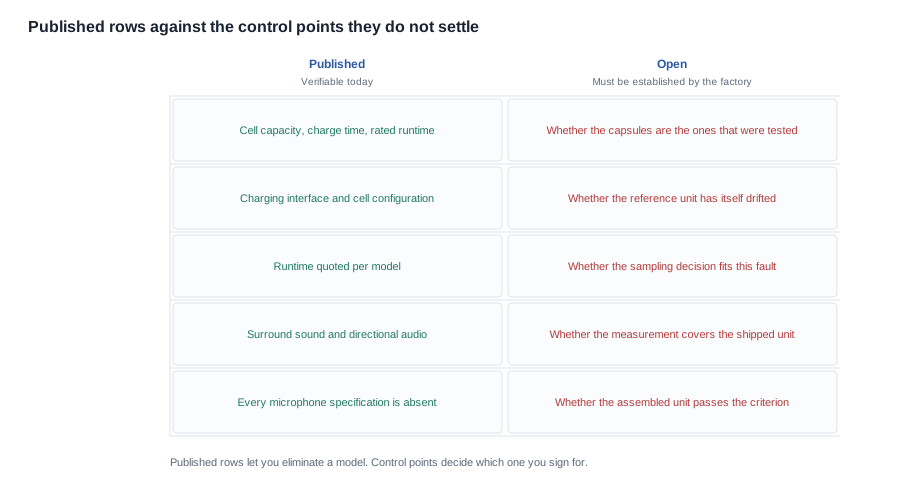
Look at what the catalogue actually publishes for the Bluetooth audio family. Every model in the audio family carries a Bluetooth version, a rated runtime, a cell configuration, a charge time and a charging method. The K01 and the K02 publish 90 mAh per cell across two cells, roughly eight hours of rated use, magnetic charging and Bluetooth 5.3. The D11 and the D12 publish a single 100 mAh cell, roughly seven hours, Type-C charging and Bluetooth 5.4. The LC-105-1 and the LC-105-2 publish two 55 mAh cells, roughly eight hours and magnetic charging. The G07 and the YK12 publish two 55 mAh cells and a shorter rated window of roughly six hours, with the G07 noted for a slim and detachable temple and the YK12 for a surround sound slim temple. The sport models publish the same five rows on their own terms: the YKC02 publishes two 70 mAh cells, roughly eight hours, magnetic charging and Bluetooth 5.4, the D17 publishes 115 mAh, roughly seven hours and a charge time of about an hour on Type-C, and the ZH12 publishes 100 mAh, roughly eight hours and about an hour to charge.
Now count what is absent across all of that. No model publishes a microphone count. No model publishes a capsule type, a sampling rate, a sensitivity, a signal-to-noise ratio, a frequency response, a pickup distance, a cancellation depth or a beamforming method. The catalogue names the acoustic approach — open-ear acoustic structure, directional audio, intelligent noise reduction — and that is a description of the technique family, not a measurement of it.
This matters for a specific reason. Electrical rows are close to self-evidencing: a cell capacity either matches the label or it does not, and the buyer can weigh the goods. Acoustic rows are not. Nothing about the shipping carton tells you whether the capsules were the capsules that were measured. So a published electrical row tells a sourcing team something about the line and a published acoustic row — if there were one — would still tell it almost nothing. The absence of acoustic rows in this range is not unusual. The consequence is that the entire quality conversation has to happen at the process level.
The failure a control point is designed to catch
Consider a new lot of microphone capsules arriving from a component supplier. Nothing about them fails a test. They are all within tolerance. But the population has shifted slightly, and the shift is visible only as a change in the measured result rather than as a rejected part. If the factory measures against a reference unit and the reference is checked on a fixed interval, the shift appears as a trend and gets investigated. If the factory measures against a number somebody once typed into a spreadsheet, the shift appears as noise in the weekly data and gets absorbed.
The second case is common and it is the reason a buyer who wants real control should ask about the reference unit before asking about the tolerance. A reference unit with a known performance, kept in a controlled condition and re-checked on a schedule is what makes two measurements a month apart comparable. Without it, the factory has a number and not a control.

Why microphone control costs more in glasses than in a headset
The reason this category resists a headset's process is geometric, and it is worth stating plainly because it explains why a headset figure cannot be transferred and why a headset factory's assurance package is not automatically a glasses factory's assurance package.
In a headset, the microphone sits a short distance from the mouth on a boom or a stem, aimed at it, in a fixed relationship to the head. In glasses, the microphone sits in a temple or a frame member, further away, off axis, and moving with the head every time the person turns. The same capsule in the two positions does not deliver the same result, and no component datasheet covers the difference because the transfer function belongs to the product, not to the part.
That has three cost consequences a buyer should expect to see in a quotation and in a lead time.
First, the fixture. A repeatable acoustic geometry is what turns a measurement into a comparable number. A headset fixture can often be a rig on a bench. A glasses fixture has to hold the product in a defined position relative to a defined acoustic source, and it has to be repeatable between a unit built in week one and a unit built in week twelve. That is tooling, and tooling is a line item with a capital cost and a change-control consequence.
Second, the free-field check. A fixture gives consistency; a free-field check on a head-mounted reference gives reality. A unit can meet a fixture criterion and still behave badly in the environment the product is sold into, because the fixture does not include the shadow of a jaw, the geometry of a face, or the movement of the person. Two arrangements together are the credible configuration, and the second one is the one that costs more.
Third, the assembled-unit check. A capsule that measures well on the board and badly in the housing has been damaged in assembly, occluded by the structure, or mounted somewhere that works poorly on a head. That fault only appears after the temples are on, which means it has to be checked after the temples are on. It also means a factory that measures only at board level has a control point in the wrong place.
For a sourcing team, the practical reading is that the cost of a microphone assurance package sits in fixture, reference units and sampling time, not in the capsule. A factory quoting a cheap unit price and declining the fixture conversation is telling you where the cost was avoided.
The eight control points a supplier has to evidence, and the thresholds behind them
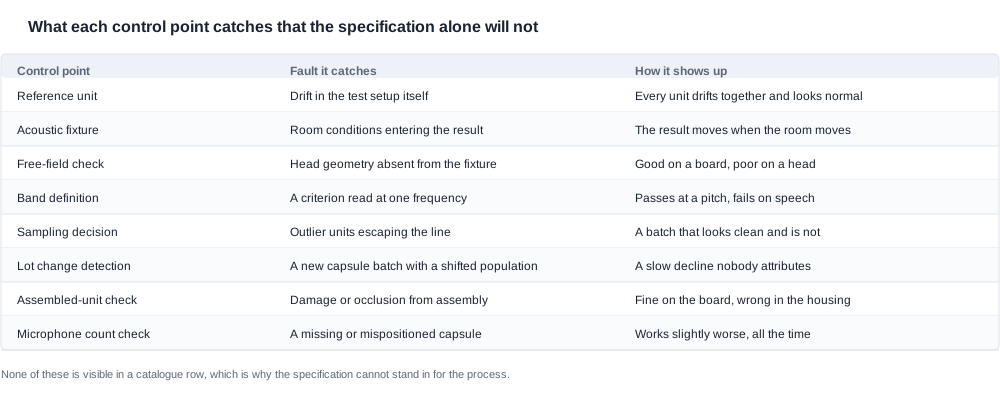
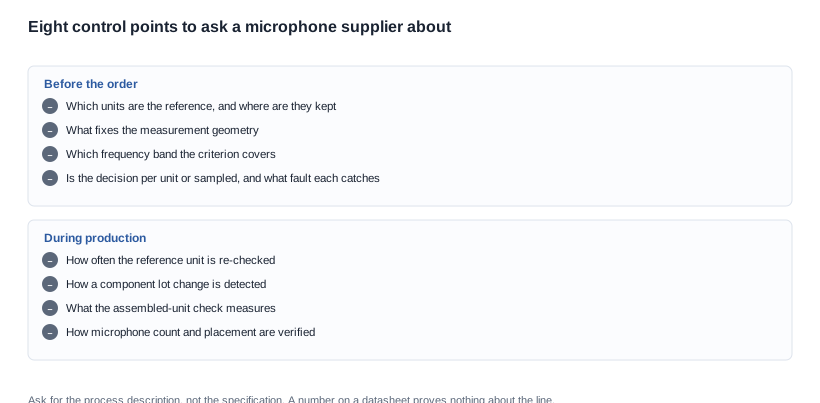
Every control point below is stated the same way: what it is, what a supplier must be able to show, and what the failure looks like if the point is missing. These are the criteria a buyer can use to compare two factories that both describe their microphone quality as controlled, because both descriptions sound identical and only the evidence separates them.
One: the reference unit
A physical unit with known performance, held under controlled conditions, used to normalise the test setup. The question is not whether one exists but where it is kept, how often it is re-checked, and against what. A reference unit that has itself drifted is worse than no reference, because it converts the drift into an invisible shift across the whole production population.
Two: the acoustic fixture
Fixed geometry, fixed source position, fixed distance, so that a unit measured this morning and a unit measured next month are measured the same way. Without one, the test is a room, and the room is part of the result. The failure mode this catches is a measurement that moves when the room moves — a different bench, a different building, a different week.
Three: the free-field check alongside the fixture
Run on a head-mounted reference rather than on a bare product, and ideally in the same session as the fixture measurement so that the two can be compared. This is the control point that catches the head-geometry fault. The tell for a factory that lacks it is that every measurement is performed on a fixture and none on a head.
Four: the band the criterion covers
A criterion expressed across a frequency band is meaningful; one expressed at a single frequency is not, because intelligibility lives in a band rather than at a pitch. The supplier should be able to state which part of the spectrum the criterion covers and what the threshold is inside it. The failure this catches is a unit that passes at a pitch and fails on speech — which is to say, a unit that passes the test and fails the customer.
Five: the per-unit or sampling decision
Testing every unit catches a wider range of faults and costs line time. Sampling catches the systematic ones and misses the outliers. Neither is wrong; leaving it unstated is wrong, because an unstated decision drifts towards sampling whenever the line gets busy, and the drift is invisible until a lot ships.
Ask which fault mode each sampling rule is designed to catch. A supplier who answers in terms of fault modes has a real sampling plan. A supplier who answers "we sample AQL" has a general quality system and a microphone that has not been thought about.
Six: drift across a production run
The control here is the re-check interval on the reference unit and the route by which a component lot change is detected. The failure this catches is the quiet one: a new capsule lot with a different tolerance does not fail loudly, it shifts the population. Nobody attributes a slow decline to a lot change unless a reference exists and the reference is checked.
Seven: the assembled-unit check
Performed after the housing and the temples are on, and measuring the product the customer actually receives. This catches assembly damage, structural occlusion and mounting position faults, all three of which are invisible at board level. It is the single most valuable of the eight and the one most often skipped, because it is the most expensive in line time.
Eight: microphone count and placement verification
Where the design calls for an array, the count and the arrangement have to be right on every unit. A missing or mispositioned capsule in a beamforming arrangement does not fail loudly — it produces a product that works slightly worse than it should, all of the time, and nobody notices until a competitor's product is compared against it in the same test.
Why these eight are a fair comparison between two factories
Two factories will both describe their microphone control as thorough, and the descriptions will be interchangeable. The eight points above are discriminating because each one produces a record a buyer can request: a reference unit log, a fixture drawing, a band definition, a sampling plan, a re-check schedule, an assembled-unit result, and a count verification step. A factory with all of those is describing a process. A factory without them is describing an intention.
Auditing a supplier's microphone process without a factory visit
Most sourcing teams do not visit the factory for a first order, and they should not need to in order to establish the basics. The audit below is a document request and a call, and it can be run by a buyer sitting at a desk. Each step has a completion criterion that can be judged before a deposit is paid.
Step one: ask for the control points, not the tolerance
Send the eight points as a list and ask which are in place, which are in place for some models only, and which are not yet established. The answer that matters is not the one that says "all of them" but the one that says "we do not have an assembled-unit check yet". A supplier who answers precisely, including about gaps, is a supplier whose answers you can use.
The completion criterion for this step is a written list naming the control points in place, the models they cover and the gaps.
Step two: ask what the reference unit is and how it is re-checked
Ask where it is kept, how often it is checked, what it is checked against, and what happens to a production run if the check fails. The last part is the discriminating question. A factory with drift detection has a defined response for a failed reference check, usually a hold and a re-measure. A factory without one has no answer.
The completion criterion is a written re-check interval and a written consequence for a failed check.
Step three: ask for the band definition and the sampling plan
Ask which frequency band the criterion covers, what the threshold is, whether testing is per unit or sampled, and which fault mode each sampling rule catches. Then ask for the most recent two results, with dates and the model they apply to.
The completion criterion is a result that carries a date, a model designation and a stated condition. A result without a date is not a result.
Step four: establish the traceability link
Ask how a tested unit relates to shipped units: component lot, build date, and the relation between the tested sample and the production run. This is the row that makes a third-party report usable. A report on a sample is evidence about a sample. Traceability is what turns it into evidence about your order.
The completion criterion is a documented link from sample to lot.
Step five: decide what the third-party report has to be
Where a buyer wants independent evidence, ask for the report itself rather than a summary of it: the standard, the method, the sample size, the date, the configuration tested and the model list it names. A report with a method is worth more than a figure without one, and a report on the finished assembly is worth more than a report on a bench.
The completion criterion is the report, with the model list checked against the models actually being ordered. This is the same document discipline the ingress rating question requires, and the reasoning is the same: a document that names a different configuration does not cover yours.
Step six: write the acceptance criteria into the purchase order
The final step is the one most often skipped and the only one that is enforceable. The criteria that live in an email are not binding. The criteria that live in the purchase order are. Specify the model, the pass condition, the sampling plan, the documentation to be supplied with the shipment and the remedy when the condition is not met.
The completion criterion is a purchase order a supplier can be held to, which is a different document from a quality agreement that describes intentions.

The failures that stay invisible until the first production lot
These are the failures that a buying team discovers after the sample passed, with the symptom, the root cause and the prevention written out so that the prevention is actionable rather than a slogan. Each prevention below is also a line you can put into a purchase order, which is the only place a prevention survives a schedule change.
Symptom: the first hundred units are fine and the next lot is worse
Root cause: a component lot change that moved the population, with no reference unit to make the shift visible, or a reference unit that was checked and ignored.
Prevention: require the reference re-check interval, the lot traceability, and a stated consequence for a failed reference check. A hold-and-re-measure rule is worth more than a tolerance, because a tolerance cannot see a shift that sits inside it.
Symptom: units are fine on the bench and wrong in the housing
Root cause: an assembled-unit check that does not exist, so an assembly or occlusion fault was never in scope.
Prevention: require the assembled-unit check as a named control point, with the result and date. If the supplier cannot produce one, that is a scoping conversation about the next production run, not a reason to accept the risk silently.
Symptom: the array works but is worse than the design should allow
Root cause: a missing or mispositioned capsule that no count check would have caught, because no count check existed.
Prevention: require the count and placement verification step, and require it on every unit if the arrangement is positional rather than merely a count.
Symptom: the unit is quiet and a gain increase made it noisier instead
Root cause: a sensitivity complaint treated as a software problem when the real cause sits in the capture path, so the fix moved the fault rather than removing it.
Prevention: require a baseline on the current platform before any change is agreed — silence, a fixed passage at one metre and at three, a call on a real network. Without a baseline, no change can be evaluated and no fault can be separated from normal variation between units.
Symptom: the returns look random and nobody can close them
Root cause: no measurement in the buyer's own hands, so every claim is argued on impressions and the dispute is about who is right rather than about the product.
Prevention: run the fixed protocol on two units from the first shipment and keep the recordings. The unit-to-unit variation inside one batch is often larger than the variation between two suppliers, and that is exactly what the returns will be made of.
Working a sample order around a specification that does not exist
The following is a worked sourcing scenario rather than a client project, and it is set out to show the order in which the steps actually run.
A brand buyer is opening a first order for a call-driven audio channel. The supplier publishes a Bluetooth 5.4 platform with two 55 mAh cells and a rated window of roughly eight hours, magnetic charging, and it offers an open-ear acoustic structure with directional audio and intelligent noise reduction. The buyer's internal policy requires a microphone figure before the purchase order is signed. The supplier has no microphone figure, for the same reason the catalogue has none: no acoustic measurement has been published for any model in the range.
The first decision is what to ask for. Asking for a figure gets nothing. Asking for the process description gets a document. The request goes out as the eight control points, with the question of which are in place, which are partial, and which are not established.
The second decision is what to do with the gaps that come back. The answer that matters is the one that separates a gap that will close during this order from a gap that will not. A factory with a fixture and no assembled-unit check has a gap that closes during the first production run if the buyer funds it. A factory with no reference unit and no plan for one has a gap that does not close, because the equipment is not the constraint — the discipline is.
The third decision is what the purchase order says. Because no acoustic figure exists, the order cannot carry an acoustic acceptance criterion. It can carry a documentary one: the control points in place, the reference re-check record supplied with each shipment, the lot traceability, and the sampling plan. The order also records that the buyer will run its own protocol on two units from the first delivery and that the result becomes a reference for the second.
The fourth decision is what goes on the listing. Nothing about microphone performance, because nothing was measured that the buyer can stand behind. The listing describes the published configuration and the technique family, and it stops there.
That is a defensible outcome from an uncomfortable starting point. The buyer did not obtain a figure. It obtained a process, a document set and a baseline, which is what actually decides whether the second order is a repeat order or a negotiation.
The trade-off worth naming is the one this buyer accepted deliberately. A shorter route existed: accept the technique names, put a microphone phrase on the listing, and accept that returns will be argued on impressions. That route is cheaper before the order and more expensive after it, because every claim that cannot be falsified also cannot be enforced. Before you order, the question to put to yourself is not whether the factory has a microphone process but whether you can name the six documents you will hold them to. If you cannot name them, the process is not established, whatever the quotation says.
How to choose between two factories that both claim control
When two factories describe their microphone control with the same vocabulary, the shortlist is made on evidence rather than on adjectives, and there are only four documents that separate them: the control point list with its gaps named, the reference unit re-check schedule with its consequence for a failed check, the most recent dated result with its model and condition, and the traceability record linking a tested sample to a lot. A factory that produces all four can be shortlisted on evidence. A factory that produces none of them has a process it cannot describe, and the trade-off there is not price — it is whether you are willing to fund the establishment of the process yourself, which is a real cost and a real schedule.
What we publish, and what we ask you to verify instead
Our catalogue publishes the electrical and structural rows for every model in the Bluetooth audio family, and it publishes the acoustic technique names — open-ear acoustic structure, directional audio, intelligent noise reduction. It publishes no microphone specification for any model: no pickup distance, no signal-to-noise ratio, no frequency response, no microphone count, no beamforming description and no third-party acoustic report. That is not a drafting shortcut. Those measurements have not been confirmed to us, and we will not describe a process we cannot evidence.
We will also be explicit about a limit that is easy to miss. Our own line-side controls, our sampling frequencies, our reference unit practice and our fixture are not published either, because the company has not confirmed them to us. We will not describe a process we cannot evidence, and that applies to our own line as much as to anyone else's.
What we can do is take a specific model and a specific microphone claim and tell you which of the eight control points we can currently document, which would have to be established before we could answer a quality question about it, and what a buyer should request from a supplier who holds them. Where samples are sent to us, we will run the fixed protocol with you and report what we hear, including where the result is worse than the expectation.
Send us the models you are comparing, the channel they are sold into, and the microphone claim in the supplier's quotation. We will tell you which published rows apply to that configuration, what the acoustic rows will not settle, and what to put in the purchase order so the answer is enforceable.
Related reading
- The technique the family is built on — open-ear audio
- The verification route — supplier verification
- The claims and how to read them — manufacturer claims
- The certification side of the same component — microphone quality and certification
Tell us the model and the microphone claim, and we will say which control points we can document today and which have to be established first.


