
The children's model in this article publishes five rows and nothing else: a Bluetooth version, a 70 mAh cell, roughly twenty hours of use, a charge time of two hours or less, and magnetic charging. Its two siblings in the same family publish the same five standard rows plus six additional lines each. That difference, one page with a feature list and one page without, is where every mistake in a children's private-label programme starts, because the compliance weight on a children's product is set by the market you sell into.
The A07 carries a model designation and a published Bluetooth version of V5.4, and those are the two published facts that separate it from the A05 and the A06: its cell is 70 mAh against their 40 mAh, and its page carries a Bluetooth row that theirs do not. Everything else on its page is identical to theirs, and there is one more thing that is missing on all three pages — a feature line.
That absence is the whole of the problem. The catalogue lists six lines on the A05 page and six on the A06 page, and lists none on this page. A buyer who reads the family description and then reads the model page can conclude, wrongly and expensively, that the listed functions are part of the product they are about to put their name on.
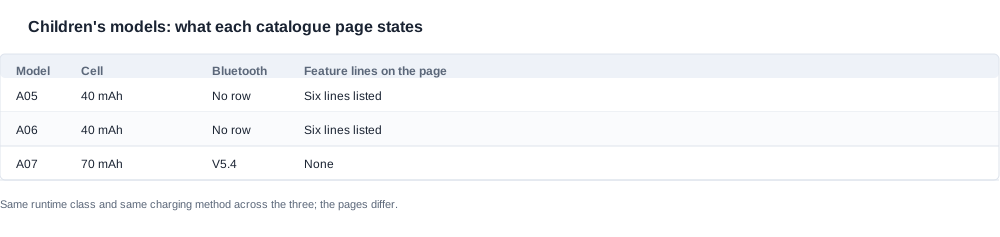
A07 published rows, and the feature list on the sibling pages
Here is everything the catalogue states for this model:
- Bluetooth version: V5.4.
- Cell: 70 mAh, a single cell.
- Rated use: roughly twenty hours, with no test condition attached.
- Charge time: two hours or less, written as a ceiling rather than a measurement.
- Charging method: magnetic.
There is no feature line on this page. No fogging entry, no posture-and-distance entry, no lens-clarity entry, no ingress rating, no colour list, no weight, no temple or lens dimensions, no touch row, no translation row, and no per-model certification entry. Those absences are not defects in the documentation; they are the documentation, and a buyer who needs any of them has to ask for them and get an answer in writing.
The three models in this family are not three versions of one product
The children's family holds three models and they differ in ways that matter to a programme, not in ways that matter to a price comparison.
- A05 and A06 publish 40 mAh cells, roughly twenty hours of rated use, a charge time of two hours or less, magnetic charging, no Bluetooth version row, and six feature lines.
- A07 publishes a 70 mAh cell, roughly twenty hours of rated use, the same charge-time ceiling, magnetic charging, a Bluetooth version row, and no feature lines at all.
The runtime is the same on all three, and the cell is not. A buyer comparing a 40 mAh model with a 70 mAh model on runtime alone will conclude they are equivalent, and on the catalogue's own numbers they are not equivalent in any way that a charging cycle depends on. The honest way to describe this group is as a family with a shared charging method and a shared runtime class, and a set of pages that have to be read individually.
What the Bluetooth row does and does not settle
A published Bluetooth version is one of only fourteen rows of that kind in the catalogue, and the camera models do not publish one at all, so this row is worth reading carefully. It tells you the radio generation of the product. It does not tell you the supported profiles, the pairing behaviour, the multipoint capability, the codec support, the update mechanism, or whether a customised firmware build can still receive the platform's later releases. All of those are questions to ask the supplier, and the last one matters whenever the product is being sold under someone else's name.
The charge time is a ceiling and the runtime has no conditions
Two hours or less is an upper bound on a charge, not a measurement of one. It does not state the state of the cell when charging starts, and it does not state the point at which charging is treated as complete. Roughly twenty hours of rated use is a catalogue figure with no published test condition behind it — no volume level, no ambient assumption, no pairing profile. For a product whose customer is a child and whose charging routine is set by an adult, this is the row you should expect to be asked about most often, and it is the row that cannot be verified from the documentation.

Why a shorter published row makes a heavier children's brief
The instinct with a thin specification sheet is to treat it as a simpler product. In the children's category the opposite is true, and the reason is structural rather than promotional.
First, the product is bought for a purpose that has to be evidenced rather than asserted. An adult buying glasses for a child is not buying a camera resolution or a radio version. They are buying a claim about what the product does in a classroom or at a desk, and every such claim has to be traceable to something the supplier can document for the market the product is sold in. A model whose page lists a feature has, at minimum, an internal product definition behind that line. A model whose page lists nothing has nothing behind it — not because the product cannot do anything, but because nothing has been published, and silence is not evidence either way.
Second, children's products carry requirements that adult products do not. The buyer-side frameworks most often named for this category are EN 71 for the European market and ASTM F963 for the United States, and they are the questions a compliance lead will bring to the table before asking about colour. Those requirements attach to the product in your market, not to a factory's paperwork, and they are not satisfied by anything the catalogue prints.
Third, the failure mode is a withdrawal rather than a complaint. If a feature is claimed in packaging or in a listing and it is not supported, the exposure is a listing withdrawal or a product withdrawal, and the cost of that is a multiple of the cost of getting the answer first.
Fourth, the decision to make a children's SKU at all sits above this model's row. Nothing in the five published rows tells you whether the concept works: whether the product is for a school, a homework routine, a travel day or a screen-time habit; who decides to buy it; who recharges it; and what the adult is told to expect. Those are concept questions, and they are the ones worth writing down before any supplier conversation, because they decide which questions to ask later.
The sibling pages list six lines, and none of them is a health claim
The A05 and the A06 pages each list six lines. They are the only pages in the entire catalogue that carry this kind of content, so it is worth stating exactly what they say, because a paraphrase is where health claims enter.
The catalogue lists a lens-based electronic arrangement, a fogging unit, prompts for correct posture and distance alongside prompts for incorrect posture and distance, and lens clarity together with lens fogging. Those are catalogue entries on two sibling models. They are not published for this model.
What these lines are not. None of them is a statement about myopia, about the development of vision, about eye health, or about the prevention of anything, and we will not help write a benefit line of that kind into packaging, a listing or a tender document. A fogging unit is a component in a list of components. A posture-and-distance prompt is a prompt in a list of prompts. Neither is a clinical outcome, and neither may be presented as one.
Why the distinction matters twice over. If you build a children's range on these lines, you need the model that actually carries them — and on the evidence published, that is the A05 and the A06 rather than this model. And if you do build on them, the claim still has to survive the market's requirements, because a catalogue line is not a conformity assessment.
And one more absence worth naming. The only published control surface anywhere in the catalogue is on the AR model's page: an indicator light and button control. This model publishes no control surface at all, which means the interaction method is either not published or not a distinguishing feature, and either way it has to be confirmed before a quick-start card is written.
The control method is a specification question, not a design preference
For a product whose user is a child, the control method decides a lot of practical work: whether the quick start can be a single printed card, whether an adult has to do something before the product works, and whether the failure mode of a mis-press is recoverable. None of that is answered by the five published rows. Ask what controls the product has, how a child is expected to operate them, and what the product does when a control is held or pressed twice. If the answer involves a touch surface, that answer is not in the catalogue for this model, and it has to come from the supplier in writing before it appears in a manual.
How to evaluate a written answer before it becomes a specification
A written answer from a supplier is either a specification or an opinion, and the two look identical in an email. Three criteria separate them, and they are the same criteria you would use to evaluate any written answer in a sourcing file.
The first is that it names this model. An answer that could apply to any product in the range has not closed the line, and the cheapest way to test that is to ask the same question about a sibling model and compare the two answers. Where they come back identical, the answer was written for the family and not for the model.
The second is that it is specific enough to be wrong. A sentence about standard Bluetooth behaviour cannot be checked. A sentence about where the device name appears, and when it appears, can be checked by a reviewer who was not part of the conversation.
The third is that it identifies who verified it. A written answer with a name, a role and a date attached is a piece of the evidence file; the same sentence without them is a claim that you will be repeating at your own risk. Ask for all three, and treat an answer that fails the first two as an open line rather than a closed one — including in the time and the money you budget for the rest of the programme.

Compliance that attaches to the product in your market
This is the part of the brief that most often gets softened into a sentence about paperwork, and softening it costs money later.
Nothing on a children's model page is a certification claim, and the catalogue's only certification page is a company-level set of images with no per-model row to read from, so the file for this model has to be requested, dated and matched to the designation before any mark goes on the box. There is no per-model certification row anywhere in the catalogue, and there is no row for any children's model that says which documents cover it. That is the actual position, and it is why every conformity question on this model is a question to a supplier rather than a line to read.
Children's requirements are additive, and they are market-specific. Whatever general requirements apply to a radio device, the additional children's requirements in your market apply on top of them, and they apply to the finished product — the model, the configuration, the packaging, the markings and the instructions together. A colour or packaging change can alter which configuration the documentation covers. That is why the conformity position is re-asked against the final configuration rather than against the catalogue page.
The three items a compliance lead should request in writing. First, the documents that name this model and its final configuration, with issuing body, validity period and the covered configuration stated. Second, the testing route the supplier intends to use for the destination market, including which parts of the product the testing covers. Third, a written statement of which parts of the product the supplier has themselves verified and which parts remain the buyer's responsibility. That third item is the one that exposes gaps early: many factory programmes cover the radio and the battery and stop there, while the packaging, the instructions and the small parts are left to the brand.
A practical red flag. If a supplier answers a conformity question with a document that names a different model, or with a family-level statement that does not identify the model, that is not a near miss — it is an absence, and the programme continues with the same open line it started with.

The sequence that closes a children's programme without reopening it
The sequence matters more here than in an adult product, because the artwork carries claims and the claims carry regulatory weight. This is the order we would work in, and the reason for each position is the cost of reversing it.
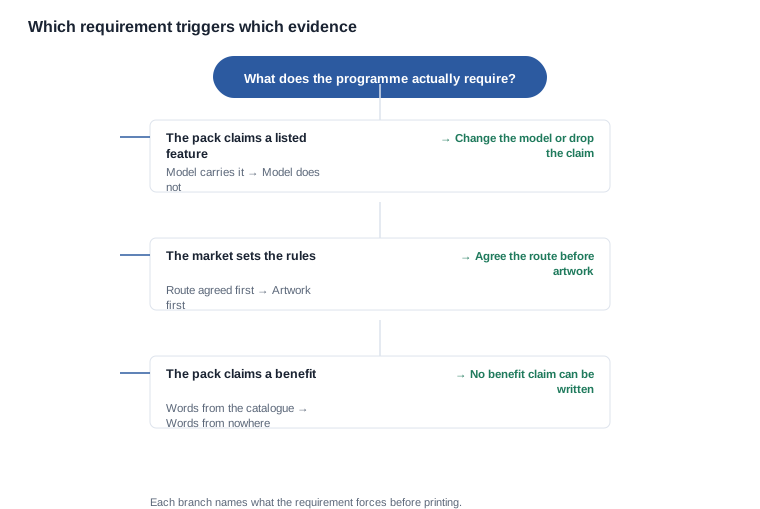
- Establish the concept before the product. Write down the situation the product is for, who buys it, who charges it, and what the adult is told to expect. If the concept needs a feature, note it here, because it decides the next step. Reversing this is the expensive error: a concept built backwards from a brochure produces artwork that cannot be substantiated.
- Ask whether the concept needs one of the six lines from the sibling pages. If it does, this model is not the one, and no amount of customisation adds a feature to a page that does not list it. Change the model or change the concept.
- Get the control method, the indicators and the interaction described in writing for this model. This is the question the published rows cannot answer, and it decides whether the quick-start card is a single card.
- Fix the identity layer. Colour and packaging are the documented customisation options for this category, and colour needs the finish confirmed against an approval unit rather than a swatch. The Bluetooth device name matters here too, because it is what an adult reads when the product will not connect.
- Settle the conformity route with a testing body, in the destination market, before artwork is approved. Not after, because artwork carries the claims and the claims cannot be compressed at the end.
- Write the packaging claims from the published rows, not from the family description. Every line on the pack should be traceable to a line that exists for this model, and any line that is not should either be removed or be supported by a written answer held in the file.
- Re-check the conformity position against the final configuration, including the finished colour, the finished packaging and the finished insert.

The evidence file a children's programme should hold
The evidence file is what makes the second order safer than the first, and in this category it is also what a compliance lead will ask to see. Here is the checklist we would hold, with the reason each item earns its place.
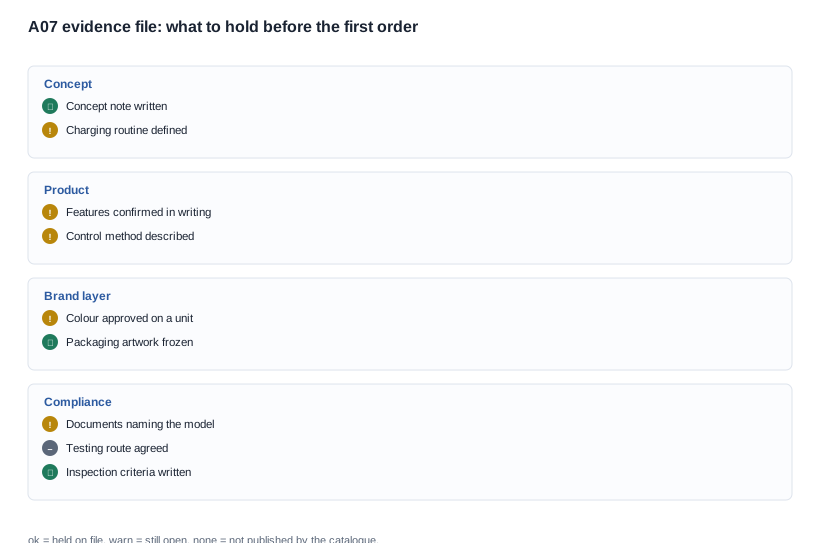
| Evidence | Who owns it | Due when | If it never arrives |
|---|---|---|---|
| Concept note: user, buyer, charging routine | Buyer writes | Before any quotation is requested | The feature question is never asked |
| Written answer on which features this model carries | Supplier answers | Before the identity layer is set | A packaging line may describe a missing feature |
| Control method and indicator description | Supplier answers | Before the quick-start card is written | The instructions describe an interaction that does not exist |
| Colourway confirmed against an approval unit | Supplier confirms | Before packaging artwork is approved | The pack shows a colour that will not ship |
| Documents naming this model and its final configuration | Supplier issues | Before the consignment is booked | The product has no documented conformity position |
| Testing route for the destination market | Supplier and testing body | Before artwork approval | Claims are printed against an unresolved route |
| Approved sample, sealed | Buyer approves and stores | Before the production run | There is no reference unit for inspection |
| Written inspection criteria | Buyer writes, supplier accepts | Before the run is released | Inspection becomes a negotiation |
Two of those lines deserve a note. The concept note is the only item in the list that costs nothing and prevents the most expensive error, because the most expensive error on this model is a programme built on a feature the page does not list. And the sealed approval sample matters more here than it would for an adult product: it is the reference against which the claims printed on the pack can be checked, so it should be stored with the artwork and the documents, not in a drawer.
The line we hold on this model
On this model, our position is narrow and we would rather state it than sell around it. We will quote the row exactly as the catalogue states it: Bluetooth V5.4, a 70 mAh cell, roughly twenty hours of rated use, a charge time of two hours or less and magnetic charging, with no feature line on its page.
We will not describe the six lines listed on the sibling pages as features of this model, we will not carry them into a proposal because the family description mentions them, and we will not turn a catalogue entry into a statement about myopia, vision development or eye health. We will not present roughly twenty hours as a tested figure, because no test condition is published, and we will not present two hours or less as a charge time in the sense of "under two hours", because a ceiling and a measurement are different assertions. Our documentation for this category records colour and packaging as the documented customisation options and records application and firmware work as unverified, so we do not offer either as a service.
What we will do is tell you, in writing and for this model, which of the open lines can be closed from what we hold, and which ones need a written answer before your packaging exists. The family sits on our kids smart glasses range page, and the routes a brand programme covers are set out in the customisation options notes.
Related reading
- The category this model belongs to — kids smart glasses for private-label programmes
- What the range supports and what it does not — customisation options across the catalogue
- The paperwork a brand programme has to collect — export documentation checklist
Send us the concept, the destination market and the volume, and we will tell you which lines this model can carry before anyone commissions artwork.


